



3-تعمل المعالجة المحورية على تحريك أداة القطع على طول X, ي, والمحاور الخطية Z. إنها واحدة من تكوينات الطحن CNC الأكثر استخدامًا, and it suits prismatic parts, جيوب, فتحات, ثقوب, and accessible 3D surfaces. ويغطي هذا الدليل كيفية عمله, فوائده, and when 4-axis or 5-axis is a better fit.
What Is 3-Axis Machining?
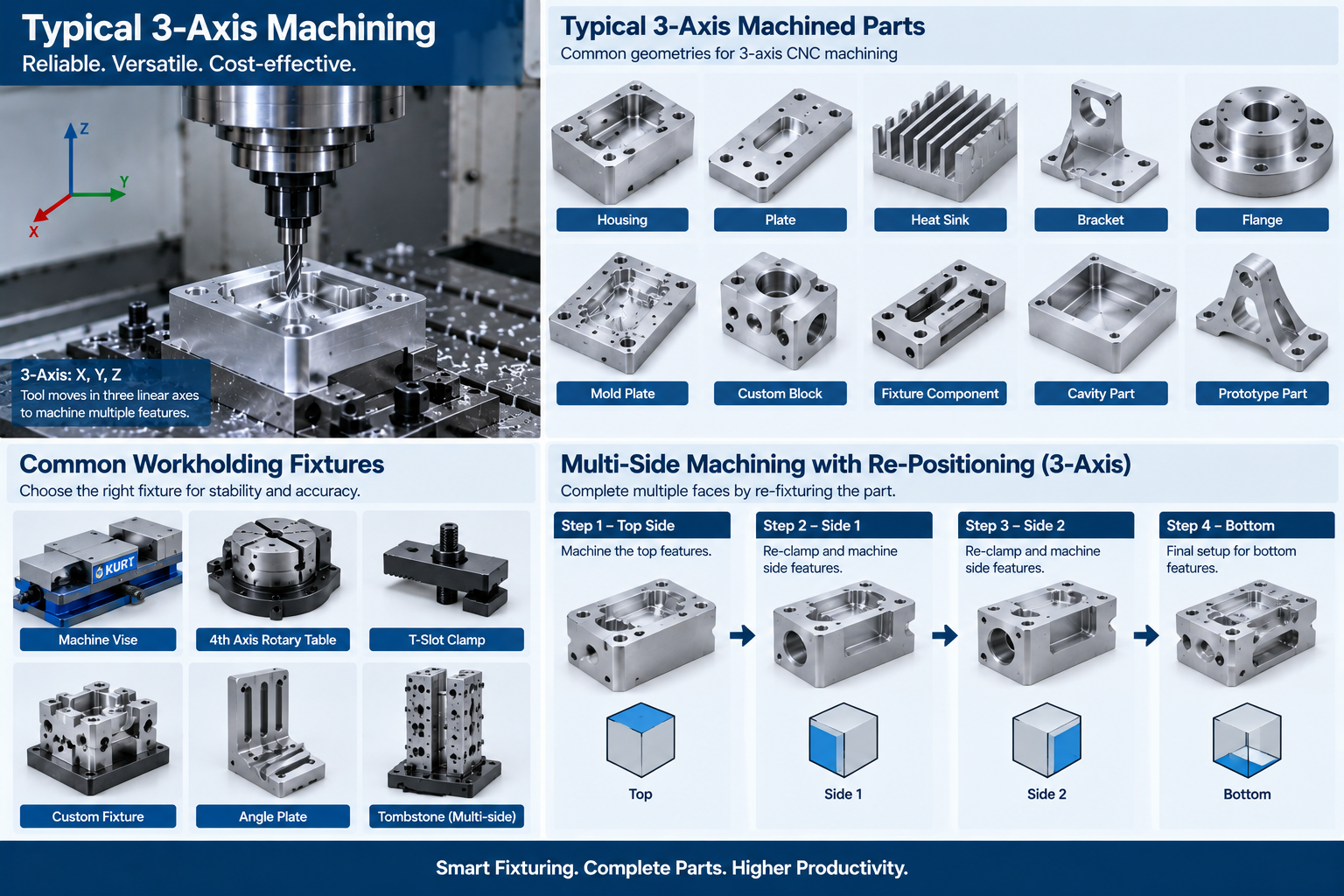
3-axis machining is CNC milling that controls three linear axes: X, ي, و ز.
The tool or the table moves along these axes while the spindle orientation stays fixed. Vertical machining centers are the most common type. Horizontal machines use the same three axes with a horizontal spindle.
Because the tool axis remains fixed, each setup can machine features accessible from that tool direction. Features on other orientations may require repositioning, additional fixtures, or multiple setups.
How Does 3-Axis Machining Work?
The controller follows a CNC program that moves the tool along a toolpath.
- The CAD model and drawing define the geometry and tolerances.
- The programmer selects suitable cutters, and CAM software generates toolpaths based on the geometry, استراتيجية التصنيع, and cutting parameters.
- The post-processor outputs machine-specific G-code.
- Workholding locates the part in the machine.
- The tool cuts along X, ي, and Z to the programmed path.
- Inspection verifies the critical dimensions.
يٌطعم, سرعة, tool engagement, and workholding rigidity decide the result. انظر دليلنا ل ما هو الطحن باستخدام الحاسب الآلي for the wider process.
Common Machine Configurations For 3-Axis Machining
Several machine styles operate with three linear axes.
These machine categories may also be available with additional rotary axes. The table describes configurations operating in three linear machining axes.
| نوع الآلة | مغزل | الاستخدام النموذجي |
| Vertical machining center | رَأسِيّ | General milling, قوالب, اقواس |
| Horizontal machining center | أفقي | تصنيع الآلات, box-type parts, إخلاء الرقائق |
| Bed mill | رَأسِيّ | Large and heavy parts |
| Gantry mill | رَأسِيّ | Very large plates and frames |
| Drilling and tapping center | رَأسِيّ | Holes and threads at speed |
| جهاز التوجيه CNC | رَأسِيّ | ملزمة, لوحات, and softer materials |
Compare styles in vertical vs horizontal milling machines و 12 types of CNC machines.
المكونات الرئيسية
Each component affects accuracy, التكرار, والحياة الأداة.
- مغزل: holds and rotates the tool at the required speed.
- Linear axes and guideways: position the tool or table.
- Ball screws and servos: convert controller commands into motion.
- المراقب المالي: reads the program and manages motion, تعويضات, وتغييرات الأداة.
- Feedback system or encoders: provide position feedback on closed-loop machines.
- Automatic tool changer: swaps cutters between operations.
- Coolant system: controls heat and clears chips.
- عقد العمل: يظهر, chucks, المشابك, and custom fixtures.
صلابة الآلة, نفاذ المغزل, and thermal stability limit the practical accuracy of any 3-axis machine.
2.5D Vs 3D Machining
2.5D machining primarily machines features at discrete Z levels, while 3D machining uses coordinated X, ي, and Z movement to follow contoured surfaces.
In 2.5D work, the cutting geometry is defined by XY motion at each depth. Typical features include pockets, فتحات, ثقوب, الزعماء, and planar contours.
3D surface machining commonly uses ball-nose or corner-radius cutters, with cutter geometry and stepover selected according to surface shape and finish requirements. Stepover controls visible scallop height, so a finer finish costs more cycle time.
3-Axis Vs 4-Axis Vs 5-Axis
More axes add access and can reduce setups, but they also add cost and complexity.
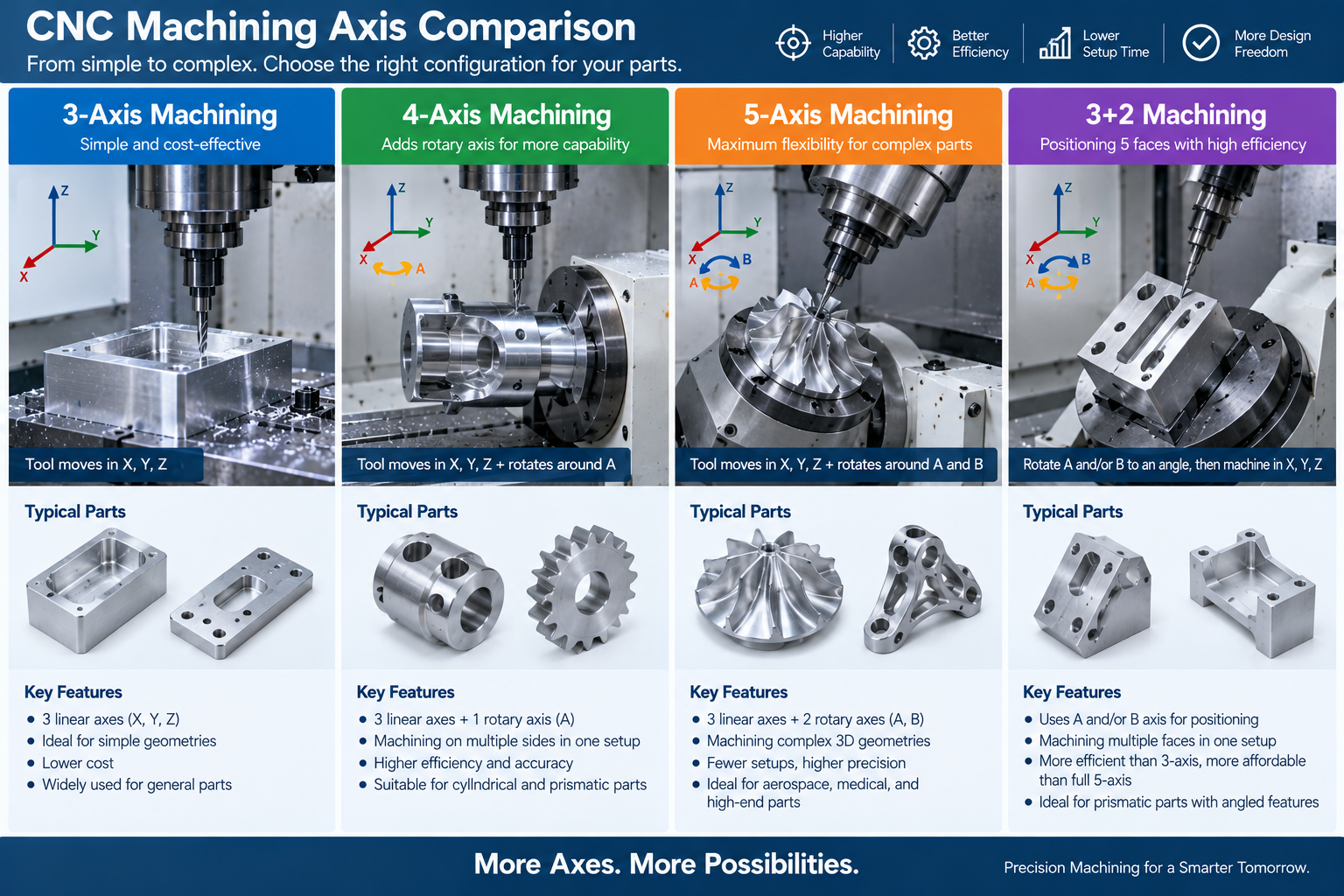
| عامل | 3-محور | 4-محور | 5-محور |
| محاور | X, ي, ز | Adds one rotary axis | Adds two rotary axes |
| Access | Features accessible from one fixed tool orientation | Features around one rotational axis | Multiple orientations and complex contours |
| Setups | More for multi-face parts | Often fewer | Often fewer |
| برمجة | Simplest | معتدل | Most complex |
| Typical machine and programming cost | أدنى | معتدل | أعلى |
| الأفضل ل | Prismatic and 2.5D parts | Shafts and wrapped features | Complex contours and multi-face relationships |
يرى 4-محور CNC الآلات و what is 5-axis machining for the alternatives.
What Is 3+2-Axis Machining?
3+2 machining is positional five-axis machining. Two rotary axes position the workpiece or tool at a fixed angle, then the machine cuts using three linear axes.
It can reduce setups on multi-face parts without requiring continuous simultaneous 5-axis motion. The rotary axes are set once, then cutting proceeds much like a 3-axis operation. هذا يجعل 3+2 a practical middle step between 3-axis and full simultaneous 5-axis work.
Benefits Of 3-Axis Machining
3-axis machining is cost-effective, متاحة على نطاق واسع, and reliable for prismatic parts.
- Often lower machine and programming cost than multi-axis machining for suitable parts.
- Simple programming and setup for 2.5D features.
- Simple machine kinematics and short, rigid tooling can support efficient material removal.
- Good dimensional control, تسطيح, and repeatability are achievable on suitable features with appropriate machines, الأدوات, عقد العمل, والتحكم في العمليات.
- Wide choice of cutters, including end mills and form cutters.
- Easy workholding with vises, المشابك, ولوحات.
- Wide machine availability can make 3-axis machining practical for prototypes and production.
For geometries that do not benefit from rotary-axis access, 3-axis machining can provide the required accuracy with lower programming and machine complexity.
Limitations Of 3-Axis Machining
The fixed spindle orientation limits what one setup can reach.
- Undercuts that are inaccessible from the fixed tool direction may need special undercutting tools, extra setups, أو Multi-axis Machining.
- Multi-face parts need extra setups, which adds cost and setup error.
- Cross-setup accuracy depends on datums, تركيبات, and workholding quality.
- Deep cavities need long tools, which deflect and chatter.
- Complex curved surfaces take many passes with small stepovers.
- Angled faces may need special fixtures or a different machine.
These limits are about access and setup count, not the accuracy of the axes themselves.
When To Choose 3-Axis Machining
Choose 3-axis when the features are reachable from accessible orientations and cost matters.
- Flat plates, اقواس, and housings with features on two or three faces.
- جيوب, فتحات, and holes with standard tolerances.
- Molds and dies where the cavity is open to one direction.
- تركيبات, الرقص, and tooling plates.
- Prototypes and low-to-medium volume parts.
- Parts where a multi-axis rate is hard to justify.
Choose 4-axis when rotary indexing or machining around one rotational axis can reduce setups or improve tool access. Choose 5-axis when complex geometry or multi-face positional relationships benefit from fewer setups.
The advantage of 5-axis is not inherent accuracy. Fewer setups can reduce datum-transfer and repositioning error. يرى 3-axis to 12-axis capabilities compared.
Design Guidelines For 3-Axis Parts
Design for tool access and for the number of setups.
- Keep features on faces the tool can reach.
- Avoid deep, narrow pockets that need long tools.
- Use the largest practical internal radii.
- Provide tool-entry clearance, relief, or accessible approach geometry where required.
- Define a clear datum for each setup.
- Limit tight tolerances to functional features.
- Allow enough stock for the finishing pass.
Reducing setup count can lower handling and fixturing cost and reduce datum-transfer error between related features.
Tolerances And Surface Finish
There is no universal tolerance for 3-axis machining. Capability depends on feature size, مادة, هندسة, machine condition, عقد العمل, الأدوات, الاستقرار الحراري, setup count, والتفتيش.
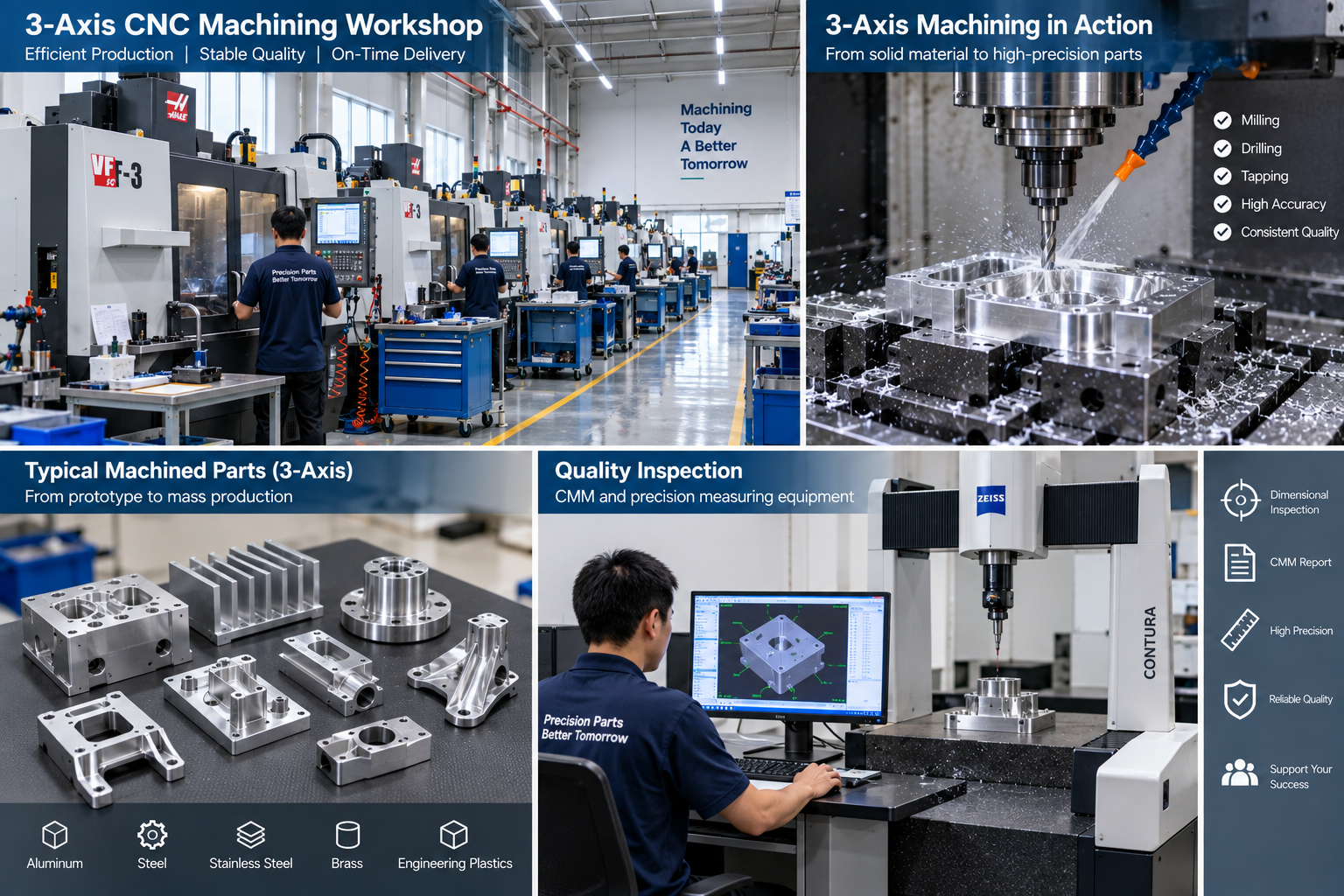
As a qualified general reference, many machined features fall around ±0.01 to ±0.05 mm. Tighter tolerances need feature-specific engineering review. TOPS Precision can evaluate selected critical features down to approximately ±0.005 mm where geometry, مادة, يثبت, and inspection capability permit.
Surface finish depends on cutter geometry, تغذية لكل سن, سرعة المغزل, نفاذ الأداة, مادة, صلابة, واستراتيجية التشطيب. On 3D contours, stepover also controls visible scallop height. Specify Ra only where surface roughness is functionally important. يرى التحمل التصنيع باستخدام الحاسب الآلي.
مواد
3-axis machining handles most machinable metals and plastics.
- Aluminum and many brass grades machine efficiently, while copper machinability varies by alloy and temper.
- Steel and stainless steel need appropriate tooling and coolant.
- Titanium needs rigid setups and controlled cutting.
- Engineering plastics such as POM, نظرة خاطفة, and acrylic need care with heat and stress.
قارن الخيارات في موقعنا مواد التصنيع باستخدام الحاسب الآلي مرشد.
عوامل التكلفة
3-axis machining cost depends on setups, وقت الآلة, مادة, والتسامح.
- Setups: each additional setup adds labour and fixture cost.
- وقت الآلة: material removal rate and toolpath length.
- مادة: alloy type and stock size.
- تسامح: tighter limits need more care and inspection.
- الانتهاء من السطح: finer 3D finishes need smaller stepovers.
- كمية: setup cost spreads across the batch.
- تقتيش: critical features need measurement time.
Machine rate matters, but setup count, وقت الدورة, تركيب, and inspection can have a larger effect on total part cost for some geometries. يرى CNC milling cost.
التطبيقات حسب الصناعة
| صناعة | Typical 3-Axis Parts |
| معدات صناعية | قوسين, لوحات, المساكن, تركيبات |
| إلكترونيات | حاويات, بالوعة الحرارة, لوحات |
| المعدات الطبية | Device housings, مكونات الصك |
| السيارات | قوسين, prototype components, الأدوات |
| Aerospace manufacturing | تركيبات, الأدوات, اقواس, المساكن, prototype components |
| المنتجات الاستهلاكية | النماذج الأولية, قوالب, custom hardware |
أسئلة مكررة
What is 3-axis machining?
It is CNC milling that moves the tool along the X, ي, والمحاور الخطية Z.
What is the difference between 3-axis and 5-axis machining?
3-axis uses three linear axes. 5-axis adds two rotary axes for complex orientations and often fewer setups.
Can 3-axis machining cut curved surfaces?
نعم. Coordinated X, ي, and Z motion follows contoured surfaces. It is slower than 5-axis for complex surfaces.
Can 3-axis machining cut undercuts?
Some undercuts can be machined on a 3-axis mill with specialized cutters if tool access is available. Inaccessible undercuts may require another setup, special fixturing, موسيقى الرقص الإلكترونية, أو Multi-axis Machining.
How accurate is 3-axis machining?
There is no single tolerance for all 3-axis machining. Accuracy depends on machine capability, حجم الميزة, هندسة, مادة, الأدوات, عقد العمل, الاستقرار الحراري, setup count, والتفتيش. Tight features should be reviewed individually.
Is 3-axis cheaper than 5-axis?
For simple parts, 3-axis machining is often more economical because machine and programming complexity are lower. For multi-face parts, 5-axis machining can reduce fixtures, setups, التعامل مع, and cycle time. Compare total part cost, not machine rate alone.
When should I use 3-axis instead of 5-axis?
When features are reachable from accessible orientations and the part does not need complex orientations or multi-face relationships.
Get A Quote For Your 3-Axis Machined Part
أرسل نموذجك ثلاثي الأبعاد, 2رسم د, مادة, كمية, ومتطلبات التسامح. Our engineers will review the geometry, count the setups, and recommend 3-axis, 4-محور, or 5-axis machining before quotation.
الاتصال بنا للحصول على الاقتباس


1 فكرت في "3-تصنيع المحور: فهم التكنولوجيا, التطبيقات والفوائد”