



يقوم EDM بإزالة المعدن بالتفريغ الكهربائي بدلاً من أدوات القطع. وهذا الاختلاف يجعله الخيار الأفضل في سبع حالات شائعة: hardened material, تجاويف عميقة, نصف قطر داخلي صغير, micro holes, جدران رقيقة, التحمل الضيق, and unusual low-volume geometry. This guide explains each case and its limits.
What Is EDM?
موسيقى الرقص الإلكترونية, or electrical discharge machining, erodes conductive material with controlled electrical sparks across a spark gap in a dielectric fluid.
Three common forms cover most work. Wire EDM cuts 2D profiles with a thin wire. Sinker EDM burns a cavity with a shaped electrode. Small-hole EDM produces fine holes, often as start holes for wire EDM. See our guides to what is EDM و sinker EDM vs wire EDM.
Why EDM Differs From Conventional Machining
EDM does not use mechanical cutting force. The electrode or wire never contacts the workpiece.
EDM is still a thermal erosion process. It can leave a thermally affected surface layer, so surface integrity matters for demanding applications.
For accessible geometry and bulk stock removal, milling and turning usually remove material faster. EDM becomes advantageous when hardness, الوصول إلى الأداة, قوة القطع, or feature geometry limits conventional cutting.
Situation 1: Hardened And Heat-Treated Materials
EDM can machine hardened conductive materials without the tool-wear and cutting-force limitations associated with conventional cutting.
Because EDM removes material by electrical discharge, workpiece hardness has much less influence on cutting capability. Hard milling and turning remain practical for many hardened steels. أداة ارتداء الأداة, قوى القطع, feature accessibility, and surface requirements can still make EDM more suitable for specific features.
You can heat treat first, then EDM the final features. This reduces the risk that post-machining heat-treatment distortion will move critical geometry out of tolerance. يرى steel hardening for the heat-treatment side.
Situation 2: Complex Cavities And Deep Narrow Features
EDM reaches deep and narrow features that a rotating cutter struggles to reach.
الأضلاع العميقة, فتحات ضيقة, blind cavities, and recessed features can restrict conventional cutter access. A long end mill deflects and chatters in these conditions. Sinker EDM can produce these shapes with an electrode.
Practical depth is still limited by electrode design, flushing, debris evacuation, electrode wear, and discharge stability. الأضلاع العميقة, فتحات ضيقة, detailed cavity features, and sharp-cornered pockets can be finished after bulk material is removed by milling. تعلم المزيد في دليلنا ل types of EDM machining.
Situation 3: Small Internal Radii
EDM can produce much smaller internal radii than conventional end milling.
A rotating end mill cannot produce a zero-radius internal corner. The achievable internal radius is constrained by cutter geometry and tool access. في الأسلاك EDM, the minimum internal radius depends on wire diameter, spark gap, machine control, وظروف القطع. في الغطاس EDM, achievable corner sharpness depends on electrode geometry, spark gap, يرتدي, واستراتيجية التشطيب.
This matters for stamping dies, تركيبات, and parts that must fit a mating square edge. يرى undercut machining for related geometry limits.
Situation 4: Micro Holes And Fine Features
Small-hole EDM produces fine features in conductive materials where micro-drilling is difficult.
Small-hole EDM can produce fine, high-aspect-ratio holes where conventional micro-drilling may be difficult because of hardness, tool strength, or depth. Because material removal does not rely on mechanical drilling force, it avoids many of the deflection and breakage limitations of very small drills.
Positional error, electrode wear, flushing, and depth-related deviation still apply. Very deep micro holes are slower and need good debris evacuation. Confirm the limit for your hole size and depth before quoting.
Situation 5: Thin Walls And Delicate Geometry
EDM reduces mechanical deflection when machining thin and delicate features.
Because EDM introduces negligible mechanical cutting force, it can reduce deflection and chatter when machining delicate ribs, narrow webs, delicate profiles, and slender features. Milling pushes against a thin wall, and the wall can deflect or break.
Thin EDM parts can still distort. Residual stress in the stock, thermal effects, clamping, إزالة المواد, and wire EDM slug movement all affect the result. EDM reduces mechanical deflection rather than guaranteeing shape retention. يرى الثرثرة في الآلات for the conventional-machining side.
Situation 6: Tight Tolerances And Fine Finish On Hard Materials
EDM achieves tight tolerances and fine surface finishes on hard conductive parts when surface integrity is controlled.
There is no universal EDM tolerance. On suitable parts, precision wire EDM can achieve tolerances around ±0.005 mm. Specialized machines and controlled applications can achieve tighter results. Accuracy depends on machine condition, هندسة, flushing, number of passes, والتفتيش. يرى التحمل التصنيع باستخدام الحاسب الآلي و تصنيع التسامح الضيق للاستراتيجية.
EDM creates a thermally affected surface layer that may include recast or white-layer effects. Skim and finishing passes, plus secondary operations, can reduce or remove this layer. For fatigue-sensitive, ختم, الأدوات, الفضاء الجوي, or other surface-critical applications, specify any recast or white-layer limit on the drawing or process specification.
Situation 7: Complex Low-Volume Profiles That Would Require Special Cutting Tools
Wire EDM produces unusual profiles without a form cutter, while sinker EDM economics depend on electrode tooling.
Wire EDM can generate complex through-profiles from a programmed wire path without a form cutter. Sinker EDM reproduces cavity geometry from a shaped electrode, so it may require one or more custom electrodes. Its tooling economics should be evaluated separately.
This applies to prototypes, spare parts, and legacy components where drawings are the only reference. انظر لدينا EDM machining service.
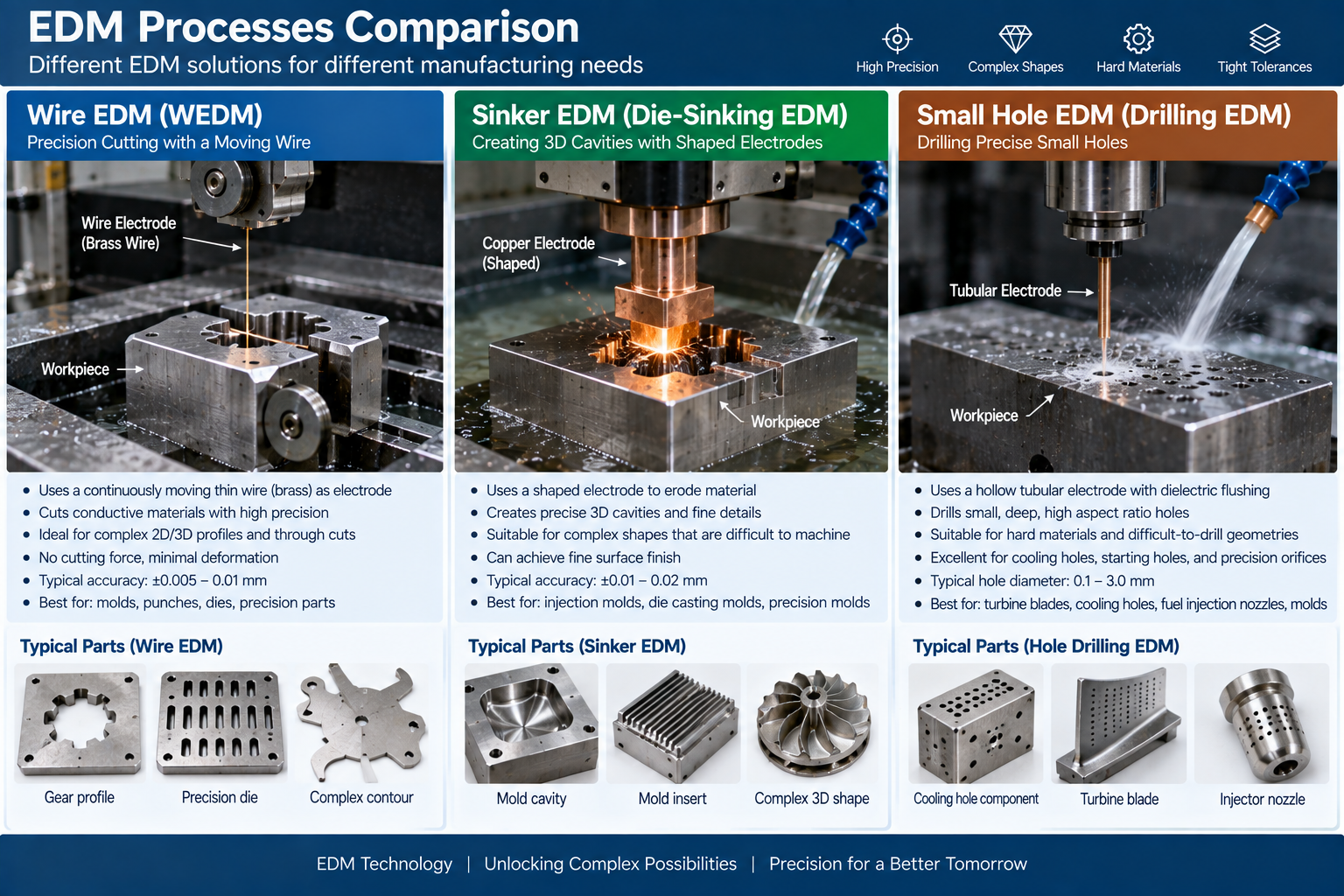
EDM Vs Conventional Machining: مقارنة سريعة
| عامل | موسيقى الرقص الإلكترونية | الآلات التقليدية |
| Process principle | Electrical discharge across a spark gap in dielectric | Mechanical cutting edge |
| قوة القطع | Negligible mechanical cutting force | Depends on operation, أداة, والمواد |
| صلابة المواد | Hardness has relatively little effect on cutting capability | Hardness affects tool selection, يرتدي, سرعة القطع, and process capability |
| Internal corners | Very small internal radii possible | Limited by cutter geometry and tool access |
| Deep narrow features | Possible with flushing and electrode control | Tool deflection and breakage risk |
| الجدران الرقيقة | Low mechanical deflection risk | Deflection and chatter risk |
| Stock removal speed | Generally lower material-removal rate | Generally higher for accessible bulk removal |
| مواد | Conductive only | المعادن والبلاستيك |
| الأدوات | Wire or electrode | Cutters and inserts |
| Surface integrity | Thermally affected layer possible | Mechanical surface effects |
Where EDM Loses
EDM is not a replacement for milling or turning in every case.
- It only works on conductive materials.
- Material removal rate is low, so bulk stock removal is slow.
- Wire EDM generally needs a threading or start hole, or another wire-access path, for enclosed internal profiles.
- Sinker electrodes wear and may need replacement.
- EDM leaves a thermally affected layer with possible recast or white-layer effects.
- Dielectric fluid and used wire need handling.
- Long burn times, multiple skim passes, electrode manufacture, wire consumption, and setup can make EDM expensive when its geometric advantages are unnecessary.
EDM is generally most valuable for geometry, صلابة, وصول, and precision rather than high-rate bulk stock removal.
When Conventional Machining Wins
Conventional machining is usually faster and cheaper for accessible geometry.
Choose milling or turning when geometry is accessible, material can be cut efficiently with conventional tooling, and the required tolerances and finish can be achieved economically. Choose conventional machining for large stock removal, non-conductive materials, and high-volume simple parts.
في الممارسة العملية, most parts use both. Milling removes bulk stock, then EDM finishes hardened details. يقارن الطحن باستخدام الحاسب الآلي with EDM when planning the process.
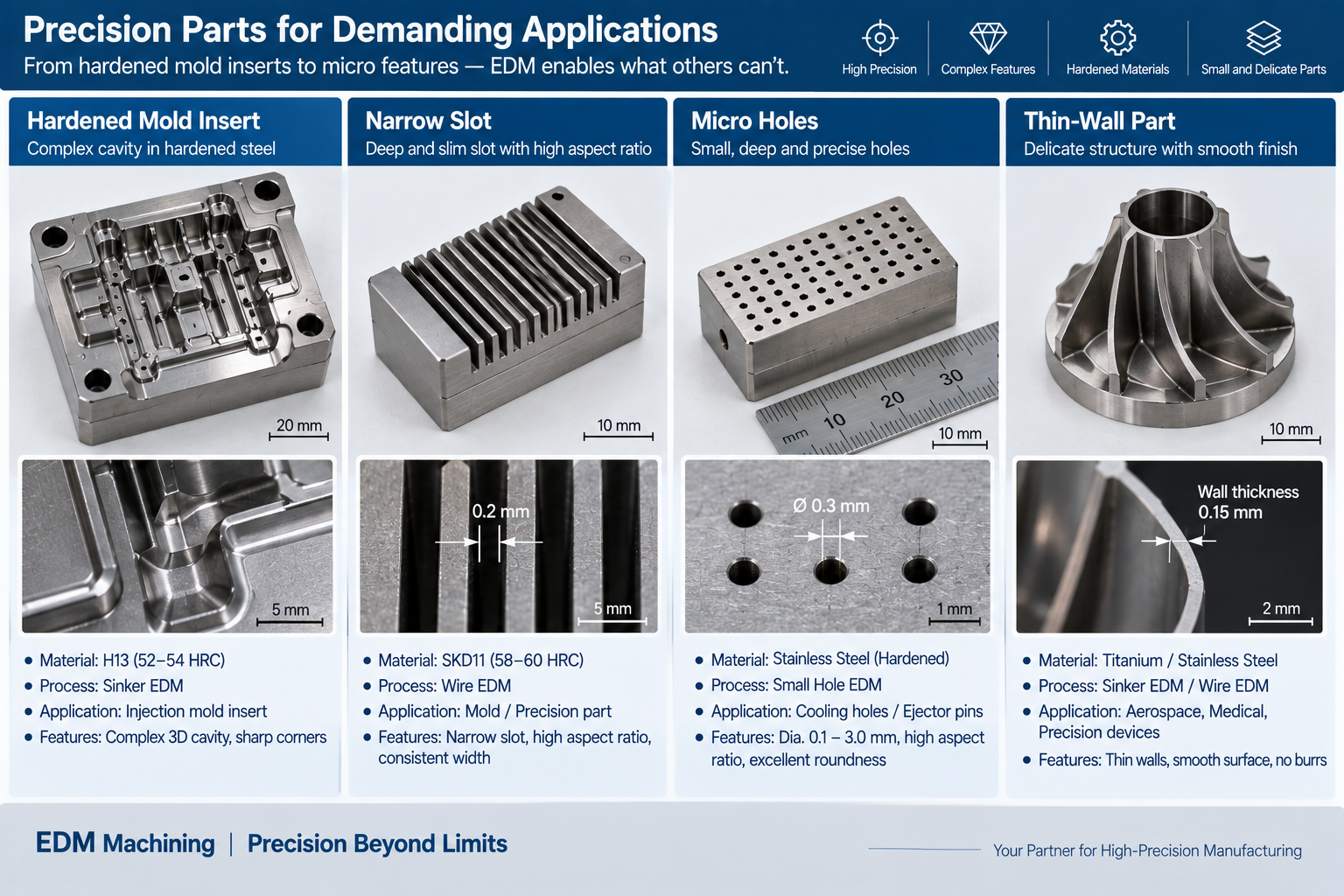
DFM Tips For EDM Parts
Design details decide whether EDM is efficient.
- Specify the material and hardness range.
- Define functional geometry rather than prescribing EDM unless the process itself is required.
- Allow a start hole or wire-access path for enclosed internal profiles.
- Consider spark gap and electrode wear in the electrode design.
- Provide flushing paths for debris evacuation in deep cavities.
- Plan skim cuts where fine finish or tight tolerance is required.
- Limit tight tolerances to functional features.
- State surface finish and any recast or white-layer limit.
- Include a datum that inspection can reach.
For difficult alloys, يرى Inconel machining as an example of why EDM is often paired with conventional cutting.
عوامل التكلفة
EDM cost depends on machine time, wire or electrodes, flushing, والتسامح.
- وقت الآلة: low removal rates make hours a major cost.
- Wire or electrodes: wire EDM continuously consumes wire, while sinker EDM requires shaped electrodes that wear and may need replacement.
- Skim and finishing passes: fine finish and tight tolerance add passes.
- Flushing and setup: deep features need more preparation.
- Tolerance and inspection: tighter limits need more measurement.
- كمية: setup and electrode cost spread across the batch.
A quote depends on geometry, مادة, والانتهاء. Send the drawing for an accurate number.
أسئلة مكررة
When should I use EDM instead of milling?
Use EDM for hardened material, نصف قطر داخلي صغير, deep narrow features, micro holes, جدران رقيقة, and tight tolerances on conductive parts.
Can EDM cut hardened steel?
نعم. Because EDM removes material by electrical discharge rather than mechanical cutting, hardened steel can be machined with much less sensitivity to workpiece hardness than conventional cutting.
Can EDM cut any material?
لا. EDM only works on electrically conductive materials.
Is EDM more accurate than milling?
Not inherently. Both EDM and precision milling can achieve tight tolerances. EDM becomes advantageous when cutter radius, قوة القطع, صلابة المواد, الوصول إلى الأداة, or feature geometry makes the required result difficult to achieve by milling.
Why is EDM slow?
EDM removes material through many controlled electrical discharges rather than continuous chip formation. Tight tolerances and fine finishes may also require multiple skim or finishing passes, which increases cycle time.
Does EDM leave a heat-affected layer?
نعم. EDM creates a thermally affected surface layer that may include recast or white-layer effects. Finishing passes and secondary operations can reduce or remove this layer when surface-integrity requirements demand it.
Get A Quote For Your EDM Parts
Send your 2D drawing or 3D model, مادة, صلابة, كمية, تسامح, الانتهاء من السطح, and any recast-layer or surface-integrity requirements. Our engineers will review tool access, feature geometry, bulk stock removal, and finishing requirements to determine whether milling, سلك التنظيم الإداري, مغسلة EDM, small-hole EDM, or a combined process is the most practical route.
الاتصال بنا للحصول على الاقتباس


