


CNC parts packaging should preserve the condition you accepted at inspection through transport, storage, and unpacking. Specify contact protection, 腐食防止, 清潔さ, 識別, and receiving criteria before ordering. A finished-part drawing alone rarely defines the complete shipping package.
Start With The Delivered Part Condition
Your packaging requirement should identify what must remain acceptable when the shipment reaches you.
List functional surfaces that cannot tolerate impact, rubbing, 汚染, or corrosion. Include sealing faces, bearing seats, precision edges, cosmetic finishes, and exposed threads where relevant. Define acceptable marks rather than relying on “good packaging.”
Then describe the route and storage period. Parcel delivery, palletized freight, repeated handling, and long warehouse storage create different demands. Tell the supplier whether you open every package immediately or keep sealed units in inventory.
Keep packaging acceptance separate from the original dimensional report. A part can meet its drawing before packing and arrive damaged. Your agreement should cover the delivered condition and the evidence needed when a problem appears.
Separate Parts And Protect Critical Features
Your packing arrangement should control movement and contact without damaging the features it supports.
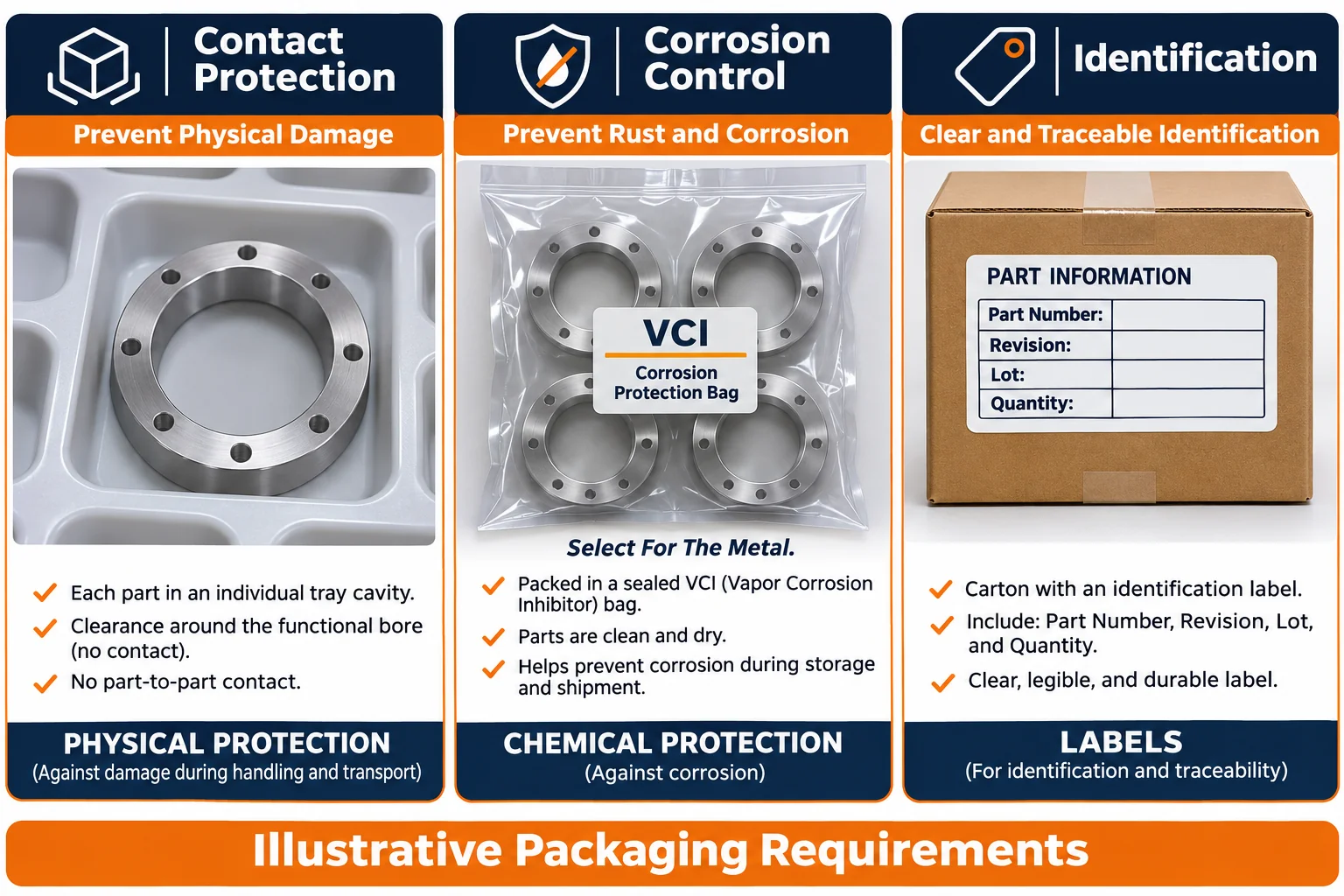
Choose individual pockets, dividers, 袖, or other suitable separation according to geometry and surface sensitivity. Avoid loose metal contact when it can damage critical faces. Check that internal restraints remain effective after the carton is moved.
Locate supports on approved areas. Do not transfer shipping loads through a delicate flange, exposed shaft tip, or thin wall without review. Protect openings and threads using components that fit without damaging the part.
A soft-looking material is not automatically suitable. Review abrasion, particle shedding, 化学互換性, そして除去. A protective film or adhesive can create a new residue problem if its contact surface is unsuitable.
Document the part orientation, quantity per layer, and separation arrangement. Photographs of an approved representative pack help prevent later substitution of a weaker arrangement.
Select Corrosion Protection For The Actual Metal
Your preservation method should suit the metal, 表面仕上げ, 環境, and intended storage duration.
Vapor corrosion inhibitor packaging, commonly called VCI, is one possible approach. ZERUST explains matching VCI to the metal. Do not assume one formulation is appropriate for every steel, 銅合金, コーティング, or mixed-metal assembly.
Parts should be clean, いいね, and visibly dry before sealing under the selected system’s instructions. ZERUST's drying guidance explains that VCI does not remove standing water.
Specify the approved preservation product and packaging closure. Protect the enclosure from punctures caused by sharp edges. Agree how inspectors reseal opened units, rather than assuming protection continues unchanged after opening.
Do not assign a universal protection period to a generic bag. Obtain a recommendation for the complete application and validate the required storage condition. Any oil or preservative must also satisfy downstream cleaning, 組み立て, and coating requirements.
Preserve Cleanliness During Packing And Unpacking
Your packaging plan should protect the cleanliness requirement until the agreed acceptance stage.
Define what happens after final cleaning. Include inspection handling, marking, cap installation, preservation, and transfer into packaging. Select contact materials and closures that do not introduce unacceptable contamination.
For particle-sensitive components, the related technical cleanliness guide explains how to define the acceptance requirement. Packaging supports that requirement; an intact bag does not itself prove the part passed a cleanliness test.
Agree how the receiving team opens and handles the package. If unpacking introduces dirt or damages a sealing face, the shipping protection has not solved the complete handling problem.
Keep cleanliness and corrosion requirements consistent. Confirm whether a protective residue is permitted and who removes it before use. Avoid an undefined requirement for both an oily protective film and a residue-free delivered surface.
Define Labels And The Packing Record
Your identification system should connect each shipping unit to the parts and records inside it.
Specify the part number, リビジョン, 量, purchase order, and required production or material lot identifiers. Define whether these appear on the individual pack, inner carton, or outer shipping unit.
Keep labels readable through expected handling. Ensure the receiving team can check contents without opening every protected unit unnecessarily. Agree how mixed part numbers or lots are separated and identified.
Record the packaging revision and approved materials. Include representative packing photographs and the packing date where required. A complete record helps determine whether a later failure involved manufacturing, preservation, 輸送, or unpacking.
Validate The Complete Shipping Unit
Your packaging validation should evaluate a representative loaded package against the expected distribution route.
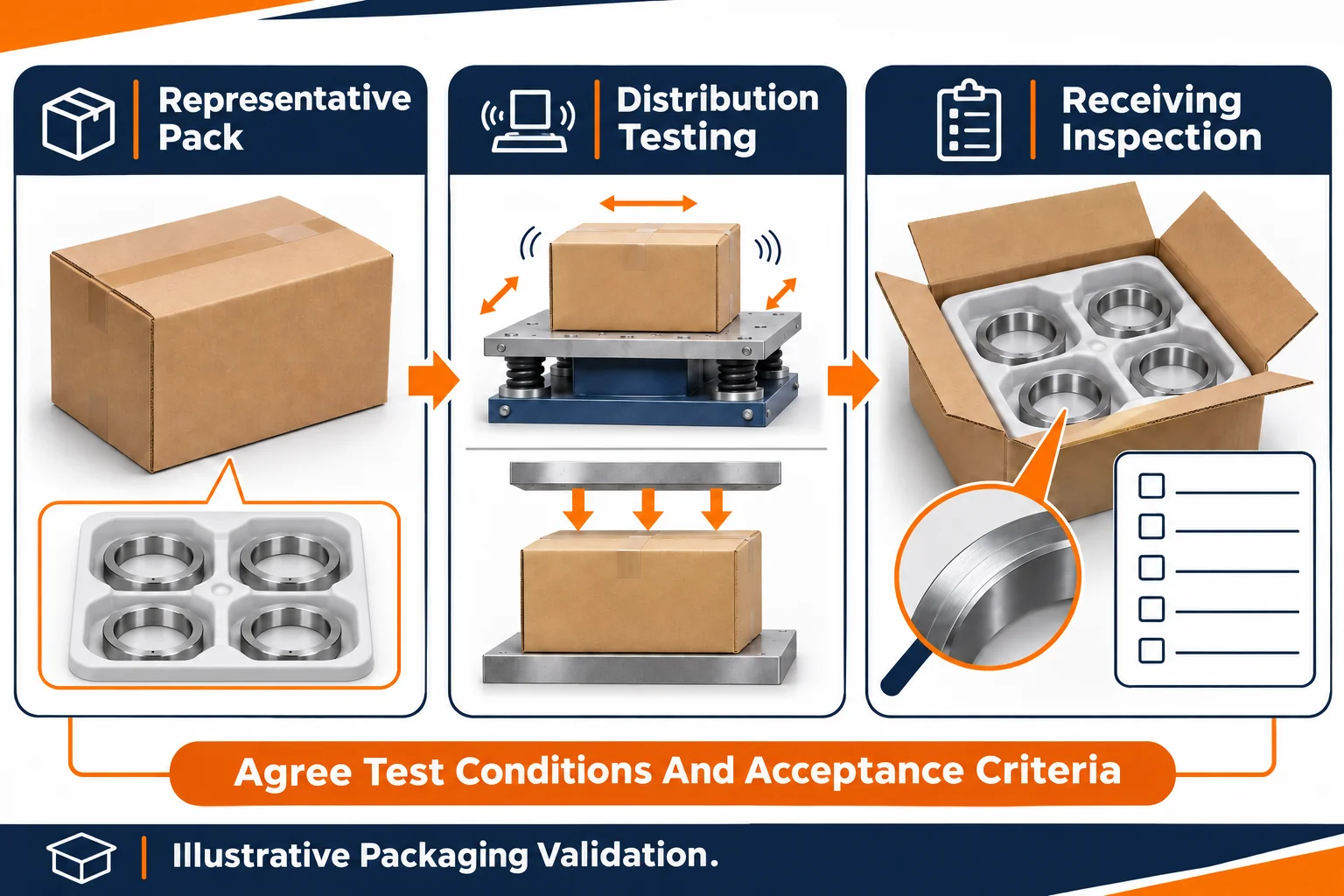
A carton tested without its normal contents does not establish the performance of your actual shipping unit. Use representative parts, internal protection, クロージャー, 量, and overall mass.
ASTM D4169 provides a framework for laboratory performance testing of shipping containers and systems. Have a packaging specialist select the applicable procedure, 版, 条件, と合格基準. Do not treat the standard’s name as a universal test schedule.
Agree what the assessment includes after testing. Review part movement, ダメージ, 表面状態, packaging integrity, and any required functional or dimensional checks. Mechanical distribution testing alone does not establish long-term corrosion protection.
Changes to part mass, pack quantity, divider material, or closure can change package behavior. Define which changes require renewed review or testing.
Compare Quotes With The Same Packaging Scope
Your quotation comparison should include the complete packaging and receiving requirement.
TOPSプレシジョンが提供する CNC加工サービス. Send the packaging specification with your drawing. Confirm the proposed arrangement and any required specialist validation for your actual components.
| Purchase Detail | Define Before Quoting | Evidence To Agree |
|---|---|---|
| Contact Protection | Critical features and permitted support | Representative packing layout |
| Preservation | 金属, product, 間隔, 環境 | Approved system instructions |
| 清潔さ | Required condition and acceptance stage | Handling and opening procedure |
| Identification | Part, リビジョン, 多く, 量 | Label example and packing record |
| Distribution | Shipping route and loaded configuration | Applicable validation report |
| Receiving | Damage criteria and disposition | Inspection and containment procedure |
Individual protection can increase packing time and package volume. Reusable trays may suit some recurring programs, but require return and cleaning arrangements. Compare these costs against the actual protection and receiving requirements.
よくある質問
Your packaging decision should address the specific failure modes your component could experience.
Does A VCI Bag Replace Drying
いいえ. VCI does not remove standing water. Follow the approved system’s preparation and closure instructions.
Should Every CNC Part Be Individually Wrapped
That depends on geometry, contact sensitivity, 清潔さ, and handling. Specify effective separation where needed instead of requiring one universal packing method.
Does A Packaging Test Guarantee Corrosion Protection
いいえ. Mechanical distribution testing and corrosion preservation address different risks. Define and verify each required condition separately.
Request A Packaging Review
お問い合わせ あなたの絵と一緒に, 材料, 量, クリティカルサーフェス, shipping route, and storage requirements. Include cleanliness, preservation, and receiving criteria. Agree the packaging scope before releasing your CNC order.