


Plastic creep testing measures how deformation develops while a sustained load is applied under controlled conditions. For molded parts, define the load, ambiente, duração, specimen, and acceptance limit before testing. A short tensile test or material data sheet cannot independently establish acceptable long-term component performance.
Start With The Function That Must Be Maintained
Your creep test should answer a specific question about the component’s function under sustained loading.
A bracket may need to hold alignment. A housing support may need to maintain clearance. Identify the displacement or other functional change that becomes unacceptable.
Separate sustained loads from brief overloads and repeated loading. Rastejar, short-term strength, and fatigue answer different design questions.
Document the assembled condition and where loads enter the part. A nominal force alone does not define the stress distribution in a molded component.
O general design principles hosted by Delrin explain why long-term loading requires separate consideration. Use data for the exact grade and application conditions.
Do not select an allowable load from a generic polymer name. Resin grade, reforço, doença, geometria, and the application all matter.
Distinguish Creep From Stress Relaxation
You should choose the test mode according to whether the application primarily holds load or constrains deformation.
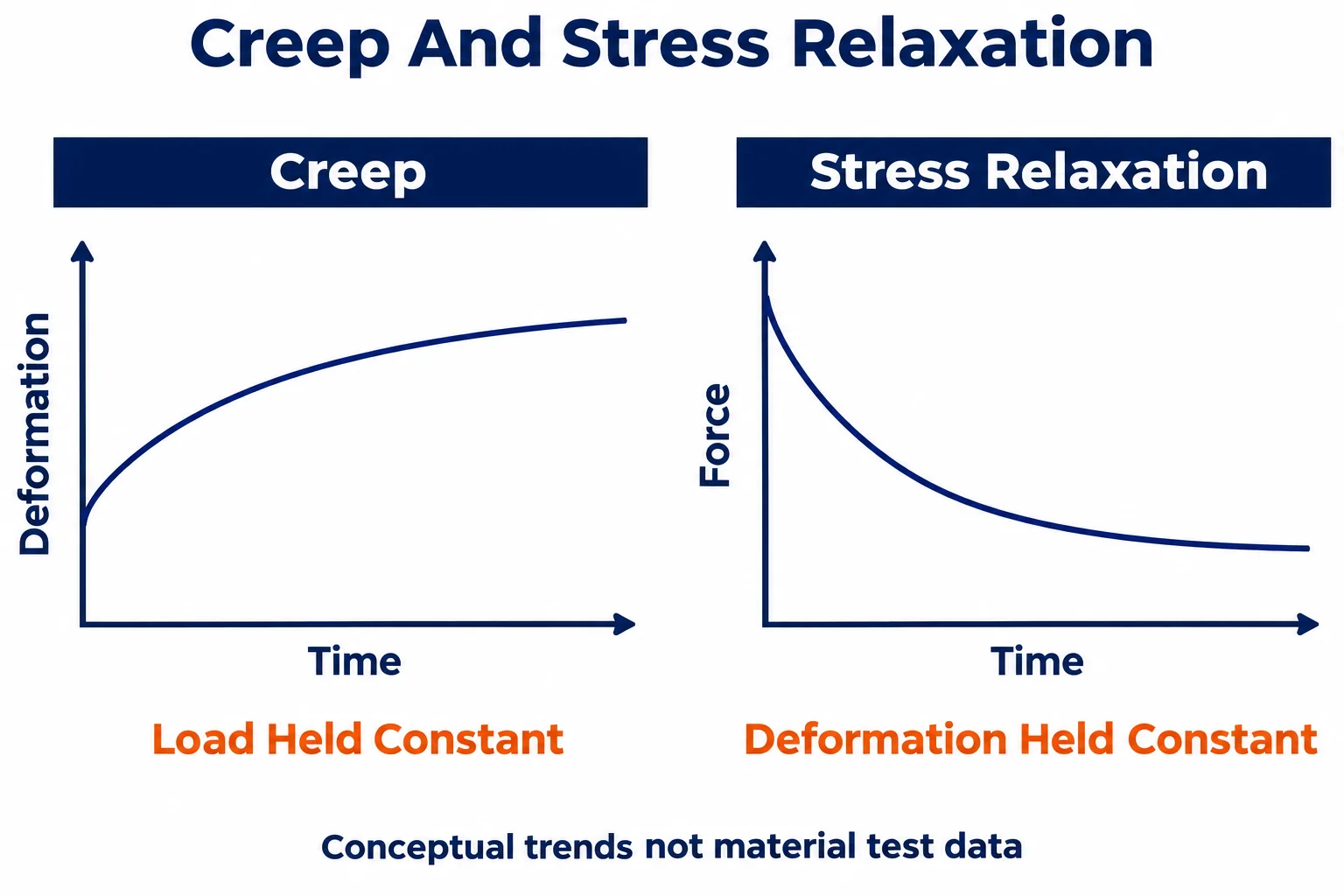
In a creep test, the applied load is maintained while deformation is recorded over time. Initial deformation and subsequent time-dependent deformation should remain distinguishable.
In a stress-relaxation test, deformation is held while the required force decreases over time. This can matter when retention depends on sustained force.
A real assembly may combine both effects. Ask the responsible engineer to define the boundary conditions and the quantity being evaluated.
Do not use the two test names interchangeably in an RFQ. State whether the result concerns displacement, variedade, force retention, or another approved measure.
Select The Test Method And Specimen
Your test specification should identify the loading mode, specimen form, and applicable method revision.
ISO 899-1:2017 addresses tensile creep of plastics using standard specimens under specified conditions. Its public scope emphasizes preparation, ambiente, dimensões, and thermal history.
ASTM D2990 covers tensile, compressive, and flexural creep methods. Its public scope identifies technical differences from ISO 899.
Choose the required method rather than assuming differently generated results are directly interchangeable. Confirm the loading mode matches the question being investigated.
Standard specimens can support material comparison and design data. Finished-part tests address geometry, jogos, superfícies de contato, and application-specific behavior.
If specimens are cut from molded parts, document their source and preparation. Do not silently treat them as identical to directly molded test specimens.
For reinforced materials, record the specimen orientation relative to the molded structure where relevant. Agree how representative the specimen is before using its results.
Define Load Environment And Duration Together
Your creep test conditions should represent the intended application or an explicitly justified evaluation condition.
Specify how the load is applied and controlled. Identify the contact area, fixture constraints, and any assembly preload relevant to the component.
Define temperature, humidity or conditioning state, and any relevant environmental exposure. A room-temperature result does not establish behavior in a different service environment.
State the required duration and measurement schedule. Agree when loading starts and how the initial deformation is recorded.
ZwickRoell describes long-term plastics testing under controlled conditions. Stable loading and temperature support meaningful time-dependent measurements.
If testing is interrupted, document the event and its effect on interpretation. Do not silently join interrupted records into an apparently continuous result.
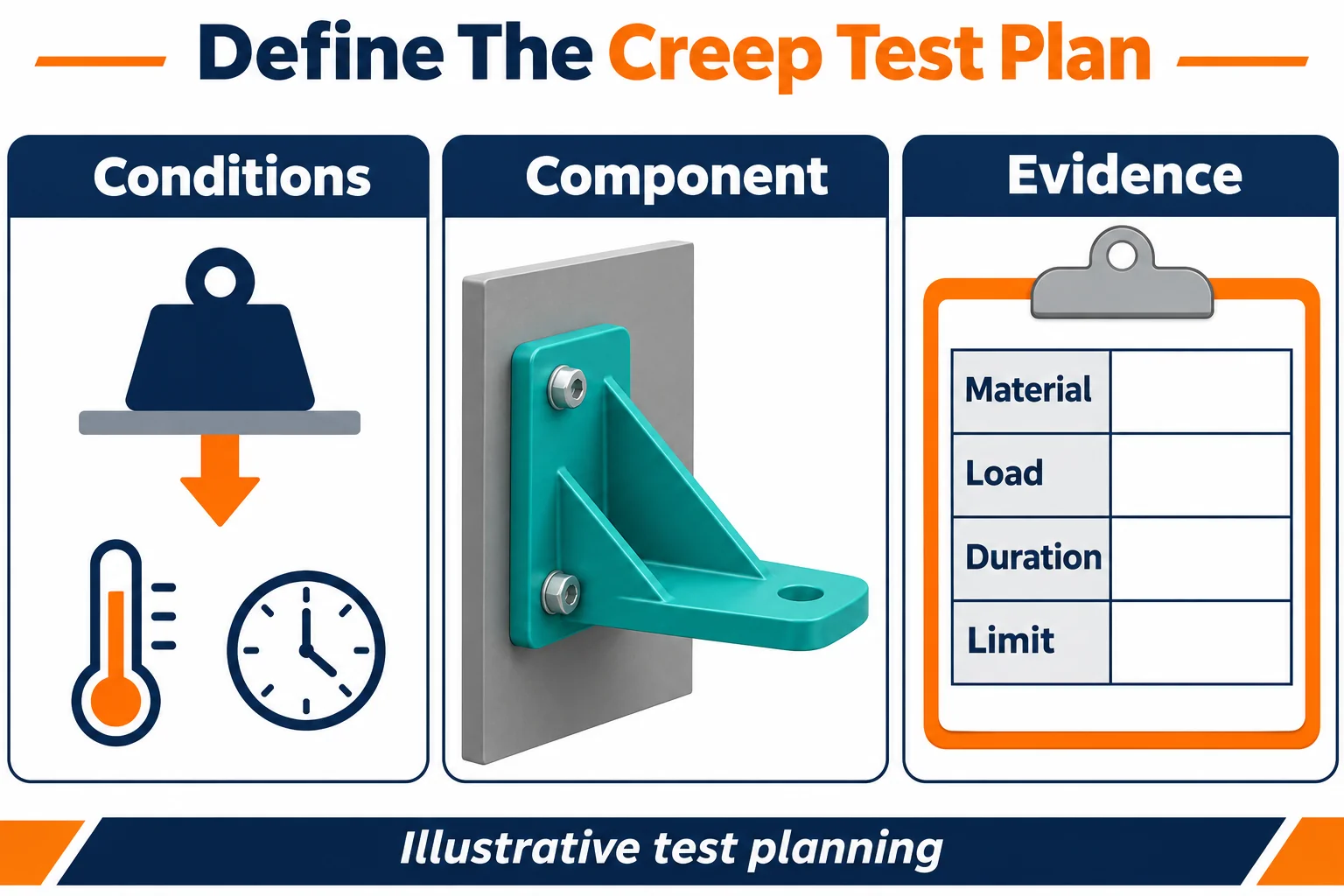
| Test Plan Item | Informações para concordar |
|---|---|
| Material and specimen | Nota exata, reforço, source, orientação, and preparation |
| Carregando | Mode, magnitude, application points, and control method |
| Ambiente | Temperatura, condicionamento, umidade, and relevant exposure |
| Tempo | Loading reference, duração, and measurement schedule |
| Medição | Quantidade, reference locations, instrument method, and fixture effects |
| Aceitação | Limites, evaluation times, failure events, and decision authority |
Separate Fixture Movement From Part Deformation
Your measurement setup should distinguish the component’s response from movement in the grips, suporta, or test frame.
Define where displacement or strain is measured and what reference it uses. Crosshead movement and local specimen extension need not represent the same quantity.
Check seating, alinhamento, and contact conditions before approving the fixture. An unintended restraint can change the component’s response.
For assembly tests, identify the mating materials, fixadores, e método de instalação. Preserve those conditions across samples being compared.
Agree the sample quantity and production representation with the responsible engineer. One convenient sample should not silently represent every cavity or manufacturing condition.
Set Acceptance Limits Before Testing Begins
Your acceptance criteria should connect measured changes to the function that must remain acceptable.
Define the allowed deformation at specified times and conditions. Include fracture, loss of engagement, contact changes, or other relevant functional events.
If recovery after unloading matters, specify the unloading and recovery evaluation separately. A loaded displacement and a recovered displacement describe different conditions.
Retain the full time history alongside summary values. A final reading alone can hide changes that occurred during the test.
Do not convert a short test into a service-life guarantee without a validated prediction method. Any extrapolation needs stated assumptions and engineering justification.
Da mesma maneira, accelerated temperature testing requires an approved relationship to the intended service behavior. A hotter test is not automatically a valid time shortcut.
Preserve Material And Manufacturing Traceability
Your test report should identify the material and manufacturing condition represented by the tested samples.
Record the resin manufacturer and grade, colorant or filler system, and relevant lots. Include the part revision and molding source.
Document conditioning, preparação de amostras, test method, actual conditions, and any departures from the plan. Retain the result and authorized disposition together.
When the grade or manufacturing route changes, assess whether existing creep evidence remains applicable. Nosso resin substitution review guide covers the broader material-change decision.
A test on one approved configuration should not become automatic approval for every replacement resin or revised geometry.
Request Quotes With The Same Validation Scope
Your molding RFQ should separate part production, preparação de amostras, and any specialist long-term testing requirements.
Ofertas TOPS serviços de moldagem por injeção de plástico. Submit your validation requirements during project review and confirm the proposed testing arrangements.
Incluir o desenho, grau de resina, quantidades, volume anual, vida do programa, and service loading. Provide the test method, condições, duração, and acceptance criteria where defined.
Costs depend on specimen preparation, fixture design, test duration, environmental control, sample quantity, and reporting. Long-duration tests also affect laboratory scheduling.
Confirm the responsible laboratory and engineering approval authority. Do not assume a molding supplier has a particular creep-testing instrument or accreditation.
perguntas frequentes
Your test request should resolve these questions before samples are submitted.
Does A Tensile Strength Value Prove Creep Resistance
Não. A short-term tensile result does not establish deformation under sustained loading for the required duration and environment.
Are Creep And Stress Relaxation The Same Test
Não. Creep testing maintains load and measures deformation. Stress-relaxation testing maintains deformation and measures force change.
Can Standard Specimens Replace Finished Part Testing
Não automaticamente. Establish how the specimen data support the actual component, geometria, conjunto, e condições de serviço.
Is There One Acceptable Creep Limit For All Plastics
Não. Set the limit from the application and approved design requirements.
Can A Short Hot Test Prove Years Of Service
Only through a validated prediction approach with justified assumptions. Temperature changes can alter the relevant material behavior.
Should Conditioning Be Recorded
Sim. Record the agreed preparation and conditioning state so results can be interpreted and compared meaningfully.
Can Results From Different Standards Be Compared Directly
Não presuma isso. Review method differences, specimens, measurement definitions, and actual test conditions first.
What Should Be Sent For A Test Planning Review
Envie o desenho, nota, assembly details, cargas, ambiente, duração, functional limits, quantidades, and required reporting.
Request A Molded Part Validation Review
Contate-nos com seu desenho, grau de resina, cargas, ambiente de serviço, volume anual, e programar a vida. Include your proposed test conditions and acceptance criteria. Agree the sample, testando, and approval responsibilities before production release.