


ウォータージェット切断は、高圧の水を使用しています, 研磨剤を混ぜることもあります, to cut sheet and plate without using heat as the cutting mechanism. It cuts metals, 石, ガラス, 複合材, and plastics without the heat-affected zone of thermal cutting. This guide covers how it works, its limits, and how to design for it.
What Is Waterjet Cutting?
Waterjet cutting is a cold cutting process that erodes material with a high-pressure water jet.
Water is pressurized and forced through a small orifice. In abrasive waterjet cutting, abrasive particles are added to the stream to cut hard materials. The jet does not rely on heat, so the material does not melt or thermally distort.
How Does Waterjet Cutting Work?
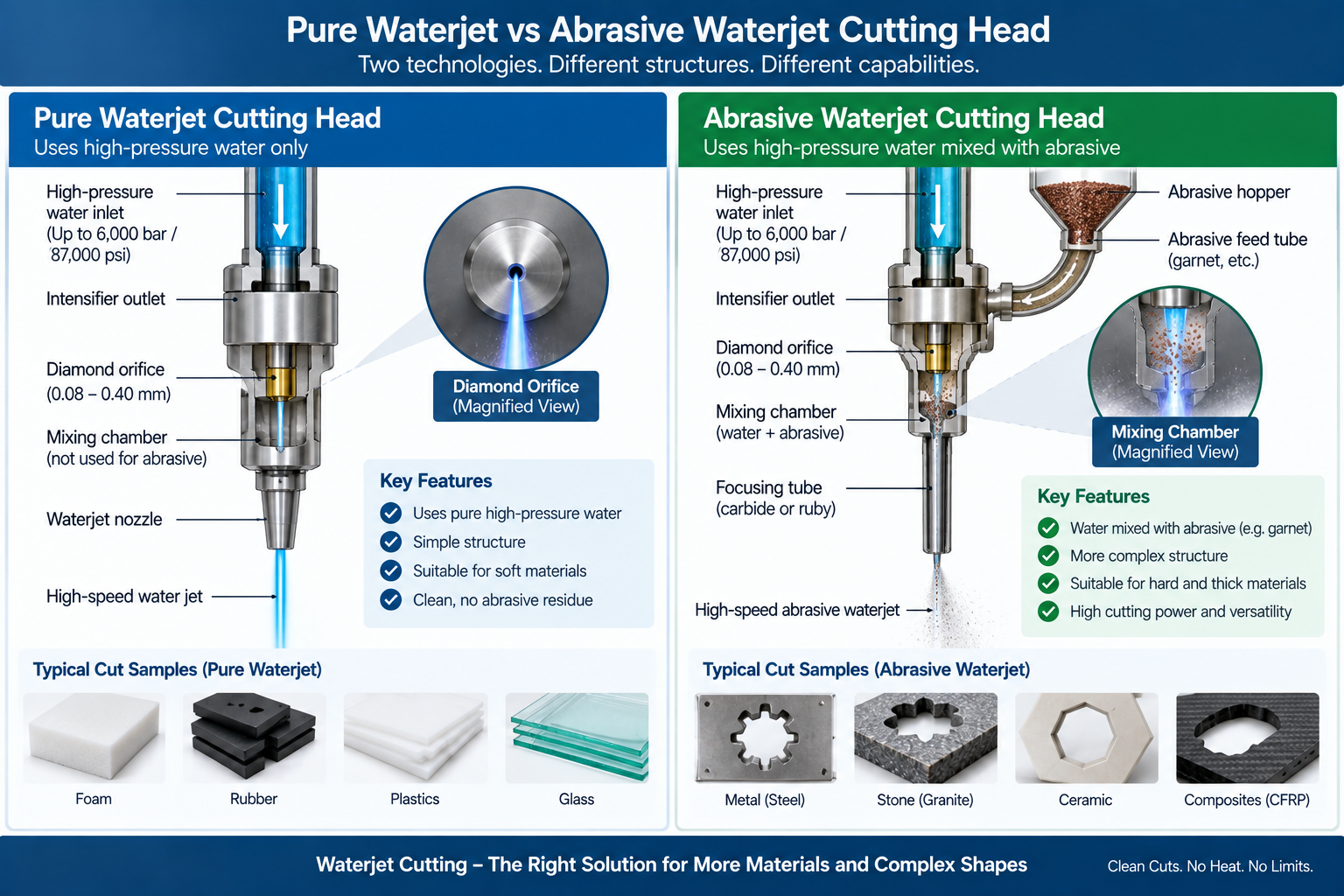
A high-pressure pump turns water into a focused jet, and the cutting head moves that jet along the part path.
- A high-pressure pump, typically an intensifier or direct-drive system, raises water to the required cutting pressure.
- Water passes through a small orifice to form a high-velocity jet.
- In abrasive cutting, abrasive is drawn into a mixing chamber and accelerated by the jet.
- The cutting head moves along the programmed path by CNC control.
- A catcher tank absorbs the jet below the material.
- Consumed abrasive and water are collected for disposal or recycling.
Industrial waterjet systems commonly operate at tens of thousands of psi, with some ultra-high-pressure systems approaching 90,000 psi. Pressure depends on the pump architecture and application.
Multi-axis cutting heads can tilt the jet to compensate for taper and produce bevels or angled edges.
Pure Waterjet Vs Abrasive Waterjet
The two waterjet types cut different materials.
| タイプ | Cutting Medium | に最適です |
| Pure waterjet | Water only | フォーム, ゴム, ガスケット, 食べ物, soft plastics, and selected soft materials |
| Abrasive waterjet | Water plus abrasive, 通常はガーネット | 金属, 石, ガラス, セラミックス, thick plate, 複合材 |
Pure waterjet cuts soft materials quickly and cleanly. Abrasive waterjet cuts hard materials but adds abrasive cost and waste handling.
Key Waterjet Cutting Parameters
Cut quality and speed depend on a small group of parameters.
- Water pressure: higher pressure increases cutting power and wear.
- Orifice diameter: sets jet energy and kerf width.
- Abrasive type and flow rate: affect cutting speed and edge quality.
- Standoff distance: affects jet coherence, kerf geometry, and edge quality. Excessive standoff generally reduces cutting precision.
- Traverse speed: slower cutting reduces taper and improves finish.
- Material thickness and hardness: thicker or harder material cuts slower.
- Abrasive mesh size: affects cutting performance and edge quality. The optimum size depends on the nozzle or focusing tube, 材料, 厚さ, abrasive flow, and desired finish.
These parameters interact. The operator balances speed, 品質, and consumable cost for each job.
What Materials Can Be Waterjet Cut?
Waterjet can cut a very broad range of materials, including many that are difficult to process with heat-based cutting methods.
- 金属: アルミニウム, 鋼鉄, ステンレス鋼, チタン, 銅, そして真鍮.
- プラスチック: アクリル, ポリカーボネート, POM, and other engineering plastics.
- 複合材料: carbon fiber and fiberglass, with attention to delamination.
- Stone and ceramics: 花崗岩, 大理石, tile, and ceramic plate.
- ガラス: flat and laminated glass. Tempered glass is generally unsuitable because cutting can trigger shattering.
- ゴム, フォーム, とガスケット: often with pure waterjet.
- Food products: cut with pure waterjet in hygienic systems.
Piercing strategy is especially important for laminated composites. Direct piercing can initiate delamination, so edge starts, pilot holes, or controlled low-pressure piercing may be preferred depending on the laminate.
Thickness capability depends on the machine, 材料, and required edge quality. Confirm the limit for your material before quoting.
正確さ, Kerf, テーパー, And Stream Lag
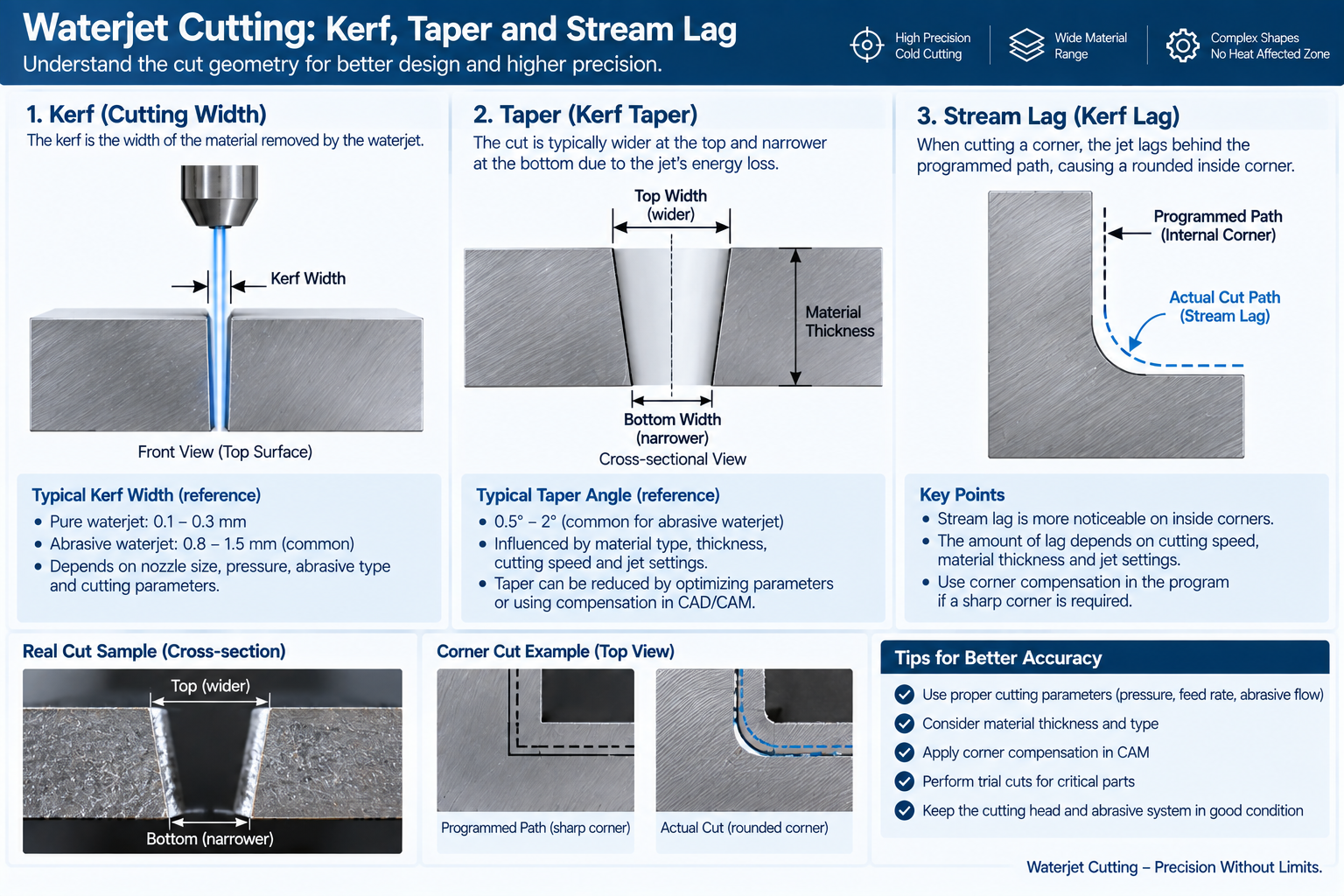
There is no universal waterjet tolerance. Finished-part accuracy depends on machine capability, 材料, 厚さ, cut speed, フィクスチング, kerf compensation, taper control, and edge-quality requirements.
Around ±0.1 mm may be achievable on many suitable abrasive-waterjet parts. Precision systems can achieve substantially tighter results under controlled conditions. Tolerance is design-dependent, so critical dimensions need review. 見る CNC加工公差 for how tolerance strategy works.
In thicker material, the lower part of the jet can lag behind the cutting head. This stream lag contributes to dimensional error, corner behavior, and edge striations, especially at higher traverse speeds.
Kerf is the width of material removed by the jet. Kerf depends on orifice size, 研磨剤, 材料, and thickness. Taper increases with thickness and cutting speed. Multi-axis heads can compensate for taper and produce bevels. As-cut edges have a matte finish and may require secondary machining for sealing surfaces, precision fits, or appearance-critical edges.
Benefits Of Waterjet Cutting
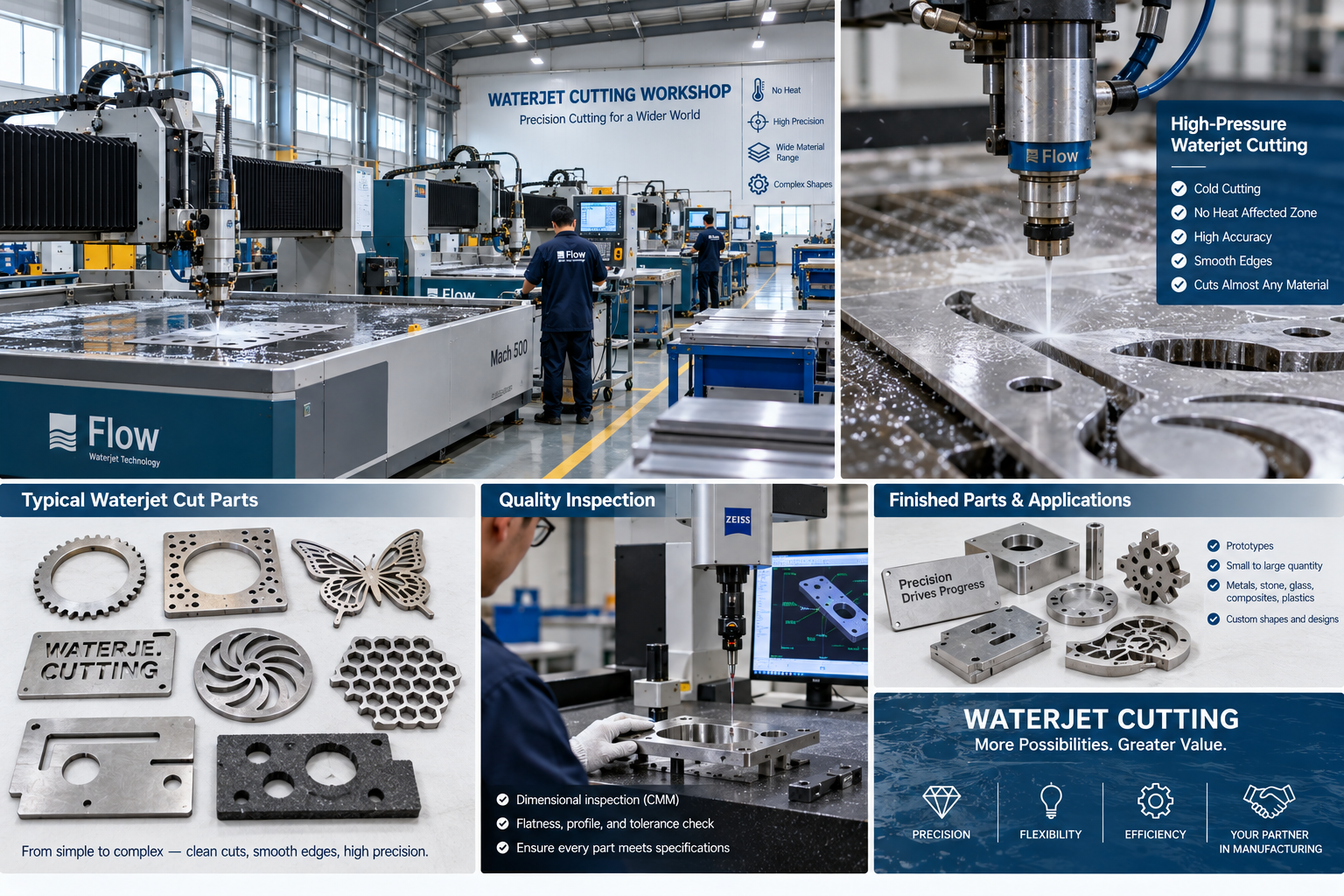
Waterjet cutting offers cold cutting, 素材の柔軟性, and low setup cost.
- No heat-affected zone and minimal thermal distortion.
- Cuts a very wide material range, including heat-sensitive and reflective materials.
- No dedicated cutting die or hard tool is normally required, which can reduce tooling cost for prototypes and variable geometry.
- Nests parts closely to improve material utilization.
- Can cut thick materials beyond the practical quality or thickness range of some laser-cutting systems, depending on material and equipment.
- Leaves material properties largely unchanged.
- Can support stack cutting in suitable applications when the layers are securely controlled.
These benefits make waterjet useful for one-off parts, プロトタイプ, and production cutting.
Limitations Of Waterjet Cutting
Waterjet is not the fastest or most accurate cutting method for every job.
- Slower than laser or plasma on thin sheet.
- Kerf is wider than laser, which affects fine detail.
- Taper appears on thick material unless compensated.
- Abrasive and water consumption add running cost.
- Abrasive sludge needs disposal or recycling.
- Pierce points can damage delicate or laminated materials.
- Tight tolerances may need secondary machining.
- Noise and water management require proper equipment.
Match the process to the material thickness and tolerance target.
Waterjet Vs Laser Vs Plasma Vs EDM
| 要素 | Waterjet | レーザ | Plasma | 放電加工 |
| Cutting mechanism | Non-thermal erosion | 熱 | 熱 | Localized electrical-discharge heating |
| Heat-affected zone | なし | はい | はい | Localized recast and thermally affected layer |
| Typical materials | Very wide range | Metals and selected nonmetals, depending on laser and material compatibility | 導電性金属 | 導電性材料 |
| Thick plate | とても良い | 限定 | 良い | 限定 |
| Thin sheet speed | 遅い | 非常に速い | 速い | 遅い |
| Dimensional capability | 良い, thickness and taper dependent | Good on suitable sheet | Moderate for general profiling | High for suitable conductive parts |
| Edge finish | マット, needs finishing for seals | 良い | 適度 | 大丈夫 |
| ツーリング | なし | なし | なし | Electrodes or wire |
For thin sheet, 比較する レーザー切断 そして プラズマ切断.
Design Guidelines For Waterjet Parts
Design for kerf, テーパー, and how the jet enters and exits the material.
- Account for kerf width and ensure the cutting program applies the correct kerf compensation.
- Avoid very small holes in thick material. Jet lag, テーパー, and piercing behavior affect roundness and edge quality as thickness increases.
- Use lead-in and lead-out paths that avoid marking the finished edge.
- Place pierce points away from critical surfaces.
- Group nested parts to improve material utilization.
- Expect some taper on thick sections unless compensated.
- Specify tight tolerances only on functional features.
- Plan secondary machining where a sealing or sliding surface is needed.
For cut sheet parts, 私たちのを参照してください CNC切断 service and 板金加工 機能.
コスト要因
Waterjet cost depends on cutting time, abrasive use, 材料, と寛容性.
- マシンタイム: thickness and cut length drive cycle time.
- Abrasive: consumption rises with cutting time and material.
- Water and power: continuous operating cost.
- 材料: cost and utilization affect the total.
- Tolerance and finish: tighter targets slow the cut.
- Secondary operations: 機械加工, バリ取り, and edge finishing add cost.
- 量: nesting and setup spread across the batch.
Waterjet has low setup cost, so it is competitive for one-off and low-volume work.
Applications By Industry
| 業界 | Typical Waterjet Parts |
| 航空宇宙 | Structural plates, 括弧, heat-sensitive alloys |
| 自動車 | Prototype panels, ガスケット, interior trim |
| Architecture and construction | 石, tile, ガラス, and metal panels |
| 医療機器 | Device plates, ハウジング, instrument components |
| エレクトロニクス | Enclosure panels, ヒートシンク, insulation parts |
| 複合材料 | Carbon fiber and fiberglass profiles |
| 食品加工 | Portioned products with pure waterjet |
When Waterjet Cutting Is Not The Best Choice
Waterjet is not always the right process.
- High-volume thin sheet is usually faster with laser cutting.
- Very tight tolerances may need CNC machining or EDM.
- Complex 3D shapes are usually better produced by milling. Waterjet is mainly a 2D and 2.5D cutting process, although bevel and multi-axis heads can produce angled edges.
- Small holes in thick plate may be impractical.
- Materials that delaminate easily need careful process control.
Choose the process by thickness, 材料, 許容範囲, edge finish, そしてボリューム.
よくある質問
What is waterjet cutting?
It is a cold cutting process that uses a high-pressure water jet, with or without abrasive, to cut material.
What is the difference between pure and abrasive waterjet?
Pure waterjet cuts soft materials with water only. Abrasive waterjet adds abrasive to cut metals, 石, ガラス, そしてセラミックス.
What materials can a waterjet cut?
金属, プラスチック, 複合材, 石, ガラス, セラミックス, ゴム, フォーム, and some food products.
Can waterjet cut tempered glass?
一般的にはありません. Cutting tempered glass can trigger shattering.
How accurate is waterjet cutting?
There is no universal tolerance. Around ±0.1 mm may be achievable on many suitable parts, while precision systems can hold tighter values under controlled conditions.
Does waterjet cutting create a heat-affected zone?
いいえ. Waterjet is a cold process, so it avoids the heat-affected zone created by laser and plasma cutting.
Can waterjet cut thick steel?
はい, on suitable machines. The practical limit depends on the machine, 材料, and required edge quality.
Get A Quote For Your Waterjet Cut Parts
Send your 2D drawing or DXF file, 材料, 厚さ, 量, 許容範囲, and edge finish requirements. Our engineers will review nesting, kerf and taper control, and whether secondary machining is needed before quoting.


1 「」について考えましたウォータージェット切断技術の究極ガイド”