


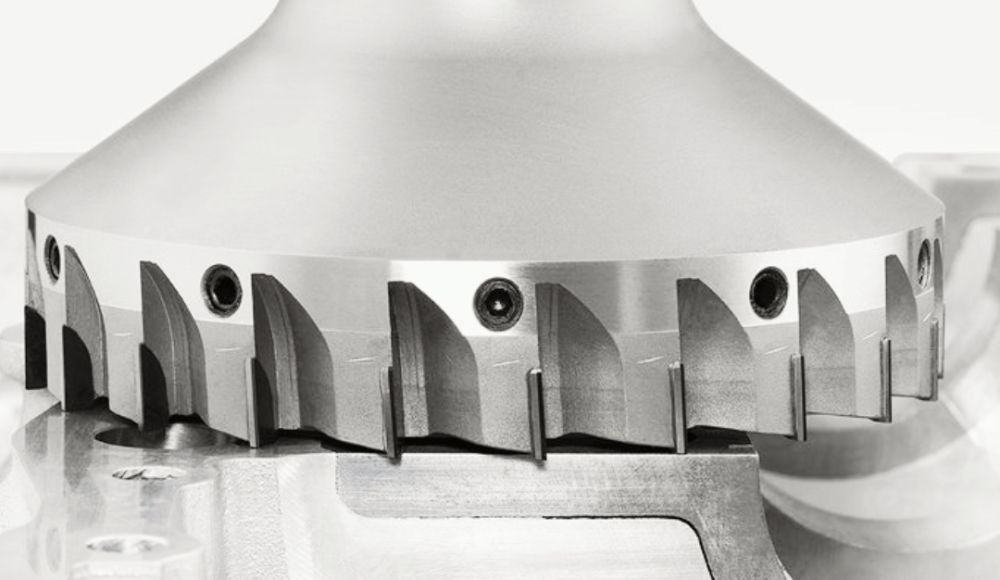
成形フライス加工では、事前に定義されたプロファイルを持つカッターを使用して、適合または相補的な形状をワークピースに機械加工します。. Simple forms can often be produced in a single pass, while deeper or wider features may require roughing and finishing passes. This guide covers the process, カッター, アプリケーション, 利点, and limits of form milling.
What Is Form Milling?
Form milling is a milling process that uses a cutter with a predefined profile to produce a matching or complementary shape in a workpiece.
The cutting edges are ground to a geometry that generates the required workpiece profile. Depending on cutter design and cutting geometry, the cutter profile may be an exact representation of the feature or a compensated geometry designed to produce the specified finished form.
How Does Form Milling Work?
Form milling transfers a cutter profile by controlling depth, 餌, およびアライメント.
- Select a standard or custom cutter with the right profile.
- Set spindle speed and feed for the workpiece material.
- Align the cutter to control axial and radial runout.
- Cut the form in one pass, or rough then finish.
- Inspect with a profile projector, comparator, or CMM.
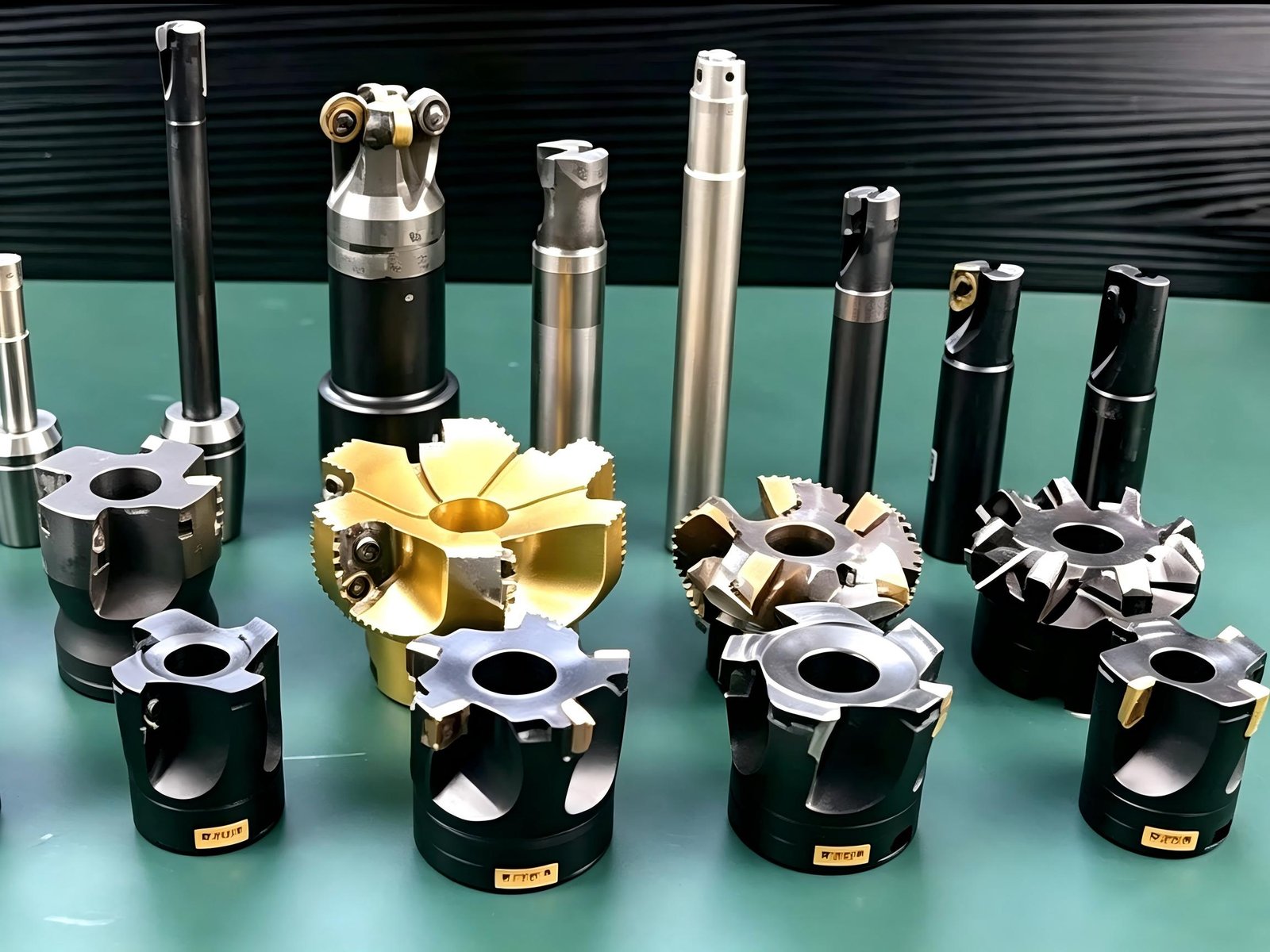
What Are Form Milling Cutters?
Form milling uses profile cutters that copy a shape. Some cutters also produce a specific feature through programmed motion.
Convex Cutters
Convex cutters machine an external radius. They round bosses, エッジ, and shoulders.
Concave Cutters
Concave cutters machine an internal fillet or half-round groove. They suit O-ring grooves and flutes.
Corner-Rounding Cutters
Corner-rounding cutters machine a rounded corner on an edge. They replace manual filing or deburring.
Gear And Spline Cutters
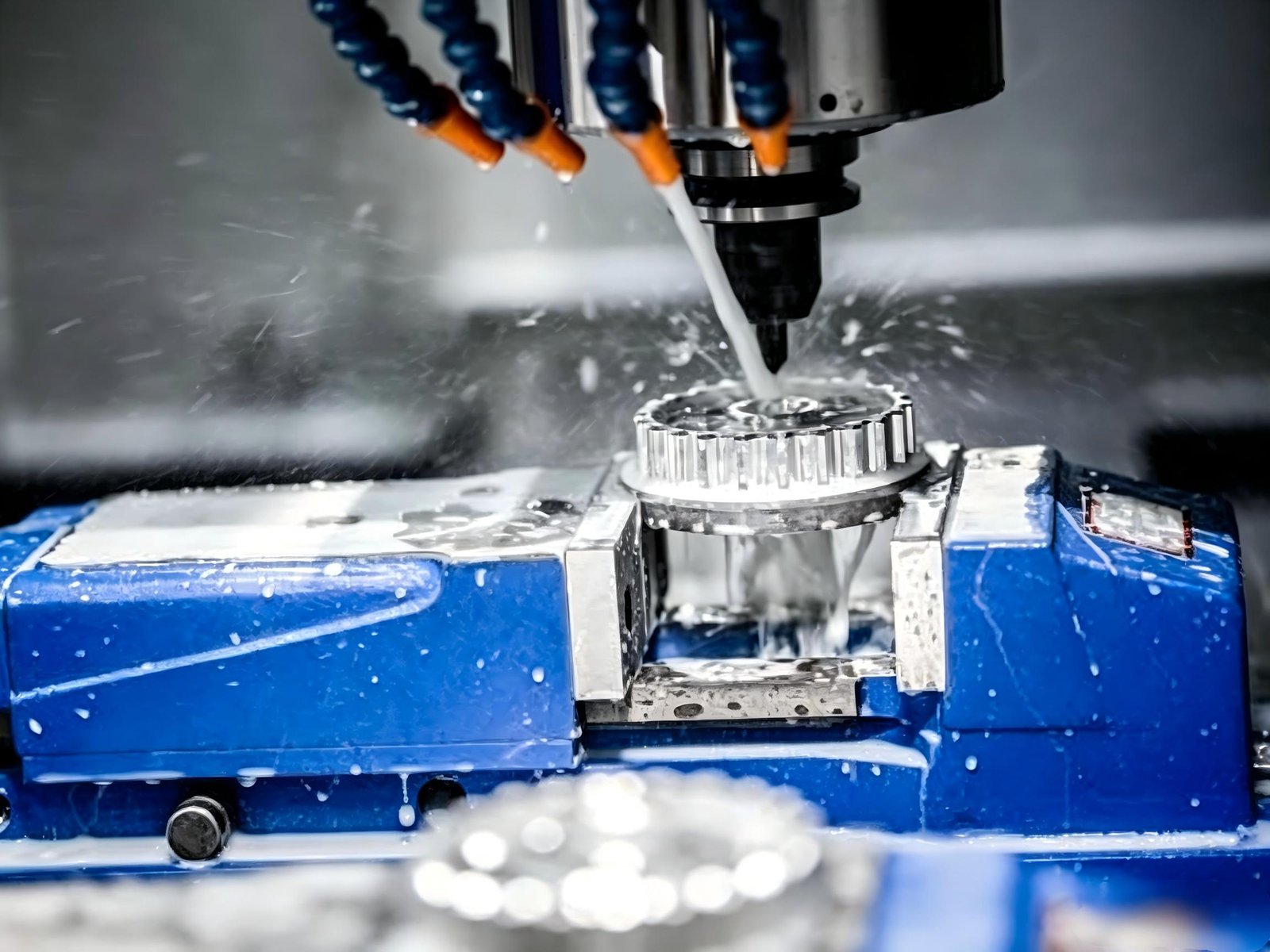
Gear and spline cutters can machine specific tooth or spline profiles, but the cutter geometry must match the required gear or spline specification. The tooth form depends on the module, pressure angle, and tooth count.
Custom Form Cutters
Custom form cutters are ground to your specific profile. They suit recurring or hard-to-reach features that standard cutters cannot produce.
ねじ切り加工, T-slot, keyseat, ダブテール, and chamfer cutters are profile-specific tools, but they are usually treated as separate operations. ねじ切り加工, 例えば, generates the thread through programmed helical motion rather than simply copying a form. 見る thread milling vs tapping for that distinction.
How To Choose A Form Milling Cutter
Choose a form milling cutter based on profile geometry, workpiece material, 許容範囲, 表面仕上げ, 機械の剛性, および生産量.
- Match the cutter profile to the required feature.
- Check whether a standard cutter exists before ordering a custom one.
- Pick HSS or carbide based on the workpiece material and volume.
- Match the coating to the material and cutting conditions.
- Confirm the cutter can hold the required surface finish.
- Confirm the machine has enough rigidity for the cutter diameter and depth of cut.
- Confirm the cutter diameter and depth of cut fit the workholding.
For tooling details, 見る CNCフライス工具.
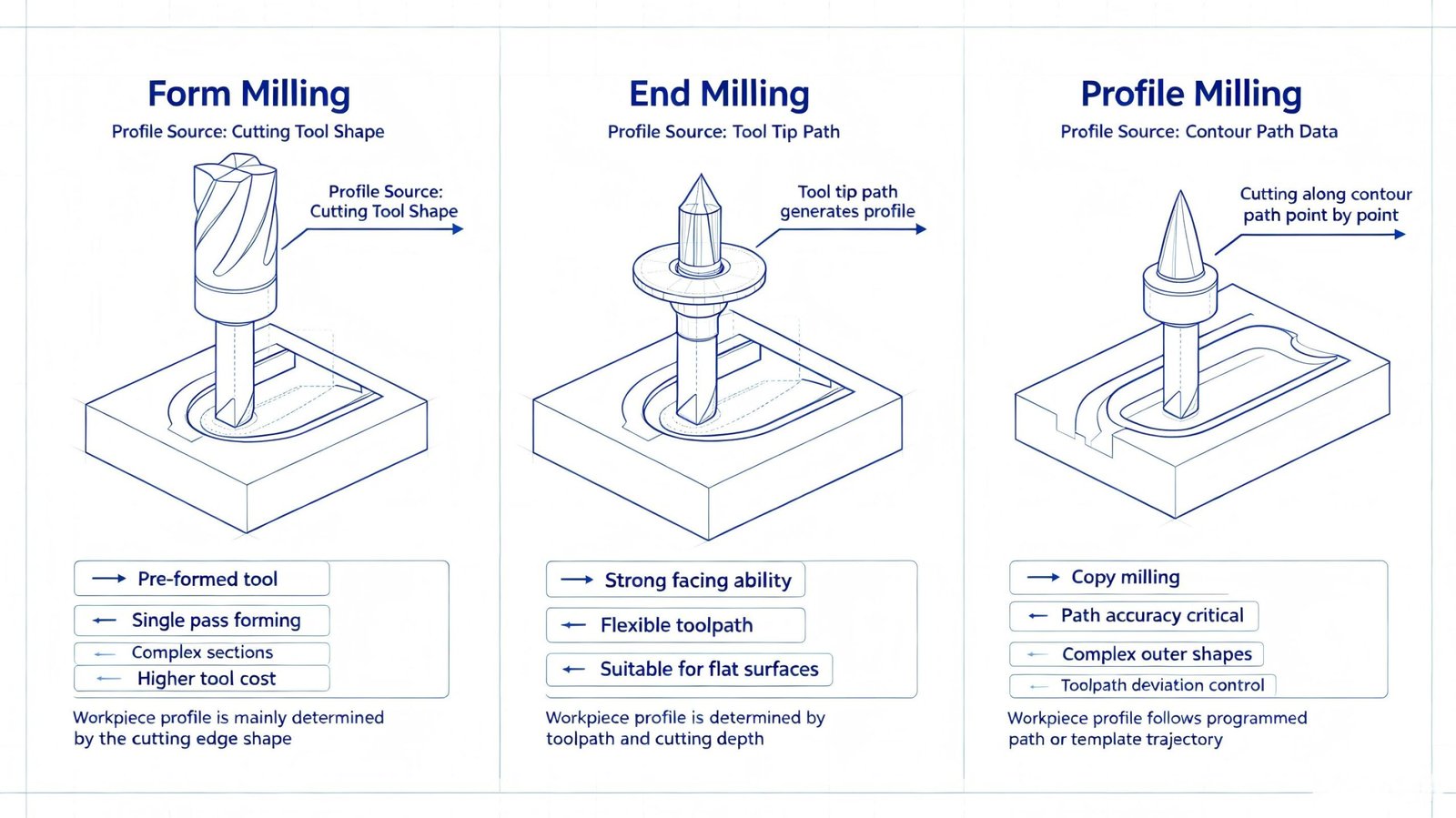
Form Milling Vs End Milling Vs Profile Milling
Form milling uses a dedicated profile cutter. End milling and profile milling build shapes with programmed tool paths.
| 要素 | フォームミリング | エンドミル加工 | プロファイルフライス加工 |
| Profile source | Cutter geometry | Toolpath and cutter | Toolpath and cutter |
| Toolpath dependency | Relies heavily on cutter geometry | Relies on programmed toolpath | Relies on programmed contour |
| 一般的な使用方法 | Repeated special profiles | General material removal and features | 2D and 3D contours |
| 柔軟性 | 低い | 高い | 高い |
| ツーリング | Dedicated profile cutter | Standard cutter | Usually standard cutter |
| プログラミング | 比較的シンプル | 適度 | More involved |
| に最適です | Repeated profiles | General-purpose machining | Changing or complex contours |
Form milling wins when the same profile repeats across parts. Profile milling wins when the contour changes often. 見る end milling そして プロファイルフライス加工 for the alternatives.
What Are The Advantages Of Form Milling?
Form milling cuts complex profiles quickly and repeatably.
- A form cutter can produce a profile in fewer passes than a conventional end mill.
- It gives a consistent profile from part to part.
- It can provide a consistent surface finish when the cutter and cutting conditions are properly selected.
- It needs less programming than 3D surfacing.
- It reaches profiles such as dovetails and keyways that standard mills cannot.
What Are The Limitations Of Form Milling?
Form milling is not always the right choice.
- Custom form cutters cost more and need lead time.
- A dedicated form cutter is optimized for a specific profile and has limited flexibility when the geometry changes.
- Tool wear changes the profile, and resharpening shifts dimensions.
- It is poor for one-off or constantly changing profiles.
- Large forms may need roughing plus finishing.
When Should You Use Form Milling?
Use form milling when you repeat the same profile across parts or need a shape standard mills cannot reach.
- Repeating grooves, 半径, シャンファー, キー溝, ダブテール, 歯車, or splines.
- Features that need high repeatability.
- Profiles such as undercuts that standard end mills cannot produce.
It is particularly attractive when production volume is high enough to justify dedicated tooling.
What Materials Can Be Form Milled?
Form milling works on metals and plastics, but cutter life depends on material hardness.
- Aluminum and brass cut easily.
- Carbide and suitable coatings are often preferred for production machining of steel and alloy steel.
- Stainless steel and titanium can increase cutting forces and tool wear, so cutter material, 幾何学, and cutting parameters require careful selection.
- Plastics machine easily but need care with heat and burrs.
Choose the material early. 見る CNC加工材料.
CNC Form Milling: 3-軸, 4-軸, And 5-Axis
CNC form milling runs on 3-axis, 4-軸, および5軸機.
- 3-axis machines simple profiles and grooves.
- 4-axis machining can index a workpiece around a rotary axis, making it useful for features distributed around shafts and cylindrical components.
- 5-axis reaches angled and complex profiles in fewer setups.
私たちの CNC加工サービス cover 3-axis, 4-軸, そして5軸 CNCフライス加工.
Common Form Milling Problems And Solutions
Most form milling problems come from tool wear, おしゃべり, or wrong cutting conditions.
| 問題 | Likely Cause | Fix |
| Profile drift or wrong size | Tool wear or wrong cutter | 検査します, resharpen, or replace and compensate |
| Chatter or poor finish | Weak setup or wrong speeds | Use rigid workholding and adjust speed and feed |
| バリ | Wrong feed or dull edge | Adjust feed and deburr |
| Short tool life | Overly aggressive cut or poor coolant | Reduce depth and add coolant |
| Undercut or overcut | Runout or misalignment | Check runout and realign the cutter |
| Profile variation between parts | Cutter wear, runout, or inconsistent setup | Monitor tool life and verify runout and setup |
Form Milling DFM Tips
Design the feature for the cutter, not the cutter for the feature.
- Specify the exact profile and tolerance.
- Use standard cutter sizes when the design permits.
- Avoid unnecessarily tight tolerances on non-critical profile features.
- Keep form depth shallow where possible.
- Leave clearance for cutter entry and exit.
- Match the material to cutter life. Hard materials wear profiles faster.
What Affects Form Milling Cost?
Form milling cost depends on the cutter, 材料, feature depth, そしてボリューム.
- Standard cutters cost less. Custom cutters add upfront cost.
- Custom tooling pays off at high volume or for recurring profiles.
- A custom cutter also pays off when it eliminates a slower multi-pass operation.
- For low-volume prototypes, standard end milling may be more economical because it avoids dedicated tooling costs.
- Harder materials raise tool wear and cycle time.
For the full picture, 見る CNC milling cost.
Form Milling Applications
Form milling suits gears, スプライン, 溝, シャンファー, 半径, ダブテール, とキー溝.
| 応用 | Form Feature |
| 歯車 | Gear tooth profile |
| Splined shafts | Spline profile |
| キー溝 | Keyseat profile |
| O-ring grooves | Half-round groove |
| Dovetail slides | Dovetail undercut |
| T-slot tables | T-slot |
| エッジ仕上げ | Chamfer or corner radius |
よくある質問
What is form milling used for?
歯車, スプライン, 溝, シャンファー, 半径, ダブテール, とキー溝.
What is a form cutter?
A milling cutter ground to a profile that generates a matching or complementary shape in the workpiece.
What is the difference between form milling and profile milling?
Form milling uses the cutter profile. Profile milling builds a contour with the side of a standard end mill and a programmed path.
Can form milling cut gears and splines?
はい. Gear tooth and spline form cutters machine those profiles directly, but the cutter geometry must match the gear or spline specification.
Can form milling be used for prototypes?
はい, but a standard end mill may be more economical for one-off prototypes. Form milling pays off when the profile repeats.
Can custom form milling cutters be made?
はい. Custom form cutters can be ground to non-standard profiles when a standard cutter does not meet the drawing requirements. They are useful for recurring production features where tooling cost can be amortized across parts.
Is form milling expensive?
場合によります. Standard cutters are inexpensive. Custom cutters add cost, but volume spreads that cost across parts.
How do you reduce form cutter wear?
Use coatings, correct speeds and feeds, クーラント, and a rigid setup.
Get A Quote For CNC Form Milling
We machine form profiles on 3-axis, 4-軸, and 5-axis CNC milling equipment under an ISO 9001:2015 品質システム.
Send us your drawing, 3Dモデル, 材料, 量, profile dimensions, および公差要件. Our engineers can review the geometry, determine whether standard or custom tooling is more economical, and recommend a machining approach before quotation.


1 「」について考えましたフォームミリング: プロセス, カッター, アプリケーション, と利点”