



Sheet metal grain direction can affect bendability and production consistency. You should specify the rolling direction relative to critical bend lines before approving the cutting layout. Then confirm the material grade, дебелина, радиус, инструментална екипировка, and inspection requirements together. Orientation alone cannot guarantee a crack-free bend.
Define Rolling Direction Relative To The Bend Line
Your drawing should show an identifiable rolling direction and its required relationship to each critical bend line.
В това ръководство, grain direction means the sheet or plate rolling direction. It does not mean an arbitrary arrow along the part’s longest dimension. A cosmetic brushed finish may also have a direction, but that is a separate requirement.
Use explicit terms such as bend line perpendicular to rolling direction. Avoid instructions such as bend across grain without defining the reference. Different teams may interpret that phrase differently.
A bend line is the axis along which the fold forms. Compare that axis with the rolling-direction arrow on the flat blank. Keep the relationship clear when the blank rotates during nesting or handling.
Review Perpendicular And Parallel Orientations Separately
You should check the material producer’s bend guidance for the actual orientation rather than applying one radius to every bend.
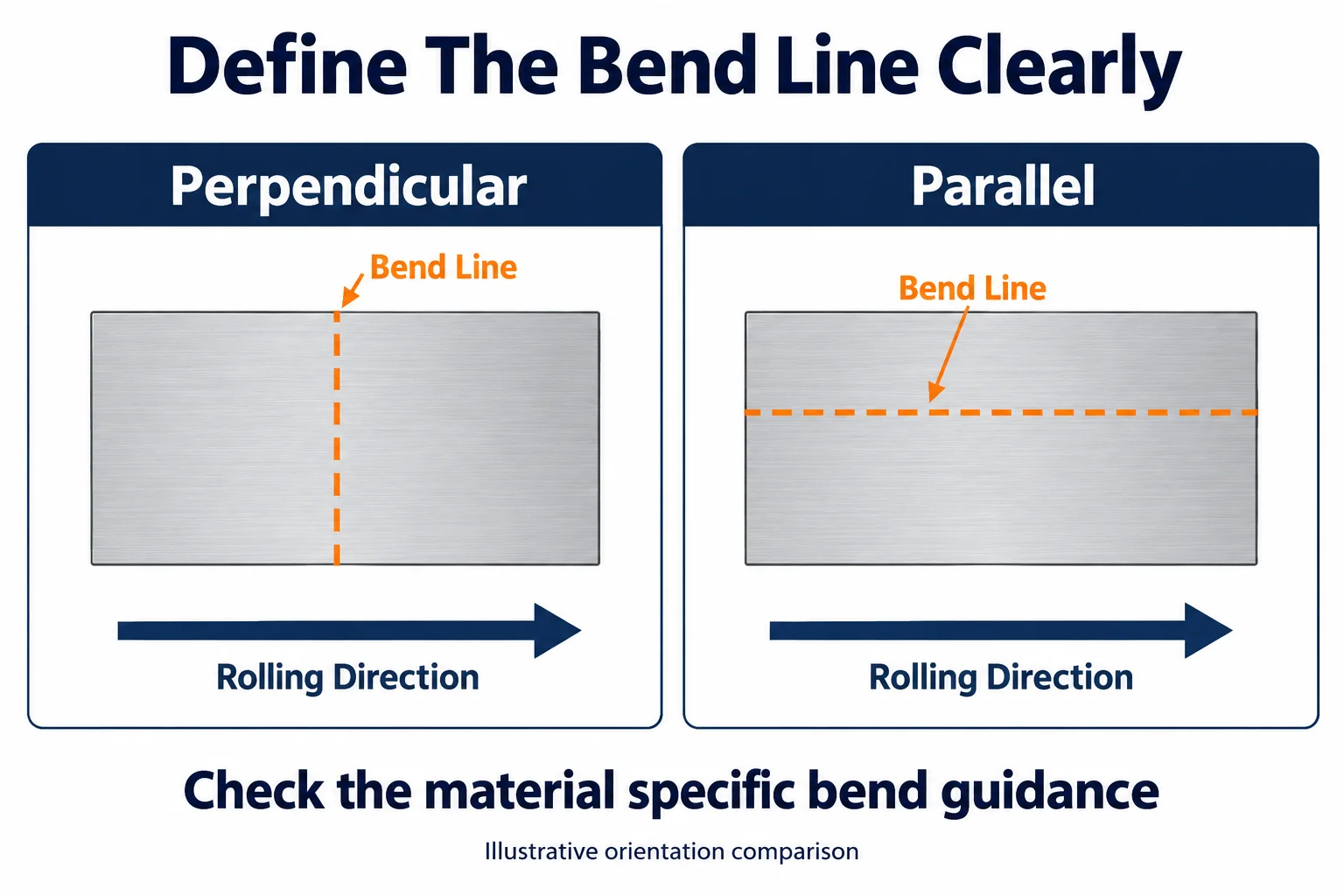
SSAB’s Strenx bending guide recommends a perpendicular bend line where possible for its covered products. It explains that this orientation can permit tighter bending than a parallel bend line.
That recommendation is not a universal rule for every sheet alloy or temper. Use the current material-specific guidance. Confirm which bend axis, диапазон на дебелината, and forming conditions its radius recommendations describe.
For another concrete example, SSAB’s A633 Grade C product data separates bend recommendations by orientation. It covers a particular structural plate product. Do not transfer its numerical limits to thin aluminum or stainless sheet.
| Bend Line Relationship | What You Should Review |
|---|---|
| Perpendicular To Rolling Direction | Material guidance, inside radius, and tooling suitability |
| Parallel To Rolling Direction | Direction-specific bend limits and trial requirements |
| Oblique To Rolling Direction | Producer guidance or representative forming validation |
| Several Bend Directions | The most demanding bend and permitted layout compromises |
Keep Material And Process Conditions In The Specification
Your bend requirement needs the material condition and forming method alongside the orientation.
Specify the alloy or steel grade, temper or delivery condition, дебелина, and required inside radius. Identify the critical finished angle and relevant dimensional tolerances. Require approval before a material substitution changes the reviewed forming conditions.
TRUMPF’s bending process overview distinguishes air bending from bottom bending and other methods. Their tool contact and forming behavior differ. A result obtained with one method does not automatically qualify another setup.
Ask the fabricator to state the proposed method and tooling during review. Do not treat punch radius, finished inside radius, and die opening as interchangeable dimensions. Resolve any difference between the drawing and the proposed process before production.
For aluminum-specific material choices, вижте нашите aluminum bending guide. Use the exact grade and condition when reviewing a particular part.
Resolve Multiple Bend Directions Before Nesting
You should identify which bends control the layout when one blank contains different bend axes.
A tray can have adjacent bends at right angles. One rolling direction cannot be perpendicular to both sets. Simply adding a grain arrow does not resolve that conflict.
Ask the engineer and fabricator to review each critical bend. Possible changes include a larger permitted radius, another approved material condition, or a different part arrangement. Evaluate those changes against strength, годни, външен вид, и производствените нужди.
Do not let a nesting operator decide which functional requirement to relax. Record the accepted orientation and any bend-specific exception in the approved documentation.
Preserve Orientation Through Cutting And Handling
Your production plan should retain the rolling-direction identity from incoming stock through blank preparation.
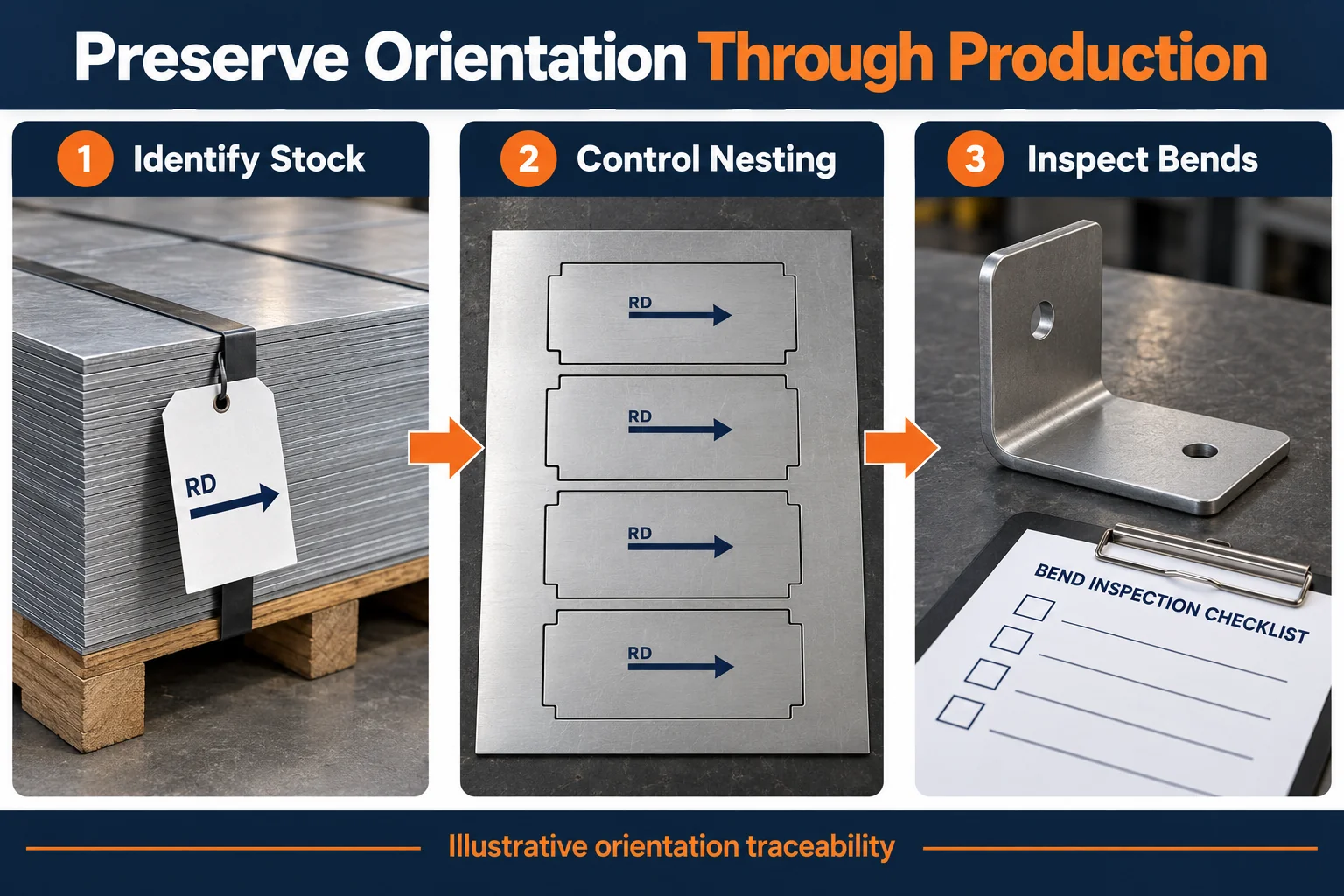
Agree on how the supplier obtains and preserves that identity. Consider supplier markings, stock records, cutting plans, and suitable temporary part identification. Do not rely on visible surface lines as the only evidence.
Restrict blank rotation when rotation would violate an approved orientation. A layout that improves sheet utilization can still produce unsuitable blanks if it ignores that restriction.
Orientation control can reduce nesting flexibility and affect material yield. Ask suppliers to quote the same restriction. В противен случай, apparently similar prices may represent different production assumptions.
For repeat orders, include offcuts in the identification plan. If orientation becomes uncertain, obtain engineering disposition before using that stock for a critical bend.
Investigate Edge Quality Alongside Grain Direction
You should examine edge condition and surface damage when a bend cracks, even when orientation is correct.
SSAB’s edge and surface guidance explains how defects can initiate cracks in its steel products. It also discusses deburring and edge preparation.
Use the relevant material and process instructions when defining your own edge preparation. Check the cut edge, burr condition, драскотини, actual radius, и инструментална екипировка. Changing orientation while leaving another cause untouched may not solve the problem.
SSAB’s bending questions and answers also emphasizes material ductility and product-specific recommendations. These reinforce the need to review the complete forming condition.
Qualify The Bend And Record Acceptance
Your qualification should use representative material and production conditions, with clear inspection and release criteria.
Agree on sample quantity, material traceability, actual orientation, and the intended tooling. Define checks for cracking, finished angle, радиус, and critical flange dimensions. Establish the inspection method and any required magnification before evaluating samples.
A visually acceptable sample does not prove unlimited fatigue life or qualify every future material substitution. Require application-specific testing where the design demands it. Preserve the approved records for repeat production.
| RFQ Or Quality Plan Item | Information To Agree |
|---|---|
| Материал | Степен, състояние, дебелина, и проследяване |
| Ориентация | Rolling arrow and permitted relationship to critical bends |
| Геометрия | Inside radius, finished angle, and functional dimensions |
| Cutting Layout | Rotation restrictions and offcut identification |
| Процес | Forming method, tooling review, and edge preparation |
| Acceptance | Метод на проверка, sample approval, and change triggers |
Review changes in material source, дебелина, инструментална екипировка, and layout before deciding whether requalification is necessary. Base that decision on the application and approved process.
Compare Suppliers Against The Same Orientation Requirement
Your quotation should include the orientation restriction and the work needed to verify the finished bends.
TOPS Прецизни предложения услуги за производство на ламарина. Submit the flat pattern and formed drawing together when available. Ask for review of the critical bends and any proposed exceptions.
Confirm material identification, cutting restrictions, подготовка на ръба, and sample inspection during project review. Avoid assuming that a general fabrication capability guarantees every tight-radius bend.
често задавани въпроси
Your bend orientation should follow material-specific guidance and the function of the finished part.
Is Perpendicular Bending Always Better
It is often reviewed first for demanding bends, but suitability depends on the material and forming conditions. Verify the producer’s guidance.
Can You Identify Rolling Direction From Brushed Lines
Not reliably as a universal method. Keep cosmetic finish direction separate and verify rolling direction through appropriate supplier records.
Can A Tray Have Every Bend Perpendicular To Rolling Direction
Not when the relevant bend axes are perpendicular to each other. Review the controlling bends and approve suitable compromises.
Does Correct Grain Direction Prevent Every Crack
не. Radius, клас, състояние, дебелина, edge defects, surface damage, and tooling can also affect bending performance.
Should A Fabricator Rotate Parts To Improve Nesting
Only within the approved orientation restrictions. Resolve material-yield changes during quoting rather than after cutting begins.
Request A Bend Orientation Review
Send your formed drawing, flat pattern, спецификация на материала, order quantity, and critical bend requirements. Contact our team to review orientation, радиус, and acceptance before production.