

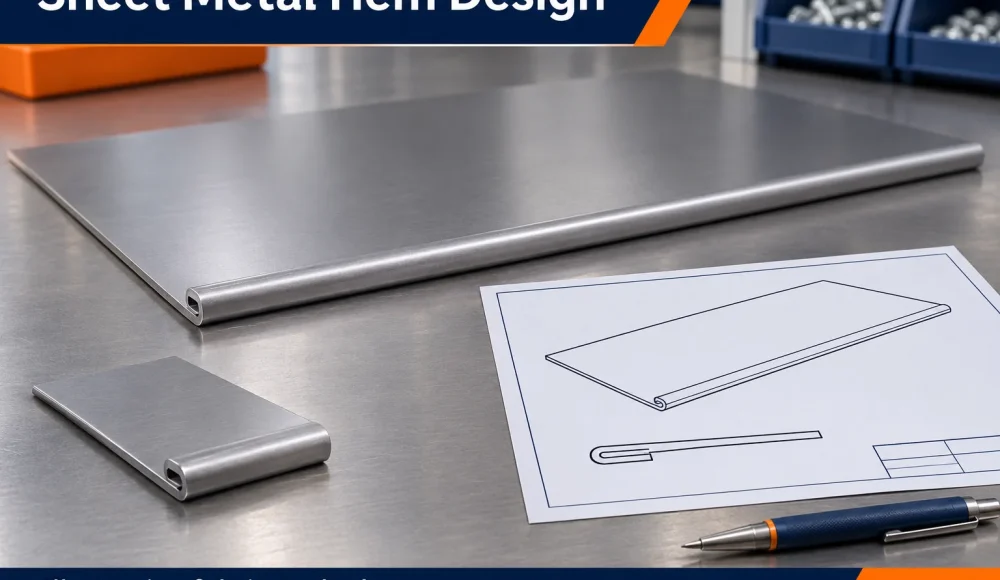
Sheet metal hem design should define the finished edge profile, материално състояние, достъп до инструменти, и критерии за приемане. Folding an edge can improve handling and stiffness, but it adds forming and inspection requirements. Specify the return length, gap, corner treatment, and finish before comparing fabrication quotes.
Define What The Hem Must Do
Your hem should serve a defined edge function rather than appear as an unspecified fold on the drawing.
A hem folds a sheet edge back toward the parent sheet. WILA describes hemming applications for edge protection and local strengthening.
Identify whether you need a protected handling edge, a stiffer panel edge, or a return that engages another component. These functions can require different profiles.
For assembly features, supply the mating geometry and clearance requirements. For handling edges, define acceptable exposure at the ends and corners.
A folded edge does not automatically establish a structural rating or eliminate every accessible sharp feature. Validate the final part against its intended use.
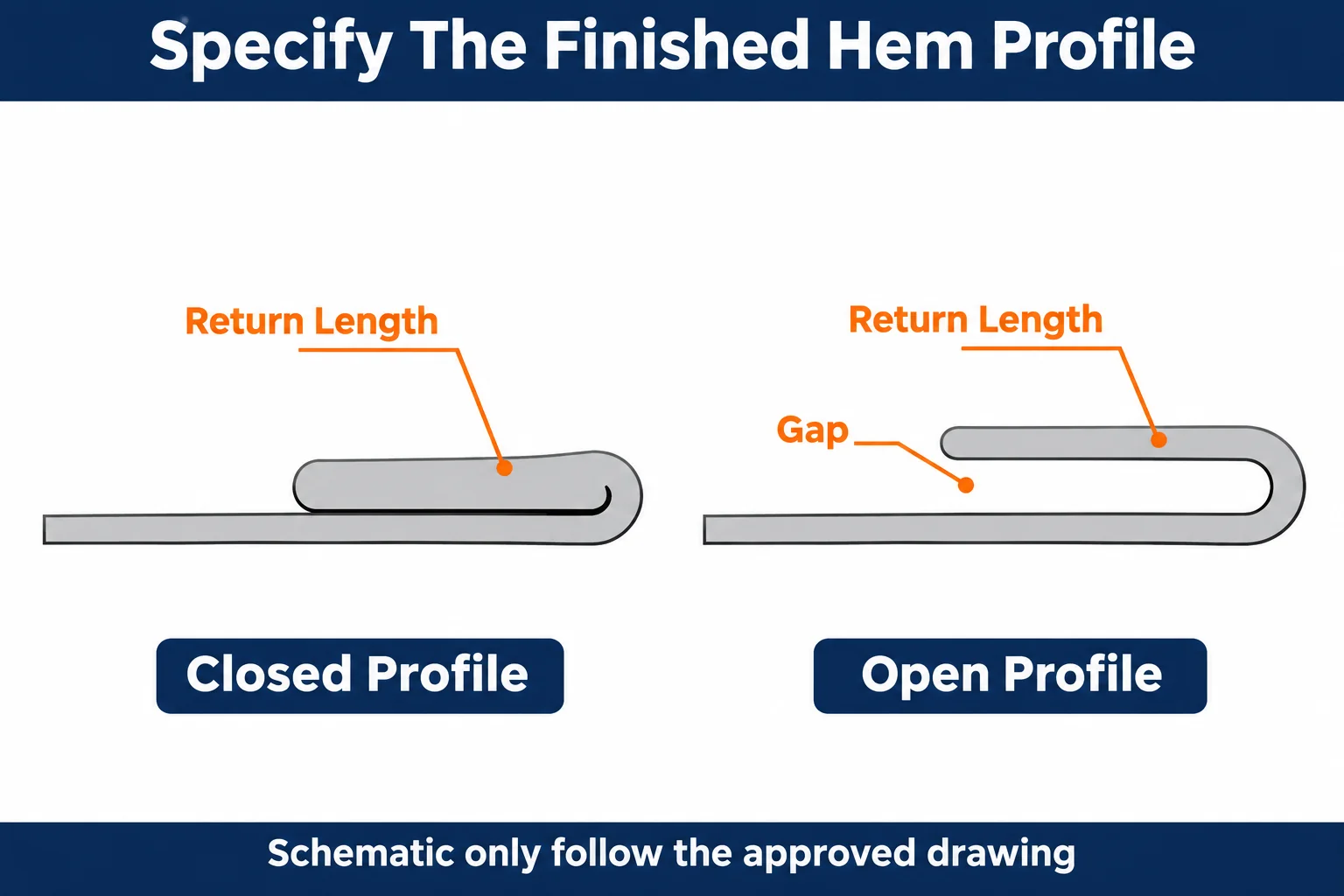
Specify The Finished Hem Profile
Your drawing should show the finished cross section and the dimensions that control its function.
Define whether the returned flange closes against the sheet or retains a specified gap. A label such as hem edge leaves this distinction unresolved.
Show the return length, overall edge envelope, permitted gap, and relevant radius requirements. Identify the reference surfaces used for inspection.
Terminology can differ between tooling suppliers. A section view and acceptance dimensions communicate more reliably than an open or closed label alone.
Do not require a physically sharp, zero-radius fold in the model. Review the achievable nose geometry for the actual material and forming route.
| Design Requirement | Decision To Resolve |
|---|---|
| Return length | Functional length and the reference used to measure it |
| Gap or closure | Allowed separation and where it applies |
| Edge envelope | Space occupied by the formed return and nose |
| Radius condition | Approved profile compatible with material and tooling |
| End and corner treatment | Relief geometry, exposed edges, и разрешение за монтаж |
| Surface acceptance | Permitted marks and the final finish condition |
Review The Material And Cut Edge
Your material specification should identify the alloy or grade, дебелина, and temper or delivery condition before hem feasibility is accepted.
A material that forms an ordinary flange may still require trials for a tightly returned edge. Do not transfer one hem design across material conditions without review.
SSAB edge condition guidance explains how edge defects can initiate cracking during bending. Its recommendations concern SSAB steels and require application review.
Specify the required cut-edge preparation before forming. Resolve burr removal and any rounding without sacrificing drawing dimensions.
Review the rolling direction where it affects material bendability. Нашите sheet metal bend direction guide covers that broader material-layout decision.
For uncertain material and profile combinations, request representative trials. Agree how cracks, splits, and unacceptable local deformation will be evaluated.
Check Tooling Access And Forming Sequence
Your supplier should confirm that the complete part can be pre-bent, затворен, and removed using the proposed tooling.
на ТРЪМП folding and hemming explanation describes a pre-bend followed by a closing operation. The finished profile depends on more than the flat blank alone.
Review nearby flanges, returns, изрези, and hardware for interference during each operation. Final assembly clearance does not establish forming-tool clearance.
Confirm the minimum workable return length with the selected tools. Avoid a universal minimum based only on sheet thickness.
Hemming also requires a force and tooling-capacity review. Do not assume the capacity used for an ordinary air bend covers closing the same length.
Agree which dimensions must be achieved in the finished condition. Let the fabricator develop the flat pattern around the validated forming route.
Resolve Corners And Adjacent Features
Your corner detail should show how the returned edge terminates without interfering with neighboring features.
Review where two hemmed edges approach each other. Show any relief, gap, or overlap as an intentional feature.
Check access to fasteners, дупки, mounting faces, and removable covers after the hem is formed. Include the return’s actual thickness and nose envelope.
Avoid placing an unspecified relief cut at a visible handling corner. Define the permitted exposed edge and required finishing condition.
If a hem retains another part, review the entire assembly sequence. Do not assume the second component can be inserted afterward.
Agree The Finish And Inspection Condition
Your acceptance plan should distinguish geometric conformity, forming damage, and cosmetic requirements.
Tool contact can leave marks during hemming. Approve representative appearance samples when a visible surface is important.
Identify the finish sequence and whether inspection occurs before or after coating. Review protective-film handling rather than assuming the film survives forming intact.
For a coated part, agree how the hem region and enclosed surfaces are addressed. A closed profile should not imply an unverified coating coverage requirement.
Inspect the nose, ends, and reliefs for cracks, splits, and accessible burrs under agreed conditions. Define any visual inspection distance or magnification required.
If the hem serves an assembly function, check it with the mating component or an approved fixture. A gap measurement alone may not demonstrate fit.
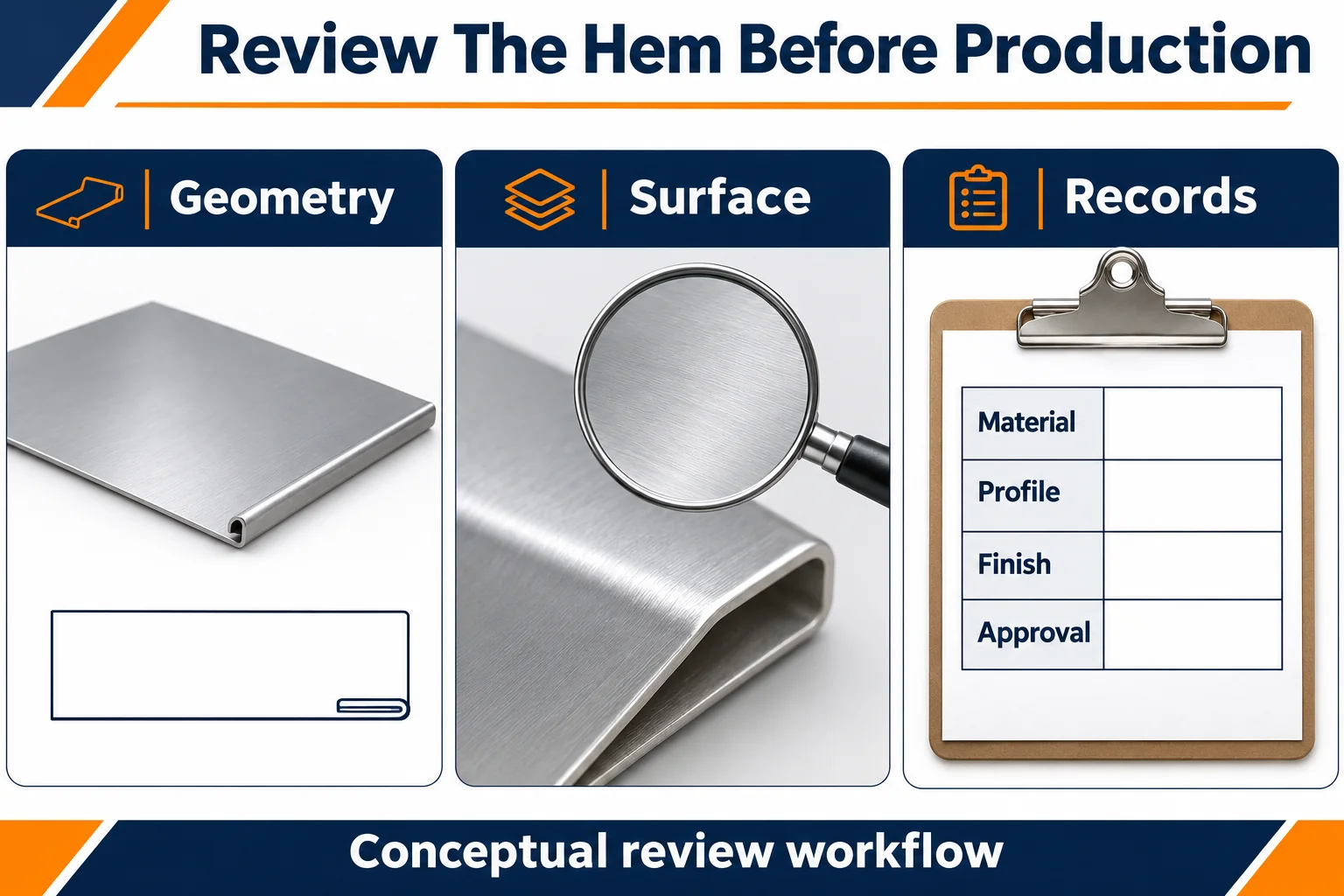
| Елемент за проверка | Evidence To Agree Before Production |
|---|---|
| Finished profile | Section requirements, measurement locations, and dimensional results |
| Edge integrity | Criteria for cracks, splits, Бърс, and end conditions |
| Външен вид | Visible zones, permitted tool marks, and approved sample |
| Assembly function | Mating-part or fixture evaluation where required |
| Условие за доставка | Final finish, чистота, and packaging requirements |
Compare Quotes With The Same Hem Requirements
Your RFQ should include the finished profile and acceptance conditions so suppliers quote the same work.
TOPS предложения услуги за производство на ламарина. Submit the hem details during project review and confirm the proposed material, инструментална екипировка, and inspection arrangements.
Включете чертежа, CAD модел, материално състояние, дебелина, количества, и завършете. Identify visible faces and the critical hem dimensions.
Cost depends on material, hem length, достъп до инструменти, forming stages, surface protection, и проверка. Trials or special tooling can also affect lead time.
If a simpler flange can meet your functional needs, compare that alternative before approving the hem. Retain the hem when its function justifies the added operations.
често задавани въпроси
Your hem drawing should resolve these production questions before parts are ordered.
What Is A Sheet Metal Hem
It is an edge folded back toward the parent sheet. Specify the finished section rather than relying on terminology alone.
Must Every Hem Be Pressed Completely Closed
не. A returned edge may retain an approved gap. Define the required profile and function on the drawing.
Is There One Minimum Hem Length For Every Material
не. Feasibility depends on material, дебелина, инструментална екипировка, and the forming sequence.
Can The Same Hem Be Used For Different Tempers
Не приемайте така. Review the exact material condition and validate the proposed profile where necessary.
Does A Hem Remove The Need To Inspect Burrs
не. Check the nose, return ends, corners, and relief cuts for accessible sharp features and other specified defects.
Can A Hem Be Guaranteed Free Of Tool Marks
Do not assume a mark-free result. Agree the surface requirement and approve representative samples for visible areas.
Should A Supplier Quote From The Flat Pattern Alone
Supply the finished drawing and model too. The required profile, достъп, and acceptance criteria determine the forming work.
What Should Be Included In A Hem Design Review
Send the material condition, дебелина, finished profile, corner details, mating geometry, завършек, количества, и изисквания за проверка.
Request A Sheet Metal Hem Review
Свържете се с нас с твоята рисунка, CAD модел, материал, дебелина, количества, и завършете. Include the hem section, corner details, Критични измерения, and appearance requirements. Agree the forming and acceptance scope before production release.