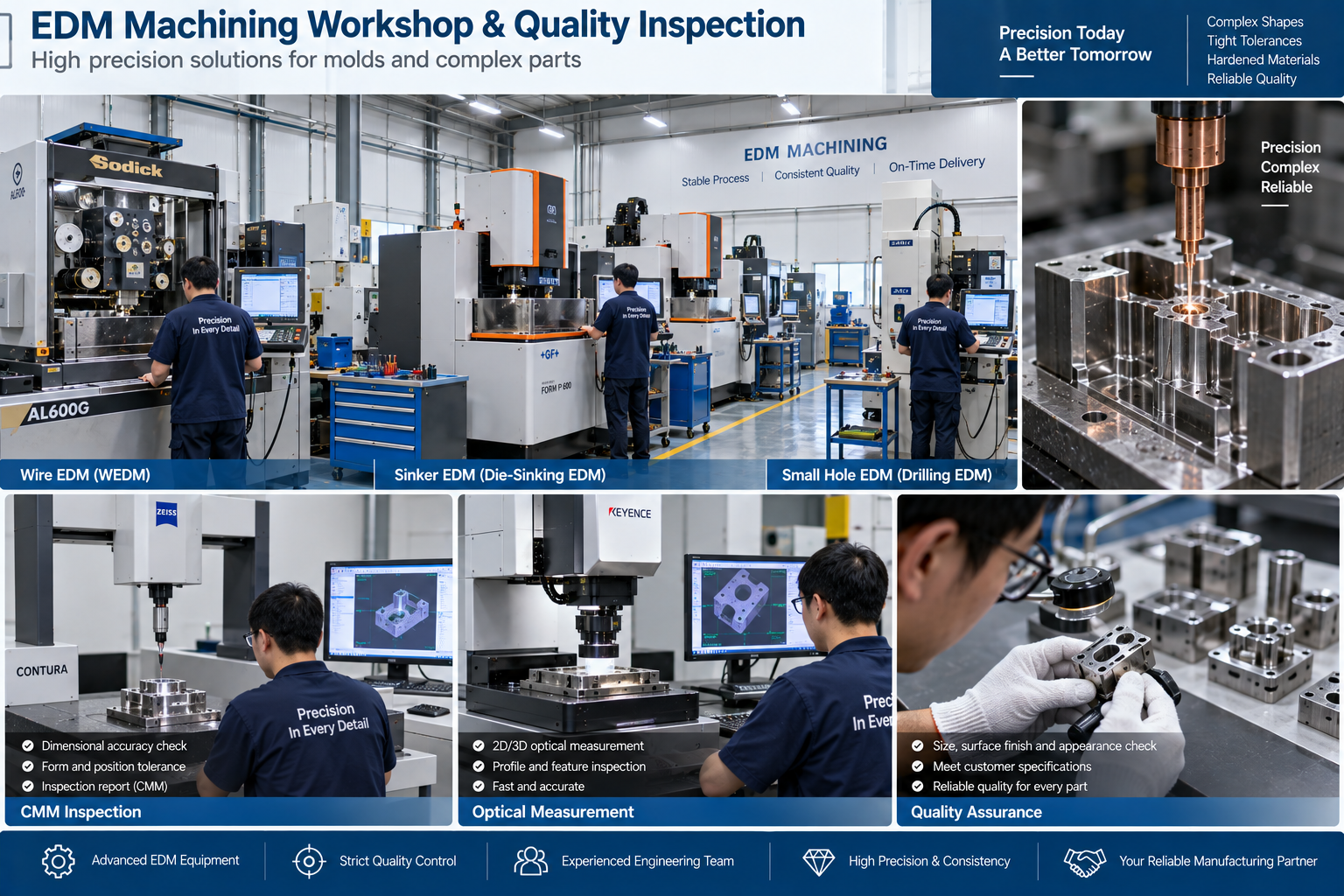



EDM премахва метала с електрически разряди вместо с режещи инструменти. Тази разлика го прави по-добрият избор в седем често срещани ситуации: hardened material, дълбоки кухини, малки вътрешни радиуси, micro holes, тънки стени, тесни допустими отклонения, and unusual low-volume geometry. This guide explains each case and its limits.
Какво е EDM?
EDM, or electrical discharge machining, erodes conductive material with controlled electrical sparks across a spark gap in a dielectric fluid.
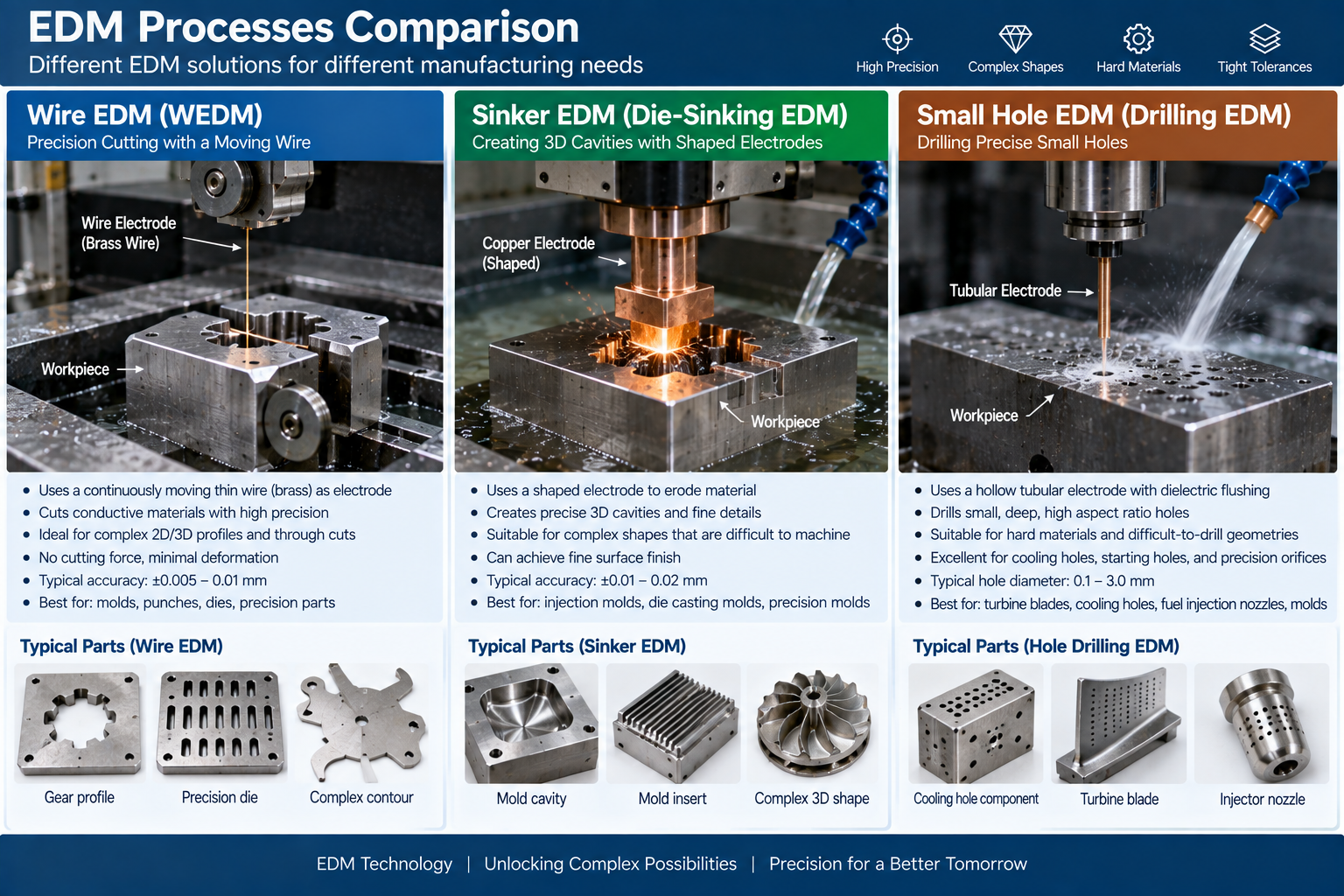
Three common forms cover most work. Wire EDM cuts 2D profiles with a thin wire. Sinker EDM burns a cavity with a shaped electrode. Small-hole EDM produces fine holes, often as start holes for wire EDM. See our guides to what is EDM и sinker EDM vs wire EDM.
Why EDM Differs From Conventional Machining
EDM does not use mechanical cutting force. The electrode or wire never contacts the workpiece.
EDM is still a thermal erosion process. It can leave a thermally affected surface layer, so surface integrity matters for demanding applications.
For accessible geometry and bulk stock removal, milling and turning usually remove material faster. EDM becomes advantageous when hardness, достъп до инструмента, Сила за рязане, or feature geometry limits conventional cutting.
Situation 1: Hardened And Heat-Treated Materials
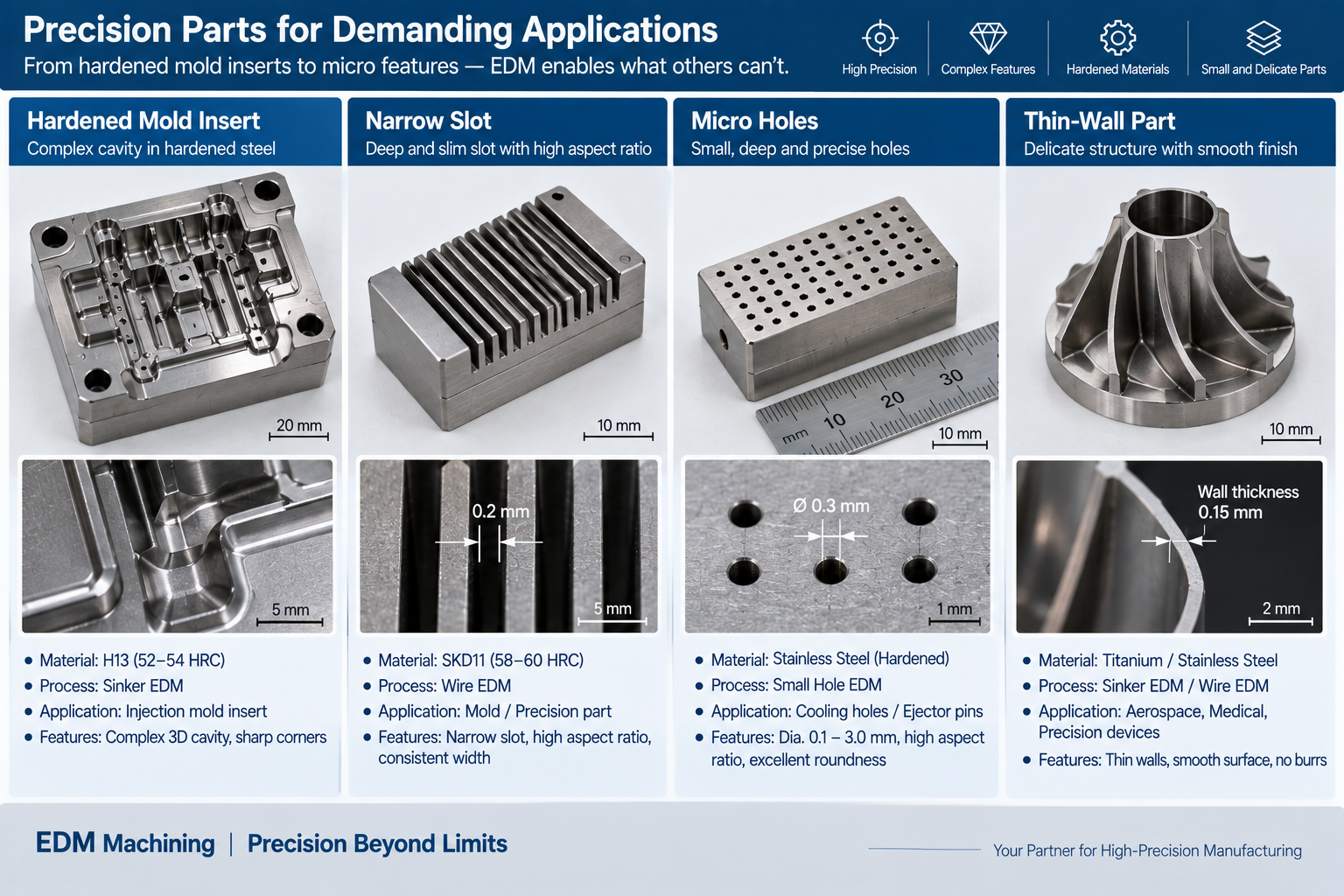
EDM can machine hardened conductive materials without the tool-wear and cutting-force limitations associated with conventional cutting.
Because EDM removes material by electrical discharge, workpiece hardness has much less influence on cutting capability. Hard milling and turning remain practical for many hardened steels. Износване на инструмента, сили на рязане, feature accessibility, and surface requirements can still make EDM more suitable for specific features.
You can heat treat first, then EDM the final features. This reduces the risk that post-machining heat-treatment distortion will move critical geometry out of tolerance. Вижте steel hardening for the heat-treatment side.
Situation 2: Complex Cavities And Deep Narrow Features
EDM reaches deep and narrow features that a rotating cutter struggles to reach.
Deep ribs, тесни слотове, blind cavities, and recessed features can restrict conventional cutter access. A long end mill deflects and chatters in these conditions. Sinker EDM can produce these shapes with an electrode.
Practical depth is still limited by electrode design, flushing, debris evacuation, electrode wear, and discharge stability. Deep ribs, тесни слотове, detailed cavity features, and sharp-cornered pockets can be finished after bulk material is removed by milling. Научете повече в нашето ръководство за types of EDM machining.
Situation 3: Small Internal Radii
EDM can produce much smaller internal radii than conventional end milling.
A rotating end mill cannot produce a zero-radius internal corner. The achievable internal radius is constrained by cutter geometry and tool access. В тел EDM, the minimum internal radius depends on wire diameter, spark gap, machine control, и условия за рязане. В леген EDM, achievable corner sharpness depends on electrode geometry, spark gap, износване, и довършителна стратегия.
This matters for stamping dies, приспособления, and parts that must fit a mating square edge. Вижте undercut machining for related geometry limits.
Situation 4: Micro Holes And Fine Features
Small-hole EDM produces fine features in conductive materials where micro-drilling is difficult.
Small-hole EDM can produce fine, high-aspect-ratio holes where conventional micro-drilling may be difficult because of hardness, tool strength, or depth. Because material removal does not rely on mechanical drilling force, it avoids many of the deflection and breakage limitations of very small drills.
Positional error, electrode wear, flushing, and depth-related deviation still apply. Very deep micro holes are slower and need good debris evacuation. Confirm the limit for your hole size and depth before quoting.
Situation 5: Thin Walls And Delicate Geometry
EDM reduces mechanical deflection when machining thin and delicate features.
Because EDM introduces negligible mechanical cutting force, it can reduce deflection and chatter when machining delicate ribs, narrow webs, delicate profiles, and slender features. Milling pushes against a thin wall, and the wall can deflect or break.
Thin EDM parts can still distort. Residual stress in the stock, thermal effects, clamping, отстраняване на материал, and wire EDM slug movement all affect the result. EDM reduces mechanical deflection rather than guaranteeing shape retention. Вижте бърборене в обработката for the conventional-machining side.
Situation 6: Tight Tolerances And Fine Finish On Hard Materials
EDM achieves tight tolerances and fine surface finishes on hard conductive parts when surface integrity is controlled.
There is no universal EDM tolerance. On suitable parts, precision wire EDM can achieve tolerances around ±0.005 mm. Specialized machines and controlled applications can achieve tighter results. Accuracy depends on machine condition, геометрия, flushing, number of passes, и проверка. Вижте Допустими отклонения при CNC обработка и Тесен толеранс обработка for strategy.
EDM creates a thermally affected surface layer that may include recast or white-layer effects. Skim and finishing passes, plus secondary operations, can reduce or remove this layer. For fatigue-sensitive, уплътняване, инструментална екипировка, космическото пространство, or other surface-critical applications, specify any recast or white-layer limit on the drawing or process specification.
Situation 7: Complex Low-Volume Profiles That Would Require Special Cutting Tools
Wire EDM produces unusual profiles without a form cutter, while sinker EDM economics depend on electrode tooling.
Wire EDM can generate complex through-profiles from a programmed wire path without a form cutter. Sinker EDM reproduces cavity geometry from a shaped electrode, so it may require one or more custom electrodes. Its tooling economics should be evaluated separately.
This applies to prototypes, spare parts, and legacy components where drawings are the only reference. Вижте нашите EDM machining service.
EDM Vs Conventional Machining: Бързо сравнение
| Фактор | EDM | Конвенционална обработка |
| Process principle | Electrical discharge across a spark gap in dielectric | Mechanical cutting edge |
| Сила за рязане | Negligible mechanical cutting force | Depends on operation, инструмент, и материал |
| Материална твърдост | Hardness has relatively little effect on cutting capability | Hardness affects tool selection, износване, скорост на рязане, and process capability |
| Internal corners | Very small internal radii possible | Limited by cutter geometry and tool access |
| Deep narrow features | Possible with flushing and electrode control | Tool deflection and breakage risk |
| Тънки стени | Low mechanical deflection risk | Deflection and chatter risk |
| Stock removal speed | Generally lower material-removal rate | Generally higher for accessible bulk removal |
| Материали | Conductive only | Метали и пластмаси |
| Инструментална екипировка | Wire or electrode | Cutters and inserts |
| Surface integrity | Thermally affected layer possible | Mechanical surface effects |
Where EDM Loses
EDM is not a replacement for milling or turning in every case.
- It only works on conductive materials.
- Material removal rate is low, so bulk stock removal is slow.
- Wire EDM generally needs a threading or start hole, or another wire-access path, for enclosed internal profiles.
- Sinker electrodes wear and may need replacement.
- EDM leaves a thermally affected layer with possible recast or white-layer effects.
- Dielectric fluid and used wire need handling.
- Long burn times, multiple skim passes, electrode manufacture, wire consumption, and setup can make EDM expensive when its geometric advantages are unnecessary.
EDM is generally most valuable for geometry, твърдост, access, and precision rather than high-rate bulk stock removal.
When Conventional Machining Wins
Conventional machining is usually faster and cheaper for accessible geometry.
Choose milling or turning when geometry is accessible, material can be cut efficiently with conventional tooling, and the required tolerances and finish can be achieved economically. Choose conventional machining for large stock removal, non-conductive materials, and high-volume simple parts.
На практика, most parts use both. Milling removes bulk stock, then EDM finishes hardened details. Сравнете CNC фрезоване with EDM when planning the process.
DFM Tips For EDM Parts
Design details decide whether EDM is efficient.
- Specify the material and hardness range.
- Define functional geometry rather than prescribing EDM unless the process itself is required.
- Allow a start hole or wire-access path for enclosed internal profiles.
- Consider spark gap and electrode wear in the electrode design.
- Provide flushing paths for debris evacuation in deep cavities.
- Plan skim cuts where fine finish or tight tolerance is required.
- Ограничете строги толеранси към функционалните характеристики.
- State surface finish and any recast or white-layer limit.
- Include a datum that inspection can reach.
For difficult alloys, виж Inconel machining as an example of why EDM is often paired with conventional cutting.
Фактори на разходите
EDM cost depends on machine time, wire or electrodes, flushing, и толерантност.
- Машинно време: low removal rates make hours a major cost.
- Wire or electrodes: wire EDM continuously consumes wire, while sinker EDM requires shaped electrodes that wear and may need replacement.
- Skim and finishing passes: fine finish and tight tolerance add passes.
- Flushing and setup: deep features need more preparation.
- Tolerance and inspection: tighter limits need more measurement.
- Количество: setup and electrode cost spread across the batch.
A quote depends on geometry, материал, и завършете. Send the drawing for an accurate number.
често задавани въпроси
When should I use EDM instead of milling?
Use EDM for hardened material, малки вътрешни радиуси, deep narrow features, micro holes, тънки стени, and tight tolerances on conductive parts.
Can EDM cut hardened steel?
да. Because EDM removes material by electrical discharge rather than mechanical cutting, hardened steel can be machined with much less sensitivity to workpiece hardness than conventional cutting.
Can EDM cut any material?
не. EDM only works on electrically conductive materials.
Is EDM more accurate than milling?
Not inherently. Both EDM and precision milling can achieve tight tolerances. EDM becomes advantageous when cutter radius, Сила за рязане, твърдост на материала, достъп до инструмента, or feature geometry makes the required result difficult to achieve by milling.
Why is EDM slow?
EDM removes material through many controlled electrical discharges rather than continuous chip formation. Tight tolerances and fine finishes may also require multiple skim or finishing passes, which increases cycle time.
Does EDM leave a heat-affected layer?
да. EDM creates a thermally affected surface layer that may include recast or white-layer effects. Finishing passes and secondary operations can reduce or remove this layer when surface-integrity requirements demand it.
Get A Quote For Your EDM Parts
Send your 2D drawing or 3D model, материал, твърдост, количество, толерантност, повърхностно покритие, and any recast-layer or surface-integrity requirements. Our engineers will review tool access, feature geometry, bulk stock removal, and finishing requirements to determine whether milling, тел EDM, Потънител Edm, small-hole EDM, or a combined process is the most practical route.