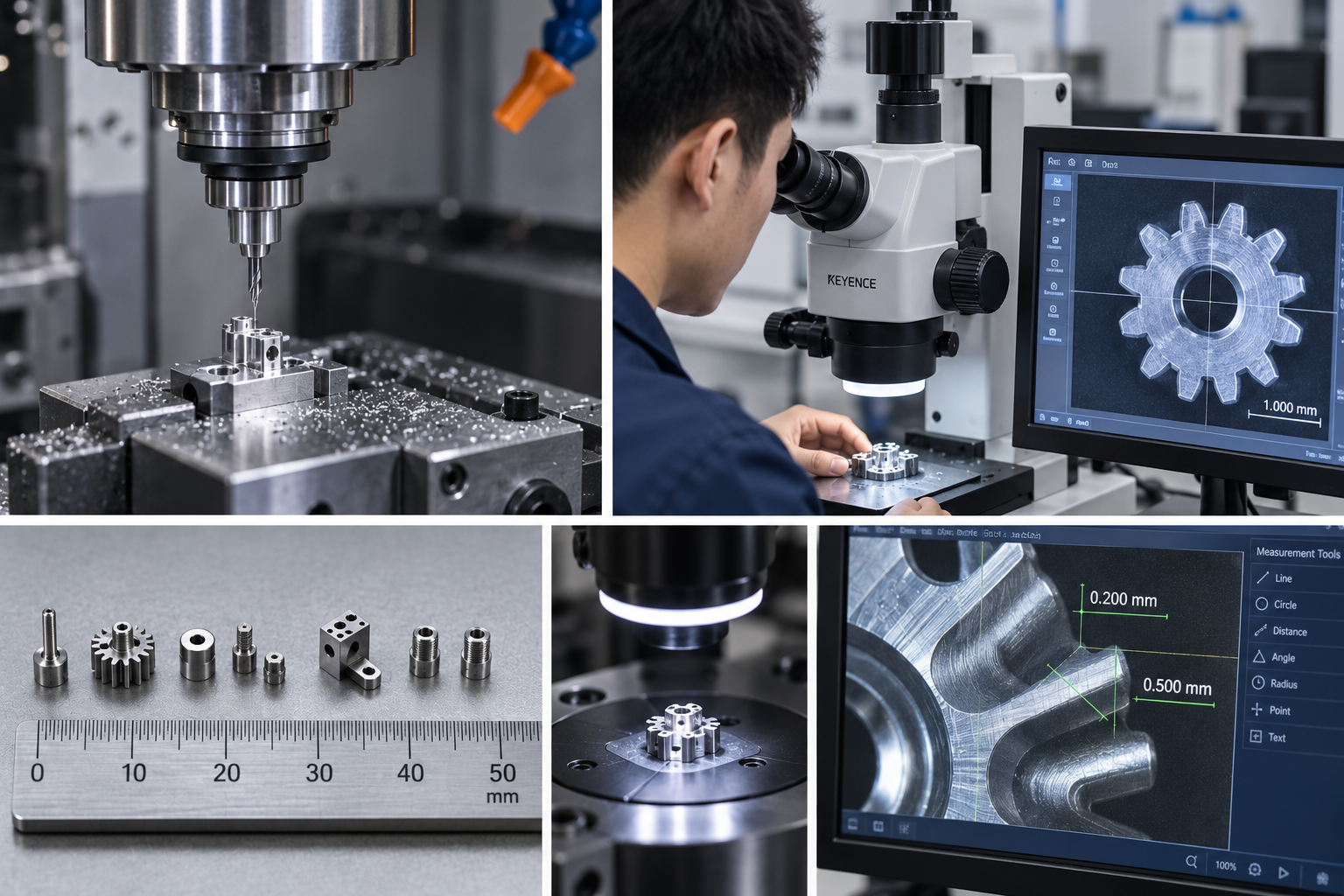



L'usinage miniature produit de très petites pièces de précision avec une précision dimensionnelle fine. Il utilise des processus de découpe réduits sur des composants qui peuvent être plus petits qu'une pièce de monnaie.. Ce guide couvre les méthodes, matériaux, tolérances, candidatures, et règles de conception pour les composants miniatures.
Qu'est-ce que l'usinage miniature?
L'usinage miniature consiste à enlever avec précision de la matière pour produire de petites pièces aux dimensions contrôlées et aux caractéristiques fines..
Il ne s’agit pas simplement de faire fonctionner une machine normale plus rapidement. Taille de l'outil, rigidité de la machine, vibration, éloignement des puces, et l'inspection se comportent tous différemment à petite échelle. Pour de très petites profondeurs de coupe, le rayon de coupe devient important par rapport à l'épaisseur des copeaux. Au lieu de cisailler proprement le matériau, l'outil peut frotter ou labourer, chaleur croissante, fouillis, et les forces de coupe.
Les pièces sont généralement mesurées en millimètres, et certaines caractéristiques de précision sont mesurées en micromètres.
Quelle est la taille des pièces usinées miniatures?
Il n'existe pas de limite dimensionnelle universellement acceptée entre l'usinage de petites pièces, usinage miniature, et micro-usinage. En pratique, L'usinage miniature fait référence à de petits composants ou éléments pour lesquels l'outillage conventionnel, porte-pièce, contrôle des copeaux, et l'inspection devient plus difficile en raison de l'échelle.
| Terme | Signification pratique | Exemple |
| Usinage de petites pièces | Petits composants fabriqués avec un usinage de précision conventionnel | Connecteurs, raccords, boîtiers de capteurs |
| Usinage miniature | Petites pièces ou détails fins nécessitant un outillage et une manipulation spécialisés | Épingles, engrenages miniatures, composants médicaux |
| Micro-usinage | Très petites fonctionnalités nécessitant des outils ou des processus à micro-échelle | Micro-trous, chaînes, micro-broches |
Confirmez la limite pratique avec votre machiniste pour votre fonctionnalité spécifique.
Usinage miniature vs micro-usinage
L'usinage miniature décrit la fabrication de très petites pièces. Le micro-usinage se concentre généralement sur des fonctionnalités extrêmement petites, outils, ou dimensions du processus. Les termes se chevauchent, et il n'y a pas de frontière unique à l'échelle de l'industrie.
| Facteur | Usinage miniature | Micro-usinage |
| Objectif principal | Petits composants | Fonctionnalités extrêmement petites |
| Outillage typique | Petits outils de coupe conventionnels | Micro-fraises en bout, exercices, GED, laser |
| Défi principal | Manutention, rigidité, fouillis | Fragilité des outils, effets d'échelle, inspection |
| Applications typiques | Épingles, raccords, des vis, composants médicaux | Microfluidique, micro-trous, Fonctionnalités liées aux MEMS |
Quelles méthodes sont utilisées pour l'usinage miniature?
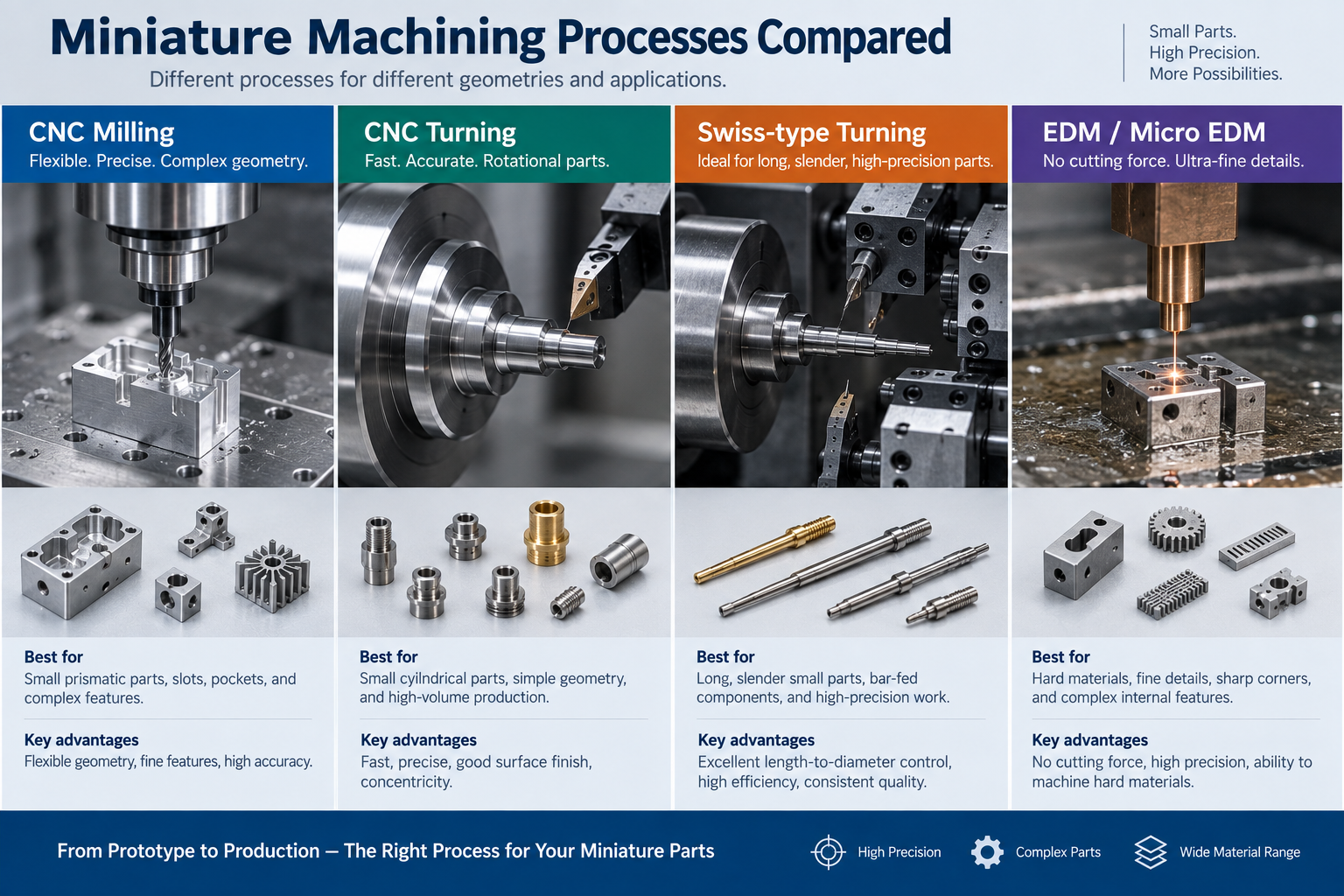
Chaque méthode convient à une forme et à un besoin de production différents.
| Méthode | Mieux pour | Forces | Limites |
| Fraisage CNC | Petites pièces prismatiques, machines à sous, les poches | Géométrie flexible, traits fins | Les petits outils sont fragiles |
| Tournage CNC | Petites pièces cylindriques | Rapide, rond, concentrique | Formes de rotation uniquement |
| Tournage à type suisse | Petites pièces longues et minces | Contrôle rigoureux de la longueur au diamètre | Idéal pour les géométries alimentées en barres |
| Micro-électroérosion / électroérosion à fil | Matériaux durs, détail fin | Aucune force de coupe, petites fonctionnalités | Ralentissez, matériaux conducteurs uniquement |
| Affûtage | Dureté, finition, tolérance stricte | Taille et finition de précision | Géométrie limitée |
Le perçage CNC et le micro-perçage produisent de petits trous pour les passages de fluides, connecteurs, composants médicaux, et assemblages de précision. À mesure que le diamètre du trou diminue, faux-rond de l'outil, rapport hauteur/largeur, évacuation de la puce, et la casse des forets devient plus importante.
Les outils de petit diamètre nécessitent souvent des vitesses de broche élevées pour maintenir une vitesse de surface appropriée. La vitesse seule ne résout pas le problème. Faux-rond de la broche, équilibre, porte-outil, alimentation par dent, et la stabilité de la machine restent essentielles.
Pour petites pièces cylindriques et à vis, voir notre guide sur Usinage de vis CNC en Suisse. Pour les travaux généraux de petites pièces, nous utilisons Fraisage CNC et Tournage CNC.
Fraisage CNC vs tournage suisse pour les pièces miniatures
Utiliser le tournage suisse lorsque la pièce est principalement cylindrique, long par rapport à son diamètre, produit à partir de barres, nécessaire en quantités moyennes ou élevées, ou concentriques et lourds en fil.
Utilisez le fraisage CNC lorsque la pièce a besoin de poches, appartements, trous hors axe, géométrie prismatique, surfaces complexes, ou usinage multiface.
Définir d'abord la géométrie. Cette décision pointe généralement vers un processus.
Quels matériaux sont utilisés pour les pièces miniatures?
Travaux d'usinage miniature sur métaux et plastiques, mais le comportement des matériaux compte davantage à petite échelle.
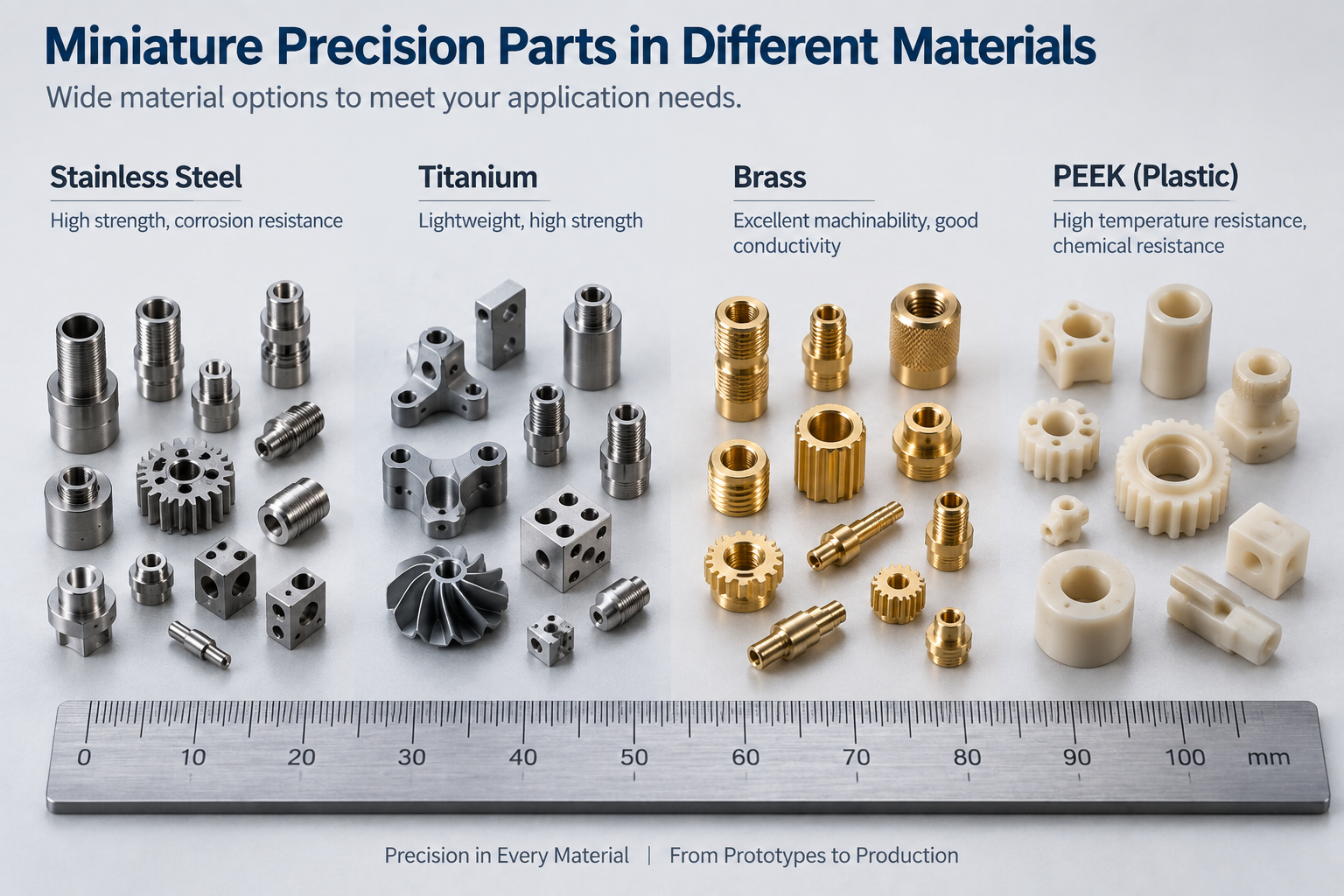
- Acier inoxydable: 303 pour l'usinabilité; 316Atterrir 17-4 PH pour la corrosion et la résistance.
- Alliages de titane: utilisé pour haute résistance, composants médicaux et aérospatiaux légers. Les applications d'implants nécessitent un matériau spécifié de qualité médicale, documentation, et contrôles validés.
- Laiton et cuivre: conducteur et libre d'usinage, bon pour les connecteurs.
- Aluminium: léger et rapide à usiner.
- Plastiques techniques: COUP D'OEIL, Delrin (acétal), et PTFE pour l'isolation, friction, et résistance chimique.
- Alliages spéciaux: peut être usiné là où la résistance, température, corrosion, ou les exigences de la demande justifient la difficulté supplémentaire. Confirmez l'alliage avec notre équipe.
Choisir le matériau par fonction et usinabilité, pas seulement par le coût. Les petites pièces sont sensibles aux défauts de matériaux et aux bavures. Voir Matériaux d'usinage CNC pour les comparaisons.
Quelles tolérances l'usinage miniature peut-il atteindre?
Les pièces miniatures nécessitent souvent des tolérances mesurées en centièmes ou millièmes de millimètre, en fonction de la fonctionnalité et de l'application.
Sur des géométries adaptées, L'usinage CNC de précision peut contenir environ ± 0,01 mm. Les dimensions critiques sélectionnées peuvent atteindre environ ±0,005 mm lorsque la capacité de la machine, matériel, installation, et l'inspection permet. Les tolérances dépendent de la conception, donc précisez-les uniquement sur les surfaces fonctionnelles.
Comment les pièces miniatures sont-elles inspectées?
La stratégie d’inspection change à petite échelle.
- Combinaison de mesure optique et visuelle petite, traits délicats.
- La MMT à stylet fin peut mesurer les dimensions critiques accessibles. La vision ou la mesure optique peuvent être préférables pour les caractéristiques très petites ou délicates.
- Les comparateurs optiques et les microscopes d'outilleur vérifient les bavures et l'état des bords.
- Les testeurs de rugosité de surface vérifient la finition si nécessaire.
Alors que les tolérances se resserrent, l'incertitude de mesure doit rester faible par rapport à la tolérance vérifiée. Sinon, le résultat peut ne pas montrer de manière fiable la conformité.
Comment les pièces miniatures sont-elles maintenues pendant l'usinage?
Le serrage doit sécuriser la pièce sans la déformer ni l'endommager.
- Les pinces de précision conviennent aux pièces rondes.
- Les mâchoires souples et les fixations personnalisées protègent les caractéristiques délicates.
- Les bagues de guidage soutiennent le travail des barres dans les machines suisses.
- Les fixations adhésives ou sacrificielles maintiennent des pièces très fines.
- Les pièces peuvent être usinées à partir d'un stock plus important et séparées à la fin.
La conception du luminaire doit également fournir un accès aux outils et une donnée stable pour l'inspection..
Quels sont les principaux défis de l’usinage miniature?
Les petites pièces amplifient des problèmes faciles à ignorer à grande échelle.
- La déviation et la casse de l'outil augmentent à mesure que la taille de l'outil diminue.
- Le faux-rond de l'outil est plus important: quelques micromètres de faux-rond peuvent devenir importants lorsque le diamètre de la fraise et la charge de copeaux sont très faibles, provoquant une coupe inégale, mauvaise finition, ou casse.
- Les bavures comptent plus: une bavure qui serait insignifiante sur une grande partie peut gêner un trou, face d'étanchéité, contact électrique, ou interface d'assemblage.
- L'évacuation des copeaux est difficile en profondeur, petites fonctionnalités.
- Les vibrations de la machine et la croissance thermique affectent la précision.
- Les pièces sont faciles à perdre, plier, ou dégâts. Emballage en barquette, nettoyage contrôlé, et la séparation partielle peut devenir une partie du processus.
- L'accès à l'inspection est limité aux géométries minuscules.
- Les tolérances doivent rester réalistes pour la taille de la fonction.
Planifiez tôt ces problèmes.
Finition de surface et contrôle des bavures
La finition de surface dépend de la taille de la fraise, matériel, faux-rond de la broche, alimentation, vibration, et état de l'outil.
Les petites caractéristiques peuvent être difficiles à polir ou à ébavurer après l'usinage. Spécifiez le Ra et les critères cosmétiques uniquement là où la fonction l'exige. Définissez les arêtes critiques et les limites de bavures au lieu d'appliquer des exigences d'ébavurage strictes à chaque arête..
Directives de conception d'usinage miniature
Suivez ces règles pour que votre pièce miniature reste réalisable.
- Évitez les murs extrêmement minces où la rigidité est nécessaire. Le mur minimum dépend du matériau et de la taille des éléments.
- Gardez la profondeur du trou raisonnable par rapport au diamètre du trou.
- Évitez les trous extrêmement profonds de petit diamètre où l'évacuation des copeaux devient peu fiable.
- Utilisez le plus grand rayon d'angle interne pratique.
- Évitez les petits rayons internes, sauf si la fonction l'exige.
- Limiter les tolérances strictes aux surfaces fonctionnelles.
- Spécifiez le contrôle des bavures uniquement sur les bords critiques.
- Évitez les poches profondes qui emprisonnent les jetons.
- Ajouter une donnée que l'inspection peut atteindre.
- Spécifiez la qualité du matériau et la finition sur le dessin.
Des conceptions qui simplifient l’accès aux outils, évacuation de la puce, débarquant, et l'inspection sont généralement plus faciles et plus économiques à fabriquer. Pour la stratégie de tolérance, voir notre guide sur Tolérances d'usinage CNC.
Où l'usinage miniature est-il utilisé?
L'usinage miniature prend en charge les industries où la taille, précision, et la fiabilité compte.
- Composants médicaux et de laboratoire: pièces d'instruments, composants de l'appareil, logements, et pièces prototypes.
- Electronique et connectique: bornes, épingles, logements, et micro connecteurs.
- Semi-conducteurs et équipements de test: broches de précision, composants d'alignement, luminaires, et petites pièces mécaniques.
- Aéronautique et défense: petits accessoires, capteurs, et pièces d'actionneur.
- Automobile: capteurs, composants d'injecteur, et petits mécanismes.
- Robotique et automatisation: micro-engrenages, arbres, et outillage.
Chaque application ajoute ses propres exigences en matière de matériaux et de propreté. Indiquez l'utilisation prévue dans votre demande.
Qu'est-ce qui affecte le coût d'usinage miniature?
Une pièce miniature peut utiliser très peu de matière, mais petite taille ne signifie pas automatiquement faible coût.
- Temps machine: les petites pièces peuvent toujours exécuter de longs cycles avec des outils fins.
- Outillage: les micro-outils sont chers et s'usent plus vite.
- Manutention: les petites pièces nécessitent un montage soigné, nettoyage, et emballage.
- Inspection: les tolérances fines nécessitent plus de temps de mesure.
- Risque de rendement: outils fragiles, pièces délicates, et les fonctionnalités exigeantes peuvent augmenter le risque de rebut ou de reprise.
- Quantité: le coût d'installation s'étale sur le lot.
- Matériel: les grades médicaux et spécialisés coûtent plus cher.
Il n’y a pas de prix par pièce fiable sans dessin. Envoyez le modèle et la quantité pour un devis précis.
Quand l’usinage miniature n’est-il pas le meilleur processus?
L'usinage n'est pas toujours la meilleure façon de fabriquer une petite pièce.
| Exigence | Processus probable |
| Métal de précision en faible volume | Usinage CNC ou Suisse |
| Petites pièces tournées à grand volume | Tournage suisse ou automatique |
| Géométrie emboutie à très grand volume | Estampillage |
| Plastique miniature à grand volume | Moulage par micro-injection |
| Caractéristique de matériau dur extrêmement fine | GED |
| Microgéométrie complexe prototype | CNC, GED, ou additif selon caractéristique |
Pour les micropièces en plastique en grand volume, voir notre service de moulage par micro-injection. Comparer Usinage CNC vs moulage par injection au moment de décider.
Questions fréquemment posées
Qu'est-ce que l'usinage miniature?
C'est un enlèvement de matière de précision qui produit de très petites pièces, généralement à l'échelle millimétrique, avec contrôle dimensionnel fin.
Jusqu'où peut aller l'usinage CNC?
Le minimum pratique dépend du processus, diamètre de coupe, rapport hauteur/largeur, matériel, capacité de la machine, et inspection. De très petites fonctionnalités peuvent nécessiter un micro-usinage dédié ou une EDM plutôt qu'une CNC conventionnelle.
Quelle est la différence entre l'usinage miniature et le micro-usinage?
L'usinage miniature se concentre sur les petits composants. Le micro-usinage se concentre sur des fonctionnalités et des outils extrêmement petits. Les termes se chevauchent.
Quels matériaux sont utilisés pour l'usinage miniature?
Acier inoxydable, titane, laiton, cuivre, aluminium, et les plastiques techniques tels que le PEEK, Delrin, et PTFE.
Quelles tolérances l'usinage miniature peut-il contenir?
Sur les fonctionnalités adaptées, ±0,01 mm peut être pratique. Environ ±0,005 mm peut être atteint pour les dimensions sélectionnées. La capacité réelle dépend de la taille, géométrie, matériel, outillage, installation, et inspection.
Le tournage suisse est-il la même chose que l'usinage miniature?
Non. Le tournage suisse est une méthode. Ça va longtemps, mince, pièces alimentées par barres de petit diamètre.
Pourquoi les pièces miniatures sont-elles chères?
Outillage fin, manipulation minutieuse, inspection détaillée, et le risque de rendement ajoute du temps. Le coût dépend de la géométrie, matériel, et la quantité.
Obtenez un devis pour votre composant miniature
Envoyez votre modèle 3D, 2Dessin D, matériel, quantité, et liste des dimensions critiques. Nos ingénieurs examineront la fabricabilité, signaler les caractéristiques de risque, et devis usinage et inspection ensemble.