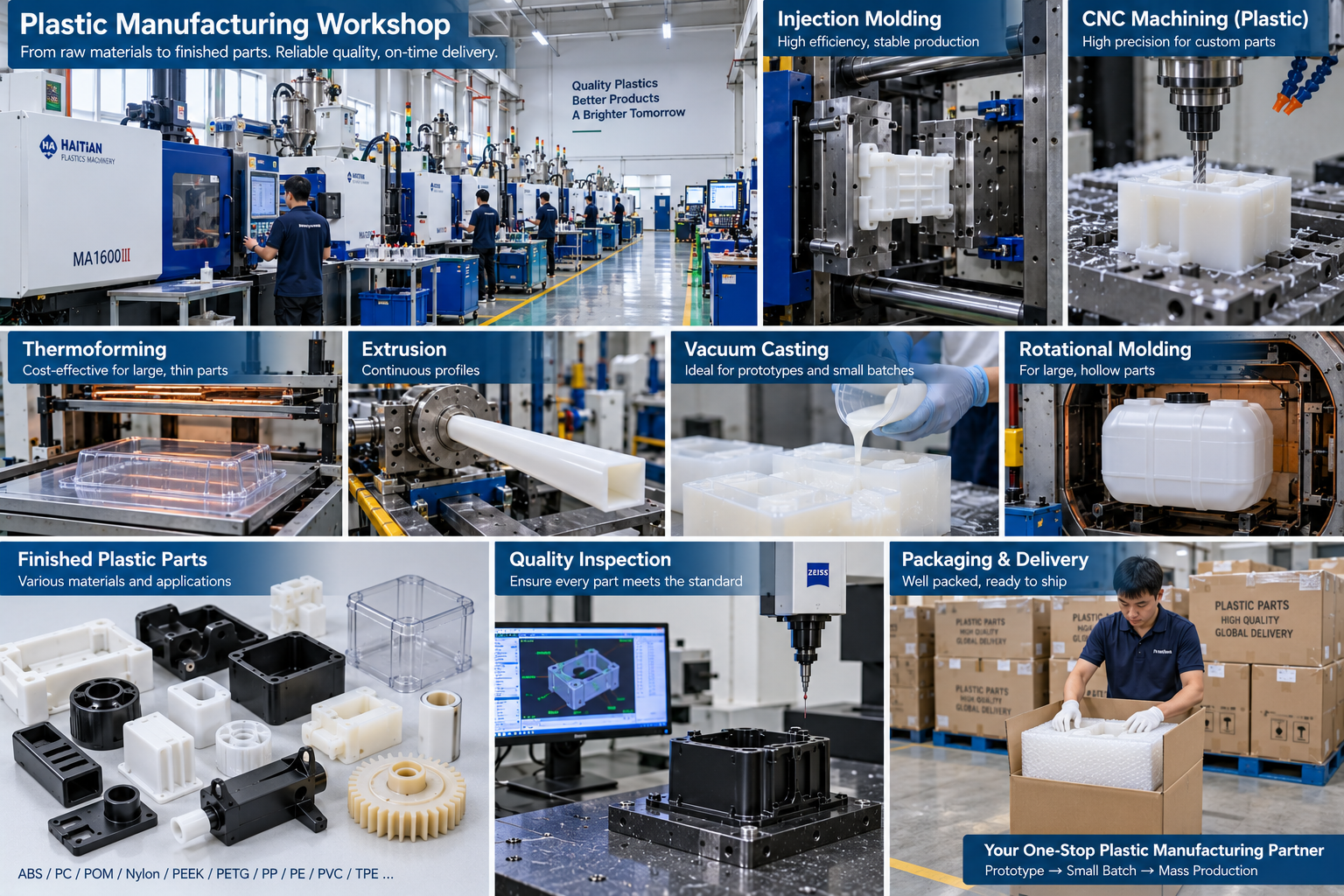



プラスチック加工がプラスチック素材を変える, シート, または樹脂を完成部品に組み込む. Methods range from CNC machining and laser cutting to thermoforming, 押し出し, 溶接, 3D印刷, そして成形. This guide compares the methods, 材料, アプリケーション, と選択基準.
What Is Plastic Fabrication?
Plastic fabrication is the process of shaping, 切断, joining, or forming plastic into a finished component.
Process choice depends on quantity, 幾何学, 許容範囲, 材料, そして表面仕上げ. Some methods remove material. Others form, join, or mold it. The right method balances cost, リードタイム, and part performance.
Thermoplastics Vs Thermosets
Plastics fall into two main classes, and the class limits which fabrication methods work.
Thermoplastics soften when heated and can be remelted. Common examples include ABS, ポリカーボネート, POM, ナイロン, ピーク, PP, and PE. They can often be machined, 溶接された, and thermoformed.
Thermosets cure permanently and do not remelt. Examples include epoxy, phenolic, ポリウレタン, and silicone. They are usually joined with adhesives rather than welded. Machining is possible, but cured thermosets are often more brittle than thermoplastics.
Plastic Fabrication Methods
These method families cover most plastic parts.
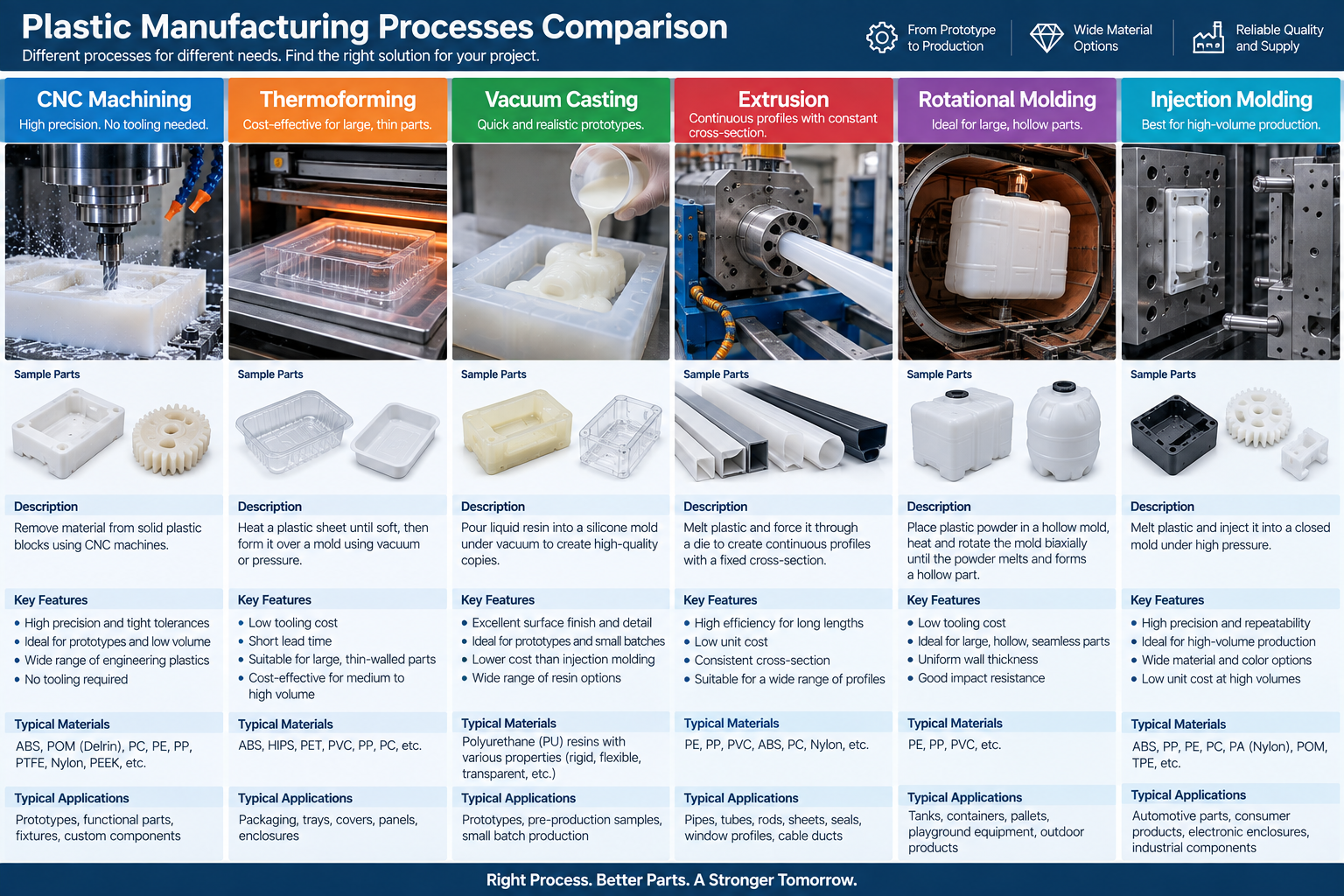
| 方法 | に最適です | ツーリング | Typical Volume |
| CNC加工 | 精密部品, プロトタイプ | Fixtures only | 1 to thousands |
| Laser and waterjet | Flat sheet parts | なし | 1 to thousands |
| 熱成形 | Large thin-wall shells | Form tool | Tens to thousands |
| 真空鋳造 | Low-volume replicas | Silicone mold | Tens to hundreds |
| 押し出し | Continuous profiles | Extrusion die | Hundreds to very high volume |
| Rotational molding | Large hollow parts | 型 | Tens to thousands |
| 3D印刷 | Complex prototypes and low volume | なし | 1 to hundreds |
| 射出成形 | High-volume complex parts | 型 | Thousands to millions |
| ブロー成形 | Hollow bottles and tanks | 型 | Thousands to millions |
| Welding and joining | 組み立てられたアセンブリ | 備品 | 1 to thousands |
CNC 加工プラスチック
CNC machining cuts plastic from solid stock, シート, or extruded shapes.
It gives good dimensional accuracy and suits prototypes, 備品, and low-to-medium volume parts. Common operations include milling, 旋回, 掘削, そしてルーティング. Plastics machine differently from metals. 熱, 切りくずの排出, and stress cracking must be managed.
For tight-tolerance plastic parts, 在庫状況, 残留応力, moisture absorption, 熱膨張, and machining heat can affect final dimensions. Annealing or staged machining may be required for some engineering plastics. See our plastic CNC machining ガイド.
Laser Cutting And Waterjet Cutting
Laser and waterjet cut flat plastic sheet without hard tooling.
Laser cutting can be fast and produce clean edges on compatible plastic sheets, but edge quality, fumes, 溶融, 変色, and fire risk depend strongly on the polymer. PVC releases corrosive and hazardous fumes and should not be laser cut.
Waterjet cutting avoids heat, so it suits thicker sections and heat-sensitive materials. It also avoids a heat-affected edge, but abrasive waterjet can leave a textured cut surface and may require edge finishing.
Thermoforming And Vacuum Forming
Thermoforming heats a plastic sheet and forms it over or into a mold.
Vacuum forming is a common type. Tooling costs less than injection molding, which suits large covers, トレイ, およびエンクロージャ. Because the sheet stretches during forming, wall thickness is not uniform in all areas. Deep draws and sharp geometry increase thinning risk, so draft, 半径, and trim allowance must be planned.
Plastic Extrusion
Extrusion pushes melted plastic through a die to create a continuous profile.
It suits tubes, チャンネル, シート, and continuous cross-sections in materials such as PVC, PP, PE, ABS, and PC. The die sets the cross-section, so design changes need a new die. Extruded profiles are cut to length and often need secondary machining, 掘削, or joining.
真空鋳造
Vacuum casting pours resin into a silicone mold made from a master pattern.
It suits low-volume prototypes, polyurethane replicas, appearance models, and bridge production of roughly tens to hundreds of parts. Silicone molds cost far less than a production mold. The trade-off is limited mold life and resin properties that may differ from the final production material.
回転成形
Rotational molding heats powder inside a rotating hollow mold.
It suits large hollow parts such as tanks, bins, ハウジング, and kayaks. Tooling cost is low compared with injection molding, which makes it useful at low-to-medium volume. サイクルタイムが長い, wall thickness is hard to control precisely, and fine detail is limited.
Plastic Welding And Joining
Welding and joining build larger parts or assemblies from smaller pieces.
Common methods include hot-gas welding, 超音波溶接, 溶剤結合, and adhesives. Not all plastics can be welded or solvent bonded. Polymer chemistry, filler content, surface energy, joint design, and cleanliness determine whether a joining method will work reliably. See our guide to joining plastics.
3D Printing Plastics
3D printing builds plastic parts layer by layer.
FDM, SLA, SLS, and MJF cover prototypes, 複雑な形状, and low volumes. Some processes, such as SLS, mjf, and engineering FDM, can also produce functional end-use components. より厳しい公差の場合, specific material properties, or higher production volumes, CNC machining or molding may be more suitable.
射出成形
Injection molding injects melted plastic into a mold cavity.
It can produce complex, repeatable parts with good dimensional control when the part, 材料, ツーリング, and process are designed appropriately. Resin shrinkage, tool design, 部品サイズ, 壁の厚さ, and process control all affect final tolerance. Mold cost is high, so volume must justify it. See our 射出成形 サービス.
ブロー成形
Blow molding inflates a heated plastic parison or preform inside a mold.
It makes hollow parts such as bottles, コンテナ, and tanks. Extrusion blow, injection blow, and stretch blow molding cover different shapes and volumes. Wall thickness distribution is the main design challenge.
Materials For Plastic Fabrication
Material choice decides strength, 温度, 耐薬品性, そしてコスト.
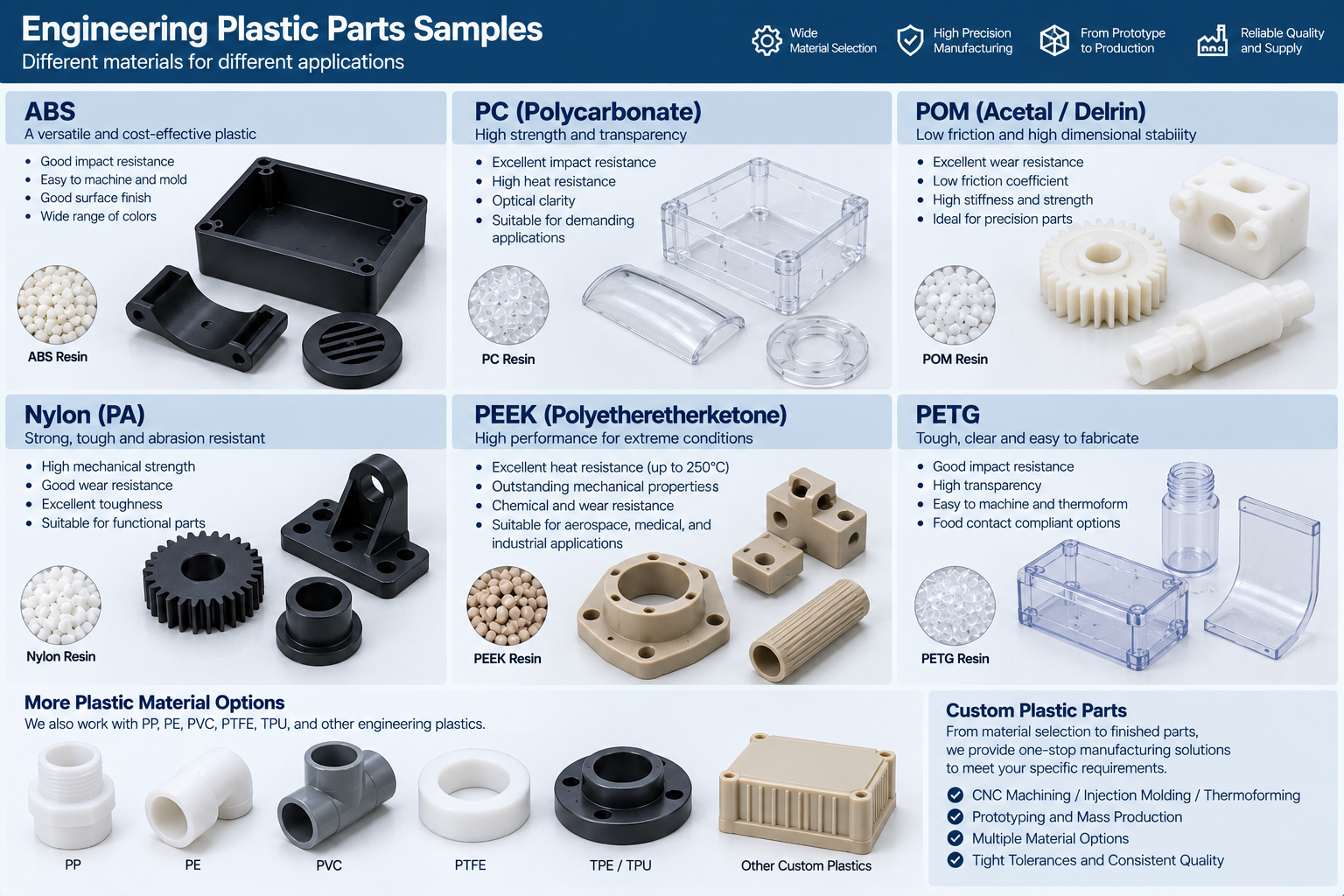
| 材料 | 主要なプロパティ | 典型的な使用 |
| ABS | 厳しい, 低コスト, 機械加工が簡単 | ハウジング, プロトタイプ |
| アクリル (PMMA) | クリア, 硬い, よく磨く | カバー, ディスプレイ |
| ポリカーボネート (パソコン) | 厳しい, 透明 | Guards, impact parts |
| POM / デルリン | 硬い, 低摩擦, 安定した | 歯車, ブッシング |
| ナイロン (PA) | 強い, 耐摩耗性, absorbs moisture | 部品を着用します |
| ピーク | High-performance mechanical, 電気, and aerospace use, with selected medical grades | 高温部品 |
| PTFE | 低摩擦, 耐薬品性 | シール, 絶縁体 |
| HDPE / UHMW-PE | 低摩擦, 耐薬品性 | ライナー, ストリップを着用する |
| PP | 耐薬品性, 厳しい | タンク, ヒンジ |
| ペット / PETG | クリア, thermoformable sheet | 包装, カバー |
| PVC | 耐薬品性, 低コスト | 配管, パネル |
| PPS and PEI | High heat and strength | 電気, 航空宇宙 |
Environmental stress cracking, moisture uptake, and thermal expansion affect performance. Test the material in the real environment when possible.
Applications By Industry
| 業界 | Typical Parts | Common Methods |
| エレクトロニクス | エンクロージャー, 絶縁体, light guides | CNC, レーザー切断, 成形 |
| 医学 | ハウジング, fluidic parts, デバイスコンポーネント | CNC, 成形 |
| 産業機器 | Guards, 備品, 摩耗部品 | CNC, thermoforming |
| 食品加工 | トレイ, カバー, ガイド | 熱成形, CNC |
| 自動車 | Interior panels, ダクト, プロトタイプ | 熱成形, 成形 |
| 化学処理 | タンク, ライナー, 配管 | 溶接, 機械加工 |
For medical and food-contact parts, material grade, トレーサビリティ, クリーニング, biocompatibility or food-contact requirements, and applicable regulatory standards must be evaluated separately.
How To Select A Plastic Fabrication Method
Choose the method by quantity, 幾何学, 許容範囲, 材料, そして終わります.
Prototypes and low volume usually favor CNC machining, 切断, または3D印刷. The break-even point depends on geometry, 材料, tooling cost, サイクル時間, 許容範囲, そして仕上げ. Higher volume favors thermoforming, 押し出し, or molding.
| 要件 | Likely Method |
| One-off precision part | CNC加工 |
| Flat sheet parts | Laser or waterjet cutting |
| Large cover or tray | 熱成形 |
| Continuous profile | 押し出し |
| Large hollow low-to-medium volume part | Rotational molding |
| 10 に 100 appearance prototypes | 真空鋳造 |
| Complex prototype | 3D印刷 |
| Joined assembly | Welding or bonding |
| High-volume complex part | 射出成形 |
| Hollow high-volume part | ブロー成形 |
見る CNC 加工と射出成形 when volume is the deciding factor.
DFM Considerations By Process
Design rules differ by process, so apply the right set.
- CNC加工: avoid unnecessarily thin walls, plan tool access and fixturing, and account for plastic movement and heat.
- 成形: use consistent walls, draft, 半径, and rib or boss design, and allow for shrinkage.
- 熱成形: plan draft, draw depth, wall thinning, and trim allowance.
- Welding and bonding: design joint geometry, overlap, and surface preparation for the chosen method.
- Sheet cutting: avoid sharp internal corners that start cracks.
Account for moisture absorption in hygroscopic materials such as nylon. Consider stress-relief or annealing where dimensional stability or machining-induced stress is critical for suitable engineering plastics. See our guide to plastic part design for manufacturability.
コスト要因
Plastic fabrication cost depends on method, 材料, サイズ, 許容範囲, 仕上げる, と量.
- ツーリング: 成形, rotational molding, and thermoforming need molds or form tools.
- マシンタイム: CNC and cutting time scale with features.
- Material and material utilization: scrap rate affects cost.
- 設定: fixtures and programming add cost at low volume.
- Finishing and secondary machining: 研磨, bonding, and post-molding machining add operations.
- Assembly and packaging: extra steps add cost.
- 検査: tight tolerances need more measurement.
For low-volume work, machining and cutting often reduce or eliminate dedicated hard-tooling cost, although fixtures, プログラミング, and setup still contribute to cost. At very high volumes, 成形, 押し出し, or other dedicated production processes may provide lower unit cost.
When Plastic May Not Be The Best Material
Plastic is not always the right material or method.
- High-temperature or high-load parts may need metal.
- At very high volumes, 成形, 押し出し, or other dedicated production processes may provide lower unit cost than CNC machining or 3D printing.
- Some plastics are hard to bond or weld reliably.
- Tight tolerances in soft plastics are difficult to hold.
- Chemical exposure can rule out otherwise suitable plastics.
If the part must be metal, compare materials before choosing a process.
よくある質問
What is plastic fabrication?
It is the process of cutting, 形にする, joining, or molding plastic into finished parts.
Which plastic fabrication method should I choose?
Choose based on geometry, 材料, 量, 許容範囲, 仕上げる, tooling budget, and lead time. CNC suits precision low-volume parts. Thermoforming suits large thin-wall shells. Extrusion suits continuous profiles. Injection molding suits high-volume complex parts.
Is CNC machining good for plastic parts?
はい. It suits prototypes and low-to-medium volume with good dimensional accuracy.
What plastic is best for machining?
POM / Delrin is one of the easiest engineering plastics to machine dimensionally. The best material depends on strength, 温度, 摩擦, 耐薬品性, 透明性, そしてコスト.
Can laser cutters cut all plastics?
いいえ. PVC should not be laser cut because it releases corrosive and hazardous fumes.
When should I choose injection molding?
When volume is high enough to justify mold cost and repeatable, complex parts are needed.
What is the difference between thermoplastics and thermosets?
Thermoplastics can be remelted and are often weldable. Thermosets cure permanently and are usually joined with adhesives.
Get A Quote For Your Plastic Parts
3Dモデルを送信してください, 2D図, material or service environment, 量, 許容範囲, and finish requirements. Our engineers can review the geometry and recommend the most suitable fabrication process before quotation.