



カスタム CNC 機械加工サービスは、カタログからではなく、お客様の図面と仕様に従って部品を製造します。. ジオメトリを定義するのはあなたです, 材料, 許容範囲, そして終わります. That control matters when standard parts cannot do the job. Here is what custom CNC involves and when to choose it.
What Is A Custom CNC Machining Service?
A custom CNC machining service produces components from your 3D model or 2D drawing.
The supplier programs machine tools for your geometry. Nothing is selected from a stock catalog. Custom work suits parts with a unique shape, a specific material, or tolerances and finishes that must match your application.
When Do You Need Custom CNC Machining?
You need custom CNC when a standard component cannot meet your geometry, 材料, 許容範囲, または終了します.
- The geometry does not exist as a standard part.
- The material must match the application and environment.
- Critical dimensions need tolerance control.
- You need a prototype before production.
- The design is still changing.
- You need material certificates or inspection reports.
A standard part is usually cheaper when it already meets the requirement. Custom is the better fit when geometry, 材料, 公差, interfaces, or finishing requirements cannot be met by a standard component.
How Does Custom CNC Machining Work?
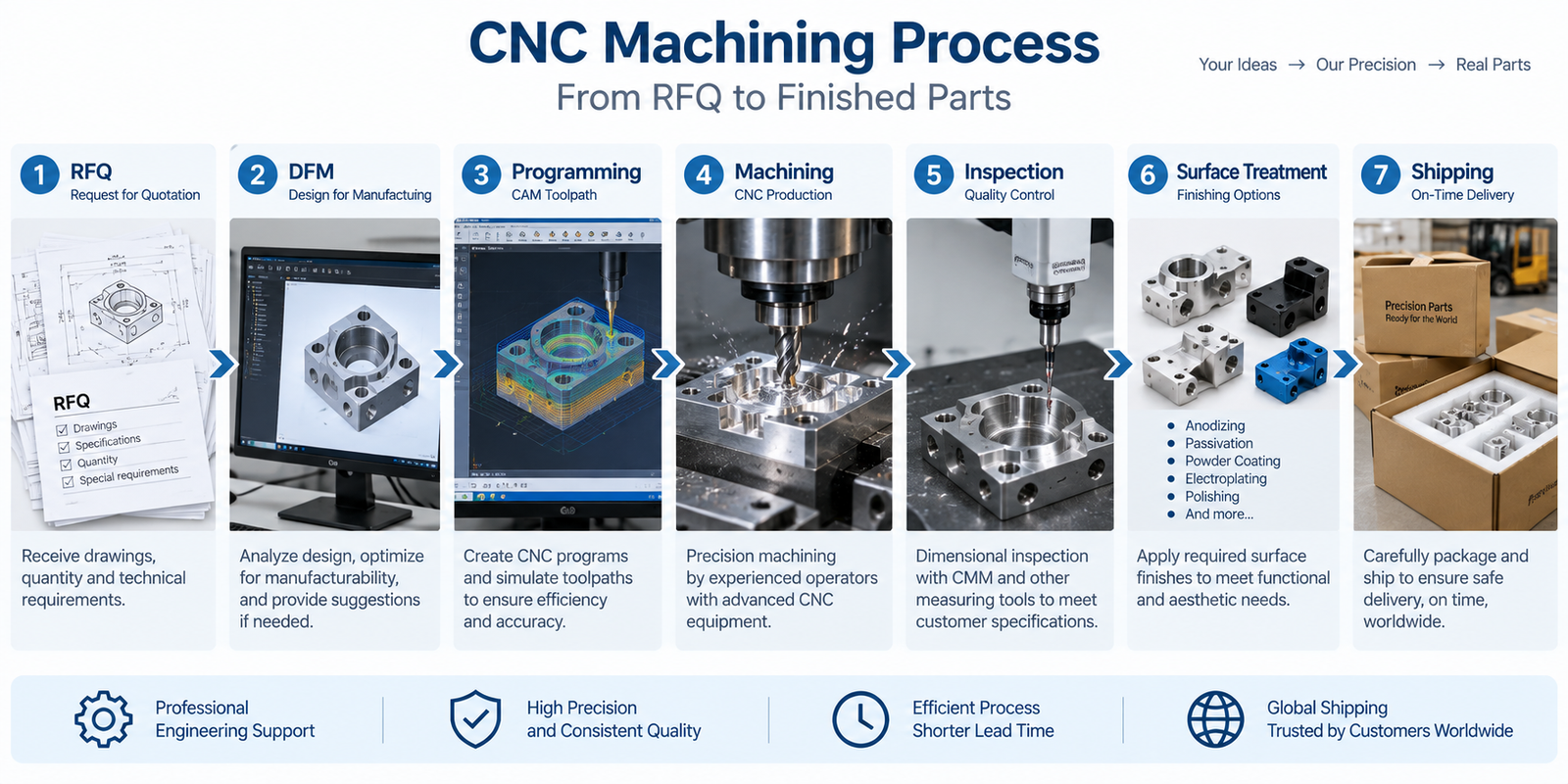
Custom CNC work follows a defined workflow from file review to shipped part.
- RFQ and file review. You send the CAD model, 描画, 材料, 量, 仕上げる, and inspection needs.
- DFM review. Engineering checks tolerances, ツールアクセス, 半径, 穴の深さ, 薄い壁, and workholding.
- Process planning. The supplier selects milling, 旋回, 放電加工, 研削, or a combination.
- Programming and setup. CAM toolpaths, カッター, 備品, and inspection strategy are prepared.
- 機械加工. Parts are machined to the approved process.
- 検査. Critical dimensions and GD&T requirements are verified.
- Finishing and documentation. 陽極酸化処理, メッキ, 危険性, or polishing are applied as specified.
- Final inspection and shipment.
What Are The Benefits Of Custom CNC Machining?
The main benefit is control over geometry, 材料, 許容範囲, 仕上げる, とドキュメント.
- Parts fit your drawing, including holes, スレッド, and mating faces.
- Materials can be matched to strength, 腐食, 温度, and weight needs.
- Tolerances are set by the drawing and confirmed during review.
- Prototypes and production can come from the same supplier.
- Design revisions avoid the cost and lead time of hard tooling.
- Finishing and documentation are managed in one workflow.
Custom CNC Machining Vs Standard Parts
| 要素 | Standard Parts | カスタムCNC加工 |
| Fit to drawing | Limited to catalog | Manufactured to agreed drawing specifications |
| Material range | Fixed catalog | Broad range of metals and plastics |
| 許容範囲 | Catalog-dependent | Specified by drawing and confirmed during manufacturing review |
| デザインの変更 | Not applicable | Often faster without hard tooling |
| 量 | Bulk oriented | From one piece to production |
| 仕上げ | 限定 | Integrated with machining |
| ドキュメンテーション | 限定 | Certificates and reports where required |
What Parts Can Custom CNC Machining Produce?
Custom CNC covers a wide range of mechanical components.
- Housings and enclosures
- Brackets and mounting plates
- シャフト, ブッシング, そして多様体
- Fixtures and tooling
- Connectors and gears
- 精密機械部品
- Replacement and legacy parts
- プロトタイプ
One example shows the range. An aluminum electronics housing may need 6061-T6, ±0.02 mm on connector locations, tapped holes, ビーズブラスト, black anodizing, and a dimensional inspection report. A custom CNC supplier can machine and manage these as one controlled project.
What CNC Machining Processes Are Available?
フライス加工, 旋回, スイスマシニング, 放電加工, and grinding cover most custom parts.
- フライス加工: 3-軸, 4-軸, and 5-axis for prismatic geometry.
- 旋回: シャフト, ブッシング, and cylindrical parts.
- スイスマシニング: 長さ, 細い, 小径部品.
- 放電加工: hardened materials and fine detail.
- 研削: tight size and finish control.
See our CNC加工サービス page for machine capabilities.
What Materials And Finishes Can Be Used?
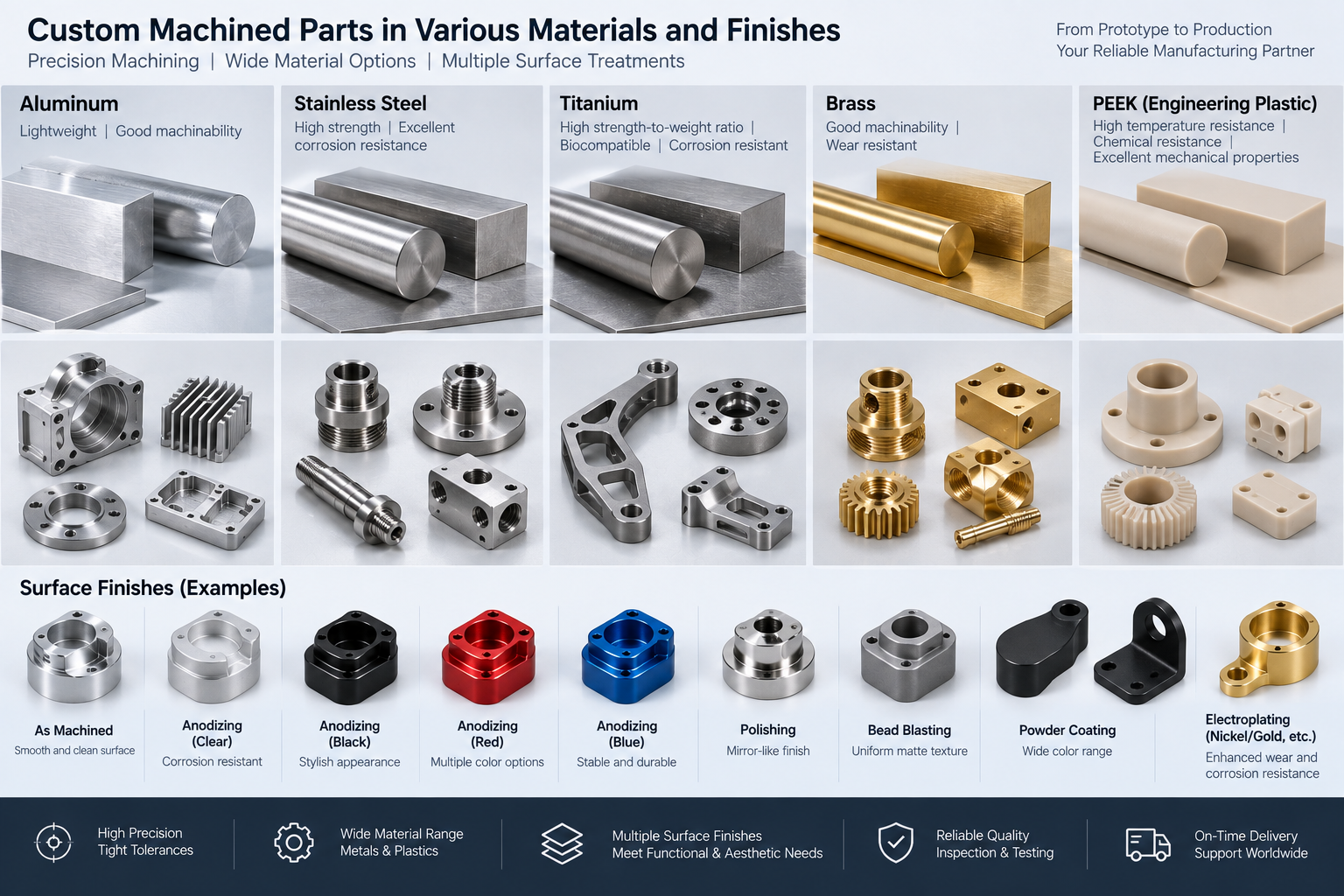
Materials range from aluminum to engineering plastics, and finishes from anodizing to polishing.
- 金属: アルミニウム, ステンレス鋼, 鋼鉄, チタン, 真鍮, と銅.
- プラスチック: ピーク, デルリン, ナイロン, and other engineering grades.
- 仕上げ: 陽極酸化処理, メッキ, 危険性, 粉体塗装, 爆破, そして磨きます.
Compare options in our CNC加工材料 guide and CNC加工用の表面仕上げ.
How Do Tolerances Affect Custom CNC Machining?
Tighter tolerances add cost and risk, so apply them only where function requires them.
Tight tolerances may need more rigid setups, additional operations, slower finishing cuts, 温度制御, specialized tooling, CMM検査, and a higher scrap risk. Apply tight tolerances only to dimensions that affect fit, 関数, シーリング, アライメント, またはパフォーマンス.
For critical parts, provide a 2D drawing with GD&T callouts for position, 平坦さ, perpendicularity, 同心, プロフィール, or other requirements that the 3D model alone cannot fully communicate. 見る CNC加工公差 for strategy.
Why Is DFM Important?
A DFM review finds features that raise cost or risk before cutting starts.
A useful review should identify unnecessarily tight tolerances, deep narrow pockets, small internal corner radii, 薄い壁, deep holes, difficult tool access, and surfaces that are hard to inspect. Resolving these points in review is cheaper than discovering them on a machined part.
Custom CNC Machining For Prototypes And Production
Custom CNC scales from one prototype into repeat production.
Once a prototype is approved, the supplier may optimize fixtures, ツーリング, サイクル時間, and inspection for higher quantities while maintaining the approved design requirements. Because CNC usually does not require dedicated hard tooling, design revisions are often faster and less costly than changes to molded or die-cast tooling.
CNC suits prototypes, bridge production, 少量から中量, and some high-volume components. At very high volumes, 鋳造, 成形, or stamping may offer lower unit cost depending on the part. 比較する CNC 加工と射出成形 when volume grows.
What Affects The Cost Of A Custom CNC Part?
Cost depends on material, 幾何学, プロセス, 許容範囲, 仕上げる, 検査, と量.
- Material and raw-stock size
- Geometry and machine type
- セットアップ数
- Tolerance and surface finish
- Tooling and inspection
- 後処理
- 量
A small part is not necessarily cheap if it needs complex setups, 厳しい許容範囲, expensive material, or extensive inspection.
How Is Quality Controlled?
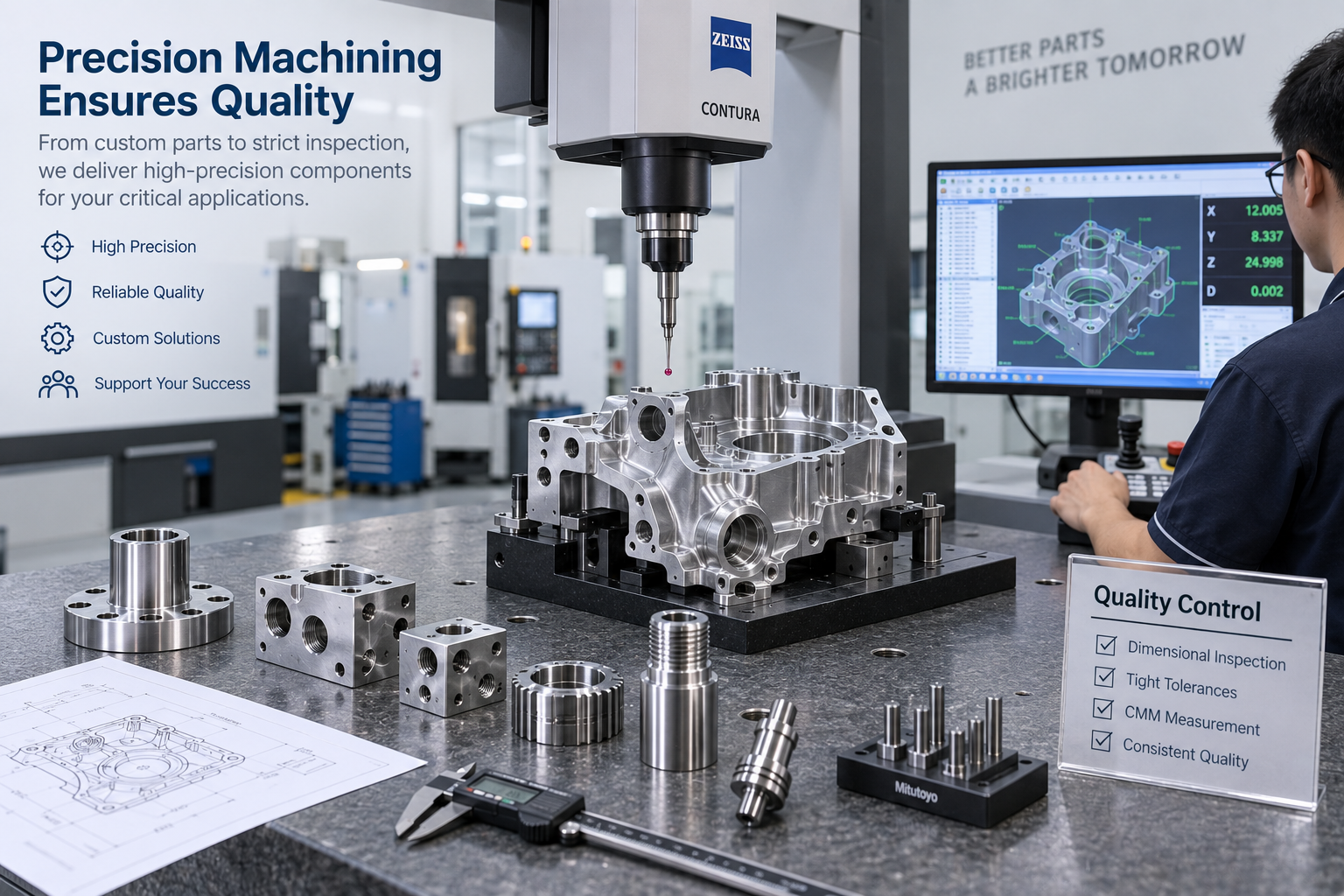
Quality planning begins before cutting. The drawing determines which dimensions, GD&T features, surface requirements, and material conditions must be verified.
- Incoming material verification
- First-piece inspection
- 工程内検査
- Final dimensional inspection
- Surface and finish verification
- Documentation where required
How To Choose A Custom CNC Machining Supplier
Qualify a supplier on capability, 検査, トレーサビリティ, and control processes.
- Confirm the machine types, axis counts, and materials you need.
- Ask about inspection equipment such as CMM, optical measurement, height gauges, roughness testing, and thread gauges.
- Ask about traceability: マテリアル証明書, certificate of conformance, ファイ, and inspection reports.
- If finishing is outsourced, ask how outside processors are qualified and controlled.
- For repeat production, ask how drawing revisions are controlled so old revisions do not enter production.
- Ask what happens if a part fails inspection.
- Confirm certifications only if the supplier actually holds them.
What Should You Send For A CNC Quote?
A complete RFQ produces a faster, more accurate quote.
- 3Dモデル: STEP is commonly preferred for geometry.
- 2D図: include critical dimensions, 公差, GD&T, スレッド, and finish notes.
- 材料: specify the alloy, 学年, そして状態, such as 6061-T6 or 17-4 PH H900.
- 量: state prototype and expected production quantities if known.
- 後処理: 陽極酸化処理, メッキ, 危険性, 熱処理, 研磨, または絵画.
- ドキュメンテーション: material certificate, dimensional report, ファイ, or certificate of conformance.
- File formats: confirm the formats your supplier accepts.
When Is Custom CNC Machining Not The Best Choice?
Custom CNC is not always the cheapest or fastest route.
- Very high-volume plastic parts may suit injection molding.
- High-volume sheet-like metal parts may suit stamping.
- Complex hollow metal geometry may suit casting or additive methods.
- Simple standard fasteners are usually cheaper as catalog parts.
- Thin sheet structures may suit sheet metal fabrication.
よくある質問
What is custom CNC machining?
It is CNC machining of parts made to your drawing, 材料, 許容範囲, そして終わります, rather than from a catalog.
What is the difference between custom CNC and standard parts?
Standard parts come from a catalog. Custom CNC parts are manufactured to your agreed drawing specification.
Can custom CNC machining produce one-off parts?
はい. CNC is well suited to prototypes and low-volume parts because it usually does not require dedicated hard tooling. Minimum order terms may depend on material, プロセス, 仕上げる, とサプライヤー.
Is custom CNC suitable for production?
はい, for prototypes, bridge production, and low-to-medium volumes. At very high volume, other processes may lower unit cost.
Why do tight tolerances cost more?
They may need more operations, slower cuts, rigid setups, specialized tooling, and CMM inspection.
How long does custom CNC take?
It depends on geometry, 材料, 量, そして終わります. Prototypes often ship in days for suitable projects.
How do I get a custom CNC quote?
Send the 3D model, 2D図, 材料, 量, 仕上げる, and documentation needs.
Get A Quote For Your Custom CNC Part
Send your drawing and requirements. 当社のエンジニアが製造可能性をレビューします, recommend materials and tolerances, and quote machining plus finishing together.


4 』への思いカスタム CNC 加工サービスを選ぶ理由?”