



A anodização converte a superfície de alumínio em uma superfície dura, camada de óxido resistente à corrosão. Os principais tipos são ácido crômico tipo I, Type II sulfuric acid, and Type III hard anodizing. Each gives different thickness, dureza, cor, e custo. This guide explains the types and how to choose.
What Are The Main Types Of Anodizing?
The three most commonly discussed anodizing categories are Type I, Tipo II, and Type III. MIL-PRF-8625 also defines Type IB, Type IC, and Type IIB variants.
| Tipo | Processo | Espessura típica | Main Strength |
| Tipo I | Chromic acid | Aprox. 0.5-7.5 um | Revestimento fino, resistência à corrosão, fatigue-sensitive applications |
| Tipo II | Sulfuric acid | Aprox. 1.8-25 um | Uso geral, dyeable, Proteção à corrosão |
| Tipo III | Anodizando difícil | Commonly around 25-75 um, application dependent | Resistência ao desgaste e abrasão |
Exact thickness should be specified on the drawing or purchase document according to the applicable standard and functional requirement.
What Is Type I Chromic Acid Anodizing?
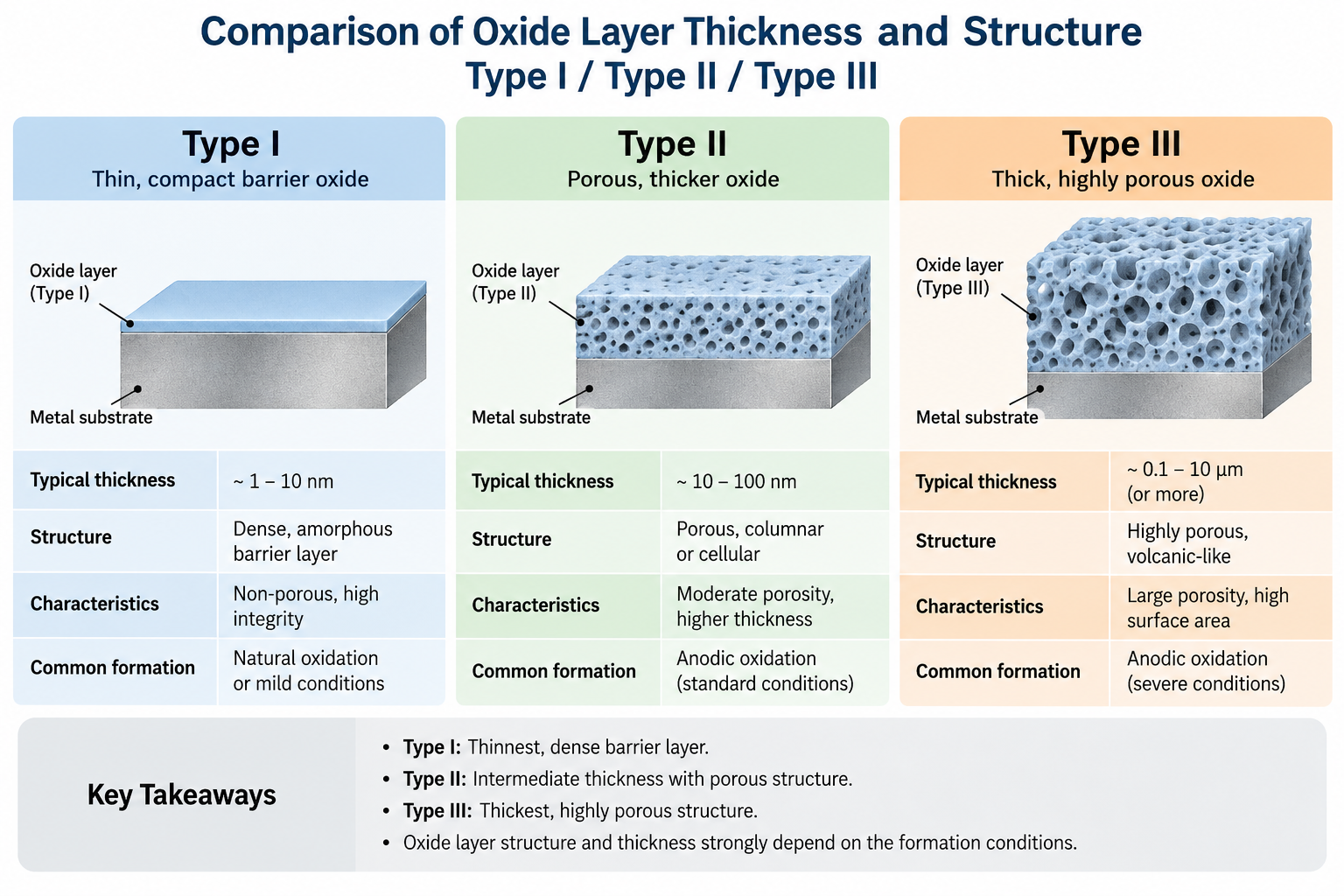
Type I chromic acid anodizing produces a thin anodic coating, typically about 0.5 para 7.5 micrômetros.
Its thin coating causes less dimensional change than thicker anodic finishes and is widely used in fatigue-sensitive aerospace applications. Process selection for blind cavities, articulações, or trapped-solution features should be reviewed with the anodizer.
What Is Type II Sulfuric Acid Anodizing?
Type II sulfuric acid anodizing is the most common anodizing type.
Typical thickness is about 1.8 para 25 micrômetros. The coating is porous, accepts dye, and gives good corrosion resistance. Type II is used for enclosures, dissipadores de calor, iluminação, e produtos de consumo. Black Type II on heat sinks is common, but the coating is electrically insulating. Its effect on thermal emissivity is a separate consideration from conduction.
What Is Type III Hardcoat Anodizing?
Type III hard anodizing produces the thickest and hardest anodic coating.
Type III is commonly specified around 25 para 75 micrômetros, with roughly 50 micrometers a common engineering requirement. Actual thickness depends on alloy, aplicativo, and specification. Hardcoat suits sliding surfaces, válvulas, pistões, e ferramentas.
Natural hardcoat color varies from light tan or gray to dark brown or black, depending on alloy, coating thickness, e condições de processo. Darker dyes may also be used where appropriate.
What Are Type IB, Type IC, And Type IIB?
MIL-PRF-8625 also includes Type IB low-voltage chromic anodizing, Type IC non-chromic alternatives, and Type IIB thin sulfuric anodizing.
These variants are more specialized than conventional Type I, Tipo II, and Type III finishes. They are selected when process chemistry, coating thickness, or environmental requirements demand it.
Anodizing Type Vs Class
Under MIL-PRF-8625, the type identifies the anodizing process, while the class identifies whether the finish is dyed.
- Aula 1: non-dyed coating
- Aula 2: dyed coating
These classes should not be confused with architectural Class I and Class II anodizing classifications, which are a different system.
How Are Anodizing Colors Added?
The anodic layer forms first. Coloring is a separate post-anodizing step before or as part of the sealing sequence.
Organic dyeing offers many colors on Type II coatings, but some dyes fade under strong UV light. Electrolytic coloring produces stable bronze, preto, and champagne tones. If color stability matters, state the expected light exposure on the drawing.
What Is Anodizing Sealing?
Sealing closes or modifies the pores in the anodic oxide after anodizing and coloring.
Sealing improves corrosion resistance and dye retention. The sealing requirement depends on the anodizing type and functional objective. Hot-water sealing and nickel-acetate or other chemical sealing are common. Hardcoat is sometimes left unsealed where wear characteristics are prioritized. Confirm the sealing requirement on the drawing.
What Other Anodizing Processes Are Used?
Specialized processes serve bonding, ambiental, and architectural needs.
- Phosphoric acid anodizing prepares aluminum for adhesive bonding.
- Boric-sulfuric acid anodizing is a lower-impact alternative in aerospace.
- Architectural anodizing follows standards for long-term exterior color and weathering.
Titanium anodizing is a different electrochemical process that forms a controlled titanium oxide layer. Its visible colors come mainly from optical interference rather than dyes. For details, see our guide on Anodizando de titânio.
Type I Vs Type II Vs Type III
| Fator | Type I Chromic | Type II Sulfuric | Type III Hard Anodizing |
| Typical thickness | 0.5-7.5 um | 1.8-25 um | Comumente 25-75 um |
| Resistência à corrosão | Bom | Good to very good | Good to very good, depending on sealing |
| Resistência ao desgaste | Baixo | Moderado | Alto |
| Colorability | Very limited | Excelente | Limitado |
| Dimensional growth | Mínimo | Moderado | Significant |
| Relative processing complexity | Especializado | Padrão, amplamente disponível | Mais alto |
| Uso típico | Aeroespacial, tolerâncias apertadas | General and colored parts | Wear and functional parts |
Growth, dureza, and corrosion results depend on alloy, processo, e vedação.
How To Choose An Anodizing Type
Choose the type by the primary requirement: corrosão, aparência, ou desgaste.
- Choose Type I when dimensions and fatigue matter and the coating must stay thin.
- Choose Type II for general corrosion protection and colored finishes.
- Choose Type III when the surface must resist wear and abrasion.
- Choose electrolytic coloring when long-term color stability matters.
- Choose organic dye when you need a specific bright color on a decorative part.
How Does Aluminum Alloy Affect Anodizing?
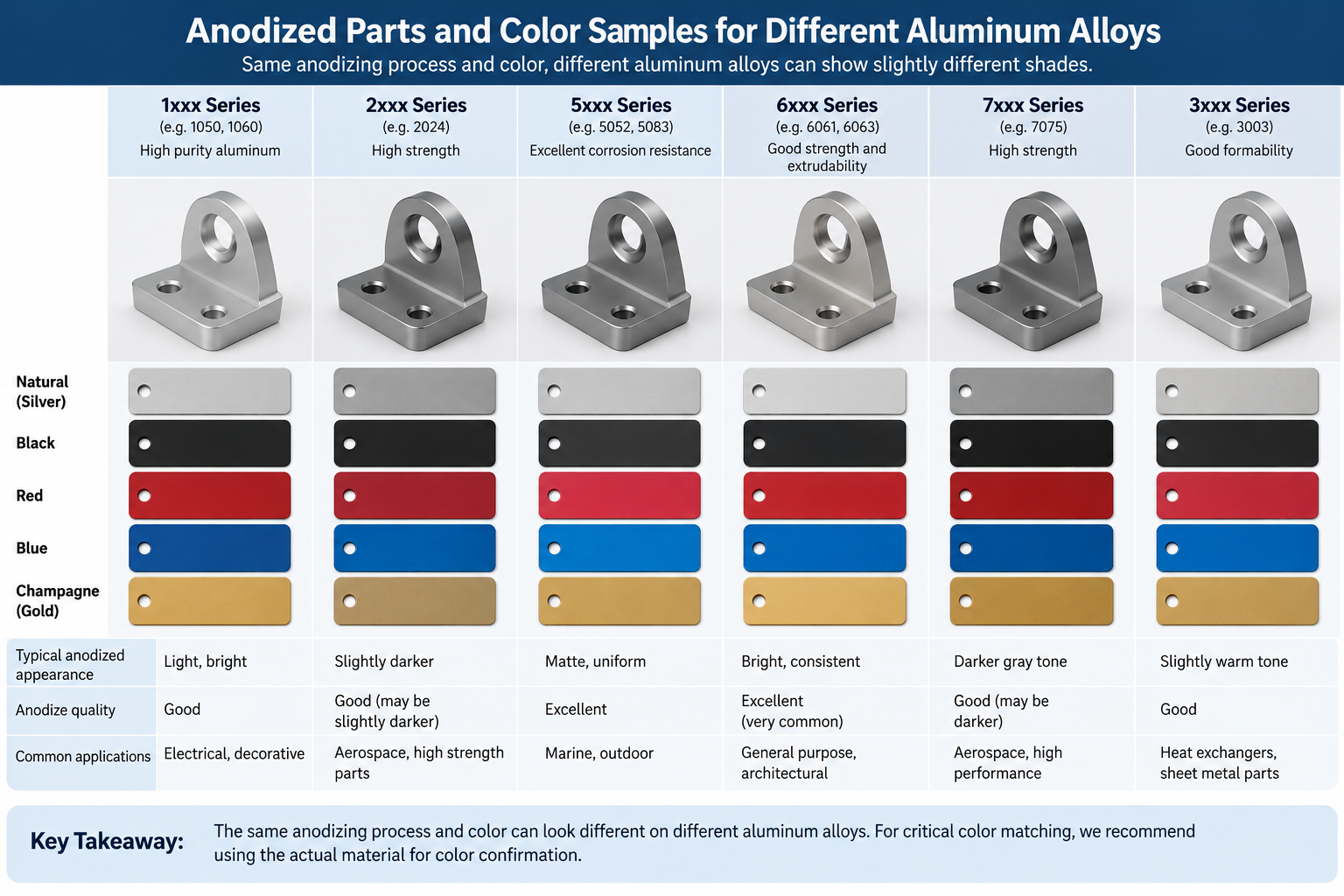
Alloy choice changes how the coating looks and performs.
| Alloy Family | Typical Anodizing Behavior |
| 5xxx | Generally good corrosion and decorative response |
| 6xxx | Commonly gives consistent decorative anodizing |
| 2xxx | Higher copper can affect color and corrosion behavior |
| 7xxx | Can require more controlled processing |
| Cast Al-Si alloys | High silicon can produce darker or less uniform appearance |
Use “generally” and “can” as the language above suggests. Confirm behavior with your finisher for the exact alloy.
Anodizing Design Considerations
Plan for coating growth, vedação, and alloy limits before you send the drawing.
- Anodizing does not simply add the full coating thickness to the outside of the part. Part of the oxide grows into the original aluminum surface, and part grows outward. Coordinate machining dimensions with coating thickness.
- Mask critical threads, contatos elétricos, and precision fits where coating cannot be tolerated. Post-anodize machining may be used when specifically required, but it exposes bare aluminum at the machined surface.
- Specify the alloy and temper.
- Specify sealing when corrosion resistance or color stability matters.
- State color, lustro, and any salt-spray or wear test on the drawing.
- Reference the current standard, MIL-PRF-8625. Older drawings may still reference MIL-A-8625; check current requirements against MIL-PRF-8625.
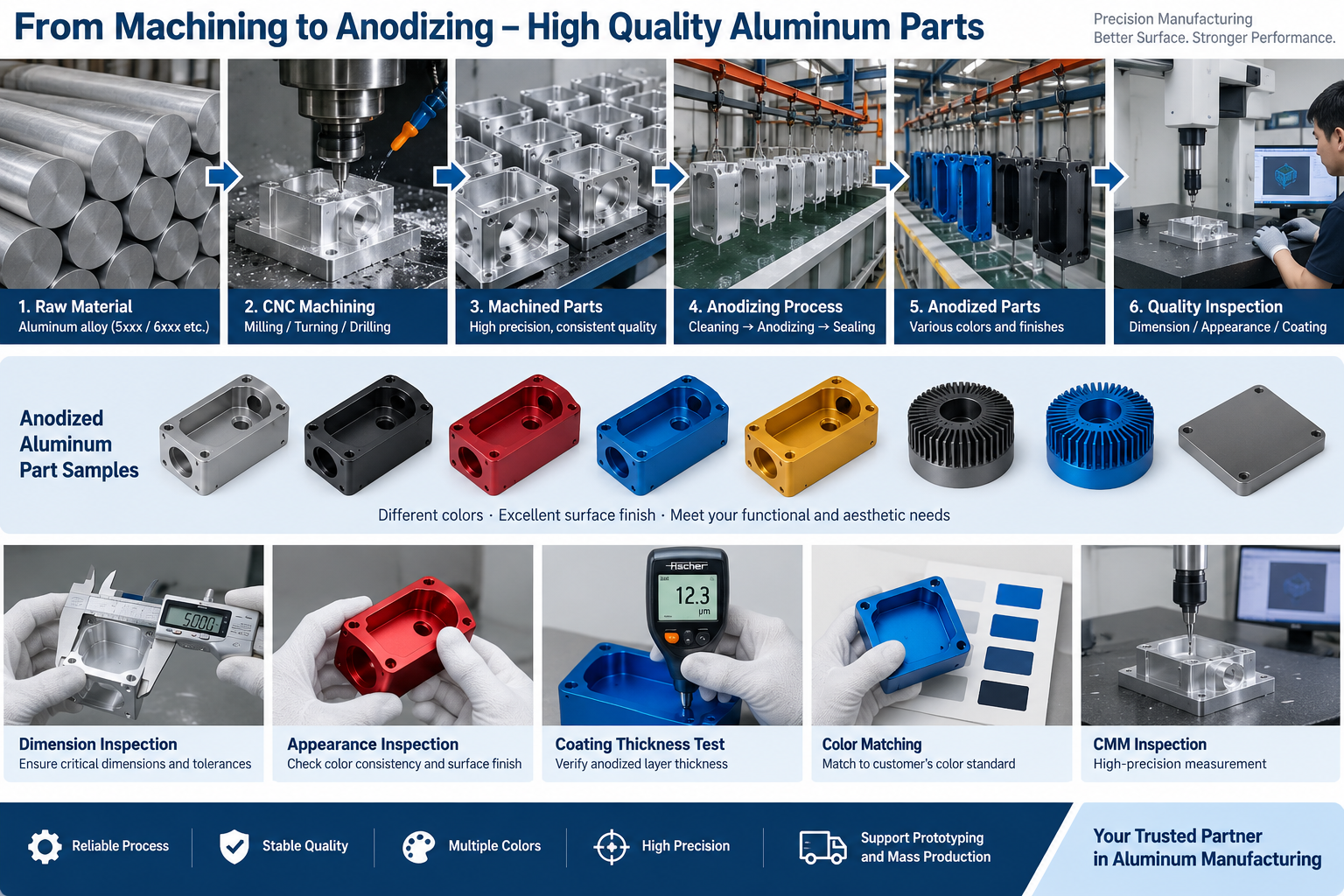
For machined aluminum parts, nosso anodized CNC machining service can quote the finish together with the part.
How To Specify Anodizing On A Drawing
Specify the full callout so the finisher applies exactly what you need.
Include the aluminum alloy and temper, the anodizing standard, the type, the class or color, the required coating thickness, the sealing requirement, masked areas, critical dimensions after coating, requisitos cosméticos, and any corrosion or wear testing.
Example for a colored finish: MIL-PRF-8625, Tipo II, Aula 2, Preto, coating thickness as specified, seal required.
Example for hardcoat: MIL-PRF-8625, Tipo III, Aula 1, 50 um nominal, mask threads as indicated.
When Should You Not Use Anodizing?
Anodizing is not the right finish for every part.
- Anodizing is most commonly used on aluminum, although related anodic processes are also used on metals such as titanium and magnesium.
- Very tight tolerances may not absorb coating growth.
- Internal threads and blind features can trap process chemistry.
- Some cast alloys anodize unevenly.
- Damaged anodic coatings cannot be easily repaired in place.
- Conductive contact points must be masked, because anodizing is insulating.
If the part needs an alternative, comparar surface finishes for CNC machining.
perguntas frequentes
What are the main types of anodizing?
Type I chromic acid, Type II sulfuric acid, and Type III hard anodizing.
What is Type II anodizing used for?
It is the most common type. It gives corrosion protection and accepts dye for colored parts.
What is the difference between Type II and Type III anodizing?
Type III is thicker and harder. Type II is thinner, more dyeable, and more widely available.
What is the difference between Type and Class in anodizing?
Type identifies the process. Class identifies whether the coating is dyed. Aula 1 is non-dyed and Class 2 is dyed under MIL-PRF-8625.
How thick is hard anodizing?
Commonly about 25 para 75 micrômetros, with roughly 50 micrometers a common requirement. Confirm with your finisher.
Does anodizing change part dimensions?
Sim. Part of the oxide grows into the surface and part grows outward. Allow for growth on tight-tolerance features.
What colors can aluminum be anodized?
Type II can be dyed in many colors. Black is most common. Hardcoat is usually in its natural tan, cinza, brown, or black range.
Can anodizing be applied to steel?
Não. Anodizing suits aluminum. Steel requires other treatments such as plating or black oxide.
Get A Quote For Anodized CNC Parts
Tell us the alloy, coating type, class, grossura, cor, and any test requirement. Our engineers will review the drawing, allow for coating growth, and quote machining plus anodizing together.


1 pensei em “Tipos de anodização: Tudo que você precisa saber”