



Unlike traditional keyed shafts, splined shafts distribute loads across multiple teeth, resulting in higher torque capacity, improved durability, reduced wear, and enhanced operational efficiency. These advantages make them the preferred choice for demanding applications where accuracy, strength, and long service life are essential.
In this comprehensive guide, we will explore what splined shafts are, how they work, the different types available, manufacturing methods, material selection, industry applications, and key design considerations.
What Is a Splined Shaft?
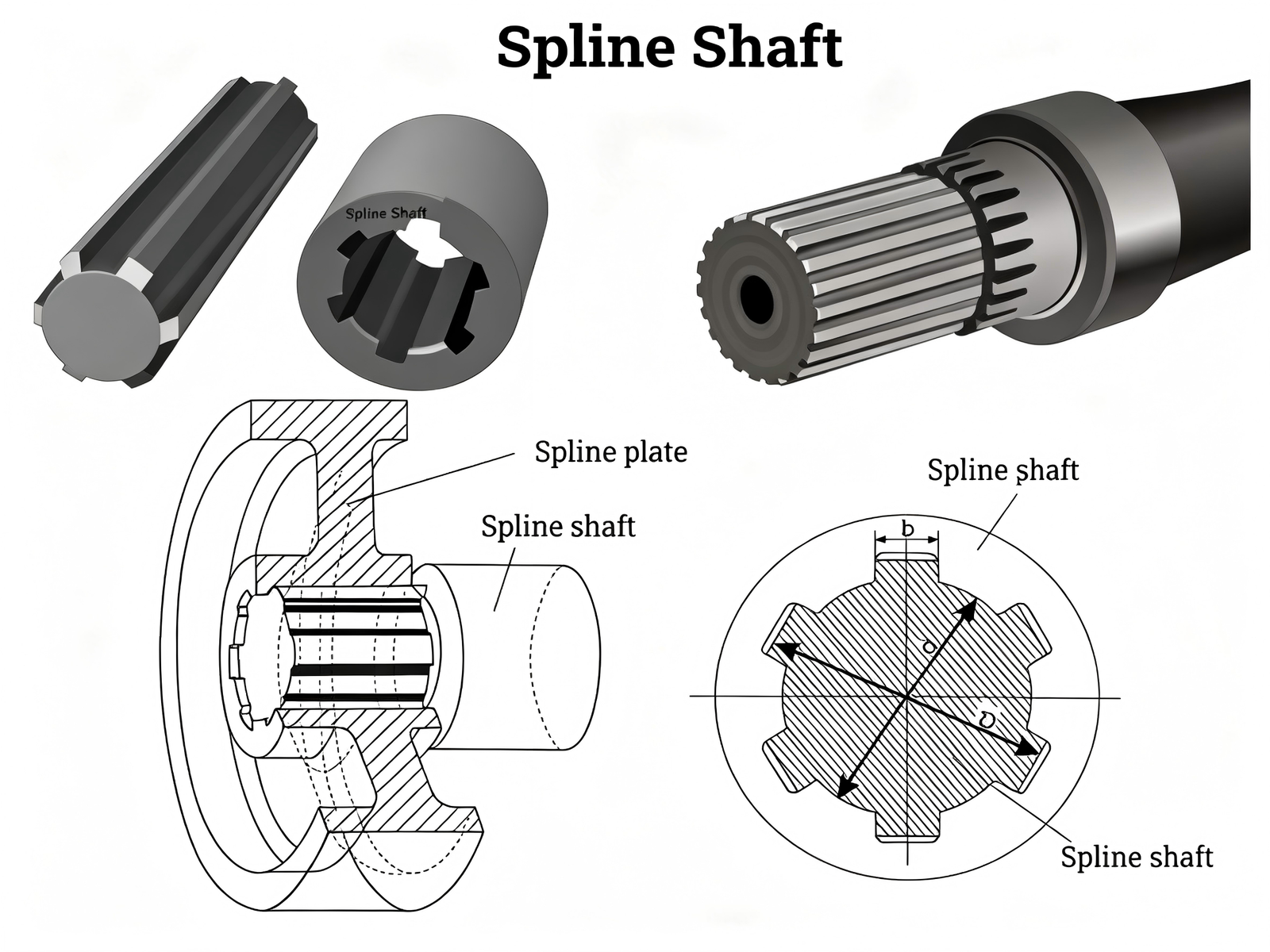
A splined shaft is a cylindrical mechanical component featuring a series of external ridges or teeth known as splines. These splines mate with corresponding grooves inside a hub, gear, coupling, pulley, or other mechanical component.
The interlocking teeth create a positive mechanical connection that enables efficient torque transmission while maintaining precise rotational alignment.
Splined shafts are widely used because they offer:
- High torque transmission capability
- Accurate shaft-to-hub alignment
- Reduced backlash
- Improved load distribution
- Enhanced durability
- Capability for axial movement in certain designs
Main Components of a Splined Shaft
A typical splined shaft consists of:
Shaft Body
The central cylindrical section that supports the splines and transfers rotational force.
Spline Teeth
The raised ridges machined along the shaft surface that engage with mating components.
Major Diameter
The outer diameter measured across the tops of the spline teeth.
Minor Diameter
The diameter measured across the root of the spline teeth.
Root Radius
The curved transition area between spline teeth that helps reduce stress concentration.
Pressure Angle
The angle between mating spline surfaces that affects load distribution and engagement characteristics.
How Does a Splined Shaft Work?
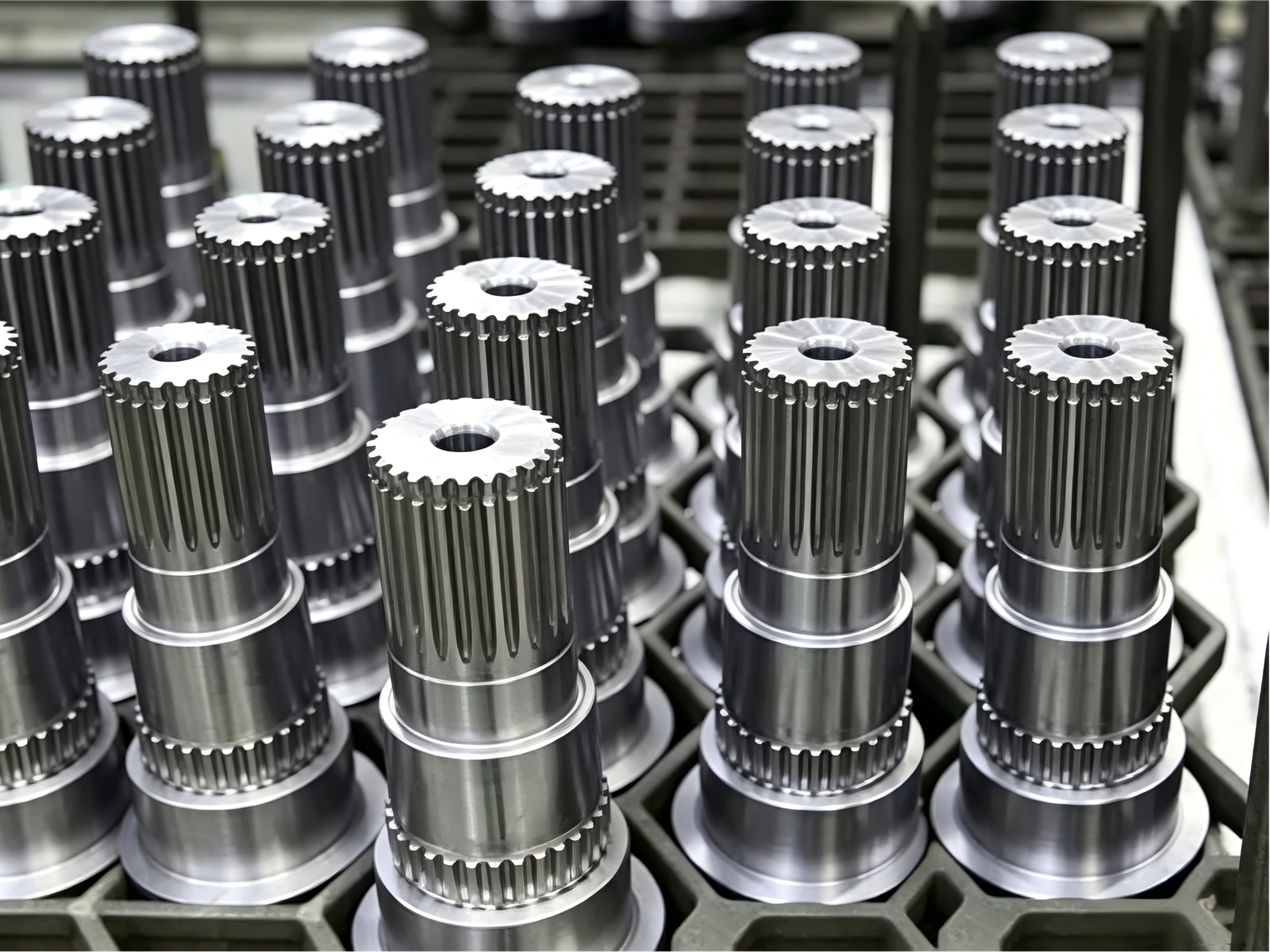
A splined shaft transmits rotational force through direct mechanical engagement between external and internal splines.
When torque is applied:
- The shaft rotates.
- Spline teeth engage the mating component.
- Load is distributed across multiple spline surfaces.
- Torque transfers efficiently with minimal slippage.
Unlike friction-based connections, splined shafts provide a positive drive mechanism, making them highly reliable in high-load applications.
Fixed Splines
Fixed splines lock the shaft and mating component together, preventing axial movement.
Common applications include:
- Gearboxes
- Couplings
- Power transmission systems
Sliding Splines
Sliding splines allow components to move along the shaft while still transmitting torque.
These are commonly found in:
- Automotive drive shafts
- Telescopic shafts
- PTO systems
Splined Shafts vs Keyed Shafts
| Feature | Splined Shaft | Keyed Shaft |
| Torque Capacity | High | Moderate |
| Load Distribution | Uniform | Concentrated |
| Wear Resistance | Excellent | Good |
| Alignment Accuracy | High | Moderate |
| Fatigue Life | Longer | Shorter |
| Backlash | Lower | Higher |
| Manufacturing Cost | Higher | Lower |
For high-performance applications, splined shafts generally outperform traditional keyed shafts.
Why Are Splined Shafts Important?
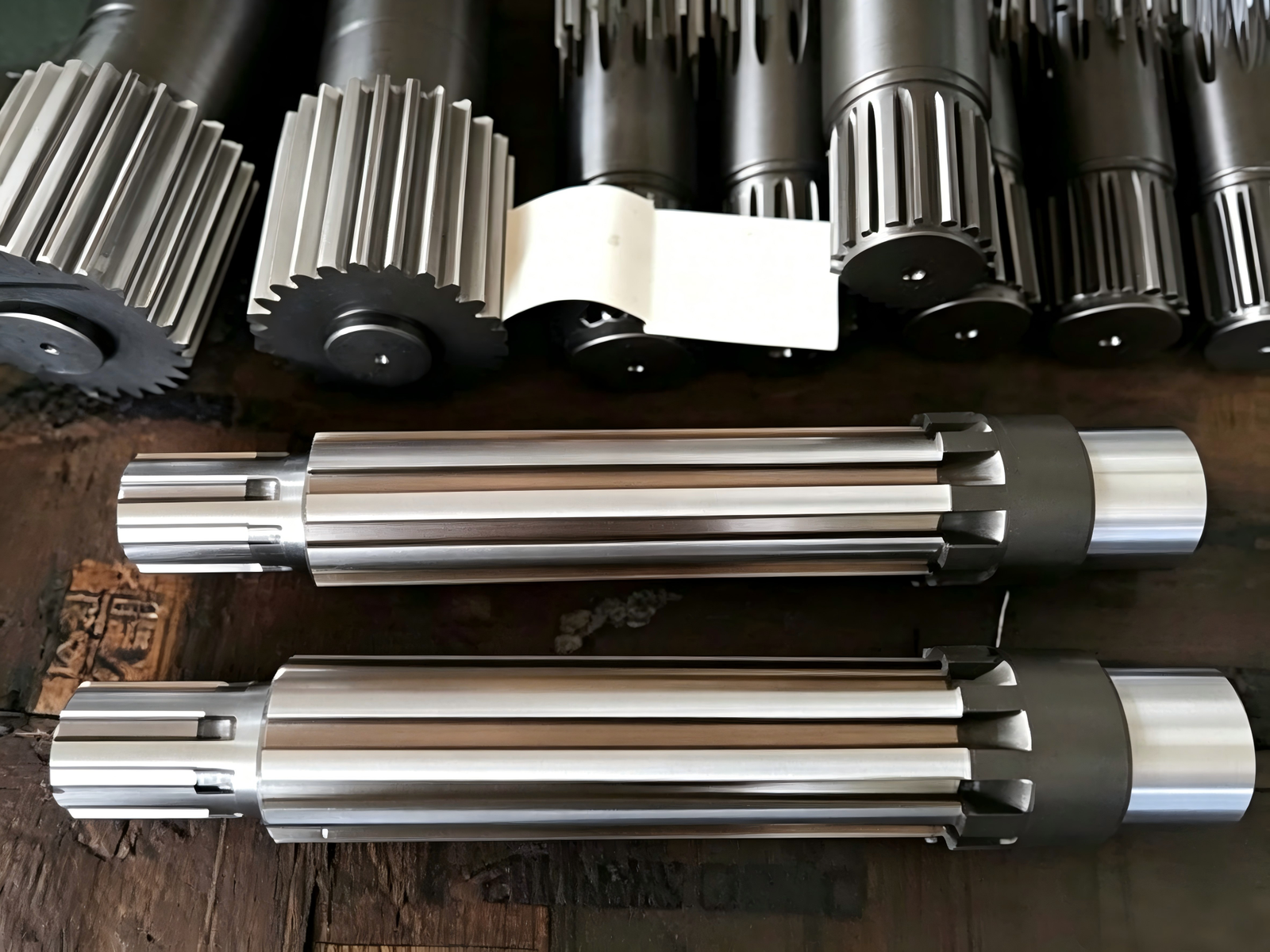
Efficient Torque Transmission
Because torque is distributed across multiple teeth, splined shafts can handle significantly higher loads than keyed connections.
Precision Alignment
The interlocking geometry maintains accurate rotational positioning between connected components.
Improved Load Distribution
Multiple contact points distribute forces evenly, reducing localized stress.
Reduced Wear
Load sharing minimizes surface damage and extends component lifespan.
Greater Reliability
Splined shafts perform consistently even under heavy-duty operating conditions.
Types of Splined Shafts
Various spline profiles are available depending on application requirements.
Involute Splines
Involute splines are the most commonly used spline design worldwide.
Characteristics
- Curved tooth profile
- Uniform load distribution
- Easy manufacturing and inspection
- Excellent self-centering capability
Applications
- Automotive transmissions
- Industrial gearboxes
- Aerospace systems
- Heavy machinery
Advantages
- High torque capacity
- Long fatigue life
- Standardized dimensions
Straight-Sided (Parallel) Splines
Straight-sided splines feature parallel tooth flanks.
Characteristics
- Simple geometry
- Easy machining
- Cost-effective production
Applications
- Agricultural machinery
- Industrial equipment
- General power transmission systems
Advantages
- Lower manufacturing costs
- Easy assembly and disassembly
Serrated Splines
Serrated splines utilize V-shaped or triangular teeth.
Characteristics
- High positioning accuracy
- Strong locking capability
- Increased friction resistance
Applications
- Steering systems
- Precision machinery
- Aerospace components
Advantages
- Excellent anti-slip performance
- Precise angular positioning
Helical Splines
Helical splines feature teeth cut at an angle around the shaft.
Characteristics
- Smooth engagement
- Reduced vibration
- Lower operational noise
Applications
- High-speed transmissions
- Precision machinery
- Aerospace drive systems
Advantages
- Quiet operation
- Improved load sharing
Crowned Splines
Crowned splines have slightly curved tooth surfaces.
Characteristics
- Compensate for misalignment
- Reduce edge loading
Applications
- Aircraft systems
- Flexible couplings
- Heavy equipment
Advantages
- Improved service life
- Better alignment tolerance
Ball Splines
Ball splines incorporate recirculating ball bearings.
Characteristics
- Simultaneous rotational and linear movement
- Extremely low friction
Applications
- Robotics
- Automation systems
- CNC machinery
Advantages
- Smooth motion
- High precision
Materials Used for Splined Shafts
Material selection significantly impacts performance and lifespan.
Carbon Steel
Common grades include:
- AISI 1045
- AISI 1050
Benefits:
- Good machinability
- Cost-effective
- Moderate strength
Alloy Steel
Popular grades:
- 4140
- 4340
- 8620
Benefits:
- High strength
- Excellent wear resistance
- Superior fatigue properties
Stainless Steel
Common grades:
- 304
- 316
- 17-4PH
Benefits:
- Corrosion resistance
- Suitable for harsh environments
- Excellent durability
Aluminum Alloys
Common grades:
- 6061-T6
- 7075-T6
Benefits:
- Lightweight
- Corrosion resistant
- Good strength-to-weight ratio
Titanium Alloys
Benefits:
- Exceptional strength
- Low weight
- Outstanding corrosion resistance
Applications:
- Aerospace
- Defense
- Medical equipment
Splined Shaft Manufacturing Processes
Precision manufacturing is critical to spline performance.
CNC Turning
The shaft body is initially machined to required dimensions.
Spline Milling
CNC milling cutters create spline profiles.
Advantages:
- Flexible production
- Suitable for prototypes
Spline Hobbing
One of the most efficient methods for large-volume production.
Benefits:
- High accuracy
- Excellent productivity
Broaching
Used primarily for internal splines.
Benefits:
- High precision
- Fast cycle times
Gear Shaping
Ideal for internal and external splines.
Benefits:
- Versatile
- Suitable for complex profiles
Wire EDM
Used for intricate spline geometries and tight tolerances.
Benefits:
- Exceptional precision
- Complex profile capability
Surface Treatments for Splined Shafts
Surface treatment enhances durability and wear resistance.
Induction Hardening
Provides localized hardness on spline teeth.
Carburizing
Creates a hard wear-resistant surface while maintaining a tough core.
Nitriding
Improves wear resistance without significant distortion.
Black Oxide
Provides mild corrosion protection.
Zinc Plating
Enhances corrosion resistance.
Hard Chrome Plating
Improves wear resistance and surface hardness.
Key Design Considerations
Proper design ensures reliable long-term performance.
Torque Requirements
The spline profile must accommodate maximum operating torque.
Number of Teeth
More teeth generally improve load distribution.
Shaft Diameter
Determines overall strength and torsional rigidity.
Pressure Angle
Affects engagement characteristics and load transfer.
Misalignment Tolerance
Important for systems subject to vibration or movement.
Fatigue Life
Critical for cyclic loading applications.
Industry Standards for Splined Shafts
Several standards govern spline dimensions and tolerances.
ANSI B92.1
Widely used in North America.
DIN 5480
Popular in Europe.
DIN 5482
Common for metric spline systems.
ISO 4156
International standard for involute splines.
SAE Standards
Frequently used in automotive applications.
Following these standards ensures compatibility and interchangeability.
Common Applications of Splined Shafts
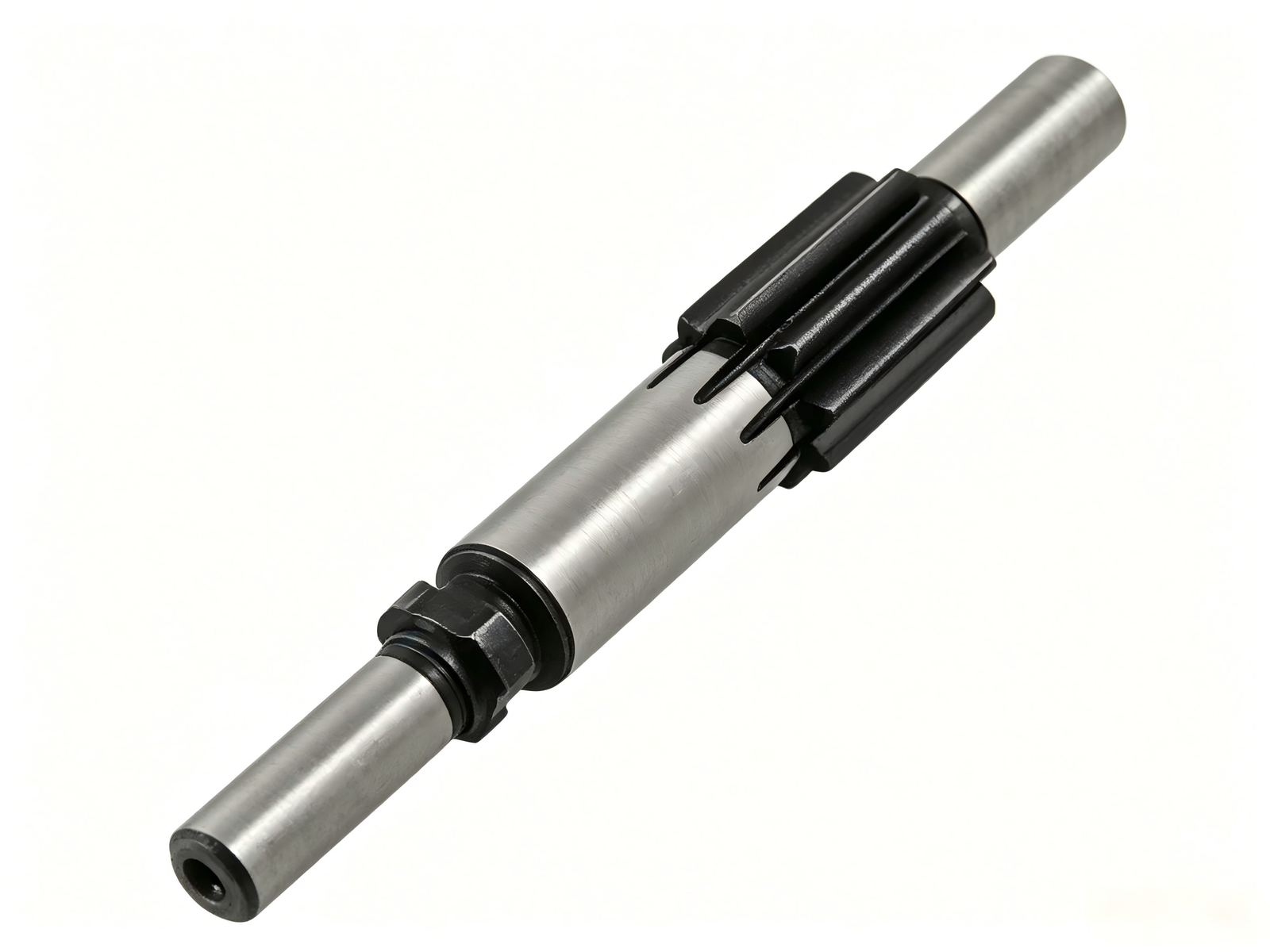
Automotive Industry
Applications include:
- Transmission shafts
- Drive shafts
- Steering columns
- Differential systems
Aerospace Industry
Applications include:
- Flight control systems
- Landing gear mechanisms
- Engine power transmission systems
Industrial Machinery
Applications include:
- Gearboxes
- Pumps
- Compressors
- Conveyors
Robotics and Automation
Applications include:
- Servo drives
- Precision actuators
- Linear motion systems
Agricultural Equipment
Applications include:
- PTO shafts
- Harvesters
- Tractors
Construction Equipment
Applications include:
- Excavators
- Wheel loaders
- Hydraulic drive systems
Common Splined Shaft Failures and Prevention
Tooth Wear
Cause:
- Insufficient lubrication
Prevention:
- Proper lubrication schedules
Fretting Corrosion
Cause:
- Micro-movement between mating surfaces
Prevention:
- Correct fit and lubrication
Fatigue Cracks
Cause:
- Repeated cyclic loading
Prevention:
- Proper material selection
- Surface hardening
Misalignment Damage
Cause:
- Improper installation
Prevention:
- Precision assembly procedures
How to Choose the Right Splined Shaft
Consider the following factors:
Torque Requirements
Determine operating and peak loads.
Material Selection
Match material properties to application requirements.
Environmental Conditions
Consider temperature, moisture, chemicals, and corrosion.
Manufacturing Tolerances
Ensure precision for proper engagement.
Surface Treatment Requirements
Improve wear resistance and service life.
Industry Standards
Verify compliance with customer specifications.
Why Choose a Professional CNC Machining Supplier for Custom Splined Shafts?
Choosing an experienced machining partner can significantly improve product quality and reliability.
A professional manufacturer should offer:
- Precision CNC machining
- Spline milling and hobbing capabilities
- Tight tolerance control
- Material traceability
- Surface treatment options
- Comprehensive inspection reports
- Prototype and production support
Whether you require custom involute splines, straight-sided splines, or complex aerospace-grade spline shafts, working with a qualified CNC machining supplier ensures consistent quality and performance.
Frequently Asked Questions
1.What is the purpose of a splined shaft?
A splined shaft transmits torque while maintaining precise alignment between connected components.
2.What is the difference between a spline and a keyway?
A spline uses multiple teeth for load distribution, while a keyway relies on a single key.
3.Which spline type is most common?
Involute splines are the most widely used due to their strength and standardization.
4.Can splined shafts accommodate axial movement?
Yes. Sliding splines are specifically designed for axial movement while transmitting torque.
5.What materials are commonly used for splined shafts?
Carbon steel, alloy steel, stainless steel, aluminum, and titanium are the most common materials.
6.How are splined shafts manufactured?
They are typically produced through CNC turning, milling, hobbing, broaching, shaping, or EDM machining.
Conclusion
Understanding spline types, materials, manufacturing methods, and design considerations allows engineers and buyers to select the most suitable solution for their application. Whether you need standard spline shafts or highly customized precision components, partnering with Tops Precision can help ensure optimal performance, durability, and cost efficiency.


