Among the various linear motion technologies available today, lead screws remain one of the most widely used and cost-effective solutions. Their simple design, high positioning accuracy, self-locking capability, and ease of maintenance make them a preferred choice across many industries.
In this comprehensive guide, we will explore everything you need to know about lead screws, including their working principles, thread types, materials, advantages, limitations, applications, and selection criteria.
What Is a Lead Screw?
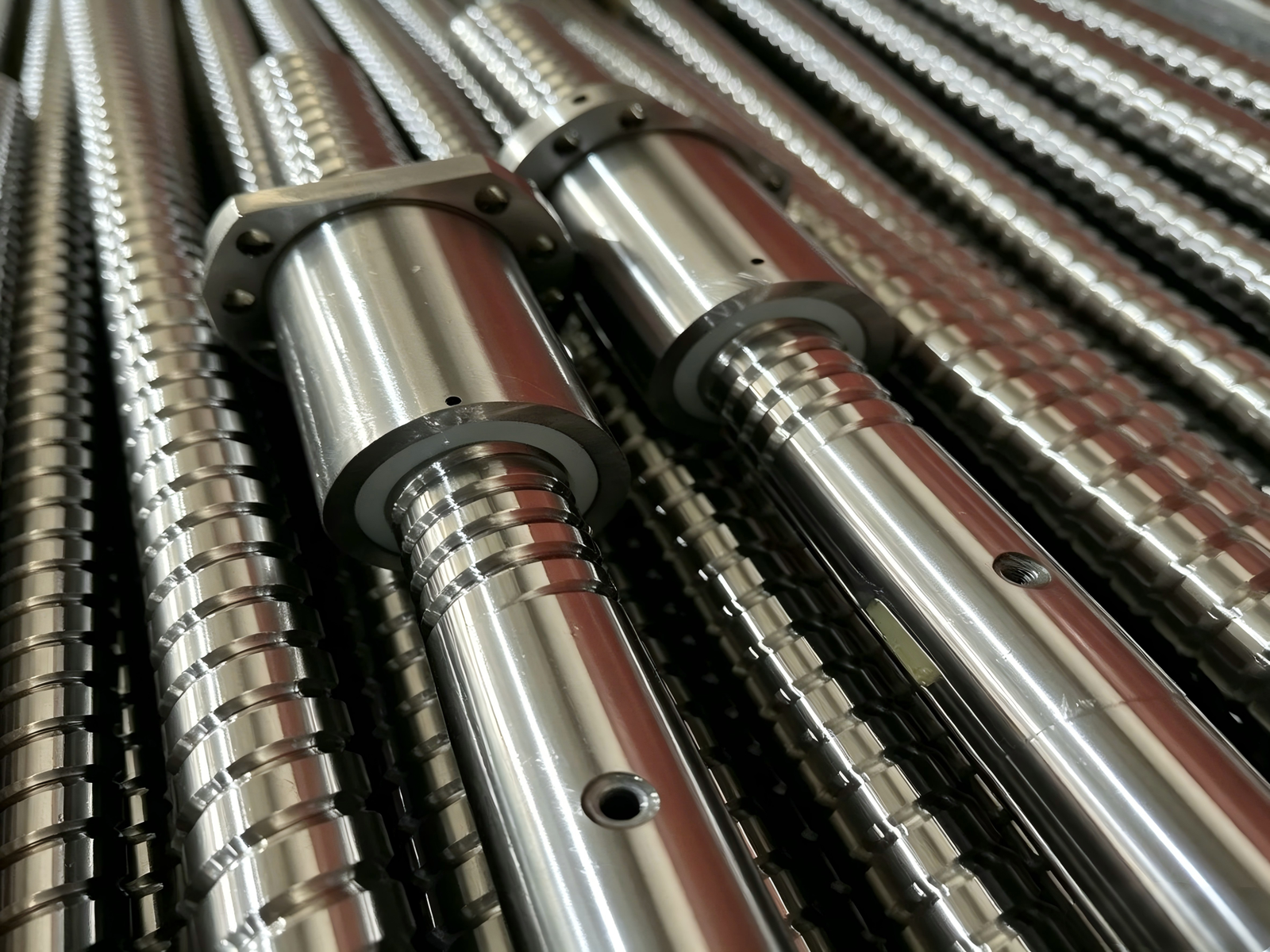
A lead screw is a mechanical power transmission component that converts rotational motion into linear motion. It consists of a threaded shaft and a matching nut that travels along the shaft when either component rotates.
Unlike ball screws, lead screws rely on sliding friction between the screw and nut rather than rolling ball bearings.
This design provides several advantages:
- Lower manufacturing cost
- Simpler structure
- Quiet operation
- Self-locking capability
- Easy maintenance
Because of these characteristics, lead screws are commonly used in applications where moderate speed and high precision are required.
Main Components of a Lead Screw Assembly
A complete lead screw system typically includes the following components:
Screw Shaft
The screw shaft contains external threads that guide the movement of the nut. It is usually manufactured from:
- Stainless steel
- Carbon steel
- Alloy steel
- Aluminum
- Titanium
Lead Nut
The nut contains internal threads that match the screw profile.
Common nut materials include:
- Bronze
- Brass
- Engineering plastics
- PTFE composites
- Self-lubricating polymers
Bearings
Bearings support the screw shaft and reduce unwanted movement.
Couplings
Couplings connect the lead screw to motors or drive systems.
End Supports
These components ensure stability and alignment during operation.
How Does a Lead Screw Work?
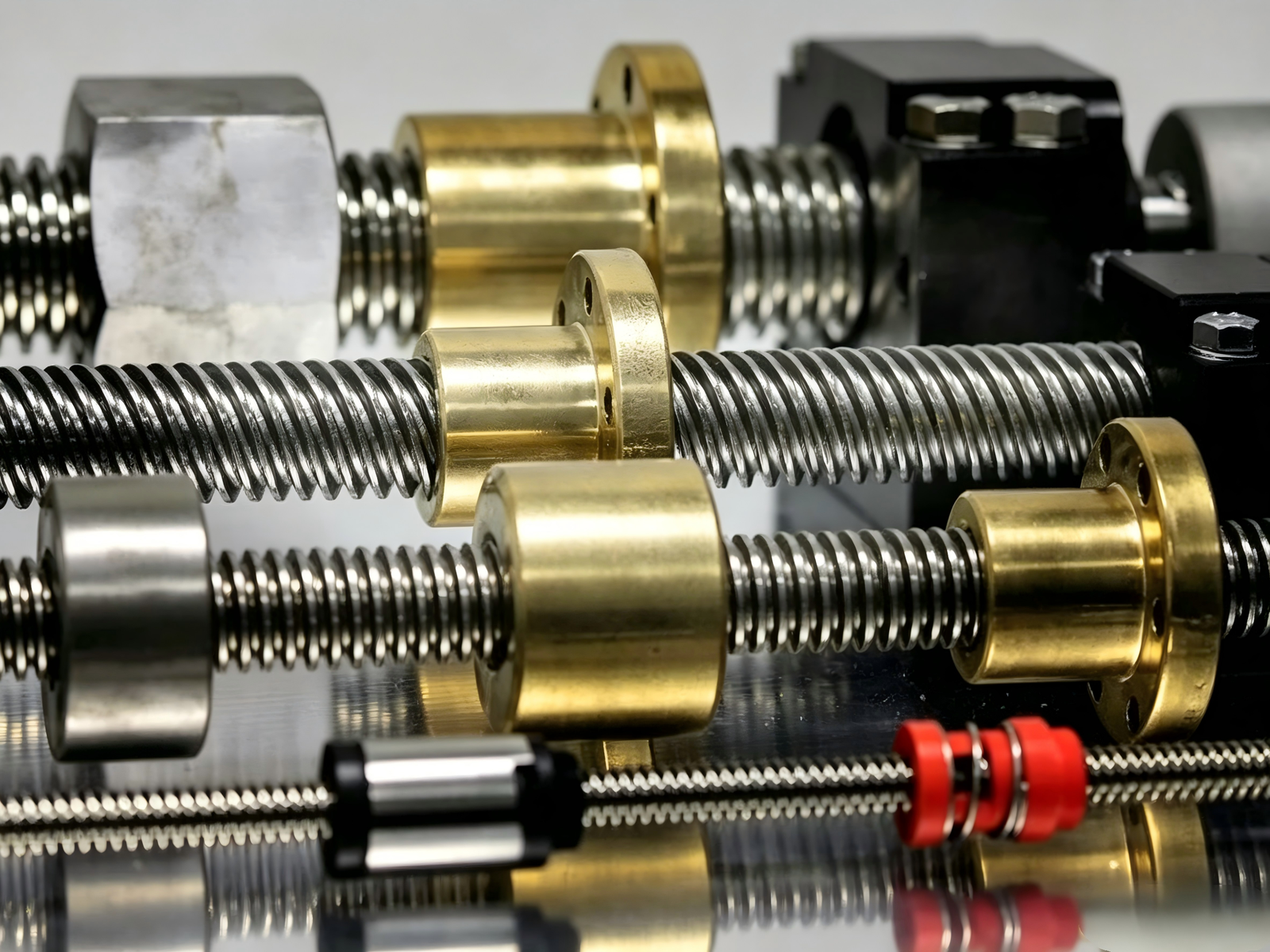
The operating principle of a lead screw is relatively simple.
When rotational force is applied to the screw or nut, the threaded interaction converts rotary motion into linear motion.
This movement occurs because the nut follows the helical path created by the screw threads.
Rotating Screw, Traveling Nut
This is the most common configuration.
The screw rotates while the nut moves linearly along the shaft.
Applications include:
- CNC equipment
- Packaging machinery
- Automation systems
Rotating Nut, Fixed Screw
In this configuration, the screw remains stationary while the nut rotates and moves.
Applications include:
- High-speed positioning systems
- Space-constrained machinery
Understanding Lead, Pitch, and Thread Geometry
Before selecting a lead screw, it is important to understand several key parameters.
Pitch
Pitch is the distance between adjacent threads.
For example:
If the distance between threads is 5 mm, the pitch equals 5 mm.
Lead
Lead refers to the linear distance traveled during one complete revolution.
For single-start screws:
Lead = Pitch
For multi-start screws:
Lead = Pitch × Number of Starts
Helix Angle
The helix angle affects:
- Efficiency
- Load capacity
- Speed
Larger helix angles generally provide higher speed but lower self-locking capability.
Types of Lead Screw Threads
Thread geometry significantly impacts performance.
The most common lead screw thread types include:
1. Square Thread
Square threads are considered the most efficient thread design because they minimize friction.
Advantages
- Highest efficiency
- Reduced wear
- Lower friction losses
- Excellent power transmission
Disadvantages
- Difficult to manufacture
- Higher production cost
- Lower root strength
Typical Applications
- Heavy-duty lifting systems
- Precision machinery
- Industrial presses
2. Acme Thread
Acme threads feature a trapezoidal profile with a 29° thread angle.
They are among the most widely used thread types worldwide.
Advantages
- Strong thread profile
- Easy manufacturing
- Good load capacity
- Lower production cost
Disadvantages
- Slightly lower efficiency than square threads
- Increased friction
Typical Applications
- CNC machines
- Industrial automation
- Machine tools
3. Trapezoidal Thread
Trapezoidal threads are the metric equivalent of Acme threads and comply with international standards.
Advantages
- Strong structure
- High durability
- Standardized dimensions
- Cost-effective production
Applications
- European machinery
- Automation equipment
- Industrial actuators
4. Buttress Thread
Buttress threads are designed to handle extremely high loads in one direction.
Advantages
- Very high load capacity
- Strong thread root
- Excellent axial force transmission
Disadvantages
- Not suitable for bidirectional loading
Applications
- Jacks
- Presses
- Heavy lifting systems
Lead Screw Materials
Material selection directly affects performance, durability, and operating life.
Common Screw Materials
Stainless Steel
Benefits:
- Corrosion resistance
- Long service life
- Suitable for food and medical industries
Carbon Steel
Benefits:
- Cost-effective
- High strength
- Easy machining
Alloy Steel
Benefits:
- Superior hardness
- High wear resistance
- Heavy-duty performance
Titanium
Benefits:
- Lightweight
- Excellent corrosion resistance
- Aerospace applications
Common Nut Materials
Bronze
The traditional choice for lead screw nuts.
Benefits:
- Excellent wear resistance
- High load capacity
- Long lifespan
Engineering Plastics
Benefits:
- Self-lubricating
- Low noise
- Corrosion resistant
Composite Materials
Benefits:
- Low friction
- Maintenance-free operation
- Extended service life
Advantages of Lead Screws
Lead screws continue to be popular due to several significant advantages.
High Positioning Accuracy
Lead screws provide precise and repeatable linear motion.
Self-Locking Capability
Many lead screw designs prevent back-driving.
This feature improves safety in vertical lifting applications.
Lower Cost
Compared with ball screws, lead screws are significantly more affordable.
Compact Design
Lead screw systems require fewer components.
Quiet Operation
The absence of recirculating balls results in lower noise levels.
Easy Maintenance
Lead screws are simple to inspect, lubricate, and replace.
Limitations of Lead Screws
Although versatile, lead screws also have certain limitations.
Lower Efficiency
Typical efficiency ranges from:
- 20% to 80%
Ball screws often exceed 90%.
Friction and Wear
Continuous sliding contact creates wear over time.
Heat Generation
Higher friction can generate heat during operation.
Limited Speed
Lead screws generally operate at lower speeds than ball screws.
Lead Screw vs Ball Screw
Choosing between a lead screw and a ball screw depends on the application.
| Feature | Lead Screw | Ball Screw |
| Cost | Low | High |
| Efficiency | 20–80% | 90–98% |
| Maintenance | Simple | Moderate |
| Speed | Moderate | High |
| Self-Locking | Yes | No |
| Noise | Low | Moderate |
| Precision | High | Very High |
Choose Lead Screws When:
- Cost is important
- Speed requirements are moderate
- Self-locking is needed
- Maintenance simplicity is preferred
Choose Ball Screws When:
- Maximum efficiency is required
- High-speed operation is critical
- Extremely high precision is needed
Common Industrial Applications
Lead screws are used across numerous industries.
CNC Machines
Provide accurate positioning for machine axes.
3D Printers
Enable controlled movement of print heads and build platforms.
Medical Equipment
Used in:
- Imaging systems
- Diagnostic devices
- Surgical equipment
Automation Systems
Support:
- Pick-and-place machines
- Robotic positioning
- Material handling equipment
Packaging Machinery
Deliver repeatable and reliable movement.
Aerospace Equipment
Used in precision control mechanisms.
Semiconductor Manufacturing
Provide ultra-precise positioning capabilities.
How to Select the Right Lead Screw
Selecting the proper lead screw requires evaluating several factors.
1. Load Capacity
Consider both:
Static Load
Load while stationary.
Dynamic Load
Load during operation.
2. Speed Requirements
Higher speed applications require larger leads and optimized thread designs.
3. Positioning Accuracy
Determine required tolerance levels before selecting thread geometry.
4. Backlash Requirements
Backlash directly impacts positioning precision.
Anti-backlash nuts can minimize this issue.
5. Operating Environment
Evaluate:
- Temperature
- Humidity
- Chemicals
- Dust exposure
6. Material Compatibility
Choose materials that balance:
- Strength
- Wear resistance
- Corrosion resistance
- Cost
7. PV Factor
Pressure-Velocity (PV) calculations help determine safe operating conditions and expected service life.
8. Critical Speed Analysis
Exceeding critical speed can cause vibration and screw failure.
Always verify speed limits during system design.
Lead Screw Maintenance Best Practices
Proper maintenance extends service life and improves performance.
Regular Inspection
Check for:
- Wear
- Corrosion
- Thread damage
- Misalignment
Proper Lubrication
Lubrication reduces friction and heat generation.
Keep Components Clean
Prevent contamination from:
- Dust
- Metal chips
- Debris
Monitor Backlash
Excessive backlash often indicates wear and the need for replacement.
Emerging Trends in Lead Screw Technology
The lead screw industry continues to evolve.
Self-Lubricating Nuts
Reduce maintenance requirements.
Advanced Engineering Polymers
Improve wear resistance and efficiency.
Precision Ground Lead Screws
Offer higher accuracy for demanding applications.
Smart Motion Systems
Integrate sensors and real-time monitoring capabilities.
Industry 4.0 Compatibility
Modern lead screw systems increasingly support predictive maintenance and digital manufacturing initiatives.
FAQs
1.What is the difference between pitch and lead?
Pitch is the distance between adjacent threads, while lead is the distance traveled during one revolution.
2.Are lead screws self-locking?
Many lead screws are self-locking due to friction between the screw and nut.
3.Which thread type is most efficient?
Square threads generally offer the highest efficiency.
4.Can lead screws replace ball screws?
In many applications, yes. However, high-speed and high-efficiency systems may require ball screws.
5.How long do lead screws last?
Service life depends on:
- Load
- Speed
- Lubrication
- Material selection
- Operating environment
Conclusion
When selecting a lead screw, engineers and procurement professionals should carefully evaluate load capacity, speed, accuracy, thread type, material selection, and environmental conditions. A properly chosen lead screw can significantly improve equipment reliability, efficiency, and operating life.
If you are developing a new machine, upgrading an automation system, or sourcing precision mechanical components, partnering with Tops Precision can help ensure the optimal lead screw solution for your application and budget.