


Resin drying for injection molding needs a grade-specific process and a verified moisture result. You should agree on material identity, drying conditions, sampling, and release criteria before production. A dryer display alone cannot confirm that pellets meet your moisture specification.
Start With The Exact Resin Grade
Your drying specification should come from the approved resin grade and its current processing guidance.
A polymer family name is insufficient. Fillers, additives, color packages, and different grades can change processing requirements. Specify the manufacturer, full grade, approved colorant, and permitted regrind before comparing molding quotations.
For example, the BASF Ultramid B3K6 processing sheet provides grade-specific moisture and drying guidance. It also explains that drying time depends on initial moisture, temperature, and air dew point. Its settings should not become a universal recipe for other materials.
Ask your supplier to identify the document revision behind its proposed process. Resolve conflicting customer and resin-manufacturer requirements before releasing the job.
Match The Dryer To The Moisture Mechanism
Your dryer must address the moisture behavior of the approved material.
Hygroscopic resins absorb moisture within their pellets. Other materials may mainly require removal of surface moisture under the relevant handling conditions. Do not assume that every resin needs the same dryer or treatment.
Conair’s dryer selection guidance distinguishes desiccant drying for hygroscopic resins from hot-air removal of surface moisture. Use this distinction when reviewing a supplier’s proposed equipment.
Ask whether the actual dryer, hopper, and conveying arrangement suit your grade and consumption rate. A machine list without a material-specific explanation provides limited purchasing evidence.
Control Temperature Time Airflow And Dew Point
You need all relevant drying conditions under control before accepting a process as suitable.
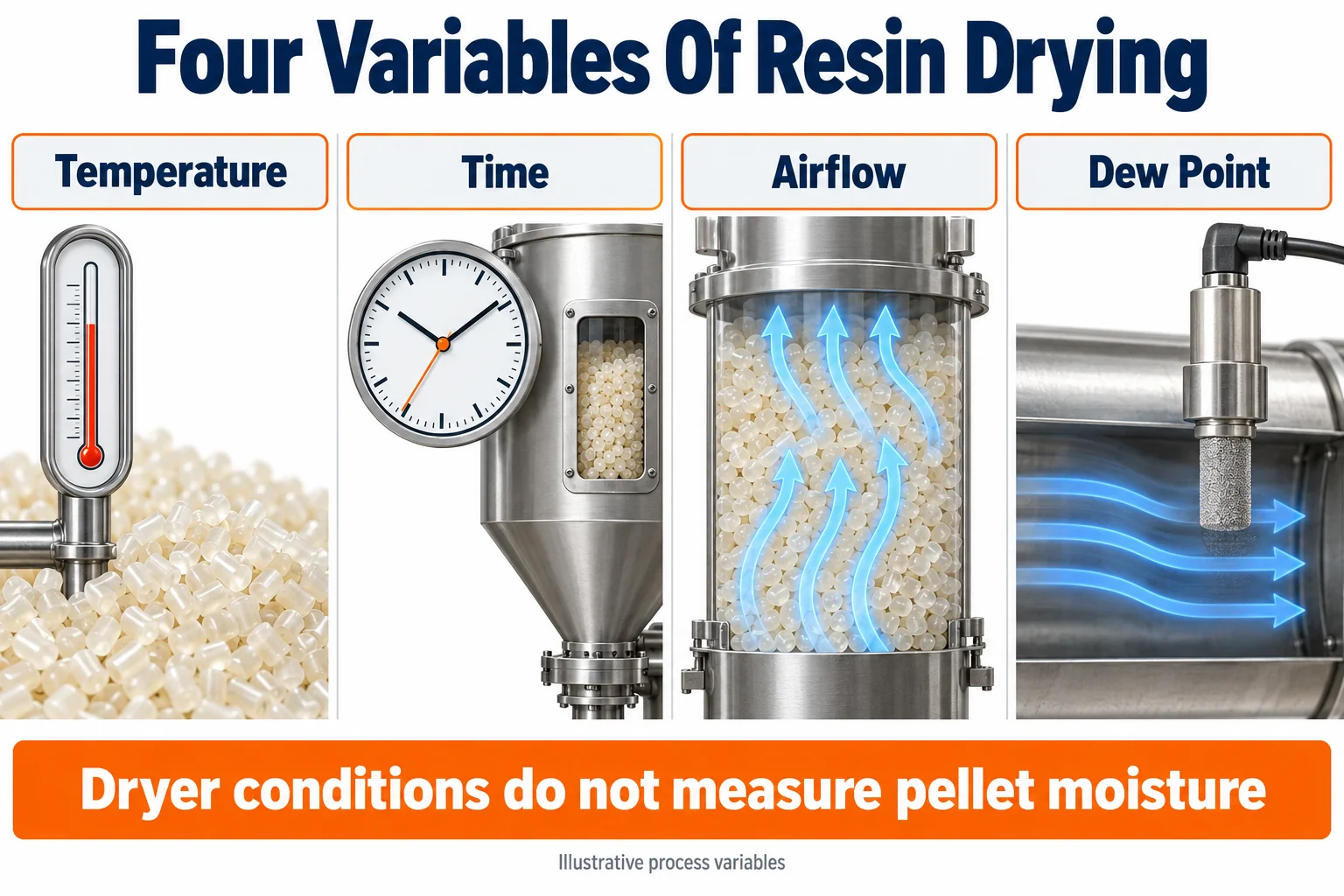
A low air dew point describes the drying air. It does not measure water remaining inside the pellets. Likewise, an elapsed timer cannot prove that all material received sufficient time at temperature.
Conair’s explanation of resin drying conditions connects pellet temperature, exposure time, and airflow. Airflow transfers heat and carries released moisture away. These relationships explain why one favorable display reading cannot establish drying performance.
| Variable | What You Should Agree | Evidence To Request |
|---|---|---|
| Temperature | Grade-specific operating range | Actual readings and sensor location |
| Time | Required exposure and startup sequence | Loading history and release time |
| Airflow | Suitable flow through the material bed | Equipment sizing and maintenance checks |
| Dew Point | Appropriate process-air condition | Reading location and alarm response |
Review these controls at the actual production throughput. Refilling, interrupted production, and material changes can alter the exposure history. Ask how the supplier prevents newly loaded material from reaching the press before adequate drying.
Verify Pellet Moisture With A Suitable Method
Your acceptance test must measure the required property at a suitable sensitivity for the approved resin.
A halogen moisture analyzer measures mass lost during heating. That loss can include water and other volatile substances. Treating every mass-loss result as water content can mislead your release decision.
METTLER TOLEDO’s comparison of moisture analysis methods distinguishes total volatile loss from water-specific Karl Fischer analysis. Neither instrument name alone establishes a valid method for your grade.
Its polymer granule application note describes Karl Fischer analysis with an oven. The procedure includes establishing an appropriate extraction temperature.
Ask for the test procedure, sample mass, temperature program, endpoint, and suitability near your acceptance limit. Where necessary, agree on correlation with an appropriate reference method. Do not compare supplier results unless their methods and units are compatible.
Protect The Sample And The Dried Material
Your sampling plan should represent material reaching the molding machine and prevent avoidable moisture changes before testing.
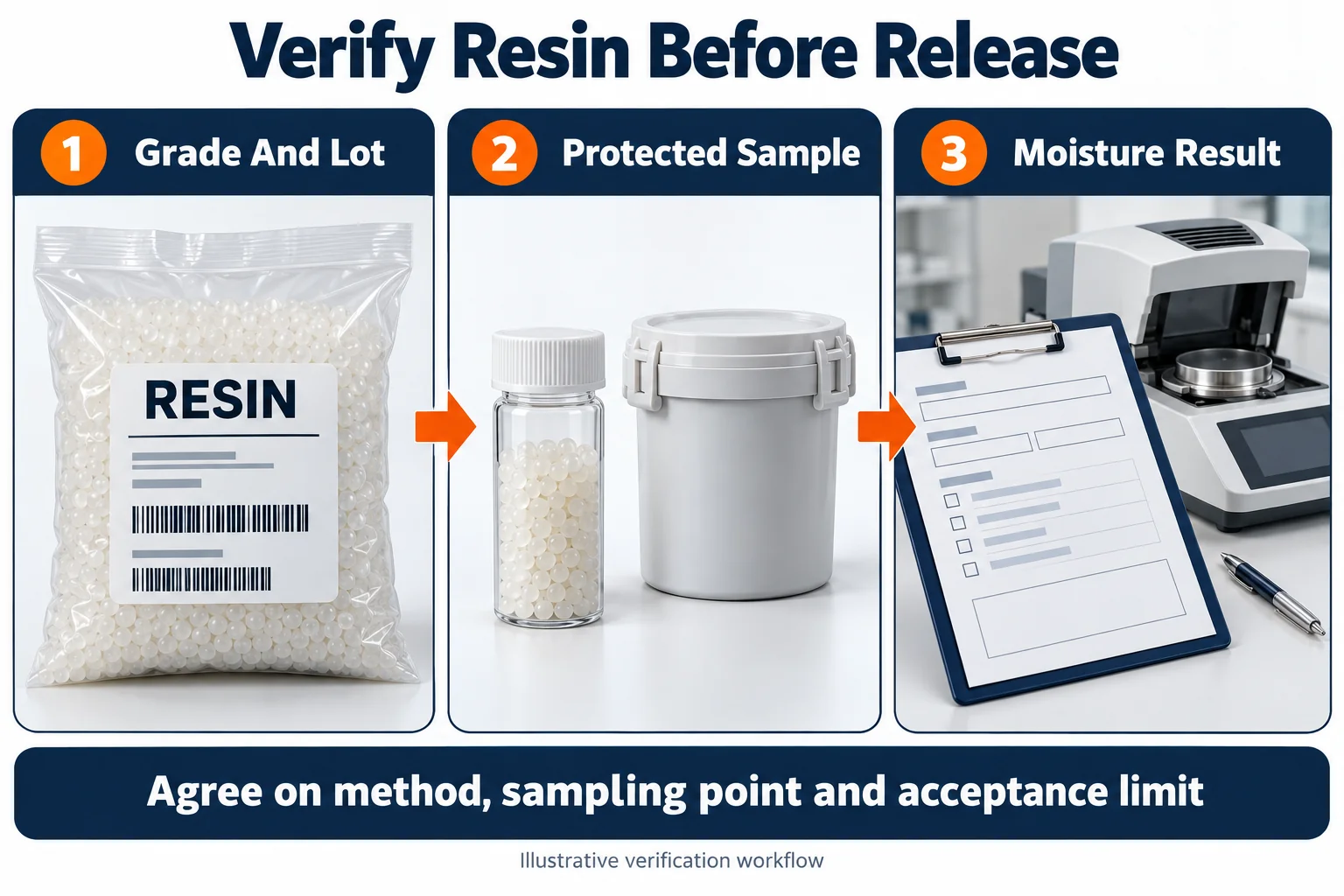
Agree on a safe, accessible sampling location with the supplier. For process qualification, consider the material path after drying and conveying. A sample collected only at the dryer may miss later exposure.
Specify a suitable sealed container, sample identification, collection time, and maximum delay before testing. Minimize unnecessary exposure during transfer. Follow the validated test procedure for container handling and preparation.
Keep production material protected after drying. Ask how the supplier handles open bags, conveying interruptions, hopper shutdowns, and material remaining overnight. Set grade-specific retest or reprocessing rules instead of assuming an unlimited holding time.
Put Moisture Acceptance Into The Quality Plan
You should define measurable release criteria and a response to failures before placing the production order.
Use the following procurement checklist as a starting point. The engineering team and material supplier should approve the final requirements.
| Requirement | Information To Record |
|---|---|
| Material Identity | Manufacturer, grade, colorant, lot, and approved regrind |
| Acceptance Limit | Grade-specific moisture criterion and reporting units |
| Test Procedure | Method revision, settings, and suitability evidence |
| Sample Control | Location, container, collection time, and test delay |
| Process Record | Dryer identification, conditions, and exposure history |
| Release Decision | Responsible person, result, disposition, and retest triggers |
Define checks at startup and after relevant interruptions or material changes. Select routine frequency through process qualification and application risk. Avoid imposing an arbitrary universal testing interval.
If a result fails, hold the affected material and identify potentially affected production. Investigate sampling, test performance, and drying conditions before disposition. Redrying pellets cannot reverse damage already introduced into molded parts.
Investigate Defects Without Assuming Moisture Is The Cause
You should connect moisture evidence with process and part inspection before assigning a root cause.
Surface streaks or bubbles can justify investigation, but appearance alone does not establish excessive pellet moisture. Conversely, a clean surface does not prove that your material met its processing requirements.
Use our injection molding defects guide for broader troubleshooting. Keep this article’s moisture release plan separate from final dimensional, cosmetic, and functional acceptance.
When needed, retain resin records alongside cavity identification and production timestamps. This lets your team connect a material event with the affected production window.
Compare Quotations Using The Same Drying Scope
Your quotation comparison should include the agreed material controls and testing responsibilities.
Drying time, equipment capacity, protected handling, testing frequency, and laboratory support can affect cost and scheduling. Small batches may still require meaningful preparation before molding starts.
Ask each bidder to state what is included and what needs additional qualification. Confirm who performs moisture testing and whether external laboratory work is required. Do not infer testing capability from a general quality-control statement.
TOPS Precision offers plastic injection molding services. Discuss your approved resin and moisture requirements during project review. Confirm the proposed drying and verification route before order acceptance.
Frequently Asked Questions
Your final requirements should follow the approved grade, validated process, and application risk.
Does A Low Dew Point Prove The Resin Is Dry
No. It describes the drying air. You still need suitable temperature, exposure, airflow, and any specified pellet moisture verification.
What Is The Correct Drying Temperature For Nylon
There is no single setting for every nylon grade. Use the exact manufacturer’s processing guidance and approved production procedure.
Can A Moisture Analyzer Replace Karl Fischer Testing
It depends on the material and acceptance requirement. Validate the proposed method rather than assuming that different technologies provide interchangeable results.
Should You Dry Every Injection Molding Resin
No universal treatment applies. Review the grade guidance, packaging condition, storage history, and relevant surface or absorbed moisture.
Can Dried Pellets Absorb Moisture Again
Hygroscopic materials can regain moisture after drying. Agree on protected handling and grade-specific holding or retesting requirements.
What Should You Send With A Molding RFQ
Provide drawings, resin grade, annual volume, program life, critical features, and your moisture acceptance requirements. Identify required records and testing responsibilities.
Request A Material Control Review
Send your drawing, approved resin grade, annual volume, program life, and moisture specification. Contact our team to discuss a drying and verification plan before requesting production approval.