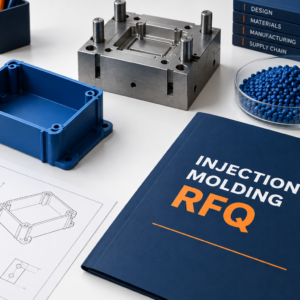



Injection molding resin substitution needs approval against the finished part’s requirements, not just a similar polymer name. You should compare exact grades, review tooling and processing differences, and validate representative parts. Keep the existing material requirement active until the authorized change is documented.
Define The Proposed Material Change Precisely
Your change request should identify the current material and candidate grade completely.
Record the manufacturer, full grade designation, filler level, color system, and permitted recycled or regrind content. Include the reason for substitution, expected availability, and proposed production date.
A description such as equivalent nylon leaves important differences unresolved. Even materials within the same family can have different reinforcement, additives, flow behavior, or intended applications.
Use our injection molding material selection guide for the broader initial selection process. Substitution adds a separate question: what evidence allows you to change an already approved part?
Require the supplier to state every known difference. A candidate should remain identified as a candidate until your approval process is complete.
Compare Properties Under Matching Test Conditions
You should compare relevant properties using compatible methods, specimen conditions, and reporting units.
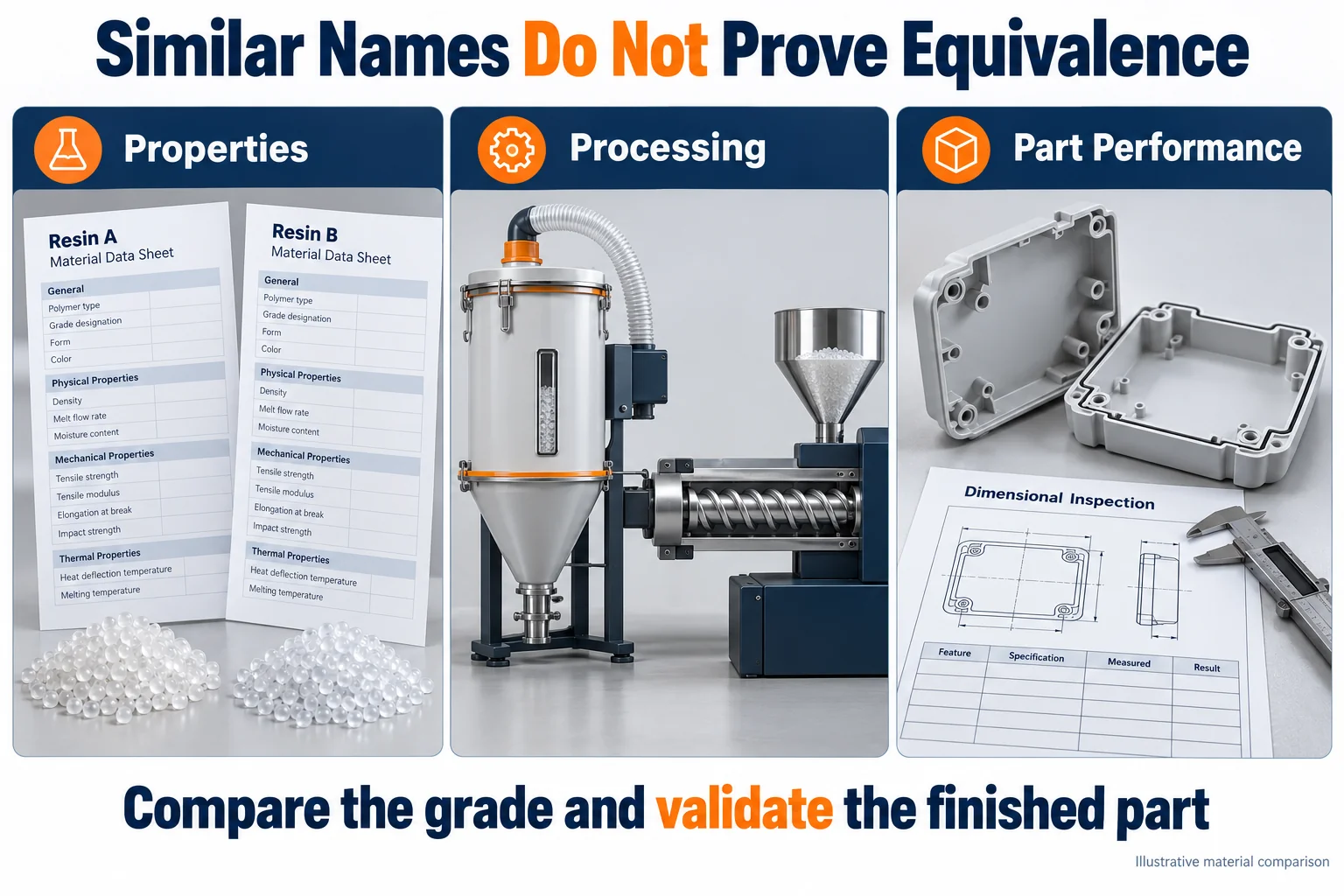
A matching headline tensile strength does not establish equivalent part performance. Review stiffness, impact behavior, temperature exposure, chemical contact, and electrical requirements where relevant.
UL Prospector’s material data sheet guidance explains why standard specimen data need careful interpretation. Data sheets describe specific test conditions, which can differ from actual service conditions.
Ask for the current data sheets and available application guidance from both producers. Mark missing data explicitly. Do not treat an unreported property as evidence that the grades match.
Separate minimum specification requirements from typical supplier data. Decide which differences require molded-part testing rather than a document comparison.
| Comparison Area | Questions For The Review |
|---|---|
| Mechanical Behavior | Does the part retain required stiffness, impact performance, and loaded function? |
| Service Environment | Are temperature, fluids, moisture, and outdoor exposure adequately addressed? |
| Processing | Are drying, melt behavior, and molding conditions suitable for the existing process? |
| Dimensional Behavior | Could shrinkage, orientation, or conditioning change fit and shape? |
| Product Requirements | Do customer approvals and applicable material records cover the candidate? |
Check Shrinkage And The Existing Mold
Your substitution review should confirm that the candidate can meet finished dimensions in the intended tooling.
The mold was developed around a particular material and process. Changing resin can affect shrinkage, warpage, filling, and the condition of critical molded features.
Toray’s TORAYCON molding guidance describes shrinkage effects involving grade, geometry, and molding conditions. Its data apply to the covered materials. They illustrate why one shrinkage number cannot prove interchangeability.
Review critical interfaces such as bearing seats, seals, snap fits, threaded features, and insert locations. Agree on measurement timing and conditioning where these affect acceptance.
Do not modify production tooling before the change owner approves the proposed route. If trial results indicate tooling changes, document the effect on the original approved resin.
Establish A Candidate Processing Window
You should develop and record suitable candidate settings instead of copying the old recipe without verification.
Producer guidance can distinguish grades by drying, temperature ranges, residence limits, and other processing requirements. For example, the BASF Ultraform W2320 processing sheet provides grade-specific guidance. Its values are not a universal substitute-resin recipe.
Ask the molder to review machine suitability, material handling, purging, drying, filling, packing, cooling, and ejection. Record the actual trial conditions and deviations.
Our resin drying and moisture guide explains a separate verification step for material preparation. A successful fill does not establish that the resin was processed appropriately.
Avoid judging the candidate from one visually acceptable shot. Define a trial that represents the cavities and conditions relevant to your production requirement.
Review Recognition And Customer Approval Requirements
You should check material-related product requirements before treating a candidate as an approved replacement.
If your product relies on a material recognition record, verify the exact candidate designation and applicable scope. Review color, thickness, and property conditions where the record makes them relevant.
UL Solutions offers material substitution and modification services to evaluate alternatives. A database match supports screening; it does not independently establish approval for your finished product.
Ask the product owner or responsible approval body what review is required. Keep customer-specific approval obligations in the change plan. Do not add certification marks or claims to trial parts without authorization.
Validate Molded Parts Against A Written Plan
Your validation should connect each important requirement to a test, acceptance criterion, and responsible reviewer.
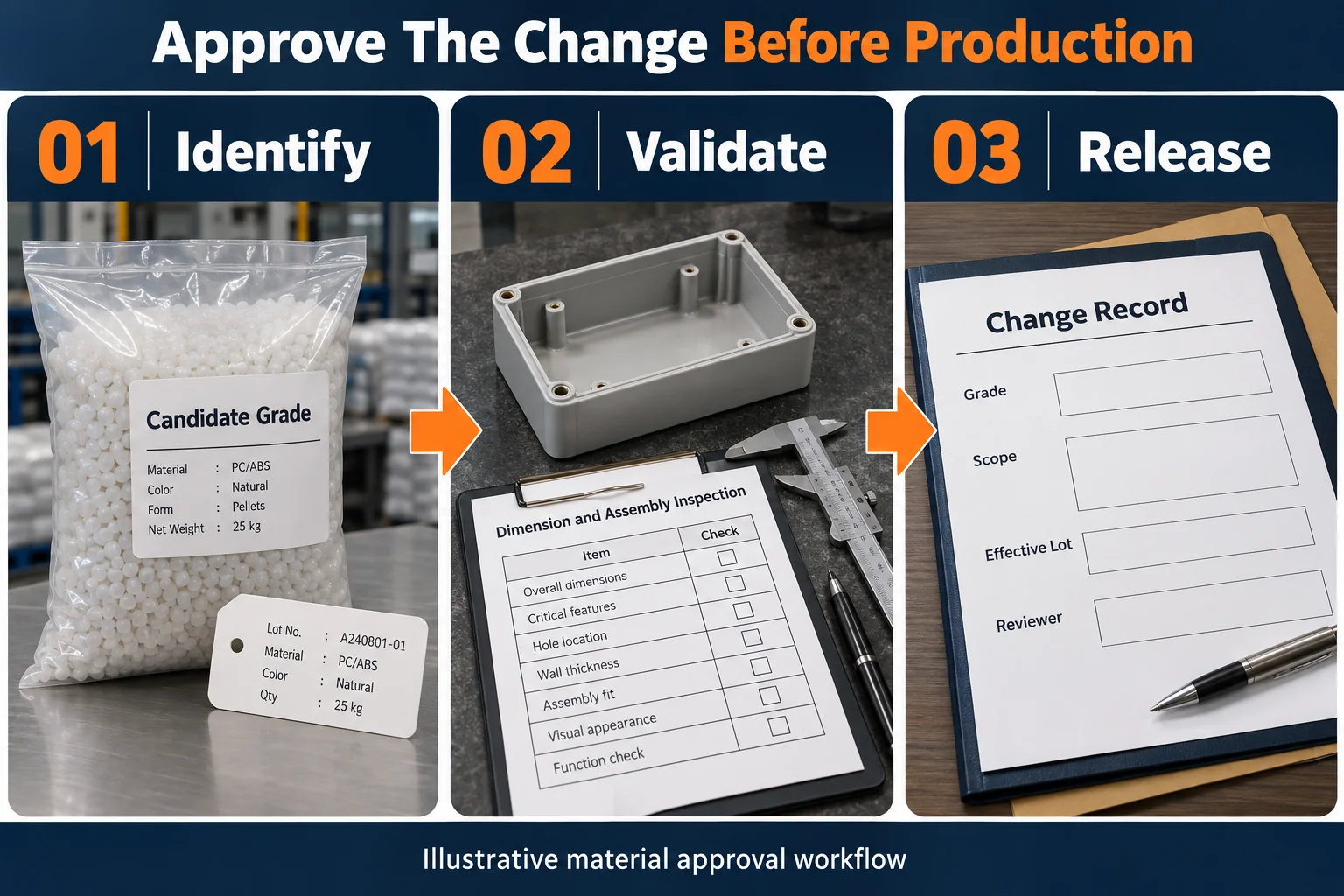
Include dimensional inspection and assembly checks on representative molded parts. Add mechanical, environmental, sealing, or electrical testing when the application requires them.
For a snap-fit enclosure, you might review engagement, retention, repeated assembly, and fit after relevant exposure. Select the actual tests from the product requirements. These examples are not a universal qualification standard.
Retain the original grade as a comparison baseline where useful. Identify material lots, cavities, process settings, conditioning, and test dates. Record failures and deviations as well as passing results.
| Validation Record | Information To Retain |
|---|---|
| Material Identity | Current and candidate grades, colorant, lots, and supporting documents |
| Trial Scope | Mold revision, cavities, machine, and actual process conditions |
| Inspection | Critical dimensions, conditioning, appearance, and assembly results |
| Functional Testing | Approved procedures, exposure conditions, and acceptance criteria |
| Disposition | Deviations, limitations, reviewer, and approval status |
| Production Release | Effective lot, documentation revision, and traceability controls |
Control The Production Change And Stock Transition
Your release plan should prevent approved and unapproved material from becoming mixed or indistinguishable.
Identify the first production lot allowed to use the substitute. Update purchasing specifications, drawings or approved material lists, process instructions, and inspection documents as applicable.
Define how existing resin, work in progress, and finished stock will be handled. Keep the material identity traceable through molding and shipment. Agree on any customer notification before dispatch.
A temporary substitution needs an expiry condition or review point. State whether approval covers one order, one lot, or ongoing production. Require a new review when the proposed scope changes.
Compare Total Substitution Cost
Your purchasing decision should include qualification and transition costs alongside resin price and availability.
Trials, laboratory work, process development, tooling changes, inventory segregation, and additional inspection can affect the business case. A cheaper resin may require expensive validation or fail a functional requirement.
TOPS Precision offers plastic injection molding services. Submit the approved grade and proposed alternative during project review. Confirm the trial, inspection, and specialist testing responsibilities before ordering.
Do not assume that a general molding capability includes every application-specific validation service. Ask the supplier to state its proposed scope and any external support required.
Frequently Asked Questions
Your substitution decision should follow the documented part requirements and authorized approval route.
Can You Replace A Resin With The Same Polymer Family
The family name alone is insufficient. Compare exact grades and validate the relevant processing and finished-part requirements.
Do Matching Data Sheets Prove Equivalence
No. Test conditions, missing properties, processing behavior, and actual service requirements can limit the comparison.
Can You Use The Existing Mold
Possibly, but dimensional and processing trials are needed. Shrinkage, filling, and ejection differences may affect suitability.
Does A Color Change Need Review
It can. Confirm the colorant system, processing effects, appearance requirements, and any relevant recognition scope before release.
Can A Temporary Substitute Become Permanent Automatically
No. Follow the approved scope and expiry conditions. Document any extension or permanent approval through the responsible change process.
Request A Resin Change Review
Send the current and candidate grades, drawings, annual volume, program life, and application requirements. Contact our team to define the trial and approval scope before changing production material.