



A prototipagem rápida transforma rapidamente um modelo CAD em uma peça física, muitas vezes dentro de horas ou dias, so you can test a design before committing to production tooling. It validates fit, função, aparência, materiais, and manufacturability through 3D printing, Usinagem CNC, fundição a vácuo, or rapid tooling. Here is what you need to know.
How Does Rapid Prototyping Work?
Rapid prototyping starts with a 3D model and ends with a physical part you can test.
- Build a 3D CAD model of the part.
- Choose the process and material.
- Make the part by printing, usinagem, fundição, or molding.
- Test and measure the result.
- Iterate the design and repeat.
Rapid prototyping reduces the time and cost of design changes because you validate the part before committing to production tooling.
What Are The Main Types Of Rapid Prototypes?
Choose the prototype type that matches what you need to learn about the design.
| Prototype Type | What It Validates | Typical Process |
| Concept prototype | Basic shape and idea | FDM, SLA |
| Protótipo visual | Aparência, tamanho, ergonomia | SLA, PolyJet |
| Protótipo funcional | Ajustar, conjunto, mechanical function | CNC, SLS, mjf |
| Engineering prototype | Material, tolerância, desempenho | Usinagem CNC |
| Pre-production prototype | Production design and manufacturability | CNC, rapid molding |
The process should follow what you validate. A visual prototype does not need production-grade material. A functional engineering prototype may need the same alloy, tolerância, and surface finish planned for production.
What Are The Main Rapid Prototyping Methods?
Rapid prototyping methods fall into additive, subtrativo, and soft-tooled families.
3Impressão D
3D printing builds parts layer by layer. It is best for complex geometry and early design checks.
- FDM is low-cost for concept and functional prototypes.
- SLA gives smooth surfaces and fine details.
- SLS gives durable nylon parts with complex geometry.
- MJF gives functional polymer prototypes and small batches.
- Metal 3D printing suits complex metal parts that are hard to machine.
Usinagem CNC. CNC machining cuts parts from solid stock. It produces functional metal and plastic prototypes with production-like properties.
Elenco de vácuo. Vacuum casting uses a silicone mold to make repeated plastic-like parts. It suits small batches of 10 para 50 cópias.
Rapid Injection Molding. Rapid injection molding uses soft aluminum molds to make production-like molded parts. It suits bridge quantities before full production.
Fabricação de chapas metálicas. Sheet metal fabrication cuts and bends sheet for enclosures, colchetes, e painéis.
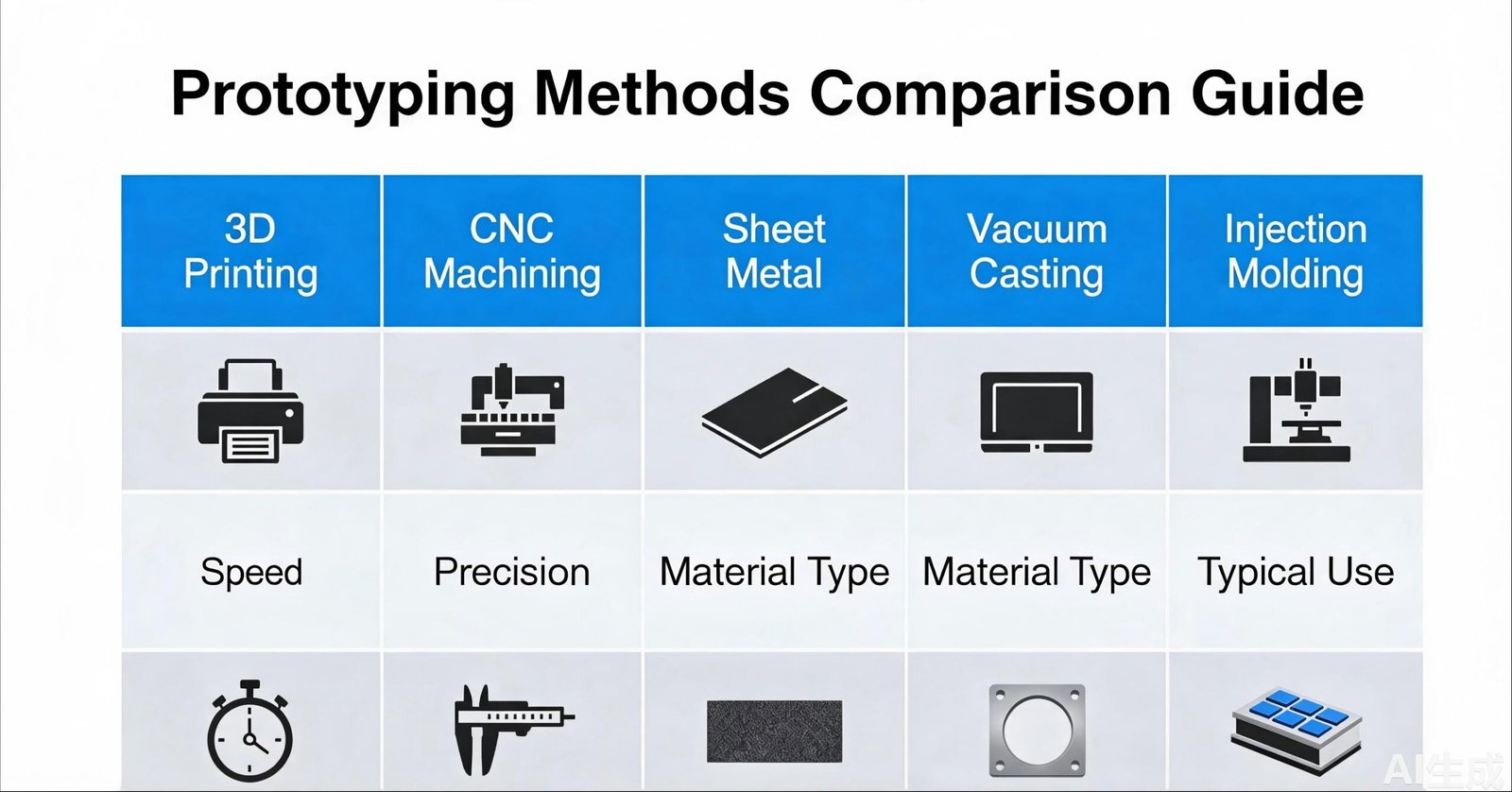
How Do Rapid Prototyping Methods Compare?
| Método | Melhor para | Material Fidelity | Tooling Required | Typical Quantity | Main Limitation |
| FDM / SLA | Concept and visual models | Baixo-médio | Não | 1-20 | Properties may differ from production |
| SLS / mjf | Functional plastic parts | Médio-alto | Não | 1-100+ | Limited surface and material options |
| Usinagem CNC | Functional metal and plastic prototypes | Alto | No hard tooling | 1-100+ | Geometry limits and machining cost |
| Fundição a vácuo | Repeated plastic-like parts | Médio | Silicone mold | 10-50 | Mold life and material equivalency |
| Rapid injection molding | Production-like molded parts | Muito alto | Mold required | Tens to thousands | Maior custo inicial de ferramentas |
| Fabricação de chapa metálica | Brackets and enclosures | Alto | Usually minimal | 1 to hundreds | Limited to sheet geometry |
What Materials Are Used For Rapid Prototyping?
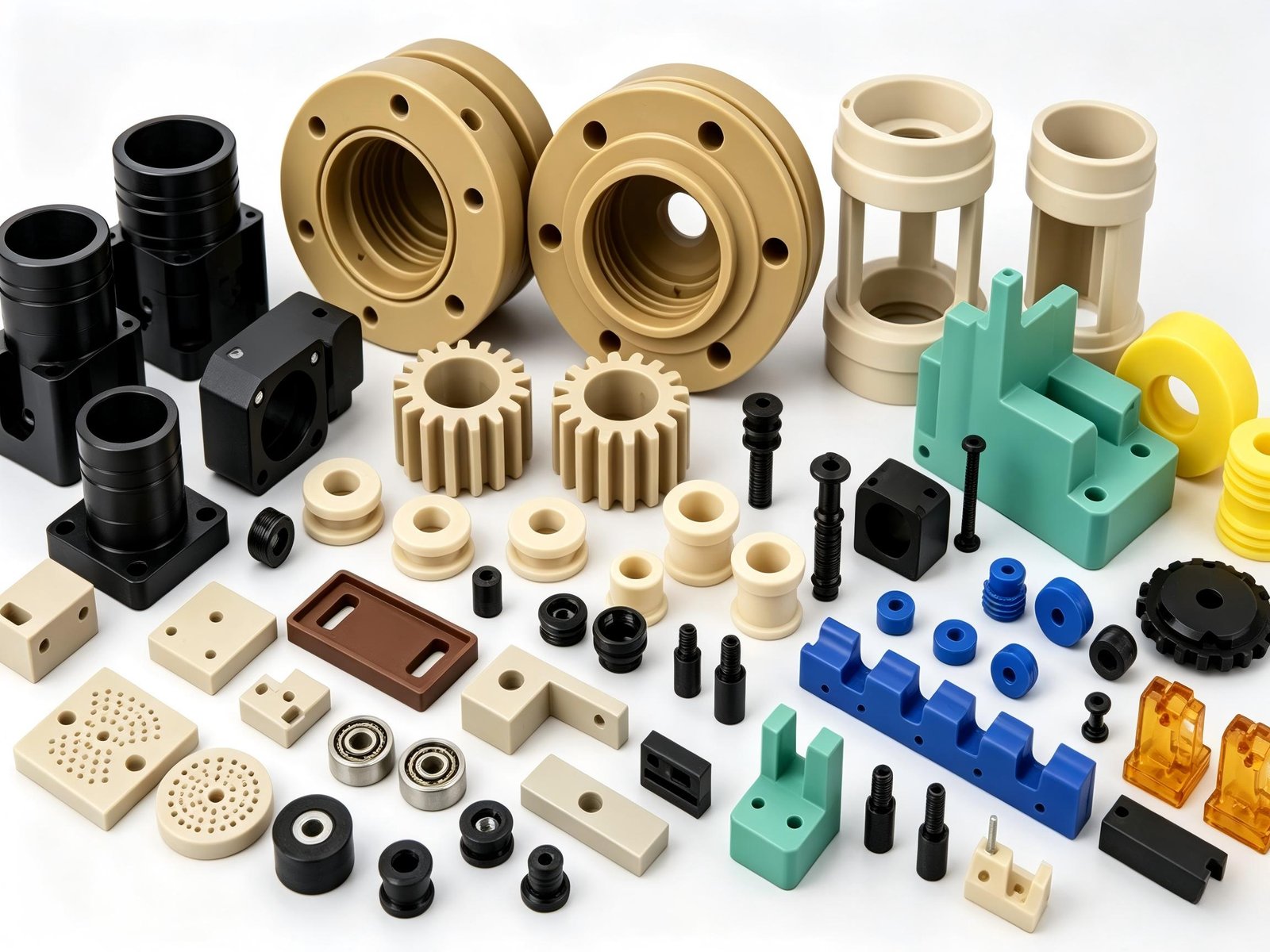
Plastics cover most prototypes. Metals are common when the test must match production.
- Plásticos: abdômen, nylon, OLHADINHA, acrílico, policarbonato, and castable resins.
- Metais: alumínio, aço, aço inoxidável, e titânio.
- Composites and ceramics for specialized tests.
For functional and engineering prototypes, use the final production material, or one with comparable mechanical, térmico, e propriedades químicas, when practical. For concept or visual prototypes, lower-cost substitute materials may be sufficient.
Material selection should depend on what you validate: dimensional fit, força mecânica, temperature resistance, resistência química, surface appearance, assembly behavior, electrical properties, or environmental exposure. Ver Materiais de usinagem CNC to compare options.
Rapid Prototyping Vs 3D Printing Vs Rapid Tooling
| Prazo | Significado |
| Prototipagem rápida | Quickly producing parts for design validation |
| 3D impressão | An additive process commonly used for prototypes |
| Ferramentas rápidas | Quickly producing molds, morre, or tooling for prototype or bridge production |
Rapid prototyping describes the development approach. 3D printing describes a manufacturing process. 3D printing is one way to produce rapid prototypes, but CNC machining, fundição a vácuo, fabricação de chapas metálicas, and rapid molding are also used.
What Are The Advantages Of Rapid Prototyping?
Rapid prototyping compresses the design cycle and reduces risk.
- It delivers parts in days instead of weeks.
- It supports fast design iterations.
- It catches errors before tooling commitments.
- It gives stakeholders a physical part to review.
- It allows functional testing with suitable materials.
- It can produce small bridge volumes before production.
What Are The Limitations Of Rapid Prototyping?
A prototype is not always identical to a production part.
- 3D-printed parts can differ in strength and surface from molded parts.
- Prototype materials may not match the final production grade.
- Single-piece costs are higher than mass production.
- Very high volumes are better served by production processes.
Interpret test results according to how closely the prototype matches the production material and process. A CNC-machined production-grade material can give strong functional validation. A 3D-printed substitute may be better for geometry or early-stage testing.
Where Is Rapid Prototyping Used?
| Aplicativo | Typical Example | Common Method |
| Desenvolvimento de produtos | Alojamentos eletrônicos | 3D printing or CNC |
| Dispositivos médicos | Fit and function models | 3D printing or CNC |
| Automotivo | Brackets and panels | CNC or rapid molding |
| Automação industrial | End-of-arm tooling | FDM or SLS |
| Marketing | Look models | SLA |
| Production bridging | Initial low volumes | Rapid injection molding |
How To Choose A Rapid Prototyping Method
Choose the process according to these six factors.
- What are you validating? Aparência, ajustar, tolerância, força, desempenho térmico, or production feasibility.
- Does material equivalency matter? Se sim, choose CNC machining or production-like molding.
- How complex is the geometry? Additive processes suit internal channels and shapes that are hard to machine.
- What tolerances are required? Tight dimensional requirements may favor CNC machining.
- How many parts do you need? One prototype and 200 bridge parts have different economics.
- Will the design change again? Avoid dedicated tooling when major revisions remain likely.
For metal parts, nosso Prototipagem CNC service produces parts from solid stock. Read our CNC prototype machining guide e how to make a metal prototype para mais detalhes.
Rapid Prototyping DFM Tips
Keep these points in mind before you send a prototype drawing.
- Avoid unnecessary tight tolerances.
- Identify critical dimensions on the 2D drawing.
- Especifique o material, nota, and temper where function depends on them.
- Avoid very deep cavities and thin walls when machining.
- Separate cosmetic and functional surface requirements.
- Specify threaded inserts, tópicos, and mating interfaces.
- Indicate which dimensions require inspection reports.
- Tell the supplier what the prototype is intended to validate.
Sharing the intended test purpose lets the manufacturer recommend a process that meets the engineering requirement without unnecessarily increasing cost.
How Much Does Rapid Prototyping Cost?
Cost depends on the method, material, tamanho, complexidade, quantidade, e terminar.
| Cost Driver | Why It Changes Price |
| Tamanho da peça | More material and machine or build time |
| Geometria | Complex features increase processing time |
| Material | Engineering plastics and specialty metals cost more |
| Tolerância | Tighter tolerances need more controlled manufacturing and inspection |
| Acabamento superficial | Polimento, anodização, and painting add operations |
| Quantidade | Setup cost is distributed over more pieces |
| Ferramentas | Vacuum casting and molding require molds |
| Tempo de espera | Urgent delivery may limit process options |
A quote gives you the real number for your specific part.
CNC Rapid Prototyping For Functional Parts
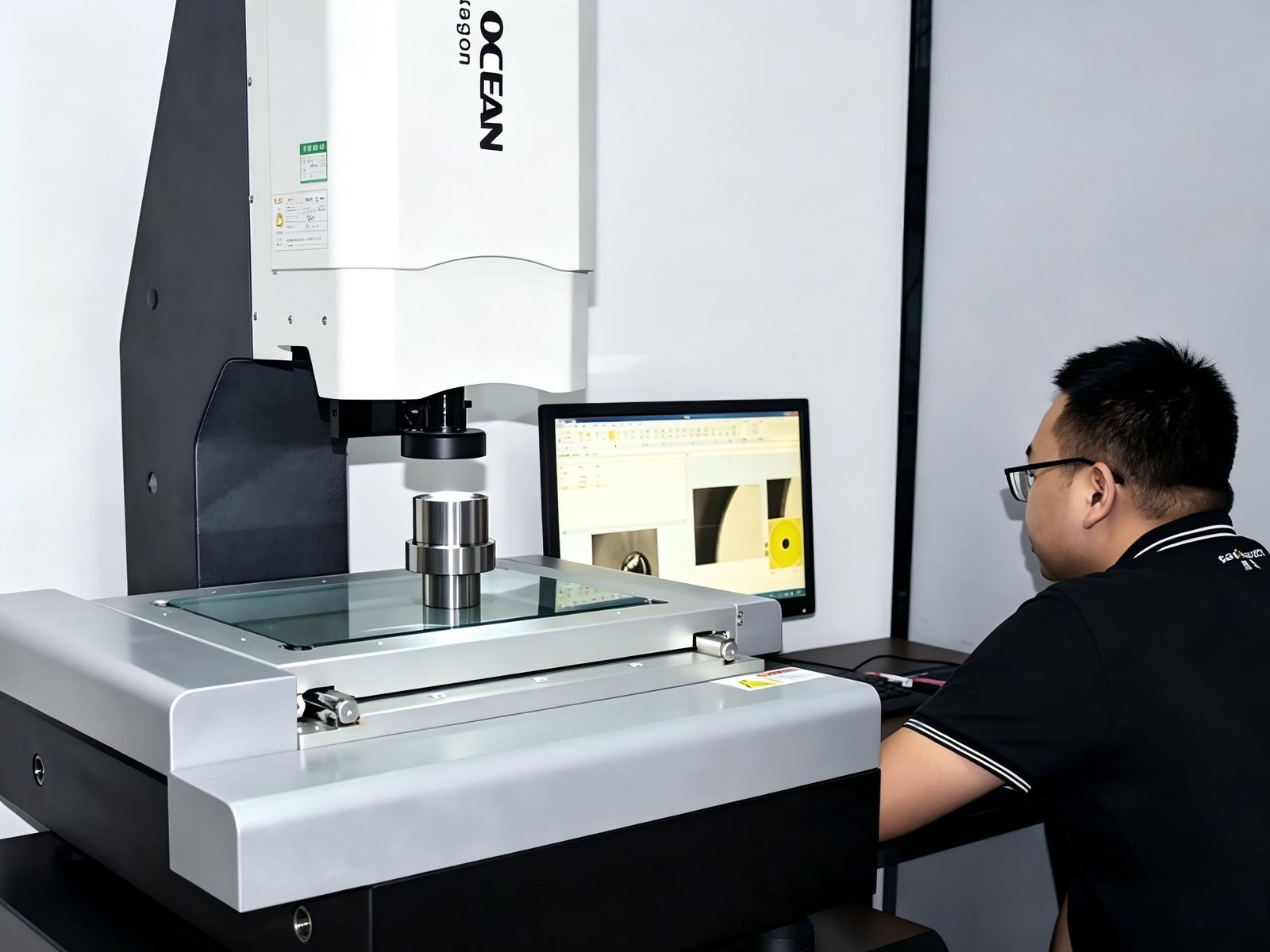
For functional metal and engineering-plastic prototypes, TOPS Precision uses CNC milling and turning to manufacture parts directly from solid stock. This approach works when the prototype needs production-grade material properties, tight dimensional control, tópicos, mating interfaces, or production-representative surface finishes.
Nós maquinamos 100+ metals and plastics under an ISO 9001:2015 quality system. For suitable projects, functional prototypes are typically completed in 1-3 dias. Sending a drawing starts a free DFM review and process recommendation.
perguntas frequentes
What is rapid prototyping used for?
It is used to test form, ajustar, função, aparência, and manufacturability before production tooling.
Is 3D printing the same as rapid prototyping?
Não. 3D printing is one rapid prototyping method. Usinagem CNC, fundição a vácuo, and rapid molding are others.
How long does rapid prototyping take?
Typically days. Exact time depends on method, material, complexidade, e quantidade.
How much does rapid prototyping cost?
It depends on size, geometria, material, tolerância, terminar, quantidade, e ferramentas. A quote gives the real number.
What is the difference between rapid prototyping and rapid tooling?
Rapid prototyping makes sample parts. Rapid tooling makes molds or dies quickly for prototype or bridge production.
Which rapid prototyping method is best for metal parts?
CNC machining is usually best for functional metal prototypes because it uses production-grade material and holds tight tolerances.
Get A Quote For Your Prototype
Send your 3D CAD file, 2D desenho, material, quantidade, and finish requirements. Our engineers will review the design, recommend the fastest reliable method, and quote your prototype before you commit to tooling.


