



Unlike conventional mass-production methods, CNC machining gives bicycle manufacturers greater control over material selection, dimensional accuracy, weight optimization, and customization. This makes it particularly suitable for premium bicycles, racing bikes, mountain bikes, e-bikes, custom bicycle builds, and low- to medium-volume production.
But which bicycle parts are actually made with CNC machining? Why is CNC machining preferred for these components? Which materials are commonly used? And when should a bicycle manufacturer choose CNC machining instead of casting or forging?
This guide explains the most common CNC machined bicycle parts, the advantages and limitations of CNC machining, material options, manufacturing considerations, and how to choose the right CNC machining partner.
1. What Is CNC Machining and Why Is It Important for Bicycle Parts?
1.1 What Is CNC Machining?
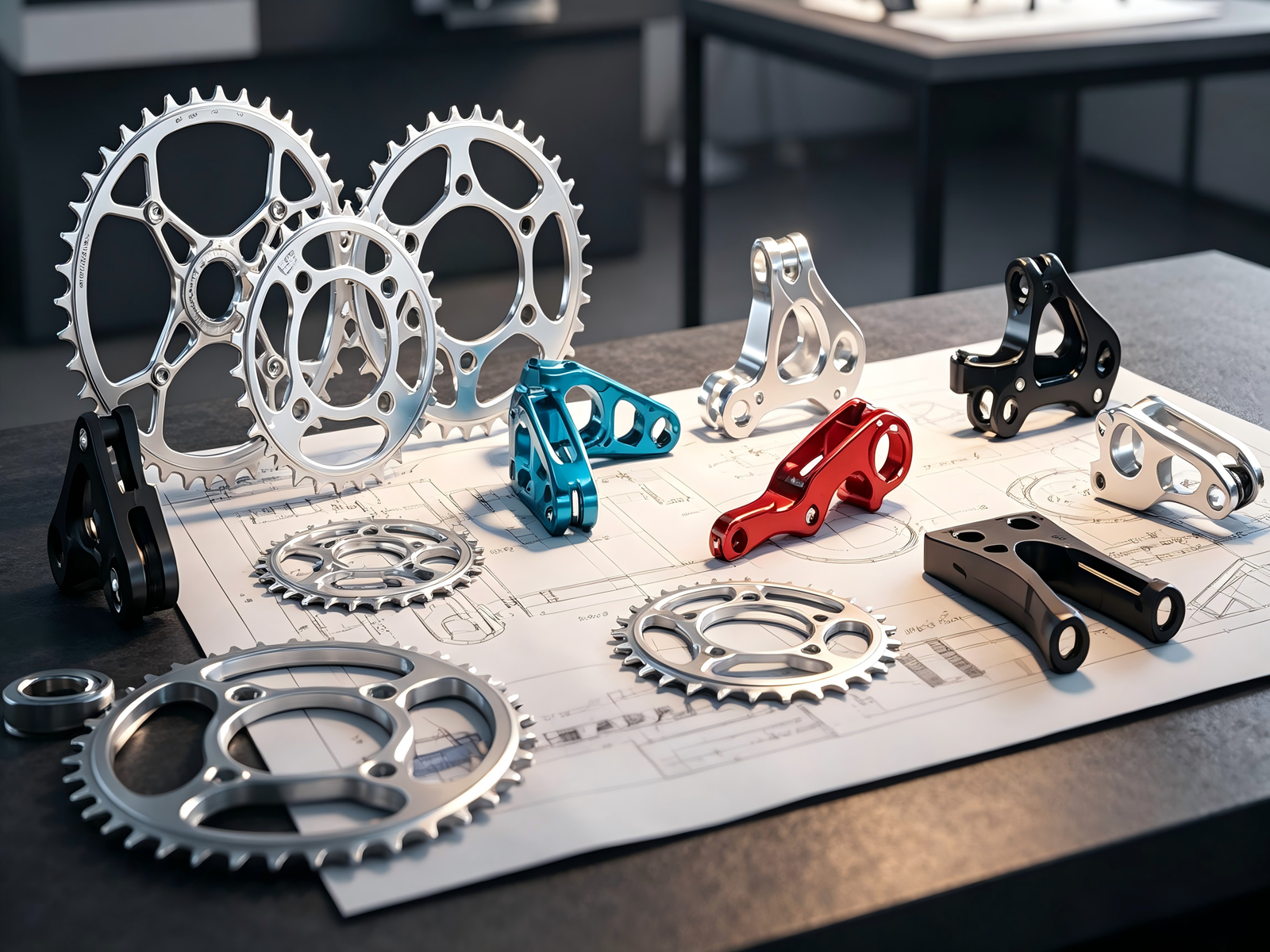
CNC stands for Computer Numerical Control. CNC machining is a subtractive manufacturing process in which computer-controlled machines remove material from a solid workpiece to create a finished component.
The manufacturing process typically starts with a digital CAD model. Engineers convert the design into machine instructions using CAM software. The CNC machine then controls the movement of cutting tools along multiple axes to remove material precisely according to the programmed geometry.
Depending on the component and design requirements, manufacturers may use:
- 3-axis CNC milling
- 4-axis CNC machining
- 5-axis CNC machining
- CNC turning
- CNC turning and milling
- Swiss-type CNC machining
For bicycle components, CNC milling is especially common because many parts require complex pockets, curved surfaces, bores, threaded holes, and lightweight structures.
The process can produce components directly from materials such as aluminum, titanium, stainless steel, steel, brass, and engineering plastics.
1.2 Why Is CNC Machining Suitable for Bicycle Components?
Bicycle components operate under a wide range of mechanical loads. Crank arms experience repeated torque, hubs carry wheel loads, stems must withstand steering forces, and brake components need to maintain accurate alignment under mechanical and thermal stress.
For these applications, small dimensional errors can affect:
- Component fit
- Mechanical performance
- Rider safety
- Weight
- Durability
- Noise and vibration
- Assembly efficiency
CNC machining is well suited to these requirements because it offers excellent dimensional control and repeatability.
For example, a CNC-machined hub can be manufactured with precise bearing seats and concentric bores. A CNC-machined stem can maintain accurate clamping surfaces. A derailleur hanger can be produced with precise mounting holes and alignment features.
This level of precision is particularly valuable when multiple components must work together as a complete bicycle system.
2. Which Bicycle Parts Are Commonly Made with CNC Machining?
Not every bicycle component requires CNC machining. However, parts that require high precision, complex geometry, lightweight construction, or customization are often excellent candidates.
Here are some of the most common CNC machined bicycle parts.
2.1 CNC Machined Cranksets and Crank Arms
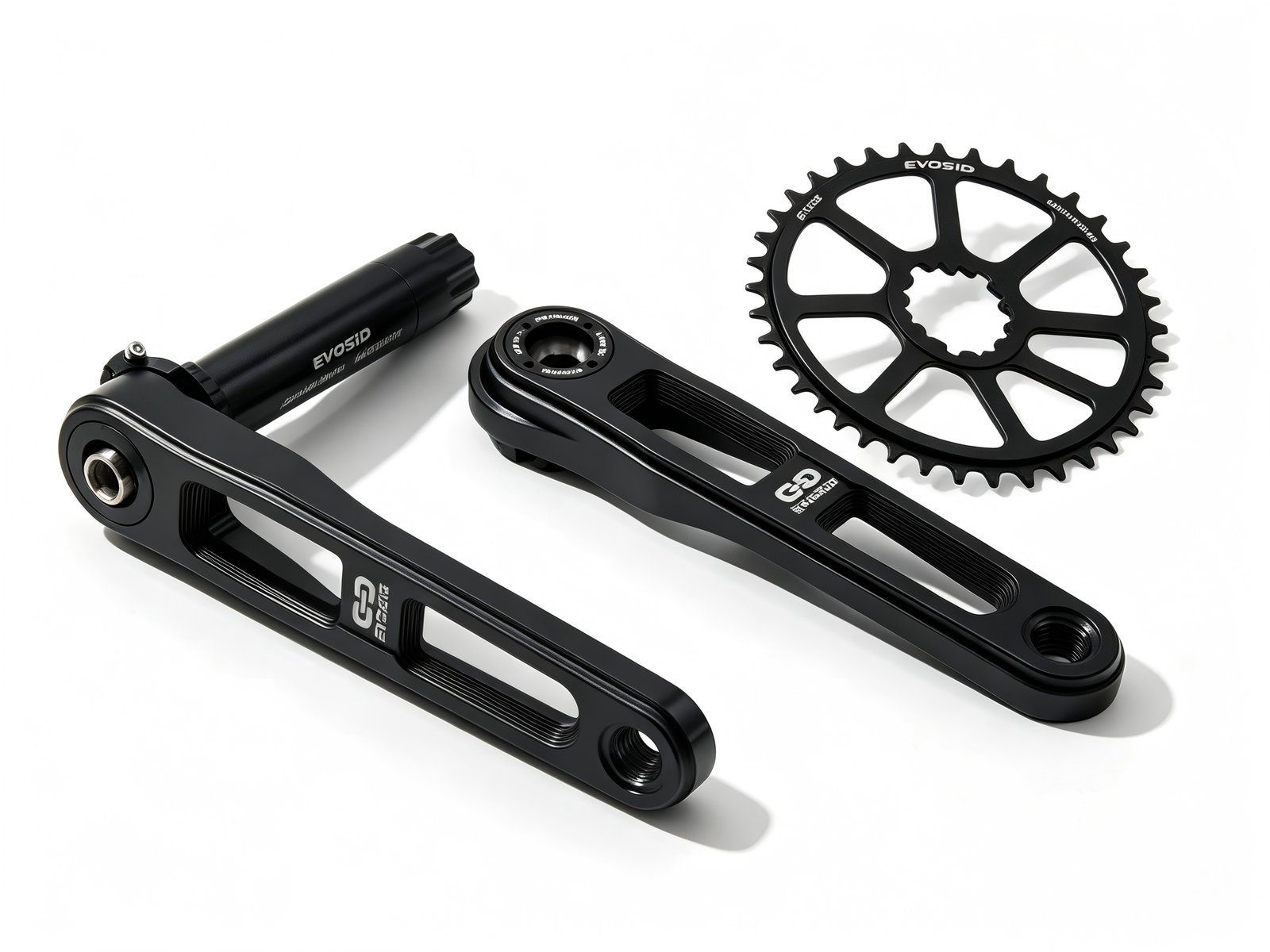
Crank arms are among the most demanding bicycle components because they transfer the rider’s pedaling force directly to the drivetrain.
During normal operation, crank arms experience repeated torque and cyclic loading. They therefore require a combination of:
- High strength
- Low weight
- Dimensional accuracy
- Structural stiffness
- Fatigue resistance
CNC machining allows manufacturers to optimize crank arm geometry by removing material from low-stress areas while maintaining sufficient material around critical load-bearing zones.
Aluminum alloys such as 6061-T6 and 7075-T6 are commonly considered for CNC-machined bicycle crank components.
CNC machining can also create precise:
- Pedal threads
- Bottom bracket interfaces
- Chainring mounting holes
- Weight-reduction pockets
- Decorative features
For premium bicycle manufacturers, CNC machining can provide greater design freedom than conventional manufacturing processes.
However, because crank arms are safety-critical components, the final design must be properly engineered and validated for the intended loads and application.
2.2 CNC Machined Chainrings
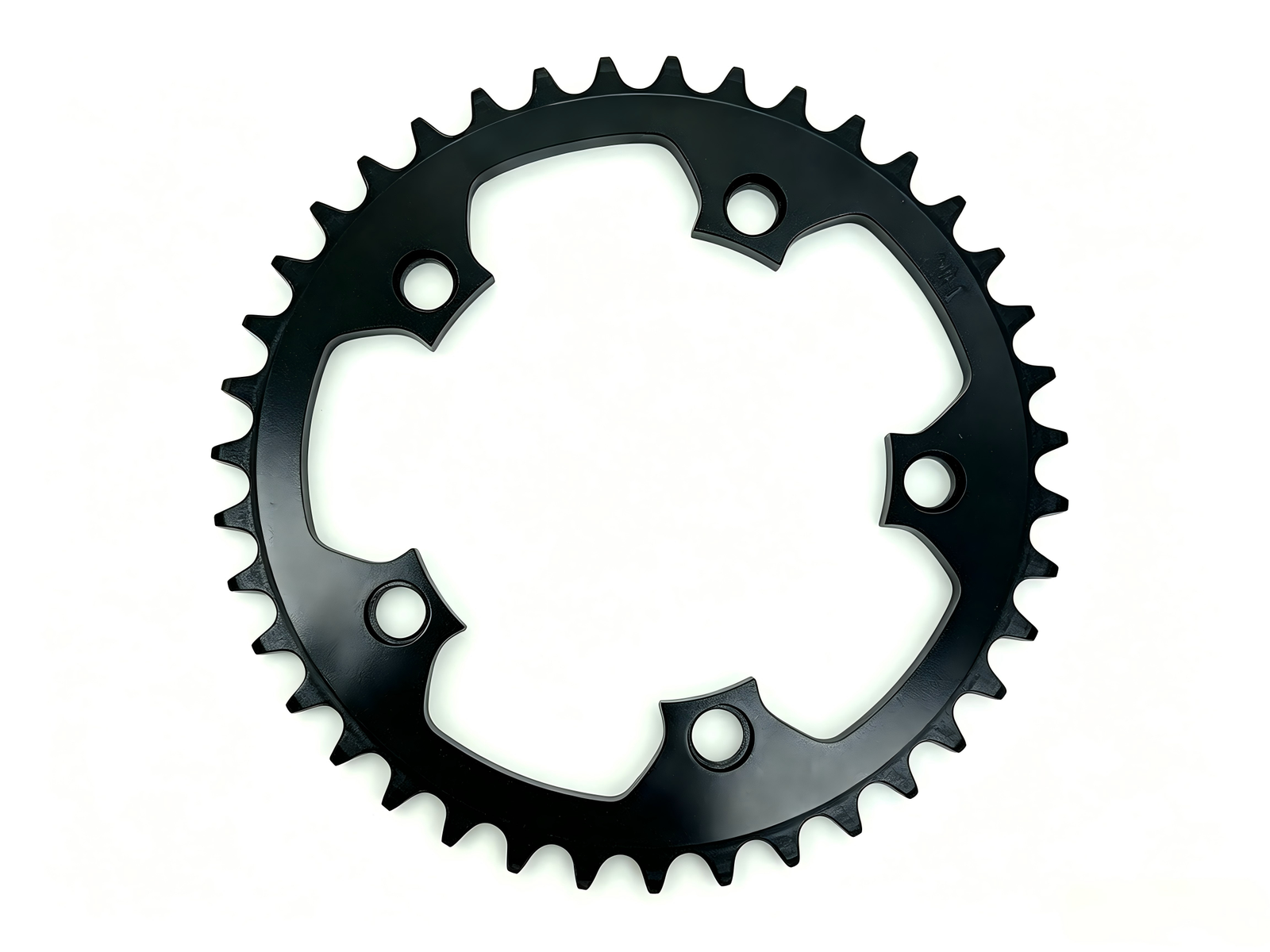
Chainrings are another common application for precision machining.
The shape and spacing of chainring teeth directly influence drivetrain performance. Small variations in tooth geometry can affect:
- Chain engagement
- Shifting performance
- Noise
- Wear
- Power transmission
CNC machining can produce highly accurate tooth profiles and mounting interfaces.
It is also suitable for specialized designs such as:
- Standard round chainrings
- Oval chainrings
- Narrow-wide chainrings
- Custom lightweight chainrings
- Limited-production performance chainrings
CNC machining allows manufacturers to optimize the chainring structure by removing excess material while maintaining sufficient strength.
After machining, manufacturers may apply finishes such as anodizing, bead blasting, brushing, or laser marking to improve corrosion resistance and visual appearance.
2.3 CNC Machined Hubs and Axles
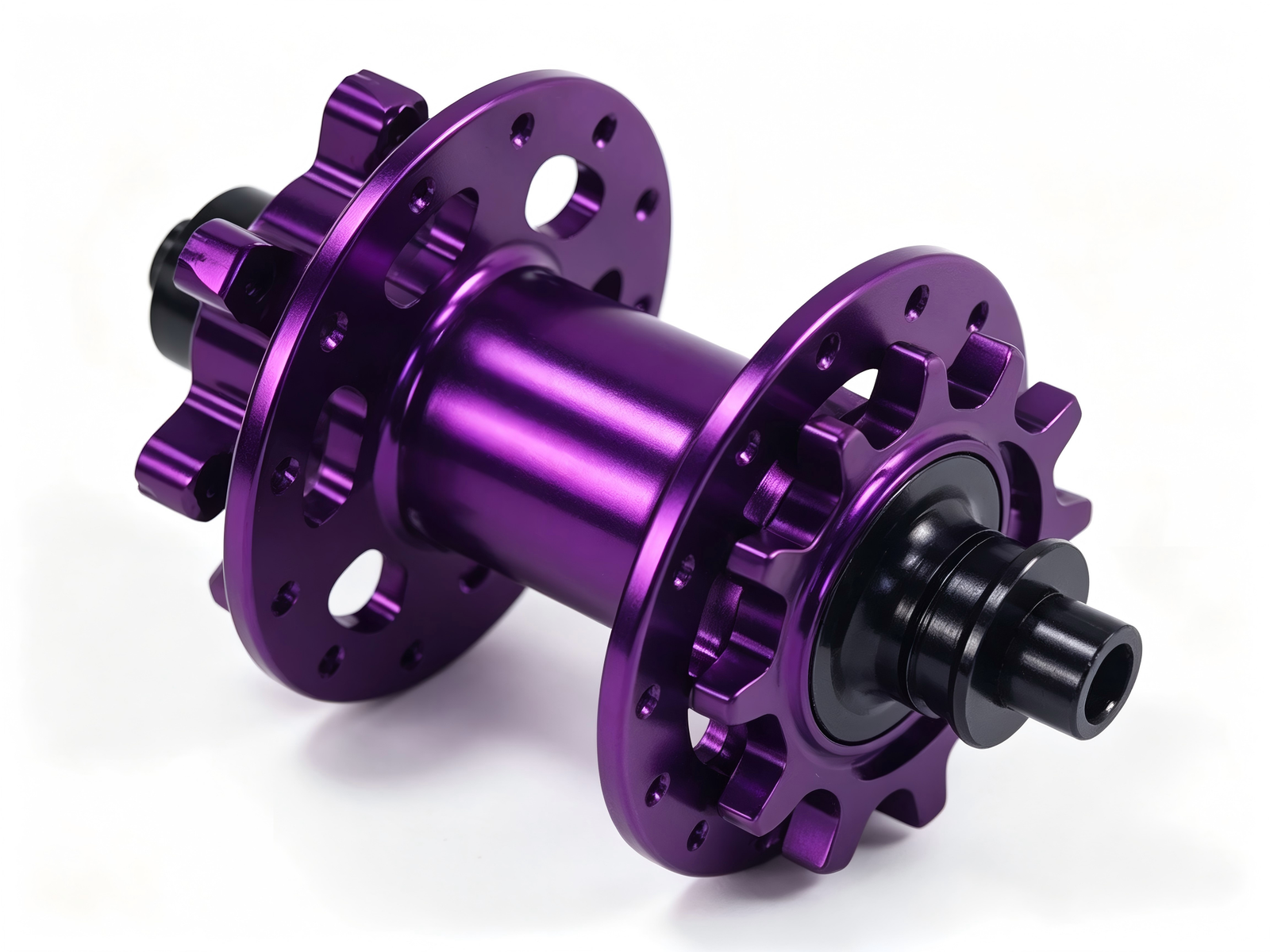
Wheel hubs are critical rotating components. Their performance depends heavily on dimensional accuracy and alignment.
A CNC-machined hub may include:
- Bearing bores
- Axle interfaces
- Spoke holes
- Flanges
- Rotor mounting features
- Freehub interfaces
The bearing seats and central bores require particular attention. Poor concentricity or inaccurate dimensions can result in:
- Increased friction
- Bearing wear
- Vibration
- Poor wheel alignment
- Reduced service life
CNC machining allows manufacturers to maintain precise relationships between these features.
The process also supports complex flange designs that can help optimize spoke geometry and reduce unnecessary weight.
CNC-machined axles can similarly benefit from precise turning and milling operations, particularly when tight fits and accurate threads are required.
2.4 CNC Machined Brake Calipers and Brake Levers
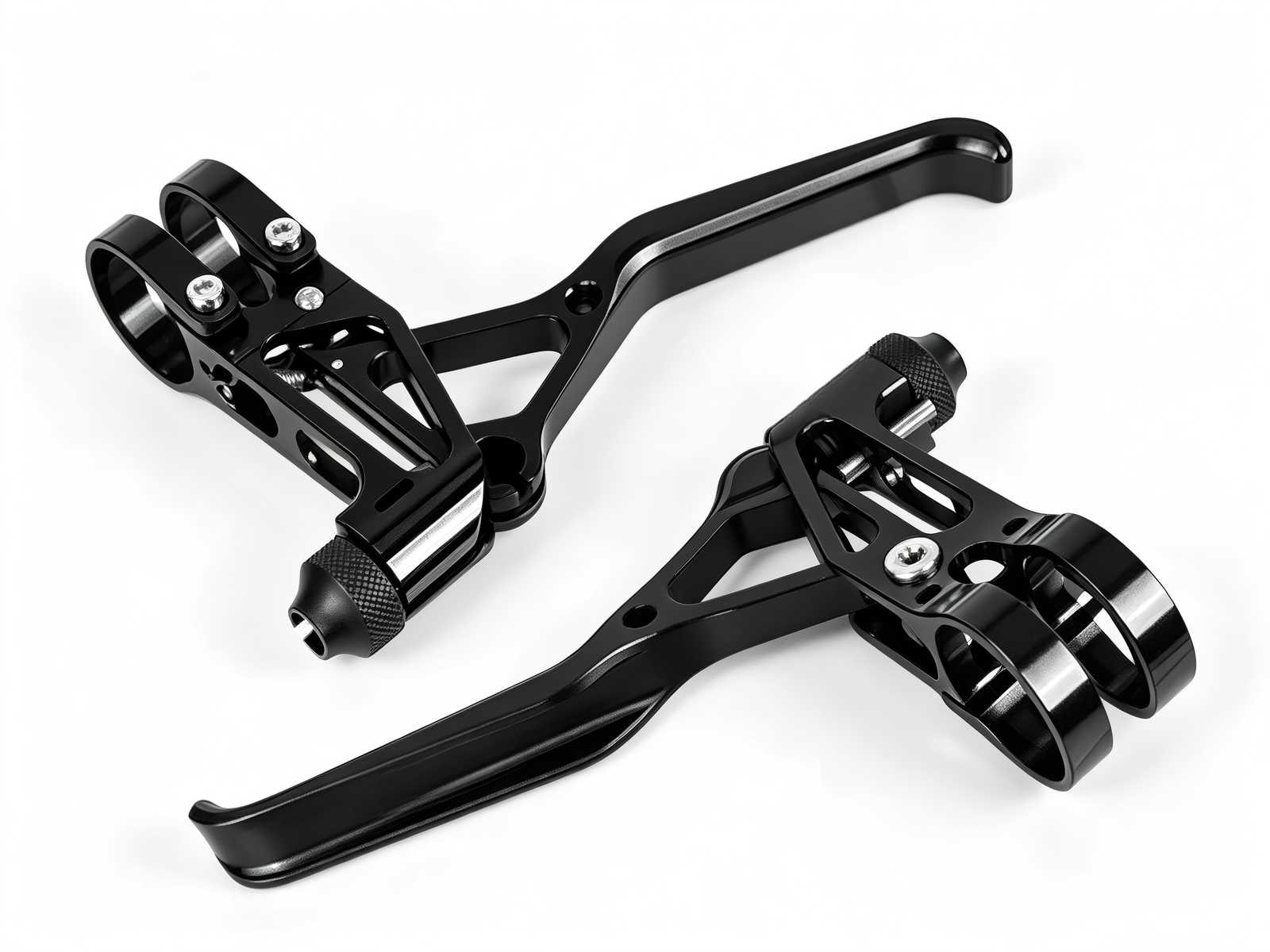
Brake components are safety-critical parts that require precise alignment and reliable mechanical performance.
CNC machining can produce brake calipers and levers with:
- Accurate mounting surfaces
- Precise pivot holes
- Lightweight structures
- Complex internal geometry
- Smooth ergonomic profiles
For high-performance bicycles, designers often want to reduce weight while maintaining sufficient stiffness.
CNC machining allows material to be strategically removed from low-stress areas while preserving structural material around critical interfaces.
For brake levers, CNC machining also enables manufacturers to develop custom ergonomic shapes and brand-specific designs.
For hydraulic systems, additional manufacturing processes may be required to create internal fluid passages and sealing interfaces.
Because braking systems directly affect rider safety, components must be designed, manufactured, and tested according to the relevant application requirements.
2.5 CNC Machined Bicycle Stems
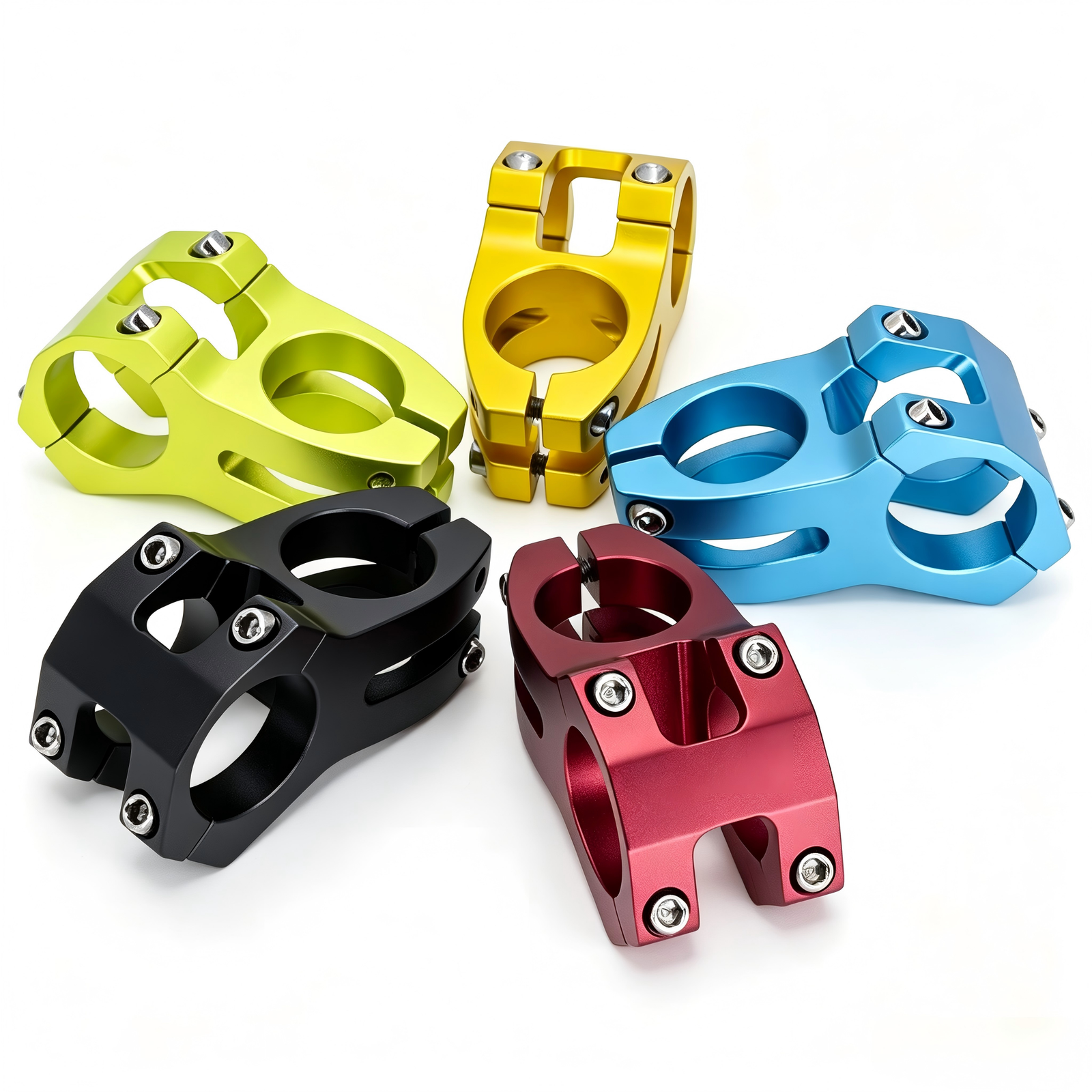
A bicycle stem connects the handlebars to the steering system and plays an important role in handling and rider control.
A CNC-machined stem typically requires accurate:
- Handlebar clamping surfaces
- Steerer tube interfaces
- Bolt holes
- Threaded holes
- Alignment features
Manufacturers can use CNC machining to create lightweight designs with carefully positioned pockets and cutouts.
The main advantages include:
- High dimensional accuracy
- Consistent clamping
- Weight optimization
- Custom geometry
- Premium surface finishes
CNC machining also allows bicycle brands to incorporate logos, decorative details, and distinctive design elements.
For high-end road, mountain, gravel, and racing bicycles, the combination of precision and lightweight construction makes CNC machining an attractive option.
2.6 CNC Machined Bicycle Pedals
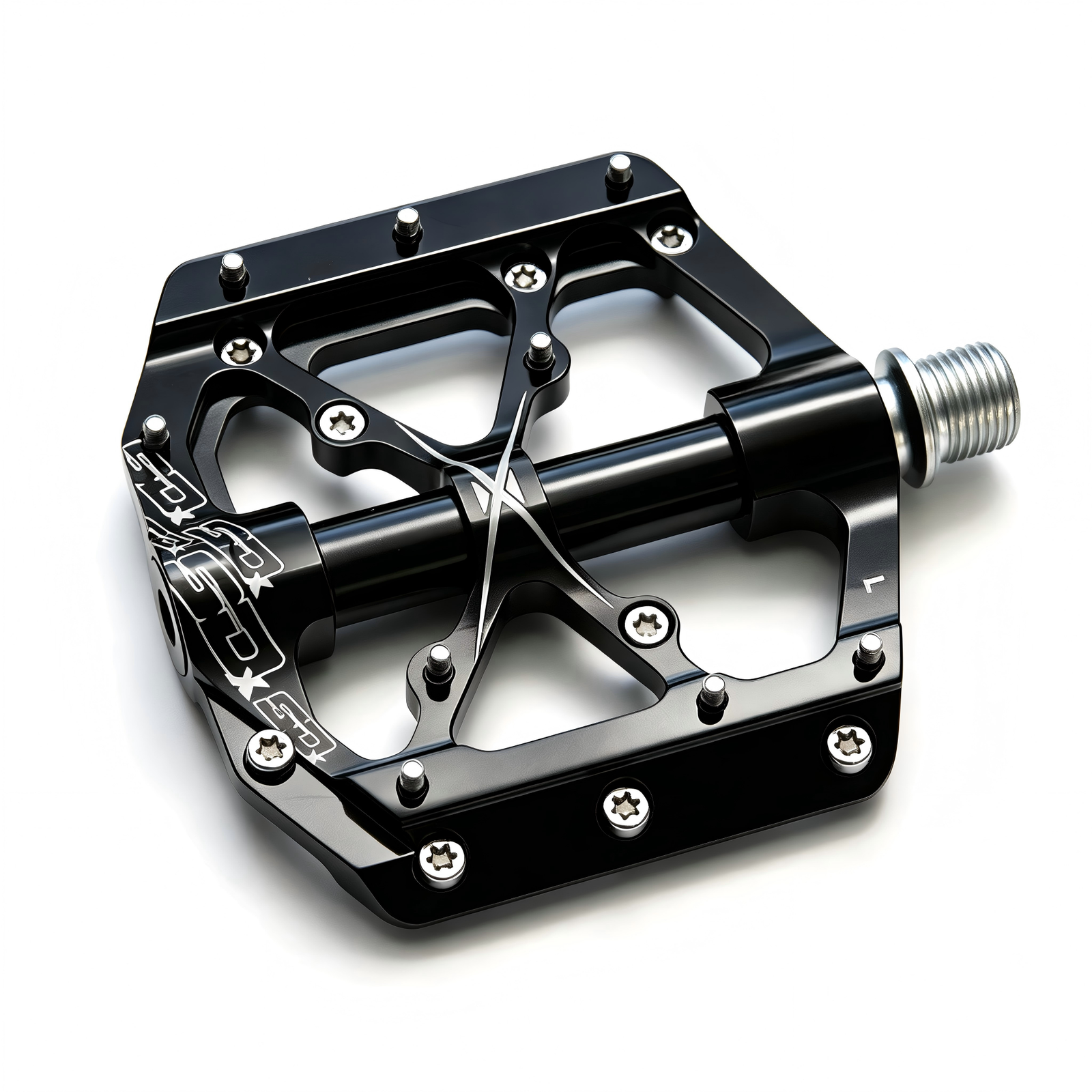
Pedals must withstand repeated impact, rotational forces, and rider weight.
CNC machining can be used to manufacture pedal bodies and other pedal components with customized features such as:
- Grip surfaces
- Pin holes
- Bearing cavities
- Lightweight pockets
- Custom contours
Aluminum alloys are commonly considered for performance-oriented pedal bodies.
CNC machining allows manufacturers to balance strength and weight while creating unique designs for different riding styles.
For example, mountain bike pedals may prioritize impact resistance and grip, while road bike components may focus more heavily on low weight and aerodynamic design.
2.7 CNC Machined Seatpost Clamps
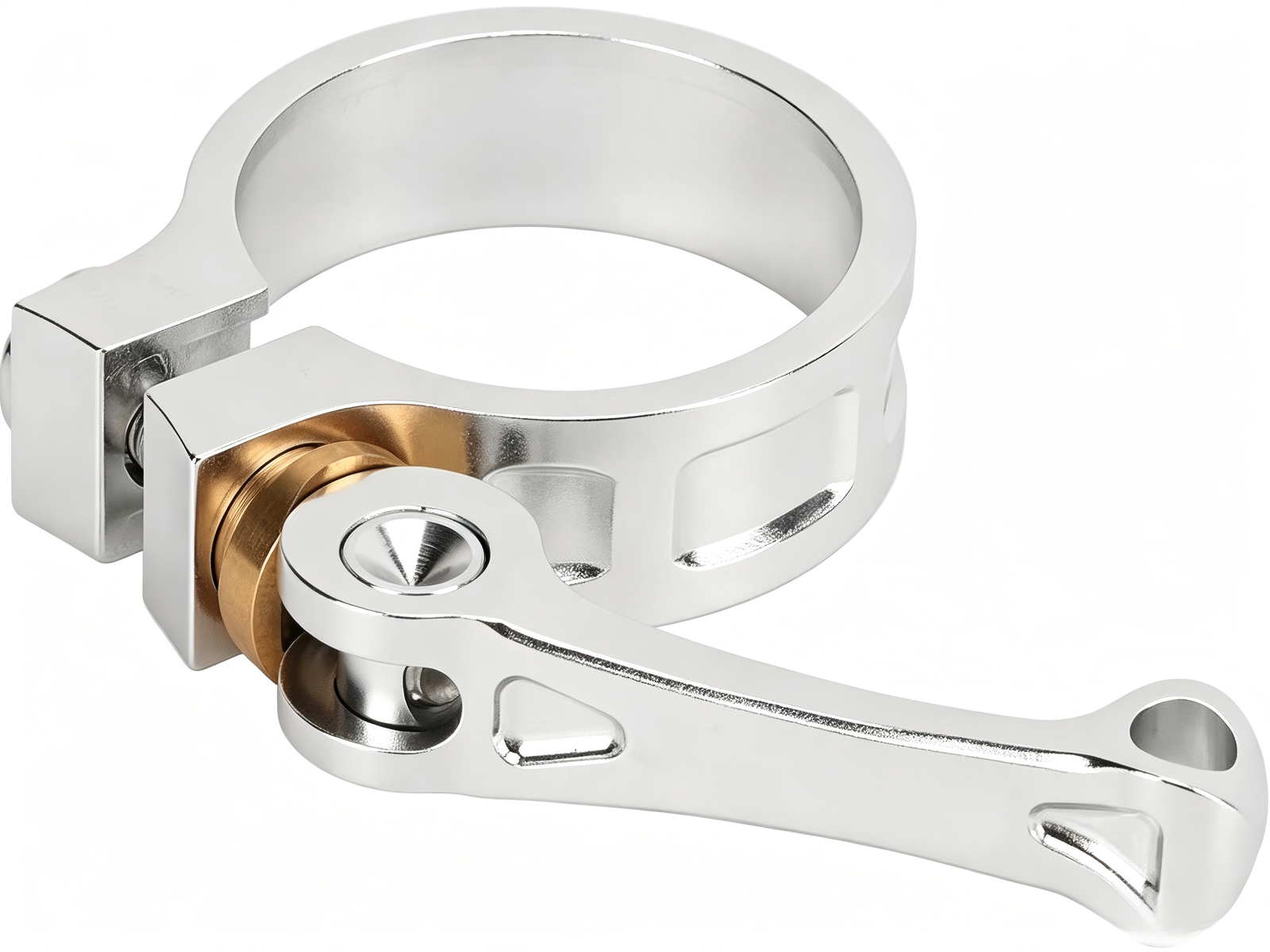
Although relatively small, seatpost clamps are important components that require consistent clamping force.
CNC machining can produce precise interfaces that help distribute clamping pressure evenly around the seatpost.
Benefits include:
- Accurate dimensions
- Consistent clamping
- Lightweight construction
- Custom designs
- High-quality finishes
Manufacturers can also add laser-etched logos or other branding elements to create a premium appearance.
2.8 Other Bicycle Parts Commonly CNC Machined
Beyond the major components above, CNC machining is also used for many specialized bicycle parts.
These may include:
- Derailleur hangers
- Dropouts
- Bottom bracket components
- Headset components
- Crank caps
- Suspension components
- Brake adapters
- Cable guides
- Mounting brackets
- E-bike motor brackets
- Battery mounting components
- Custom frame fittings
For e-bikes, CNC machining is increasingly useful for custom mechanical components that connect electrical systems, batteries, motors, and bicycle frames.
The suitability of CNC machining depends on the part’s geometry, material, quantity, tolerance requirements, and production budget.
3. Why Do Bicycle Manufacturers Prefer CNC Machining?
CNC machining is not always the cheapest manufacturing process. However, it provides a unique combination of precision, flexibility, design freedom, and quality.
3.1 High Precision and Tight Tolerances
Precision is critical when bicycle components must fit together accurately.
Examples include:
- Bearing seats
- Axle interfaces
- Threaded holes
- Clamping surfaces
- Mounting holes
- Drivetrain components
CNC machining allows manufacturers to control these features consistently.
However, it is important to understand that not every feature needs an extremely tight tolerance.
Over-specifying tolerances can increase machining time and inspection requirements without improving actual performance.
A professional CNC supplier should review the drawings and recommend appropriate tolerances based on the function of each feature.
3.2 Excellent Strength-to-Weight Optimization
One of the biggest advantages of CNC machining for performance bicycles is the ability to optimize material distribution.
Instead of manufacturing a solid block with unnecessary mass, engineers can create pockets and contours in areas where material is not structurally essential.
This can help achieve a balance between:
Strength + stiffness + weight + functionality
This approach is particularly valuable for:
- Crank arms
- Stems
- Pedals
- Hubs
- Brake components
The final design must always be validated for the intended mechanical loads, especially for safety-critical components.
3.3 Superior Surface Finish and Appearance
CNC machining can produce clean edges, smooth surfaces, and precise details.
Additional finishing processes may include:
- Anodizing
- Bead blasting
- Brushing
- Polishing
- Powder coating
- Laser engraving
For bicycle brands, appearance can be almost as important as performance.
A high-quality surface finish can help create a premium visual identity and improve corrosion resistance, depending on the selected finishing process.
3.4 Design Flexibility and Customization
CNC machining is particularly valuable for brands that want to differentiate their products.
Manufacturers can create:
- Custom logos
- Unique cutouts
- Brand-specific geometries
- Personalized dimensions
- Limited-edition designs
- Performance-specific structures
Unlike processes that require dedicated molds or dies, CNC machining can often accommodate design changes by modifying the CAD/CAM program.
This makes it attractive for product development and customized bicycle components.
3.5 Ideal for Prototyping and Small-Batch Production
CNC machining is often an excellent choice when production quantities are relatively low.
It can be used for:
- 1-10 prototype parts
- Engineering validation
- 10-100 piece pilot production
- Small-batch commercial production
- Product revisions
The absence of expensive injection molds or forging dies can make CNC machining economically attractive for early-stage product development.
Once the design is validated and production volumes increase significantly, manufacturers can evaluate whether another process would provide a lower unit cost.
3.6 Consistent Quality and Repeatability
For bicycle brands, consistency is critical.
A reliable CNC machining process can help maintain consistent:
- Dimensions
- Surface finishes
- Hole locations
- Threads
- Assembly interfaces
A professional supplier should also have a documented quality control system and appropriate inspection equipment.
Depending on the component, inspection may include:
- Calipers
- Micrometers
- Height gauges
- CMM inspection
- Thread gauges
- Surface roughness measurement
4. CNC Machining vs. Other Bicycle Part Manufacturing Processes
Choosing the correct manufacturing process depends on production volume, design complexity, material, tolerance, and target cost.
4.1 CNC Machining vs. Casting
Casting is generally more suitable for high-volume production because the cost of tooling can be spread across a large number of parts.
Advantages of casting include:
- Lower unit cost at high volumes
- Complex near-net-shape production
- Efficient mass production
However, casting may require additional machining to achieve tight tolerances.
CNC machining is generally preferred when:
- Quantities are low or moderate
- Tight tolerances are required
- Surface finish is important
- Customization is needed
- Tooling investment should be minimized
4.2 CNC Machining vs. Forging
Forging can provide excellent mechanical properties because the manufacturing process can improve material grain flow.
It is often attractive for high-volume structural components.
However, forging usually requires dedicated tooling and may be less flexible for highly customized designs.
CNC machining is often preferred for:
- Prototypes
- Custom components
- Complex geometries
- Low-volume production
- Frequent design changes
For some bicycle components, a combination of forging and CNC machining may provide the best balance between strength, cost, and precision.
4.3 CNC Machining vs. Injection Molding
Injection molding is primarily used for plastic components.
It is highly efficient for mass production but requires an initial mold investment.
CNC machining is more suitable when:
- The component is metallic
- Quantities are relatively low
- The design is still evolving
- Tight tolerances are required
For plastic bicycle components, CNC machining can be useful for prototypes, while injection molding may become more economical for high-volume production.
4.4 When Should You Choose CNC Machining?
CNC machining is generally a strong choice when you need:
- High dimensional accuracy
- Tight functional tolerances
- Complex geometry
- Lightweight designs
- Premium surface finishes
- Custom bicycle components
- Rapid prototypes
- Low- to medium-volume production
If your project requires millions of identical parts at the lowest possible unit cost, other processes may be more appropriate.
The best manufacturing process should always be selected based on the complete product lifecycle rather than unit price alone.
4.5 CNC Machining vs. Other Manufacturing Processes: Quick Comparison
| Manufacturing Process | Accuracy | Tooling Cost | Design Flexibility | Best Production Volume | Typical Bicycle Applications |
| CNC Machining | High | Low to moderate | Excellent | Low to medium | Custom and precision parts |
| Casting | Moderate to high | Moderate to high | High | Medium to high | Complex mass-produced parts |
| Forging | High | High | Moderate | Medium to high | High-strength structural parts |
| Injection Molding | High for plastics | High | Moderate | High | Plastic components |
The right choice depends on the part design, material, quantity, tolerance, and target cost.
5. What Materials Are Commonly Used for CNC Bicycle Parts?
Material selection directly affects component weight, strength, durability, machinability, and cost.
5.1 Aluminum Alloys
Aluminum is one of the most common materials for CNC-machined bicycle components.
Popular options include:
- 6061 aluminum
- 7075 aluminum
6061 Aluminum
6061 is widely used because it offers:
- Good machinability
- Good corrosion resistance
- Balanced strength
- Competitive cost
- Excellent availability
It is suitable for many general-purpose bicycle components.
7075 Aluminum
7075 aluminum offers higher strength than 6061 in many conditions and is often selected for performance-oriented applications where strength-to-weight ratio is critical.
Potential applications include:
- Stems
- Crank components
- Hubs
- High-performance brackets
- Structural bicycle components
The final material choice should be based on the actual loading conditions and required mechanical properties.
5.2 Titanium
Titanium is valued for:
- High strength-to-weight ratio
- Excellent corrosion resistance
- Long-term durability
- Premium appearance
However, titanium is generally more expensive and more challenging to machine than aluminum.
It may be used for premium bicycle components where performance and durability justify the higher manufacturing cost.
5.3 Stainless Steel
Stainless steel offers:
- High durability
- Corrosion resistance
- Good wear resistance
It may be suitable for components that require greater strength or wear resistance than aluminum can provide.
The disadvantage is its higher density, which makes it less attractive for applications where minimizing weight is the primary goal.
5.4 Engineering Plastics
Certain engineering plastics can also be CNC machined for bicycle applications.
Potential materials include:
- POM
- Nylon
- PEEK
These materials may be selected for:
- Lightweight components
- Bushings
- Spacers
- Guides
- Insulating components
- Prototype parts
The specific material should be selected based on temperature, wear, friction, strength, and environmental requirements.
5.5 How to Choose the Right Material
When selecting a material for CNC bicycle parts, consider:
- Mechanical loads
- Required strength
- Weight target
- Corrosion environment
- Wear resistance
- Machinability
- Surface finishing requirements
- Production quantity
- Budget
A qualified CNC machining supplier should be able to provide material recommendations during the DFM review.
6. How Much Does It Cost to CNC Machine Bicycle Parts?
There is no universal price for CNC bicycle parts because the cost depends on the specific design and production requirements.
The main cost factors include:
Material
Titanium generally costs more to machine than aluminum.
Part Complexity
More complex geometries require additional programming, tooling, and machining time.
Tolerances
Extremely tight tolerances may require additional machining operations and inspection.
Machining Time
The longer a CNC machine runs, the higher the manufacturing cost.
Surface Finishing
Anodizing, polishing, brushing, and other processes add to the total cost.
Quantity
Higher production quantities can reduce the average cost per piece.
Fixturing
Complex components may require custom fixtures to ensure stable and accurate machining.
Inspection
Critical components may require detailed dimensional inspection or CMM measurement.
To reduce CNC machining costs, consider:
- Using standard materials
- Avoiding unnecessary tight tolerances
- Simplifying complex features
- Optimizing part orientation
- Designing for standard cutting tools
- Increasing order quantity when appropriate
- Combining compatible operations
The most effective way to obtain an accurate price is to send the supplier a 2D drawing and 3D CAD model, together with the required material, surface finish, quantity, and delivery requirements.
7. Frequently Asked Questions About CNC Bicycle Parts
1. Which bicycle parts are commonly CNC machined?
Common CNC bicycle parts include crank arms, chainrings, hubs, axles, stems, brake components, pedals, seatpost clamps, derailleur hangers, dropouts, and custom frame components.
2. What is the best material for CNC bicycle parts?
There is no single best material. 6061 aluminum is a versatile choice for many applications, while 7075 aluminum is often selected for higher-strength requirements. Titanium and stainless steel are also suitable for specialized applications.
3. Is CNC machining better than forging for bicycle components?
Not necessarily. CNC machining provides greater design flexibility and is excellent for prototypes and low-volume production. Forging can offer excellent mechanical properties and lower unit costs for high-volume production.
4. Can CNC machining produce lightweight bicycle parts?
Yes. CNC machining allows engineers to remove material strategically through pockets, cavities, and optimized geometries while maintaining structural material in critical areas.
5. What aluminum alloy is best for CNC bike components?
6061 and 7075 are both widely used. 6061 offers excellent machinability and balanced performance, while 7075 generally provides higher strength and is often chosen for performance-oriented components.
6. How accurate are CNC machined bicycle parts?
Accuracy depends on the machine, material, geometry, tolerance requirements, tooling, and inspection process. A qualified CNC supplier can establish realistic tolerances based on the function of each component.
7. Can CNC machining be used for custom bicycle parts?
Yes. CNC machining is particularly suitable for custom components because designs can be manufactured directly from CAD files without requiring expensive molds or dies.
8. Is CNC machining suitable for bicycle prototypes?
Yes. CNC machining is widely used for prototypes because it allows engineers to test real production materials and functional geometries before committing to high-volume manufacturing.
9. How can I reduce the cost of CNC machined bike parts?
You can reduce costs by optimizing the design for manufacturability, avoiding unnecessary tight tolerances, using standard materials and tooling, simplifying machining operations, and selecting appropriate production quantities.
10. How do I choose a reliable CNC bicycle parts manufacturer?
Look for a supplier with suitable CNC equipment, experience with bicycle components, strong quality control, DFM support, material expertise, surface finishing capabilities, and a proven track record of delivering consistent parts.
8. Conclusion: Choosing the Right CNC Manufacturing Process for Bicycle Parts
From crank arms, chainrings, hubs, and axles to stems, pedals, brake components, and derailleur hangers, CNC machining provides the precision and flexibility needed for demanding bicycle applications.
Its key advantages include:
- High dimensional accuracy
- Consistent repeatability
- Complex geometry capability
- Lightweight design optimization
- Broad material compatibility
- Customization
- Excellent surface finishes
- Efficient prototyping and low-volume production
However, CNC machining is not automatically the best solution for every bicycle part. The right process depends on the component’s material, geometry, tolerance, quantity, performance requirements, and target cost.
For bicycle manufacturers and product developers, the best approach is to evaluate the entire manufacturing process before production begins. A professional CNC machining partner can provide DFM feedback, recommend suitable materials and tolerances, optimize the design, and help determine whether CNC machining, casting, forging, or another process is the right choice.
Looking for a reliable CNC machining partner for custom bicycle components?
Send your 2D drawings or 3D CAD files for a professional DFM review and quotation. Whether you need a single prototype, a small production batch, or ongoing manufacturing support, working with Tops Precision-an experienced CNC supplier can help you achieve the right balance of precision, performance, cost, and production reliability.


