


Environmental stress cracking can damage injection molded parts when tensile stress combines with an incompatible chemical exposure. You should qualify the actual resin grade, molded condition, assembly, and cleaning routine together. An unstressed chemical resistance chart cannot establish that your finished part will survive service.
What Environmental Stress Cracking Means For Your Parts
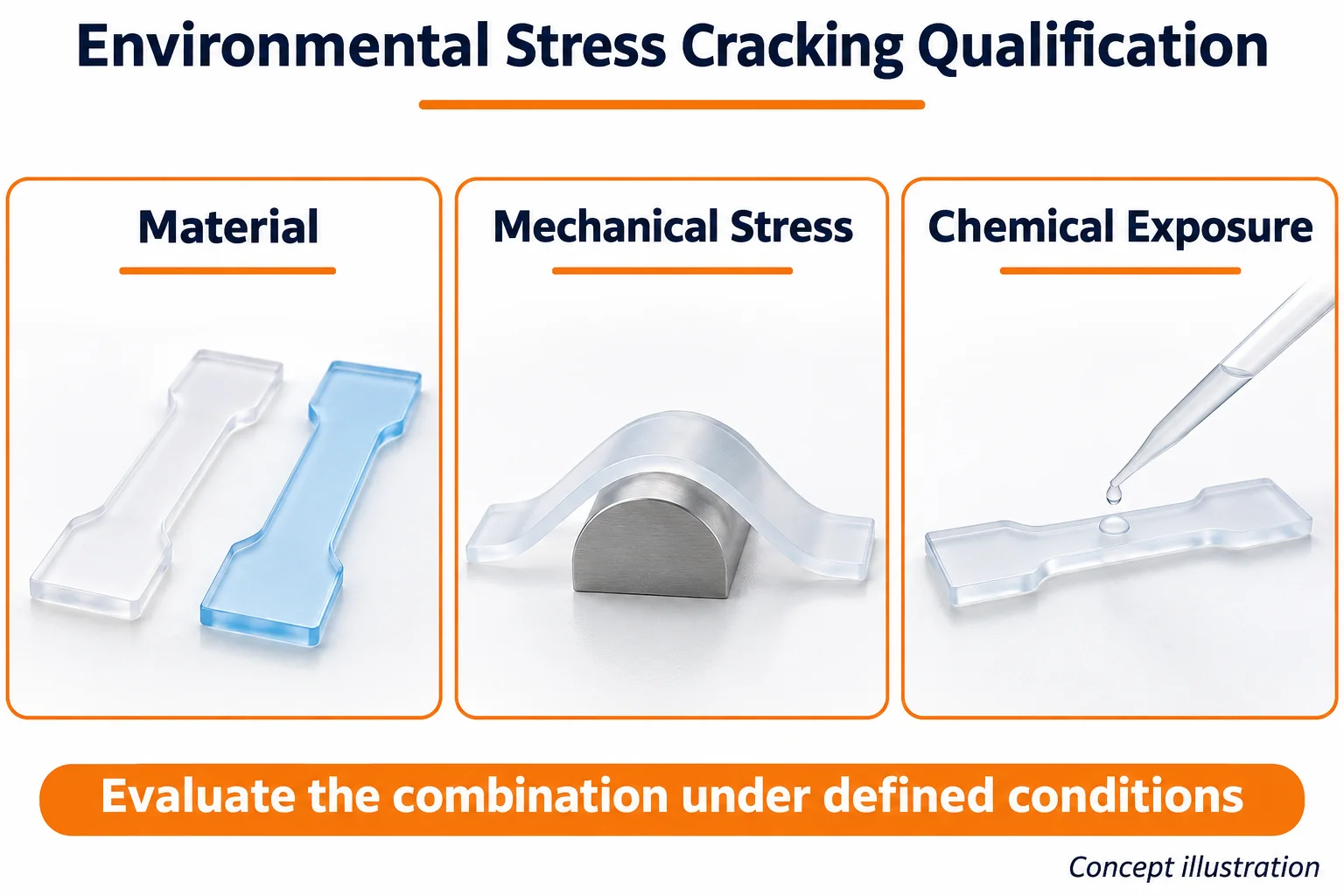
Environmental stress cracking is a combined material, stress, and exposure problem rather than a chemical selection problem alone.
You may see fine crazing near a screw boss, a cracked snap feature, or unexpected loss of mechanical performance. Appearance alone does not establish the cause. Investigate overload, molding defects, degradation, and other damage mechanisms before assigning a corrective action.
Your part can carry residual molding stress before assembly. Fastening, press fits, or restrained movement can add applied stress. Chemical contact then becomes part of the same qualification question.
Celanese polyester technical manual treats chemical stress cracking separately from other chemical exposures. Its PBT examples do not qualify your finished housing.
You should identify the critical locations before ordering samples. Include bosses, clips, sharp transitions, sealing interfaces, and regions loaded during installation.
Define The Chemical Exposure Before Comparing Resins
Your exposure specification should identify the actual formulation, concentration, temperature, contact sequence, and duration.
“Cleaner resistant” leaves too many assumptions unresolved. A brief wipe, pooled liquid, and continuous immersion create different conditions.
Ask your customer or product team for the commercial product identity and current formulation information. Record the use dilution, not only the concentrate name.
Include manufacturing chemicals as well as service fluids. Lubricants, release agents, adhesives, inks, and residues deserve review when they contact the molded surface.
| Exposure Detail | What You Should Record | Why Your Supplier Needs It |
|---|---|---|
| Chemical identity | Product name, supplier, formulation reference, and batch where relevant | A chemical family name may hide additives |
| Concentration | Use dilution and allowable variation | Test media must represent the agreed exposure |
| Application | Wipe, spray, splash, immersion, or retained residue | Contact conditions differ |
| Time and temperature | Dwell, frequency, drying, and relevant temperature range | Compatibility depends on the exposure conditions |
| Sequence | Assembly, cleaning, rinsing, drying, and repeated use | The finished part experiences a sequence |
A safety data sheet helps identify the product. Do not treat it as proof of compatibility with your resin grade.
Qualify The Exact Grade And Molded Condition
You should evaluate the specified resin grade and representative molded parts rather than a generic polymer family.
Record the manufacturer, grade, color system, reinforcement, and permitted regrind condition. Ask whether available compatibility data covers that exact formulation.
The BASF nylon chemical resistance guide distinguishes base resins from modified or reinforced grades. Its tables are a screening resource, not an approval of every nylon component.
Use your resin substitution controls to keep qualification evidence connected to production material. An apparently equivalent grade needs review before substitution.
Specify how samples will represent production. Record the tool, cavity, molding conditions, conditioning, and sample age relevant to your evaluation.
Review local stress with the molder and responsible designer. Changes to wall transitions, interference, or assembly loading may help. Processing changes should follow resin guidance and a controlled trial.
Annealing is not a universal remedy. You need a grade-specific process and separate checks for dimensions, appearance, and performance before adopting it.
Choose A Test Method That Matches The Question
Your test method should reproduce the relevant stress mode and exposure while keeping comparisons controlled.
The ISO 22088 series addresses thermoplastic environmental stress cracking. Choose the applicable part and edition with your laboratory.
| Evaluation | What It Helps You Compare | Important Limit |
|---|---|---|
| Unstressed chemical exposure | Visible change or property change without imposed loading | Does not establish stressed-part performance |
| Bent strip screening | Relative response under fixed flexural strain and chemical contact | Fixture strain is not automatically your assembly strain |
| Constant tensile load | Relative response under applied load and chemical contact | Specimen results do not directly predict service life |
| Finished assembly evaluation | Behavior of the actual joint, geometry, and exposure sequence | Results apply to the tested configuration and conditions |
ISO 22088-3:2006 describes the bent strip method using fixed flexural strain. ISO 22088-2:2006 addresses constant tensile loading.
Both published summaries describe ranking tests rather than direct design or performance prediction. Do not convert a screening result into an unsupported lifetime guarantee.
Agree sample preparation, conditioning, loading, reference medium, exposure medium, and observation intervals before testing. Different preparation or conditions can undermine a material comparison.
You should also agree a reference group without the chemical exposure. Where useful, include an unloaded exposed group to separate observations. Your laboratory should approve the comparison design and sample quantities.
Evaluate Finished Assemblies And Functional Retention
You should test representative assembled parts when assembly stress or local geometry could influence the failure.
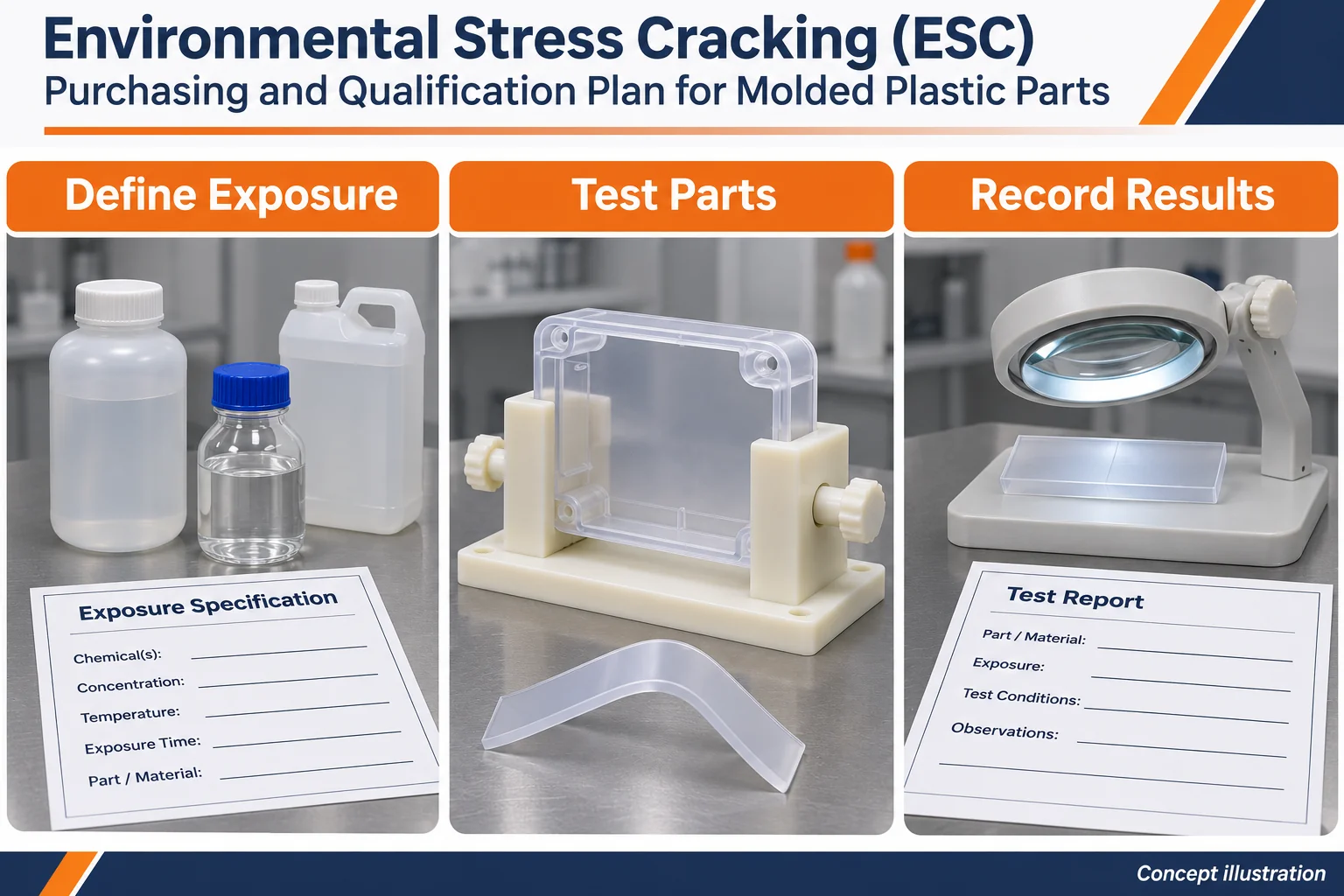
Use the specified screws, inserts, interference fits, and installation procedure. Record tightening conditions and fixture constraints instead of describing samples only as “assembled.”
Apply the agreed chemical contact sequence. Record solution preparation, temperature, contact time, rinse conditions, and drying between exposures.
Define visual and functional acceptance separately. Your product may require retained impact performance, clip retention, sealing, or another measurable function.
Specify the inspection method, lighting, magnification where needed, and locations to examine. Choose a visual method suitable for your resin color and surface condition.
Choose application-relevant mechanical checks with your engineering team. A photograph without visible cracks does not establish retained strength.
Your report should connect each observation to the sample identity, resin condition, assembly state, and exposure history. Keep failed samples for investigation when practical.
Put Qualification Responsibilities In Your RFQ
Your RFQ should distinguish molding supply from material screening, finished-part testing, and final application approval.
TOPS lists plastic injection molding services. Submit the exposure requirements with your drawings so the project scope can be reviewed.
Confirm laboratory arrangements and required records before placing the order. This article does not claim that TOPS operates a dedicated ESC laboratory.
Include these items in the purchasing agreement.
Approved resin grade, color, reinforcement, and substitution rules.
Drawing revision, critical loaded features, and assembly configuration.
Named chemicals, use dilution, temperature, and contact sequence.
Applicable test method, sample preparation, and reference groups.
Sample quantities, observation schedule, and acceptance criteria.
Responsibility for testing, failure analysis, and application approval.
Requalification triggers for material, process, assembly, or chemical changes.
Cost depends on sample molding, fixtures, chemical handling, test duration, observations, and functional checks. Compare quotations against the same qualification scope.
Frequently Asked Questions
You should settle these environmental stress cracking questions before approving molded parts for chemical exposure.
Is Chemical Resistance The Same As ESC Resistance
No. A chart may describe unstressed material behavior. Your component can experience additional stress from molding, assembly, and service.
Can A Compatible Cleaner Still Damage An Assembled Part
Yes. The grade, stress, formulation, concentration, temperature, and contact sequence may differ from the conditions behind the compatibility statement.
Should You Test The Actual Commercial Cleaner
Yes, when it represents your application. Record its identity, use dilution, and relevant formulation or batch information.
Does A Bent Strip Result Approve Your Finished Housing
No. It helps compare materials under defined conditions. You still need application evaluation where geometry and assembly affect stress.
Can You Judge Compatibility From Appearance Alone
Not reliably. Define functional checks where loss of strength or another property would matter to your product.
Does Annealing Eliminate The Need For Qualification
No. Any annealing procedure needs grade-specific approval and dimensional review. It does not establish compatibility with every chemical exposure.
Should Resin Or Color Changes Trigger Review
Yes. Connect change approval to the tested formulation and application. Decide whether new evidence or repeat testing is required.
Can You Predict Service Years From A Short ESC Test
Not directly. Screening tests rank behavior under defined conditions. Service performance requires appropriate application evidence and engineering assessment.
Request A Molding And Qualification Scope Review
Send your drawings, resin specification, assembly details, chemicals, and acceptance plan. Include target quantities, annual volume, and program life. Contact us to review molding supply, sample preparation, and testing responsibilities before qualification begins.