



Galvanic isolation for aluminum and stainless steel requires control of every electrical contact across a wet joint. You should specify the gasket, fastener insulation, coatings, drainage, and verification together. A plastic washer alone may leave a conductive path through the bolt shank or mating faces.
When Your Assembly Needs Galvanic Isolation
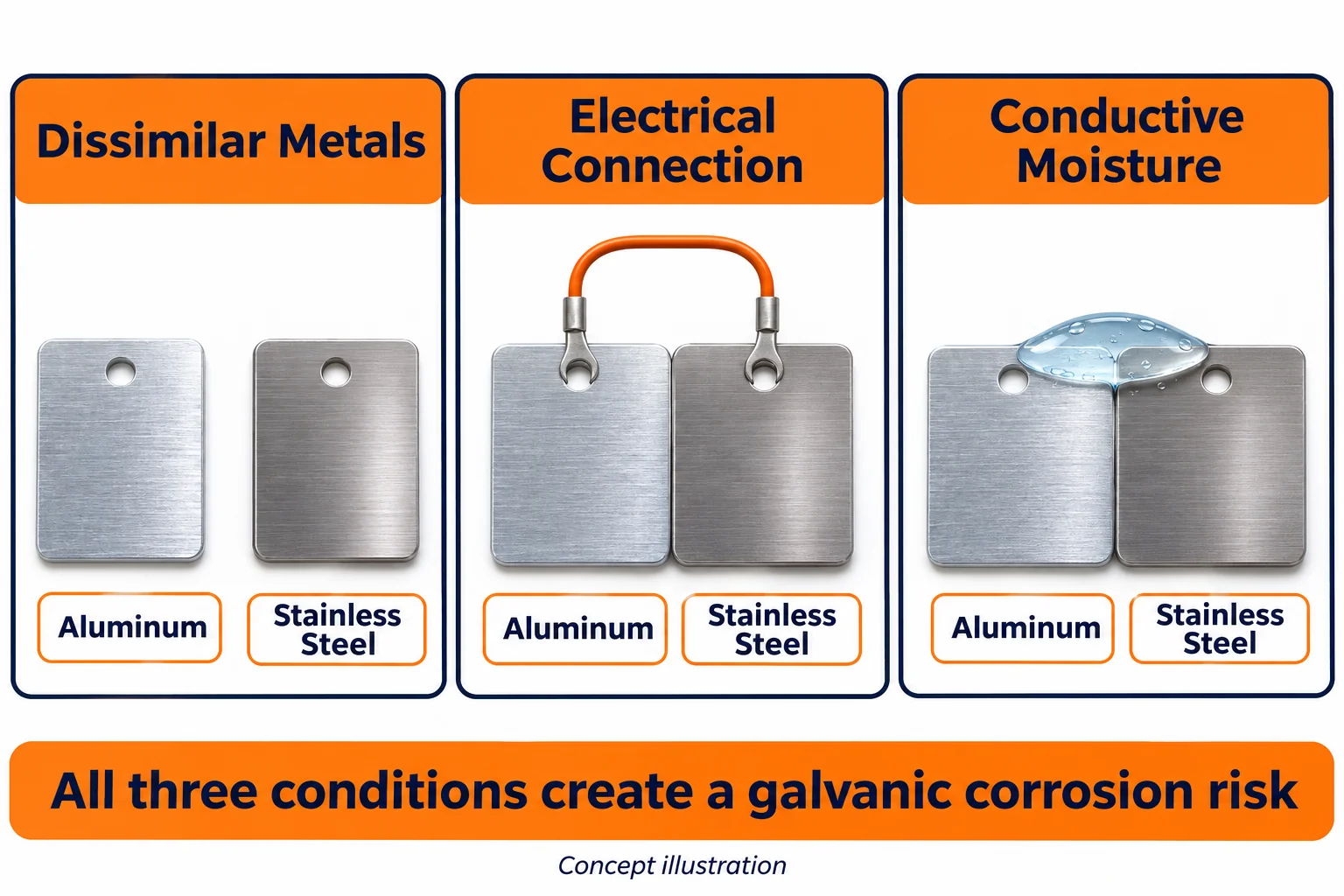
You need a galvanic corrosion review when dissimilar metals share an electrical path and conductive moisture can reach them.
An aluminum bracket attached to stainless hardware is not automatically unsuitable. Assess condensation, washdown, salt deposits, immersion, temperature, and maintenance access before choosing protection.
The BSSA guidance on aluminum and stainless steel explains why dry contact differs from wet exposure. It also describes the importance of relative surface areas.
You should assess the wetted surfaces connected through the assembly. A small exposed aluminum region beside a larger stainless surface can concentrate attack. Overall component mass does not describe this risk.
A galvanic series helps identify concerns within its stated environment. You cannot use the voltage separation alone to calculate service life.
Specify Every Contact Path In The Joint
Your isolation specification should identify mating faces, fastener holes, washers, threads, and any secondary conductive connection.
Start with an assembly section showing where each material touches. Mark the electrical boundary that your design intends to preserve.
A face gasket separates broad surfaces. An insulating sleeve can separate a bolt shank from a hole. Insulating washers address contact beneath selected heads or nuts.
The exact stack depends on the connection. Do not copy a generic washer arrangement into a load-bearing joint without engineering review.
Your drawing should identify the following purchasing requirements.
| Joint Feature | Information To Specify | Verification To Request |
|---|---|---|
| Mating faces | Gasket material, coverage, thickness, and permitted compression | Correct coverage without metal contact |
| Bolt passage | Sleeve geometry, fit, and coverage through the hole | No exposed shank contact at the intended boundary |
| Head and nut seats | Washer material and complete stack order | Correct parts on each specified side |
| Coated surfaces | Approved finish, masking, damage limits, and repair method | Inspection after final assembly |
| Secondary paths | Brackets, cables, shields, inserts, and grounding connections | Review of the complete electrical path |
The IMOA galvanic corrosion guidance warns that contact elsewhere can connect otherwise separated metals. You should therefore inspect the complete assembly, not one fastener.
Select Barriers For Mechanical And Environmental Duty
Your insulating materials must retain their required function under the actual load, fluids, temperature, and exposure.
Ask for the specified material grade rather than accepting an unspecified plastic washer. Request supporting material information for compression, creep, moisture, chemical exposure, and temperature where relevant.
Check whether sleeve dimensions accommodate the actual hole and fastener tolerances. Confirm that tightening does not cut, extrude, or displace the barrier.
You also need a defined tightening procedure. Added polymer components can change the joint stack and its clamping behavior. Your responsible engineer should approve the fastening design and validation conditions.
Paint or anodizing can contribute protection, but scratches and assembly damage can defeat a barrier. Do not assume an attractive coating proves electrical isolation.
Conductive fillers also matter. Ask whether the proposed gasket or compound contains conductive constituents before approving it as an electrical barrier.
Control Moisture Without Creating Trapped Crevices
Your joint should limit conductive moisture exposure while allowing the intended drainage and maintenance.
Specify where sealant belongs, which surfaces require preparation, and when curing occurs. Identify how you will inspect coverage before the joint becomes inaccessible.
A sealant bead at one edge does not establish that every entry route is closed. Review bolt holes, seams, underside surfaces, and service openings together.
Check whether a gasket creates a persistent wet crevice. Electrical isolation does not eliminate independent pitting or crevice corrosion mechanisms.
You should also reconcile isolation with grounding, shielding, or bonding requirements. If electrical continuity is required, corrosion protection needs a coordinated design. Do not remove a required safety bond to achieve isolation.
Approve The Assembly And Inspection Plan
You should approve a representative assembled joint before releasing repeat production.
Use production materials, coatings, fasteners, barriers, and tightening methods in that review. A coating coupon alone does not represent the complete connection.
Use our salt spray specification guide when defining the test agreement.
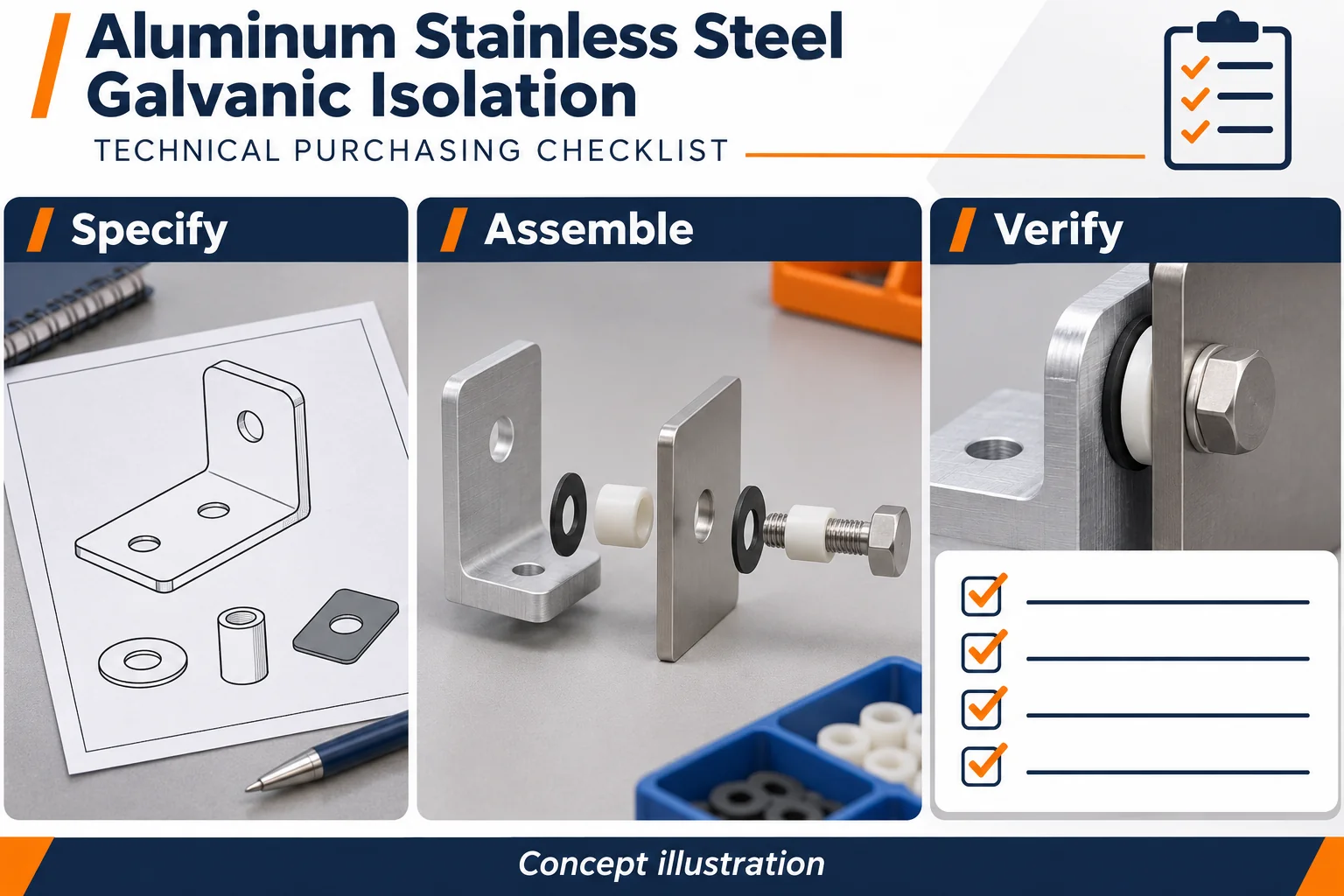
Ask your supplier to record the following checks.
Confirm component grades, barrier part numbers, and drawing revisions.
Check burrs and contact edges before fitting insulating components.
Inspect sleeve position, gasket coverage, and washer order after tightening.
Examine coating damage and sealant continuity at accessible boundaries.
Record the electrical test method and limits when isolation is a drawing requirement.
Define reinspection after environmental exposure or relevant mechanical cycling.
Your electrical test plan should name the measurement points, assembly state, instrument, conditions, and acceptance limits. There is no universal resistance threshold for every product.
Define corrosion acceptance separately. State the permitted damage, inspection locations, sample quantity, and exposure sequence in your qualification plan.
ASTM B117 describes salt spray apparatus practice. Its published scope cautions against using standalone results to predict natural exposure performance. You should not translate chamber hours directly into service years.
Align Your RFQ With Supplier Responsibilities
Your RFQ should separate part manufacture, barrier procurement, assembly, and qualification responsibilities.
Otherwise, one quotation may include finished assemblies while another includes only machined metal parts. These offers carry different inspection and purchasing scope.
| RFQ Item | Buyer Decision |
|---|---|
| Scope of supply | Separate components, kits, or assembled joints |
| Metal parts | Alloy, condition, process, drawing, and finish |
| Insulating components | Approved grades, dimensions, supplier restrictions, and substitution approval |
| Assembly | Stack order, tightening procedure, sealant, and handling |
| Acceptance | Dimensional, visual, electrical, and corrosion requirements |
| Records | Material identification, inspection results, and approved revision |
TOPS lists CNC machining services and sheet metal fabrication among its manufacturing services. You should submit the joint requirements alongside the individual part drawings.
Confirm project-specific assembly and testing scope before ordering. This article does not establish a qualified barrier system or an in-house corrosion testing capability.
Cost depends on additional components, controlled assembly, finishing, inspection, qualification, and replacement access. Compare quotations against the same responsibility matrix.
Frequently Asked Questions
You should resolve these galvanic isolation questions before approving your aluminum and stainless assembly.
Can Stainless Steel Bolts Be Used With Aluminum
Yes, but suitability depends on the environment and joint design. Wet salt exposure requires more scrutiny than reliably dry service.
Is One Plastic Washer Enough
Not necessarily. You must check the bolt shank, mating faces, threads, and other conductive connections across the intended boundary.
Does Anodizing Guarantee Electrical Isolation
No. You must account for coverage, damage, wear, and assembly contact. Verify the finished connection against your specified requirements.
Can You Use Any Polymer Sleeve
No. Specify its grade and geometry. Confirm compatibility with joint loads, temperature, fluids, and the required electrical function.
Should You Insulate Both Sides Of A Bolt
That depends on the intended electrical boundary and complete stack. Your drawing should define every required washer and sleeve.
Does Isolation Prevent Every Type Of Corrosion
No. You still need suitable alloys, drainage, and surface protection. Pitting and crevice corrosion can occur without a dissimilar-metal connection.
What If Your Assembly Requires Grounding
Coordinate the corrosion and electrical designs. Use an approved bonding arrangement and do not interrupt required protective grounding.
Can Salt Spray Hours Predict Service Life
Not directly. Use a qualification plan that reflects your application, and evaluate the complete assembled joint.
Request A Quote For Your Metal Components
Send your assembly section and component drawings for a scope review. Include alloys, finishes, barriers, environment, quantities, annual volume, and acceptance requirements. Contact us to clarify manufacturing, assembly, and inspection responsibilities before placing your order.

