

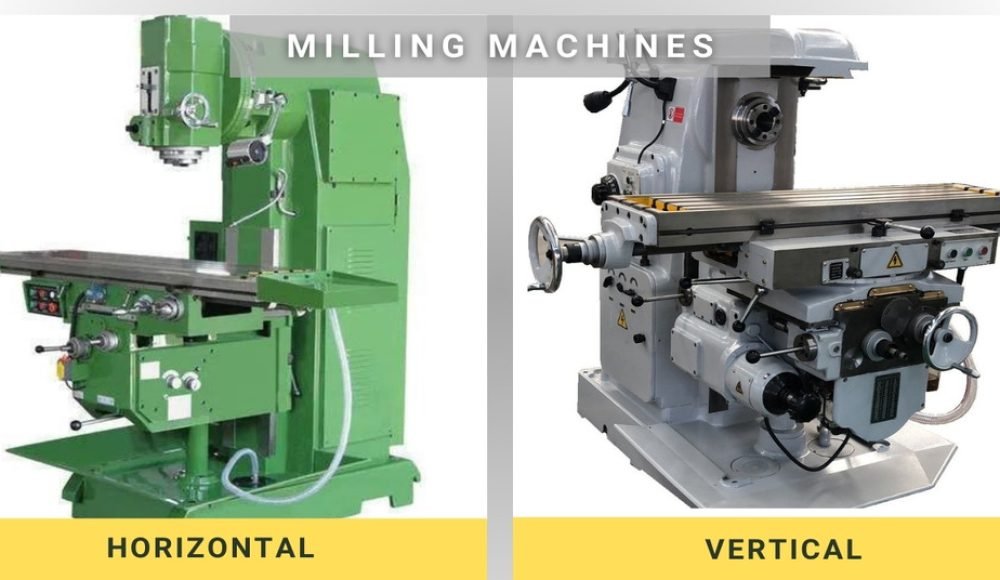
La distinction la plus importante dans les fraiseuses réside dans le orientation de la broche-la partie qui maintient et fait tourner l'outil de coupe. Sur la base de ce facteur, les machines sont généralement classées en fraiseuses verticales et fraiseuses horizontales. Chacun a des forces et des faiblesses uniques, ce qui les rend mieux adaptés à différentes applications.
Pour les petits ateliers et le prototypage, les machines verticales sont le choix courant en raison de leur prix abordable et de leur simplicité. D'autre part, les opérations de fabrication à grande échelle privilégient souvent les machines horizontales en raison de leur productivité plus élevée et de leur capacité à manipuler des charges plus lourdes., coupes plus complexes.
Cet article examine de près les deux types de machines, explique brièvement comment ils fonctionnent, puis approfondit leur principales différences. À la fin, vous aurez une idée claire de la configuration qui convient le mieux vos besoins en usinage.
Un aperçu rapide des fraiseuses verticales
Principe de fonctionnement
Une fraiseuse verticale est conçue de manière à ce que la broche tenant l'outil de coupe soit orientée verticalement., perpendiculaire à la pièce. Cette configuration permet à l'outil de coupe de descendre dans le matériau. La pièce elle-même reste immobile, solidement fixé à la table de la machine, tandis que l'outil de coupe découpe progressivement le matériau.
Les broyeurs verticaux sont privilégiés pour travail de précision. La broche verticale permet une meilleure visibilité de la zone de coupe, ce qui signifie que les opérateurs peuvent surveiller directement le processus et effectuer des ajustements rapides. Cela rend les machines verticales extrêmement populaires dans les ateliers d'outillage., ateliers de prototypage, et fabrication à petite échelle.
Un autre avantage est leur polyvalence pour les opérations en surface comme le rainurage, forage, parement, et contouring. Cependant, lorsqu'il s'agit de coupes profondes ou de travail avec de très grandes pièces, les fraiseuses verticales commencent à montrer leurs limites.
Types communs (flush & Fraisage de lit)
Les fraiseuses verticales se déclinent généralement en deux modèles principaux: moulins à tourelle et moulins à lit.
Fraiseuses à tourelle:
Les fraiseuses à tourelle sont compactes et conçues pour les petites pièces. La broche reste fixe, mais la tête de la tourelle peut pivoter et la table peut se déplacer dans plusieurs directions (Axes X et Y). Cette conception rend les fraiseuses à tourelle excellentes pour les travaux légers et les pièces nécessitant des détails fins.. Considérez-les comme les « bêtes de somme » de la précision, usinage en faible volume.
Fraiseuses à lit:
Les broyeurs à lit sont plus grands et plus robustes. Dans cette conception, la broche peut se déplacer verticalement, tandis que la table se déplace horizontalement le long du lit. Cette configuration offre plus de rigidité et de support pour les pièces plus lourdes. Les fraiseuses à lit sont plus courantes dans les ateliers d'usinage traditionnels car elles établissent un équilibre entre précision et capacité à traiter des composants de taille moyenne..
En résumé, les broyeurs verticaux sont plus simples, plus facile à apprendre, et moins cher. Ils constituent un point d'entrée naturel pour de nombreux machinistes et restent largement utilisés dans les industries pour l'usinage de petite taille ou de précision..
Un aperçu rapide des fraiseuses horizontales
Principe de fonctionnement
Les fraiseuses horizontales fonctionnent sur le même principe fondamental que les machines verticales: un outil de coupe rotatif enlève de la matière d'une pièce fixe. Cependant, la distinction clé est la orientation horizontale de la broche. Ce changement modifie considérablement les performances de la machine.
Au lieu de réduire vers le bas, l'outil monté horizontalement coupe le matériau. Cette conception rend les machines horizontales particulièrement efficaces pour coupes plus lourdes et plus profondes, car l'outil est plus court et plus épais que son homologue vertical. La géométrie de l'outil plus solide réduit les vibrations, permettant à la machine de gérer facilement des opérations plus exigeantes.
Les fraiseuses horizontales sont couramment utilisées pour les séries de production à grande échelle, usinage de pièces surdimensionnées, et les travaux qui nécessitent des taux d'enlèvement de matière agressifs. Des industries comme l'aérospatiale, énergie, et la fabrication d'équipements lourds s'appuient fortement sur des configurations horizontales pour leur capacité à livrer productivité élevée et performances robustes.
Capacités spéciales (Évacuation des copeaux & Gestion des angles)
Deux des plus grands avantages des fraiseuses horizontales sont évacuation de la puce et gestion des angles.
Évacuation des copeaux:
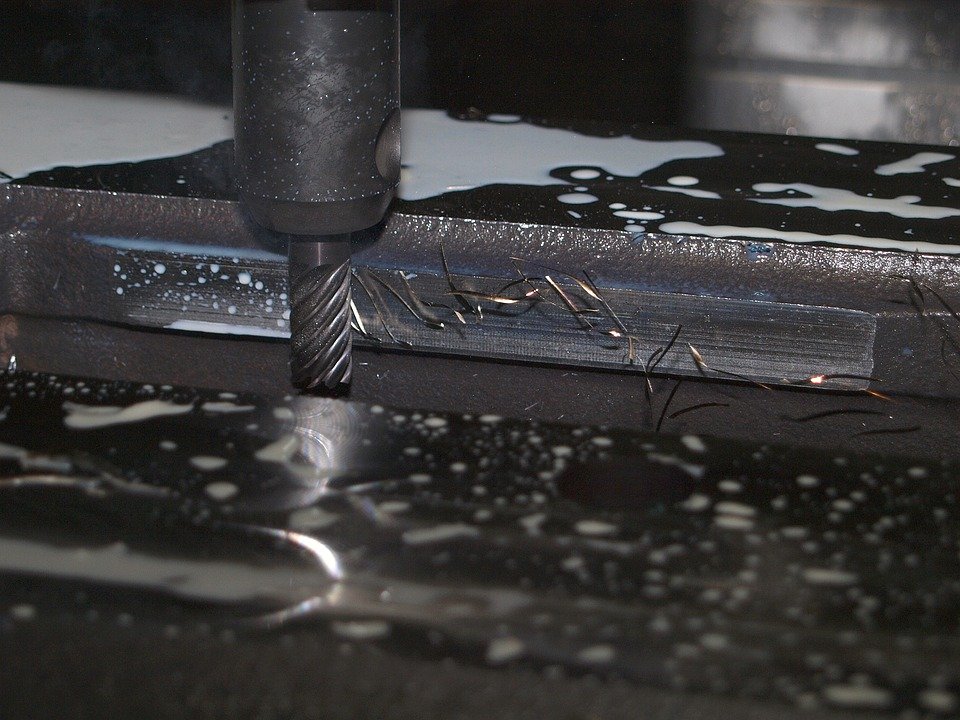
Pendant le fraisage, puces (petits morceaux de matière enlevée) s'accumuler autour de la zone de coupe. Dans les machines verticales, la gravité provoque souvent une accumulation de copeaux sur la pièce à usiner, conduisant à des défauts de surface, surchauffe, ou la nécessité d'un nettoyage supplémentaire. Machines horizontales, d'autre part, éjectent naturellement les copeaux de la zone de coupe grâce à l'orientation de leur broche. Cela améliore non seulement la finition de la surface, mais réduit également les temps d'arrêt pour le nettoyage..
Gestion des angles:
Les machines horizontales sont souvent équipées d'une table universelle, ce qui permet à la pièce d'être tournée et inclinée. Cette capacité signifie que la fraise peut s'approcher de la pièce à usiner dans plusieurs directions., facilitant l'usinage de géométries et de caractéristiques complexes. Machines verticales, en revanche, sont limités à travailler sur un seul plan.
En substance, tandis que les broyeurs horizontaux nécessitent un investissement initial plus important, ils apportent des avantages uniques qui les rendent indispensables dans les secteurs à grand volume, environnements d'usinage complexes.
Avantages et inconvénients en bref
Fraiseuses verticales – Avantages & Les inconvénients
Avantages: Abordable, largement disponible, plus facile à utiliser, idéal pour le travail de précision, peu d'entretien.
Les inconvénients: Profondeur de coupe limitée, taux d'enlèvement de matière plus lent, moins efficace pour les grandes pièces.
Fraiseuses horizontales – Avantages & Les inconvénients
Avantages: Productivité plus élevée, meilleure évacuation des copeaux, capacité à couper en angle, excellent pour les coupes profondes et les grandes pièces.
Les inconvénients: Cher à acheter et à entretenir, plus difficile de trouver des opérateurs qualifiés, moins adapté aux petits ateliers.
Différences clés entre les frais de fraisage verticaux et horizontaux
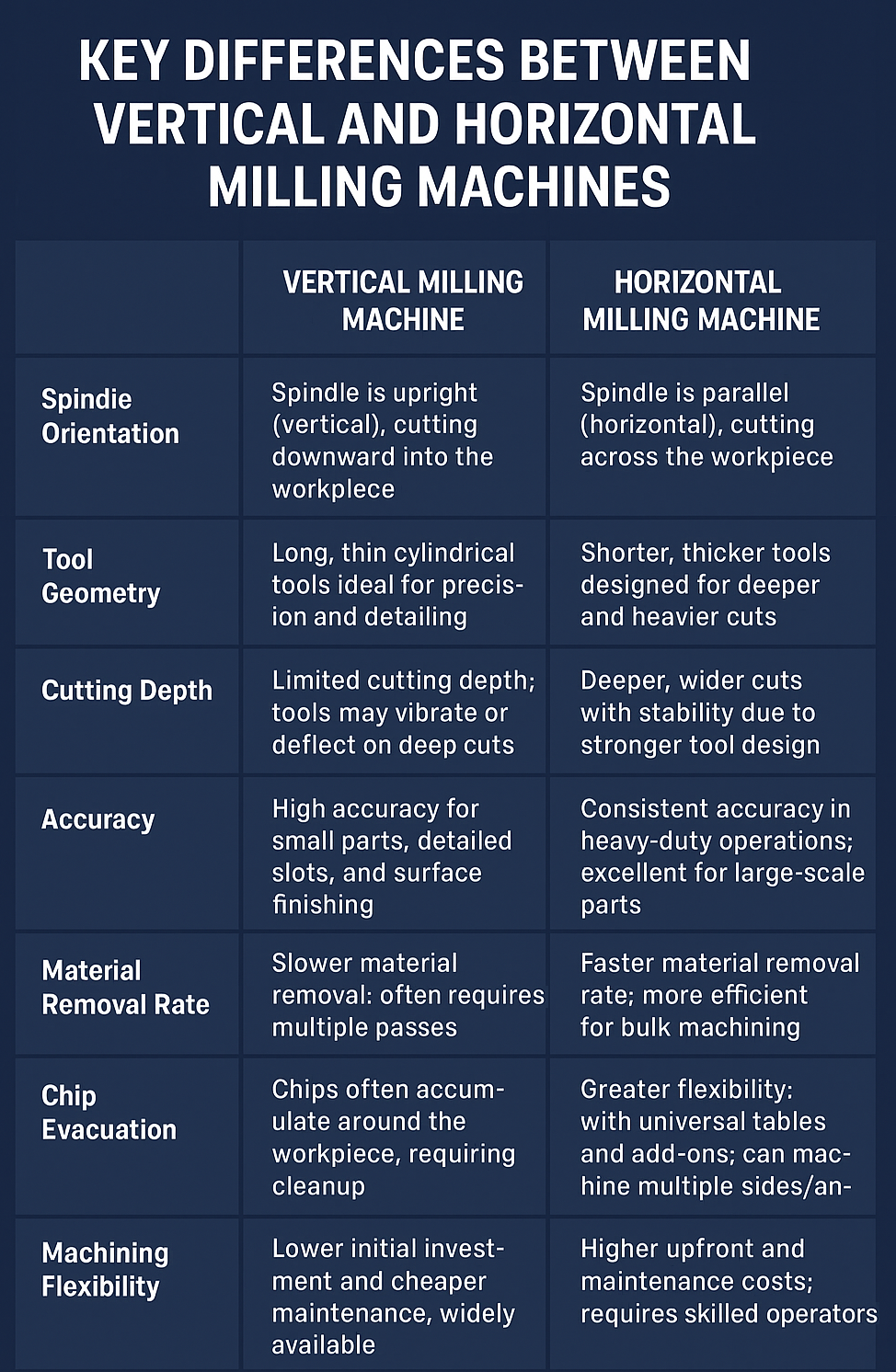
Orientation de la broche
La différence la plus évidente entre les fraiseuses verticales et horizontales réside dans l'orientation de la broche.. En fraisage vertical, la broche est positionnée verticalement, perpendiculaire à la pièce. Cela permet à l'outil de coupe de se déplacer vers le bas, en appuyant sur le matériau. La configuration permet aux opérateurs de surveiller facilement visuellement le processus et de l'ajuster en temps réel., ce qui est particulièrement utile pour les travaux de précision, prototypage, et petits projets.
En revanche, les fraiseuses horizontales positionnent la broche parallèlement à la pièce à usiner. Cette configuration horizontale signifie que l'outil se déplace à travers le matériau au lieu de s'y enfoncer.. Le résultat est un plus fort, processus de coupe plus stable, spécialement pour les coupes plus profondes et les pièces plus grandes. Parce que l'outil est plus court et plus robuste, il résiste à la flexion ou aux oscillations sous de lourdes charges, quelque chose avec lequel les outils verticaux ont souvent du mal.
Le choix entre les deux orientations affecte non seulement les performances mais également les types de pièces que vous pouvez produire.. Les broches verticales sont meilleures pour les détails, usinage au niveau de la surface où la précision compte le plus, tandis que les broches horizontales brillent dans les scénarios nécessitant de l'énergie, vitesse, et durabilité. Par exemple, la fabrication de moules ou de rainures précises est mieux gérée par une configuration verticale, tandis que couper un carter de boîte de vitesses robuste serait plus efficace sur une machine horizontale.
En bref, l'orientation de la broche détermine le fonctionnement de chaque type de machine, influençant directement la stabilité, profondeur de coupe, et la complexité des pièces que vous pouvez fabriquer.
Géométrie et conception des outils
Une autre différence clé vient des outils eux-mêmes. Utilisation des fraiseuses verticales long, outils cylindriques minces, qui peut atteindre des espaces restreints et gérer des conceptions complexes. Ces outils sont parfaits pour des opérations comme le forage, rainurage, et contouring là où des détails fins sont nécessaires. Cependant, leur structure mince les rend plus sujets aux vibrations et à la déviation lorsqu'ils sont chargés de coupes plus profondes ou d'enlèvements de matière plus lourds.
D'autre part, les fraiseuses horizontales comptent sur plus court, outils plus épais. Ces couteaux sont conçus pour résister à une plus grande résistance sans se plier ni vaciller.. Leur géométrie les rend idéales pour traiter des pièces plus volumineuses et effectuer des coupes profondes ou larges en moins de passes.. En plus, les broyeurs horizontaux peuvent accueillir des couteaux spécialisés, comme des couteaux latéraux et frontaux, broyeurs de dalles, et configurations de fraisage groupé, qui permettent plusieurs coupes simultanément.
La géométrie des outils a un impact direct sur la productivité et la qualité des pièces. Par exemple, si vous usinez un petit composant en aluminium qui nécessite des fentes précises, l'outil mince d'une machine verticale est parfait. Mais si vous travaillez avec de l’acier trempé et que vous devez retirer rapidement une quantité importante de matière, la robustesse des outils horizontaux donnera de bien meilleurs résultats.
Cette différence dans la conception des outils souligne pourquoi chaque machine a sa niche. Alors que les usines verticales se concentrent sur précision et accessibilité, les broyeurs horizontaux soulignent puissance et efficacité.
Spécifications et précision de coupe
Quand il s'agit de précision, les fraiseuses verticales prennent généralement les devants, surtout pour bien, travail détaillé. Leur orientation de broche verticale offre une excellente visibilité, permettant aux machinistes de voir exactement ce que fait l'outil. Ce contrôle pratique permet d'atteindre des tolérances serrées, faire des machines verticales le choix idéal pour les prototypes, moules, et les pièces qui nécessitent une finition complexe.
Cependant, la précision n’est pas toujours synonyme d’efficacité. Outils verticaux, en raison de leur conception plus longue et plus fine, devenir moins stable lorsque des coupes plus profondes sont nécessaires. Cette instabilité provoque des vibrations, bavarder, ou même des écarts par rapport à la conception prévue. Par conséquent, les broyeurs verticaux sont limités quant à la quantité de matière qu'ils peuvent éliminer en un seul passage.
Fraiseuses horizontales, en revanche, peut ne pas correspondre à l'extrême précision des configurations verticales dans les travaux délicats, mais ils excellent dans cohérence sous charge. Grâce à leurs outils plus épais et leur conception rigide, ils peuvent gérer plus profondément, coupes plus lourdes sans sacrifier la précision. Les fraiseuses horizontales CNC modernes intègrent même des systèmes de contrôle avancés qui leur permettent de rivaliser avec les machines verticales en termes de précision tout en offrant une productivité inégalée..
Les plats à emporter? Si votre projet implique des parois minces, fentes peu profondes, ou finition esthétique, un broyeur vertical est souvent supérieur. Mais si tu as besoin de forages profonds, larges rainures, ou usinage intensif avec des tolérances constantes, les machines horizontales surperformeront à chaque fois.
Coût et entretien
Pour de nombreux ateliers, le coût est souvent le facteur décisif lorsqu'il s'agit de choisir entre une fraiseuse verticale et une fraiseuse horizontale.. Les broyeurs verticaux sont généralement beaucoup plus abordable acheter, avec des modèles d'entrée de gamme disponibles pour les petits ateliers et centres de formation. Leur conception est plus simple, ce qui signifie moins de besoins de maintenance et moins de pannes. En plus, parce qu'ils sont si courants, trouver des pièces de rechange ou des opérateurs qualifiés est rarement un problème.
Fraiseuses horizontales, cependant, venir avec un prix plus élevé. Non seulement ils sont plus chers à l’achat à l’avance, mais ils nécessitent également des coûts permanents plus élevés pour l'entretien et la réparation.. Leur construction complexe et leur charge de travail plus lourde nécessitent une formation spécialisée des opérateurs., et les pièces de rechange peuvent être plus difficiles à trouver. Ces facteurs se combinent pour faire des usines horizontales un investissement plus important en temps et en argent..
Qui dit, le coût plus élevé s'accompagne d'avantages proportionnels. Les broyeurs horizontaux peuvent éliminer la matière plus rapidement, gérer des travaux plus importants, et maintenir la productivité dans les environnements de fabrication à haut volume. Pour les grandes entreprises produisant des milliers de pièces identiques, l'investissement est souvent rentabilisé par une réduction du temps d'usinage et une augmentation du rendement.
Pour les petits ateliers et startups, le prix abordable des machines verticales en fait un choix pratique. Mais pour les entreprises établies où le débit et l'efficacité sont essentiels, le coût plus élevé des machines horizontales est justifié.
Taux d'enlèvement de matière
La vitesse à laquelle la matière peut être enlevée est une mesure de performance déterminante en fraisage., et ici les machines horizontales sont clairement les gagnantes. La géométrie et l'orientation de leurs outils permettent plus rapide, coupes plus profondes, ce qui signifie que plus de matière peut être retirée en moins de temps. Dans un environnement de production, cela se traduit par des temps de cycle plus courts, efficacité supérieure, et la capacité de terminer rapidement des commandes importantes.
Fraiseuses verticales, tout en étant précis, sont plus lents en comparaison. Leurs outils ne peuvent gérer que des coupes plus petites à la fois, et les opérateurs doivent souvent effectuer plusieurs passes pour atteindre la profondeur souhaitée. Cela prolonge non seulement le temps d'usinage, mais réduit également la productivité globale., surtout lorsque vous travaillez sur des pièces grandes ou complexes.
Un autre facteur est la gestion des puces. Les machines horizontales éliminent naturellement les copeaux de la pièce à usiner en raison de la gravité et de l'orientation de l'outil., prévenir les blocages et la surchauffe. Machines verticales, cependant, ont souvent du mal à accumuler des copeaux, ce qui peut ralentir les opérations et impacter négativement la finition de la pièce.
En bref, si la productivité et la rapidité sont des priorités absolues, le fraisage horizontal est inégalé. Machines verticales, bien que plus lent, fournir un meilleur contrôle pour un travail soigné, ce qui les rend mieux adaptés aux petits travaux ou aux pièces personnalisées.
Nombre de côtés et flexibilité d'usinage
La flexibilité de l'usinage dépend souvent du nombre de côtés de la pièce accessibles sans re-serrage.. Les fraiseuses verticales sont pour la plupart limitées à fonctionner sur un un seul avion à la fois. Bien que les pièces jointes puissent étendre quelque peu leurs capacités, ils restent moins polyvalents par rapport à leurs homologues horizontaux.
Fraiseuses horizontales, notamment ceux équipés de tables universelles, offrir une bien plus grande flexibilité. La table universelle permet de faire pivoter et de repositionner la pièce, permettant à la fraise d'approcher sous plusieurs angles. Cette fonctionnalité permet d'usiner des formes complexes, contours, et des pièces multifaces dans moins de configurations.
En plus, les broyeurs horizontaux peuvent être équipés d'accessoires tels que des tables rotatives, diviseurs, et plusieurs couteaux, élargissant encore leur polyvalence. Pour les industries qui nécessitent des, usinage multi-axes, les configurations horizontales offrent un niveau d'adaptabilité que les machines verticales ne peuvent égaler.
Pour des travaux simples, la capacité monoplan des machines verticales est suffisante et rentable. Mais pour les pièces aux géométries complexes ou aux surfaces multiples, la flexibilité des machines horizontales permet d'économiser beaucoup de temps et d'efforts.
Choisir la bonne machine pour vos besoins
Le choix entre une fraiseuse verticale ou horizontale n'est pas une décision unique. Le bon choix dépend fortement de votre exigences de la pièce, volume de production, budget, et l'expertise disponible. Décomposons ces considérations:
1. Taille et complexité de la pièce
Si vos projets concernent majoritairement pièces de petite à moyenne taille qui nécessitent une finition détaillée, comme les fentes, rainures, ou des motifs complexes : une fraiseuse verticale est généralement le choix le plus judicieux. Sa géométrie d'outil permet un travail délicat et sa visibilité permet aux machinistes de superviser plus facilement les coupes de précision..
Cependant, si vous usinez pièces grandes ou volumineuses, tels que les composants du moteur, cadres structurels, ou moules industriels, une machine horizontale est bien plus efficace. Sa conception d'outil robuste et sa puissante orientation de broche peuvent supporter des charges plus importantes sans compromettre la stabilité..
2. Volume de production
Pour à faible volume, coutume, ou travail de prototype, les broyeurs verticaux sont souvent idéaux. Ils sont faciles à configurer, programme, et exploiter, ce qui réduit les délais. Cette flexibilité en fait un favori parmi les petites entreprises et les ateliers de prototypage..
Mais si votre objectif est production en grand volume, les machines horizontales sont imbattables. Leur taux d'enlèvement de matière supérieur et leur capacité à usiner plusieurs côtés en une seule configuration vous permettent de produire plus de pièces en moins de temps.. Cette productivité est essentielle pour la fabrication à grande échelle.
3. Budget et coûts
Le coût est l'un des facteurs les plus décisifs. Les fraiseuses verticales sont plus abordable, tant en termes de prix d'achat que de maintenance continue. Même les petits ateliers peuvent se permettre d'en installer un, et les opérateurs sont largement disponibles.
Machines horizontales, d'autre part, représente un gros investissement. Le coût initial est élevé, et la maintenance nécessite plus de ressources. Les opérateurs qualifiés sont plus difficiles à trouver, ce qui peut alourdir les dépenses de main d'œuvre. Qui dit, pour les entreprises ayant des exigences de production élevées, le coût est justifié car la machine s'amortit rapidement grâce à son efficacité.
4. Compétence et disponibilité des opérateurs
Un autre facteur négligé est le disponibilité de machinistes qualifiés. Les fraiseuses verticales sont plus courantes, ce qui signifie que davantage d'opérateurs sont formés pour les utiliser. La formation est également plus facile car le processus est plus simple.
Les fraiseuses horizontales nécessitent des connaissances spécialisées. Puisque moins d’ateliers les utilisent, trouver des opérateurs ayant une expérience du monde réel peut être un défi. Pour les petites entreprises, cela peut être un facteur décisif, à moins qu'ils sous-traitent le travail à des services d'usinage CNC.
5. Considérations sur le modèle commercial
Pour startups et petits ateliers de fabrication, une machine verticale a du sens : elle est polyvalente, abordable, et fiable pour les projets quotidiens. Mais pour entreprises manufacturières établies qui mettent l'accent sur l'efficacité, débit, et usinage de pièces complexes, une machine horizontale est souvent le meilleur investissement à long terme.
Conclusion
Le débat entre fraiseuses verticales et horizontales se résume à précision versus productivité. Les deux machines partagent le même principe fondamental : utiliser un outil rotatif pour enlever de la matière sur une pièce fixe, mais leurs différences de conception les rendent adaptées à des tâches très différentes..
Fraiseuses verticales exceller dans le travail de précision, pièces de petite à moyenne taille, et projets personnalisés ou prototypes. Ils sont abordables, facile à entretenir, et idéal pour les entreprises ayant des exigences de production faibles.
Fraiseuses horizontales sont des moteurs pour les opérations lourdes, grandes pièces, et production à volume élevé. Leur capacité à réaliser des coupes profondes, gérer plusieurs côtés, et l'éjection efficace des puces les rend inestimables dans la fabrication à grande échelle, mais à un coût plus élevé.
Finalement, la décision dépend de vous besoins spécifiques, objectifs de production, et le budget. Pour les petits ateliers, la fraiseuse verticale est souvent le point de départ naturel. Pour les opérations à l’échelle industrielle, la productivité supérieure de la machine horizontale justifie l’investissement.
Et n'oublions pas : l'externalisation vers Services d'usinage CNC est une alternative pratique. Les entreprises qui ne peuvent pas se permettre d'investir dans des machines horizontales peuvent toujours accéder à des capacités de fraisage de premier ordre par l'intermédiaire de prestataires de services professionnels..
Que vous soyez propriétaire d'une petite entreprise, un machiniste, ou un cadre de fabrication, comprendre ces différences clés vous aide à choisir le bon outil pour le travail. En usinage, comme dans la vie, choisir le bon outil détermine souvent la qualité du résultat.