



Un service d'usinage CNC personnalisé fabrique des pièces selon vos dessins et spécifications plutôt qu'à partir d'un catalogue.. Vous définissez la géométrie, matériel, tolérance, et finir. That control matters when standard parts cannot do the job. Here is what custom CNC involves and when to choose it.
What Is A Custom CNC Machining Service?
A custom CNC machining service produces components from your 3D model or 2D drawing.
The supplier programs machine tools for your geometry. Nothing is selected from a stock catalog. Custom work suits parts with a unique shape, a specific material, or tolerances and finishes that must match your application.
When Do You Need Custom CNC Machining?
You need custom CNC when a standard component cannot meet your geometry, matériel, tolérance, ou finir.
- The geometry does not exist as a standard part.
- The material must match the application and environment.
- Critical dimensions need tolerance control.
- You need a prototype before production.
- The design is still changing.
- You need material certificates or inspection reports.
A standard part is usually cheaper when it already meets the requirement. Custom is the better fit when geometry, matériel, tolérances, interfaces, or finishing requirements cannot be met by a standard component.
How Does Custom CNC Machining Work?
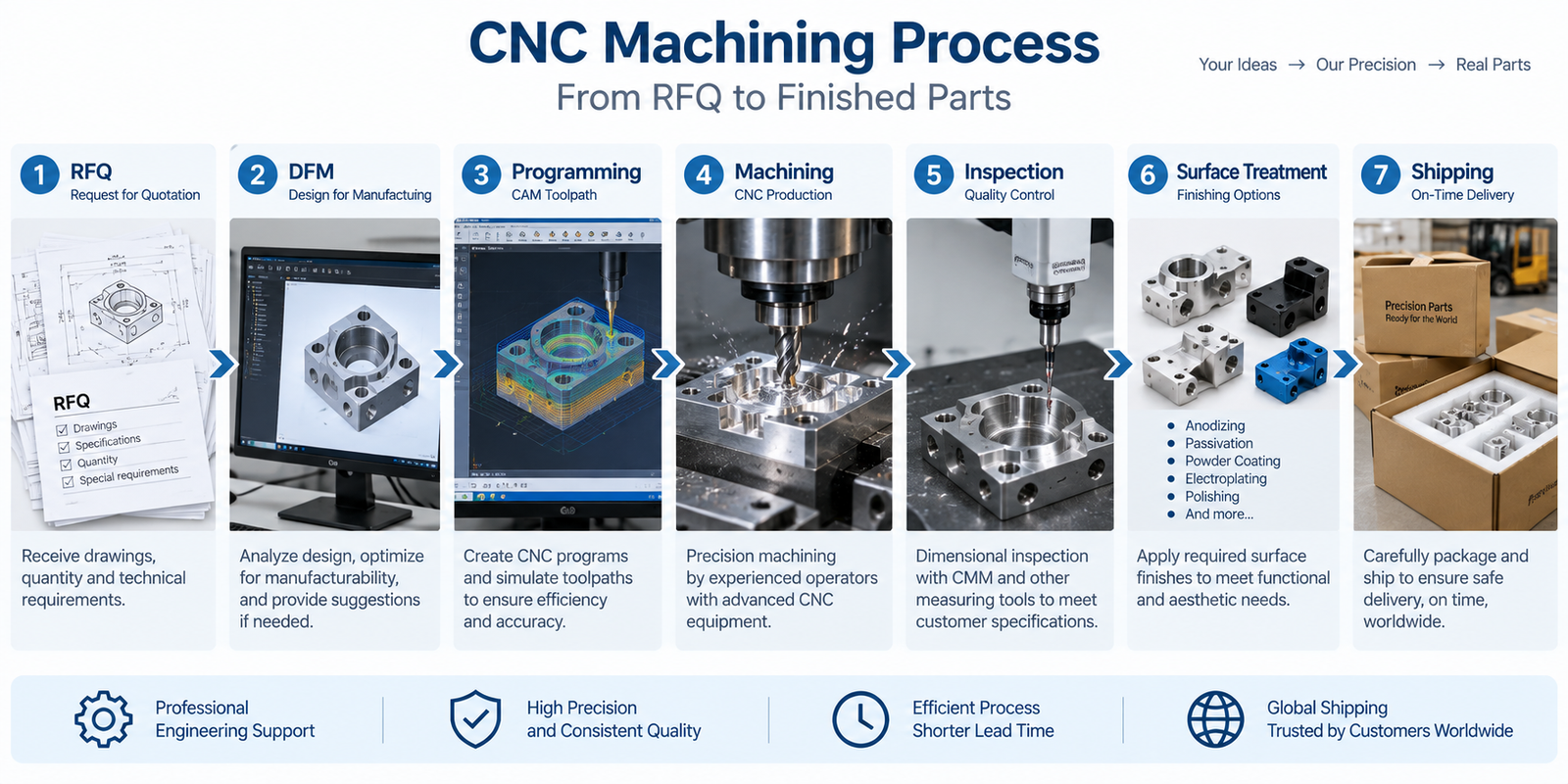
Custom CNC work follows a defined workflow from file review to shipped part.
- RFQ and file review. You send the CAD model, dessin, matériel, quantité, finition, and inspection needs.
- DFM review. Engineering checks tolerances, accès aux outils, rayons, profondeur de trou, parois minces, and workholding.
- Process planning. The supplier selects milling, tournant, GED, affûtage, or a combination.
- Programming and setup. CAM toolpaths, couteaux, luminaires, and inspection strategy are prepared.
- Usinage. Parts are machined to the approved process.
- Inspection. Critical dimensions and GD&T requirements are verified.
- Finishing and documentation. Anodisation, placage, passivation, or polishing are applied as specified.
- Final inspection and shipment.
What Are The Benefits Of Custom CNC Machining?
The main benefit is control over geometry, matériel, tolérance, finition, et documentation.
- Parts fit your drawing, including holes, fils de discussion, and mating faces.
- Materials can be matched to strength, corrosion, température, and weight needs.
- Tolerances are set by the drawing and confirmed during review.
- Prototypes and production can come from the same supplier.
- Design revisions avoid the cost and lead time of hard tooling.
- Finishing and documentation are managed in one workflow.
Custom CNC Machining Vs Standard Parts
| Facteur | Standard Parts | Usinage CNC personnalisé |
| Fit to drawing | Limited to catalog | Manufactured to agreed drawing specifications |
| Material range | Fixed catalog | Broad range of metals and plastics |
| Tolérance | Catalog-dependent | Specified by drawing and confirmed during manufacturing review |
| Modifications de conception | Not applicable | Often faster without hard tooling |
| Quantité | Bulk oriented | From one piece to production |
| Finition | Limité | Integrated with machining |
| Documentation | Limité | Certificates and reports where required |
What Parts Can Custom CNC Machining Produce?
Custom CNC covers a wide range of mechanical components.
- Housings and enclosures
- Brackets and mounting plates
- Arbres, bagues, et collecteurs
- Fixtures and tooling
- Connectors and gears
- Pièces mécaniques de précision
- Replacement and legacy parts
- Prototypes
One example shows the range. An aluminum electronics housing may need 6061-T6, ±0.02 mm on connector locations, tapped holes, microbillage, black anodizing, and a dimensional inspection report. A custom CNC supplier can machine and manage these as one controlled project.
What CNC Machining Processes Are Available?
Fraisage, tournant, Swiss machining, GED, and grinding cover most custom parts.
- Fraisage: 3-axe, 4-axe, and 5-axis for prismatic geometry.
- Tournant: arbres, bagues, and cylindrical parts.
- Swiss machining: long, mince, pièces de petit diamètre.
- GED: hardened materials and fine detail.
- Affûtage: tight size and finish control.
Voir notre Services d'usinage CNC page for machine capabilities.
What Materials And Finishes Can Be Used?
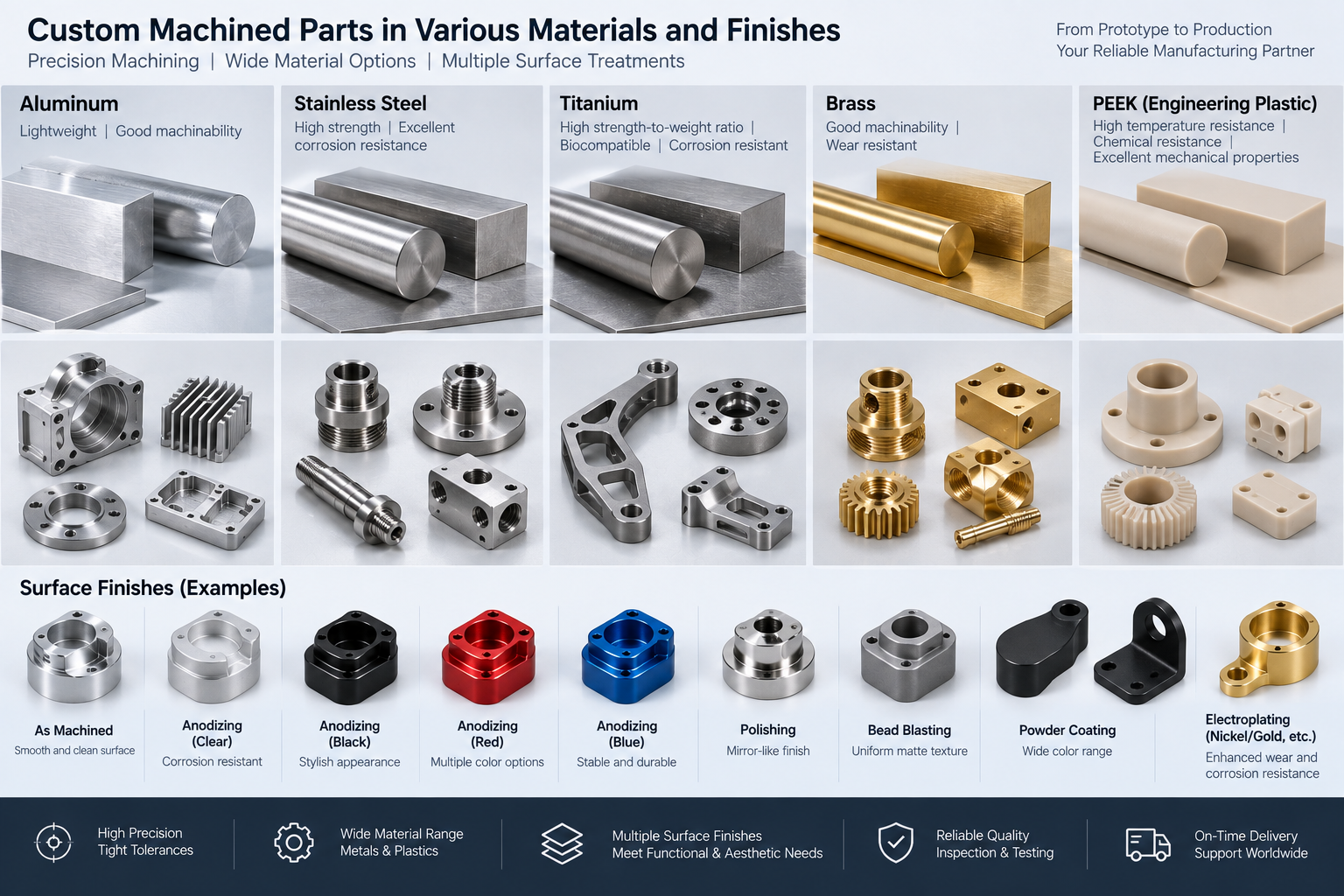
Materials range from aluminum to engineering plastics, and finishes from anodizing to polishing.
- Les métaux: aluminium, acier inoxydable, acier, titane, laiton, et du cuivre.
- Plastiques: COUP D'OEIL, Delrin, nylon, and other engineering grades.
- Finishes: anodisation, placage, passivation, revêtement en poudre, dynamitage, et polissage.
Comparez les options dans notre Matériaux d'usinage CNC guide and finitions de surface pour l'usinage CNC.
How Do Tolerances Affect Custom CNC Machining?
Tighter tolerances add cost and risk, so apply them only where function requires them.
Tight tolerances may need more rigid setups, additional operations, slower finishing cuts, contrôle de la température, specialized tooling, Inspection CMM, and a higher scrap risk. Apply tight tolerances only to dimensions that affect fit, fonction, scellage, alignement, ou performance.
For critical parts, provide a 2D drawing with GD&T callouts for position, platitude, perpendicularity, concentricité, profil, or other requirements that the 3D model alone cannot fully communicate. Voir Tolérances d'usinage CNC for strategy.
Why Is DFM Important?
A DFM review finds features that raise cost or risk before cutting starts.
A useful review should identify unnecessarily tight tolerances, deep narrow pockets, small internal corner radii, parois minces, deep holes, difficult tool access, and surfaces that are hard to inspect. Resolving these points in review is cheaper than discovering them on a machined part.
Custom CNC Machining For Prototypes And Production
Custom CNC scales from one prototype into repeat production.
Once a prototype is approved, the supplier may optimize fixtures, outillage, temps de cycle, and inspection for higher quantities while maintaining the approved design requirements. Because CNC usually does not require dedicated hard tooling, design revisions are often faster and less costly than changes to molded or die-cast tooling.
CNC suits prototypes, fabrication de ponts, volumes faibles à moyens, and some high-volume components. À des volumes très élevés, fonderie, moulage, or stamping may offer lower unit cost depending on the part. Comparer Usinage CNC vs moulage par injection when volume grows.
What Affects The Cost Of A Custom CNC Part?
Cost depends on material, géométrie, processus, tolérance, finition, inspection, et la quantité.
- Material and raw-stock size
- Geometry and machine type
- Nombre de configurations
- Tolerance and surface finish
- Tooling and inspection
- Post-traitement
- Quantité
A small part is not necessarily cheap if it needs complex setups, tolérances étroites, expensive material, or extensive inspection.
How Is Quality Controlled?
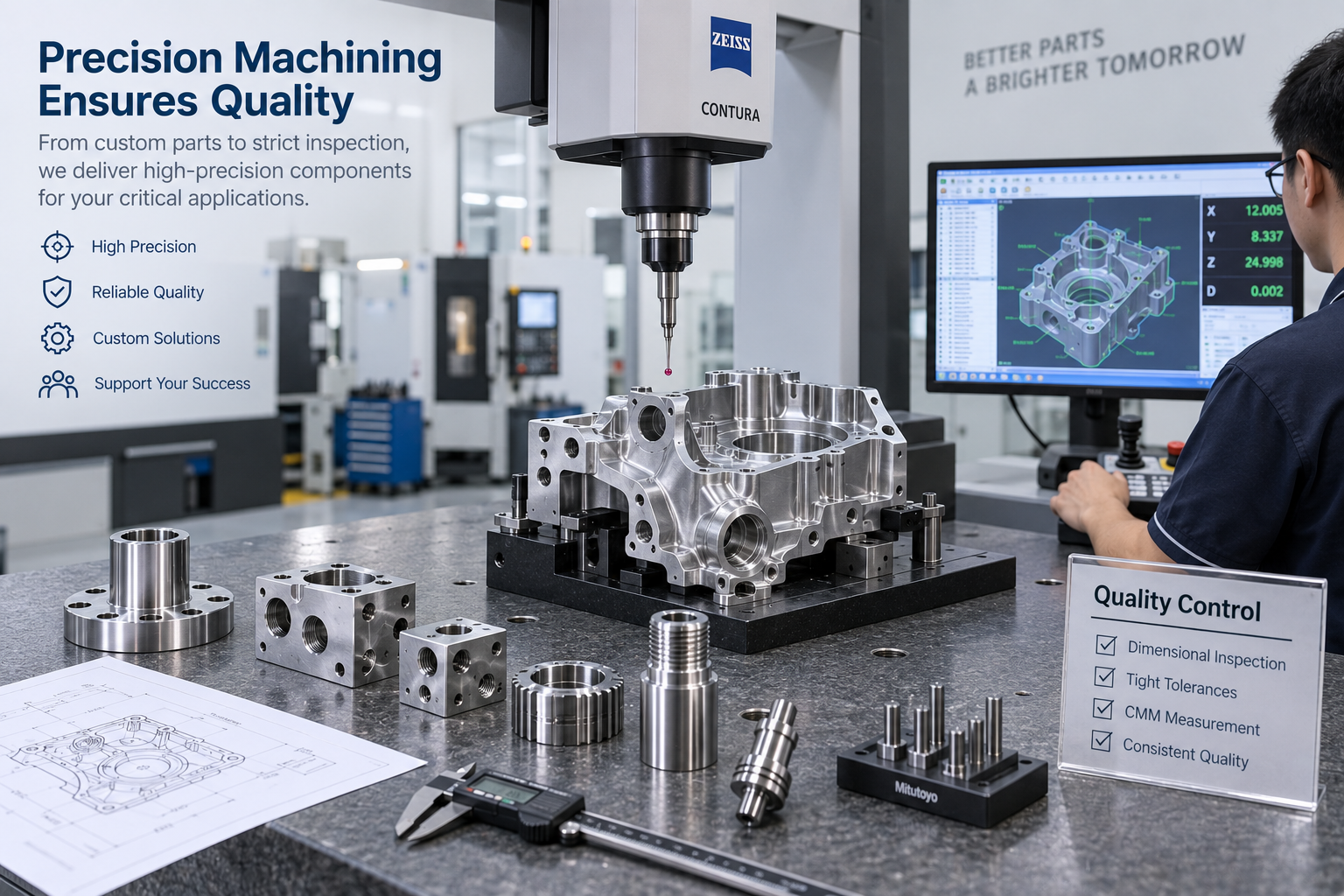
Quality planning begins before cutting. The drawing determines which dimensions, DG&T features, surface requirements, and material conditions must be verified.
- Incoming material verification
- First-piece inspection
- Inspection en cours de fabrication
- Final dimensional inspection
- Surface and finish verification
- Documentation where required
How To Choose A Custom CNC Machining Supplier
Qualify a supplier on capability, inspection, traçabilité, and control processes.
- Confirm the machine types, axis counts, and materials you need.
- Ask about inspection equipment such as CMM, mesure optique, height gauges, roughness testing, and thread gauges.
- Ask about traceability: certificats de matériel, certificate of conformance, Fai, et rapports d'inspection.
- If finishing is outsourced, ask how outside processors are qualified and controlled.
- For repeat production, ask how drawing revisions are controlled so old revisions do not enter production.
- Ask what happens if a part fails inspection.
- Confirm certifications only if the supplier actually holds them.
What Should You Send For A CNC Quote?
A complete RFQ produces a faster, more accurate quote.
- 3Modèle d: STEP is commonly preferred for geometry.
- 2Dessin D: include critical dimensions, tolérances, DG&T, fils de discussion, and finish notes.
- Matériel: specify the alloy, grade, et l'état, such as 6061-T6 or 17-4 PH H900.
- Quantité: state prototype and expected production quantities if known.
- Post-traitement: anodisation, placage, passivation, traitement thermique, polissage, ou peinture.
- Documentation: material certificate, dimensional report, Fai, or certificate of conformance.
- Formats de fichiers: confirm the formats your supplier accepts.
When Is Custom CNC Machining Not The Best Choice?
Custom CNC is not always the cheapest or fastest route.
- Very high-volume plastic parts may suit injection molding.
- High-volume sheet-like metal parts may suit stamping.
- Complex hollow metal geometry may suit casting or additive methods.
- Simple standard fasteners are usually cheaper as catalog parts.
- Thin sheet structures may suit sheet metal fabrication.
Questions fréquemment posées
What is custom CNC machining?
It is CNC machining of parts made to your drawing, matériel, tolérance, et finir, rather than from a catalog.
What is the difference between custom CNC and standard parts?
Standard parts come from a catalog. Custom CNC parts are manufactured to your agreed drawing specification.
Can custom CNC machining produce one-off parts?
Oui. CNC is well suited to prototypes and low-volume parts because it usually does not require dedicated hard tooling. Minimum order terms may depend on material, processus, finition, et fournisseur.
Is custom CNC suitable for production?
Oui, for prototypes, fabrication de ponts, and low-to-medium volumes. At very high volume, other processes may lower unit cost.
Why do tight tolerances cost more?
They may need more operations, slower cuts, rigid setups, specialized tooling, and CMM inspection.
How long does custom CNC take?
It depends on geometry, matériel, quantité, et finir. Prototypes often ship in days for suitable projects.
How do I get a custom CNC quote?
Send the 3D model, 2Dessin D, matériel, quantité, finition, and documentation needs.
Get A Quote For Your Custom CNC Part
Send your drawing and requirements. Nos ingénieurs examineront la fabricabilité, recommend materials and tolerances, and quote machining plus finishing together.


4 réflexions sur "Pourquoi choisir un service d'usinage CNC personnalisé?”