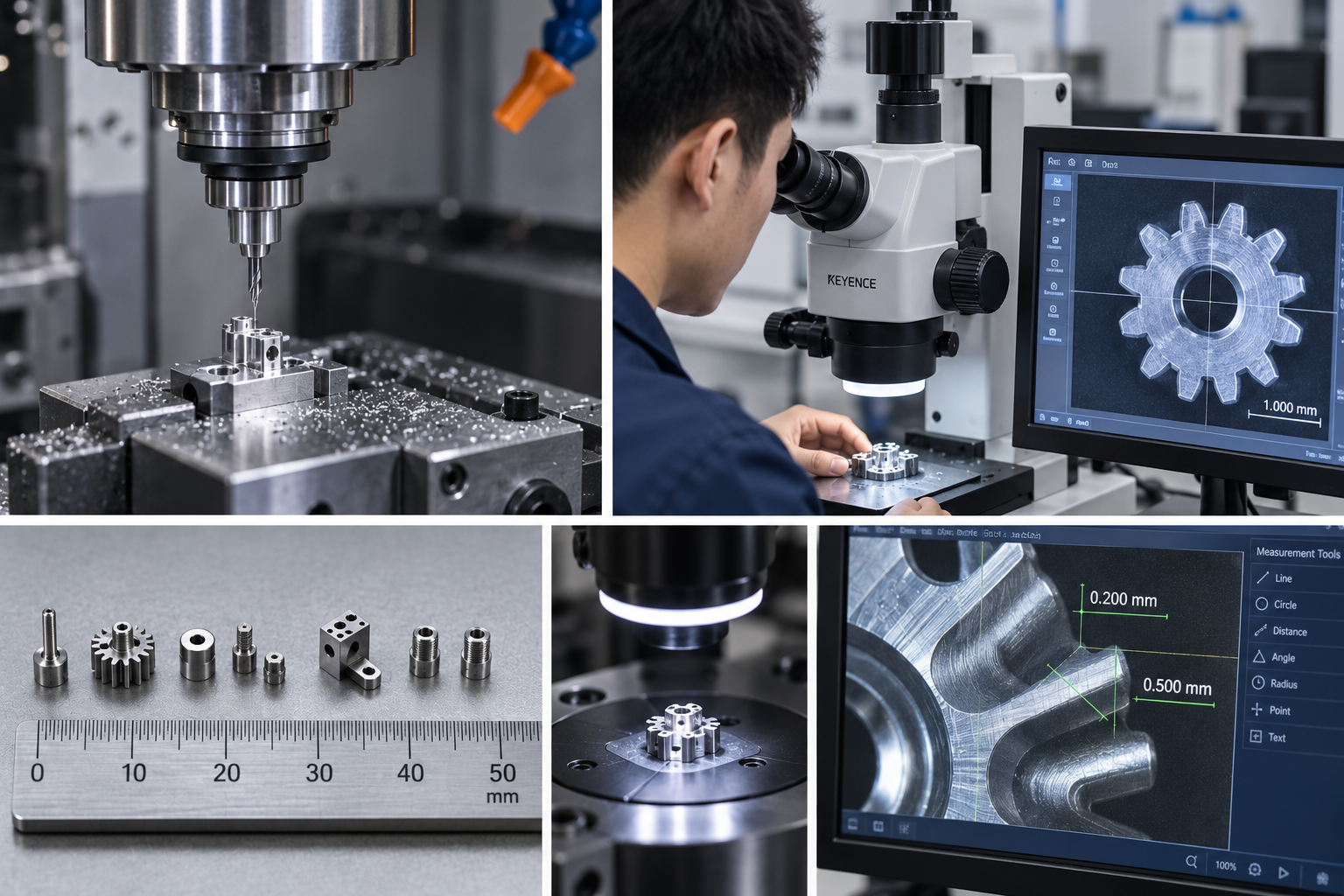



La lavorazione in miniatura produce parti di precisione molto piccole con precisione dimensionale elevata. It uses scaled-down cutting processes on components that can be smaller than a coin. This guide covers methods, materiali, tolleranze, applicazioni, and design rules for miniature components.
What Is Miniature Machining?
Miniature machining is the precision removal of material to produce small parts with controlled dimensions and fine features.
It is not simply running a normal machine faster. Tool size, Rigidità della macchina, vibrazione, rimozione del chip, and inspection all behave differently at small scale. At very small cutting depths, the cutting edge radius becomes significant relative to chip thickness. Instead of shearing material cleanly, the tool may rub or plough, increasing heat, Burrs, e tagliare le forze.
Parts are usually measured in millimeters, and some precision features are measured in micrometers.
How Small Are Miniature Machined Parts?
There is no universally accepted dimensional boundary between small-part machining, miniature machining, and micromachining. In pratica, miniature machining refers to small components or features where conventional tooling, tenuta del lavoro, chip control, and inspection become more difficult because of scale.
| Termine | Practical Meaning | Esempio |
| Small-part machining | Small components made with conventional precision machining | Connettori, raccordi, Alloggi per sensori |
| Lavorazione in miniatura | Small parts or fine features needing specialized tooling and handling | Perni, miniature gears, componenti medici |
| Micromachining | Very small features needing micro-scale tools or processes | Micro holes, canali, micro pins |
Confirm the practical limit with your machinist for your specific feature.
Miniature Machining Vs Micromachining
Miniature machining describes the manufacture of very small parts. Micromachining usually focuses on extremely small features, utensili, or process dimensions. The terms overlap, and there is no single industry-wide boundary.
| Fattore | Lavorazione in miniatura | Micromachining |
| Main focus | Small components | Extremely small features |
| Typical tooling | Small conventional cutting tools | Micro end mills, trapani, Elettroerosione, laser |
| Main challenge | Gestione, rigidità, Burrs | Tool fragility, scale effects, ispezione |
| Applicazioni tipiche | Perni, raccordi, viti, componenti medici | Microfluidics, microfori, MEMS-related features |
What Methods Are Used For Miniature Machining?
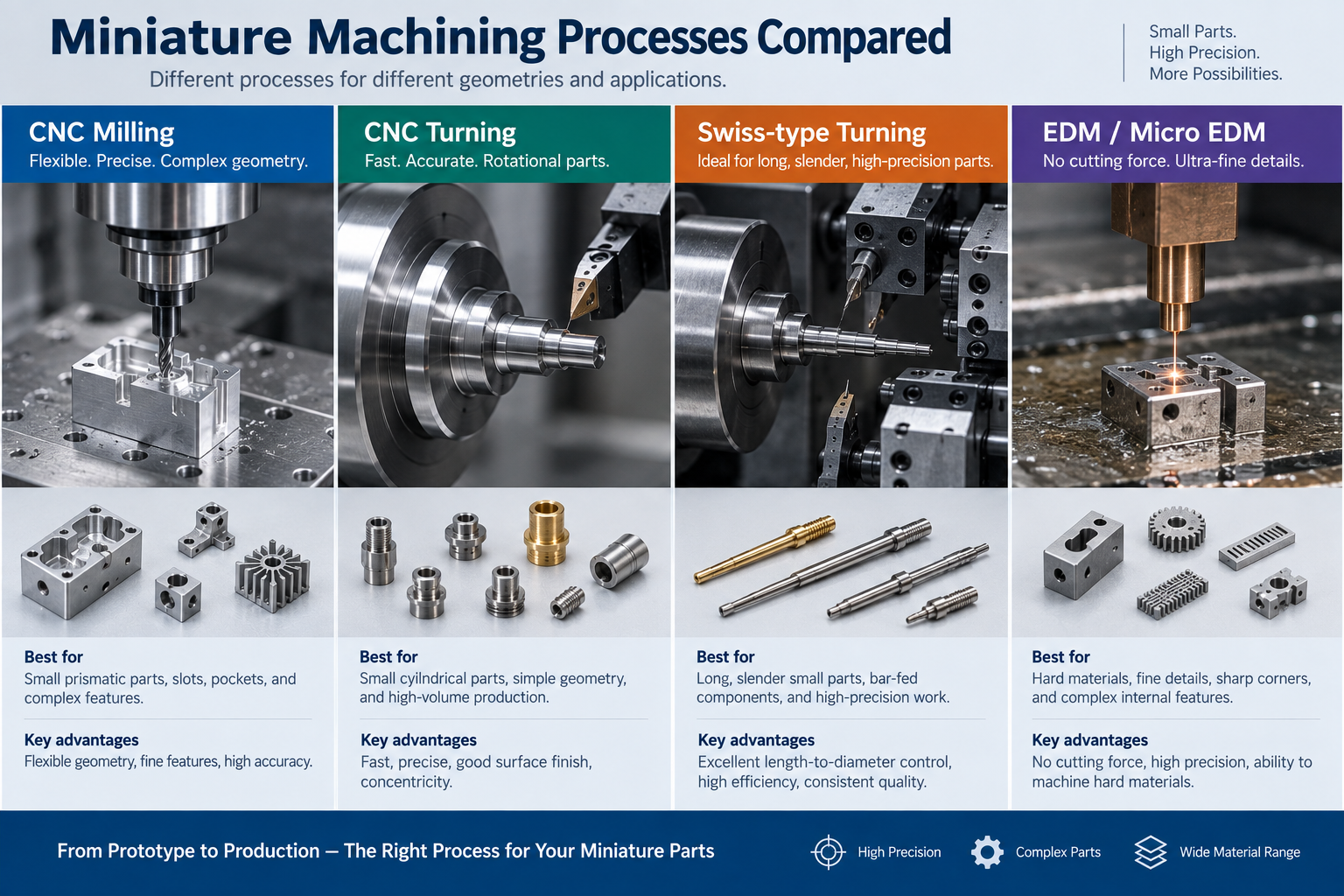
Each method suits a different shape and production need.
| Metodo | Meglio per | Punti di forza | Limits |
| Fresatura CNC | Small prismatic parts, slot, tasche | Flexible geometry, fine features | Small tools are fragile |
| Tornitura CNC | Small cylindrical parts | Veloce, girare, concentric | Rotational shapes only |
| Swiss-type turning | Long slender small parts | Strong length-to-diameter control | Best suited to bar-fed geometry |
| Micro EDM / elettroerosione a filo | Materiali duri, dettaglio accurato | No cutting force, small features | Più lentamente, conductive materials only |
| Rettifica | Durezza, fine, tight tolerance | Precision size and finish | Geometry limited |
CNC drilling and micro drilling produce small holes for fluid passages, connettori, componenti medici, and precision assemblies. As hole diameter decreases, tool runout, proporzioni, Evacuazione dei chip, and drill breakage become more important.
Small-diameter tools often require high spindle speeds to maintain suitable surface speed. Speed alone does not solve the problem. Spindle runout, bilancia, toolholding, feed per tooth, and machine stability remain critical.
For small cylindrical and screw-type parts, consulta la nostra guida su CNC Swiss screw machining. For general small-part work, we use Fresatura CNC E Tornitura CNC.
CNC Milling Vs Swiss Turning For Miniature Parts
Use Swiss turning when the part is primarily cylindrical, long relative to its diameter, produced from bar stock, needed in medium or high quantities, or concentric and thread-heavy.
Use CNC milling when the part needs pockets, flats, off-axis holes, prismatic geometry, complex surfaces, or multi-face machining.
Define the geometry first. That decision usually points to one process.
What Materials Are Used For Miniature Parts?
Miniature machining works on metals and plastics, but material behavior matters more at small scale.
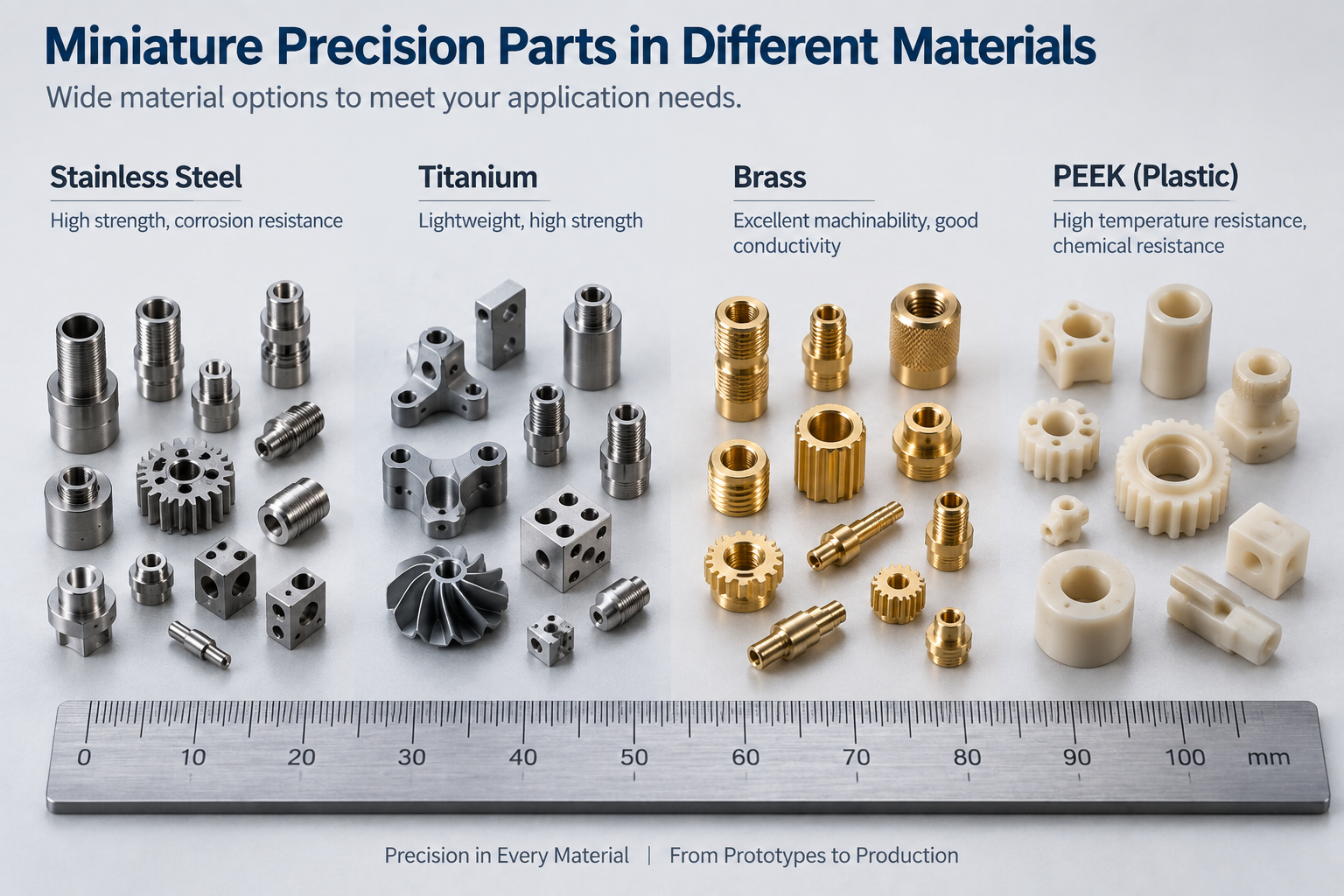
- Acciaio inossidabile: 303 for machinability; 316L and 17-4 PH for corrosion and strength.
- Leghe di titanio: used for high-strength, lightweight medical and aerospace components. Implant applications require specified medical-grade material, documentazione, and validated controls.
- Ottone e rame: conductive and free-machining, good for connectors.
- Alluminio: light and fast to machine.
- Ingegneria delle materie plastiche: SBIRCIARE, Delrin (acetale), and PTFE for insulation, attrito, e resistenza chimica.
- Specialty alloys: may be machined where strength, temperatura, corrosione, or application requirements justify the added difficulty. Confirm the alloy with our team.
Choose material by function and machinability, not only by cost. Small parts are sensitive to material defects and burrs. Vedere Materiali per la lavorazione CNC for comparisons.
What Tolerances Can Miniature Machining Achieve?
Miniature parts often require tolerances measured in hundredths or thousandths of a millimeter, depending on the feature and application.
On suitable geometries, precision CNC machining may hold around ±0.01 mm. Selected critical dimensions may reach approximately ±0.005 mm when machine capability, materiale, impostare, and inspection allow. Tolerances are design-dependent, so specify them only on functional surfaces.
How Are Miniature Parts Inspected?
Inspection strategy changes at small scale.
- Optical and vision measurement suit small, delicate features.
- Fine-stylus CMM can measure accessible critical dimensions. Vision or optical measurement may be preferable for very small or delicate features.
- Optical comparators and toolmaker microscopes check burrs and edge condition.
- Surface roughness testers verify finish where required.
As tolerances tighten, measurement uncertainty must stay small relative to the tolerance being verified. Altrimenti, the result may not reliably show conformity.
How Are Miniature Parts Held During Machining?
Workholding must secure the part without distorting or damaging it.
- Precision collets suit round parts.
- Soft jaws and custom fixtures protect delicate features.
- Guide bushings support bar work in Swiss machines.
- Adhesive or sacrificial fixtures hold very thin parts.
- Parts may be machined from larger stock and separated at the end.
Fixture design must also provide tool access and a stable datum for inspection.
What Are The Main Challenges In Miniature Machining?
Small parts amplify problems that are easy to ignore at full scale.
- Tool deflection and breakage rise as tool size drops.
- Tool runout matters more: a few micrometers of runout can become significant when cutter diameter and chip load are very small, causing uneven cutting, poor finish, o rottura.
- Burrs matter more: a burr that would be insignificant on a large part can interfere with a hole, sealing face, electrical contact, or assembly interface.
- Chip evacuation is difficult in deep, tiny features.
- Machine vibration and thermal growth affect accuracy.
- Parts are easy to lose, curva, o danni. Tray packaging, controlled cleaning, and part separation may become part of the process.
- Inspection access is limited on tiny geometries.
- Tolerances must stay realistic for the feature size.
Plan for these issues early.
Surface Finish And Burr Control
Surface finish depends on cutter size, materiale, spindle runout, foraggio, vibrazione, and tool condition.
Small features can be difficult to polish or deburr after machining. Specify Ra and cosmetic criteria only where function demands them. Define critical edges and burr limits instead of applying a strict deburring requirement to every edge.
Miniature Machining Design Guidelines
Follow these rules to keep your miniature part manufacturable.
- Avoid extremely thin walls where stiffness is needed. Minimum wall depends on material and feature size.
- Keep hole depth reasonable relative to hole diameter.
- Avoid extremely deep small-diameter holes where chip evacuation becomes unreliable.
- Use the largest practical internal corner radius.
- Avoid tiny internal radii unless function requires them.
- Limit tight tolerances to functional surfaces.
- Specify burr control on critical edges only.
- Avoid deep pockets that trap chips.
- Add a datum that inspection can reach.
- Specify material grade and finish on the drawing.
Designs that simplify tool access, Evacuazione dei chip, sfacciato, and inspection are generally easier and more economical to manufacture. For tolerance strategy, consulta la nostra guida su Tolleranze di lavorazione CNC.
Where Is Miniature Machining Used?
Miniature machining supports industries where size, precisione, and reliability matter.
- Medical and laboratory components: instrument parts, device components, alloggiamenti, and prototype parts.
- Elettronica e connettori: terminali, perni, alloggiamenti, and micro connectors.
- Semiconductor and test equipment: pin di precisione, alignment components, infissi, and small mechanical parts.
- Aerospace and defense: small fittings, sensori, and actuator parts.
- Settore automobilistico: sensori, injector components, and small mechanisms.
- Robotica e automazione: micro gears, Aste, e utensili.
Each application adds its own material and cleanliness requirements. State the intended use in your inquiry.
What Affects Miniature Machining Cost?
A miniature part may use very little material, but small size does not automatically mean low cost.
- Tempo macchina: small parts can still run long cycles with fine tools.
- Utensileria: micro tools are expensive and wear faster.
- Gestione: small parts need careful fixturing, pulizia, e imballaggio.
- Ispezione: fine tolerances need more measurement time.
- Yield risk: fragile tools, parti delicate, and demanding features can increase scrap or rework risk.
- Quantità: setup cost spreads over the batch.
- Materiale: medical and specialty grades cost more.
There is no reliable per-part price without a drawing. Send the model and quantity for an accurate quote.
When Is Miniature Machining Not The Best Process?
Machining is not always the best way to make a small part.
| Requisito | Likely Process |
| Low-volume precision metal | CNC or Swiss machining |
| High-volume small turned part | Swiss or automatic turning |
| Very high-volume stamped geometry | Stampaggio |
| High-volume miniature plastic | Micro injection molding |
| Extremely fine hard-material feature | Elettroerosione |
| Prototype complex micro geometry | CNC, Elettroerosione, or additive depending on feature |
For high-volume plastic micro parts, vedi il nostro micro injection molding service. Confrontare Lavorazione CNC vs stampaggio a iniezione when deciding.
Domande frequenti
What is miniature machining?
It is precision material removal that produces very small parts, typically at millimeter scale, with fine dimensional control.
How small can CNC machining go?
The practical minimum depends on process, cutter diameter, proporzioni, materiale, capacità della macchina, e ispezione. Very small features may need dedicated micromachining or EDM rather than conventional CNC.
What is the difference between miniature machining and micromachining?
Miniature machining focuses on small components. Micromachining focuses on extremely small features and tools. The terms overlap.
What materials are used for miniature machining?
Acciaio inossidabile, titanio, ottone, rame, alluminio, and engineering plastics such as PEEK, Delrin, and PTFE.
What tolerances can miniature machining hold?
On suitable features, ±0.01 mm may be practical. Approximately ±0.005 mm may be achievable for selected dimensions. Actual capability depends on size, geometria, materiale, utensileria, impostare, e ispezione.
Is Swiss turning the same as miniature machining?
NO. Swiss turning is one method. It suits long, slender, small-diameter bar-fed parts.
Why are miniature parts expensive?
Fine tooling, Attenta maneggevolezza, detailed inspection, and yield risk add time. Cost depends on geometry, materiale, e quantità.
Get A Quote For Your Miniature Component
Send your 3D model, 2disegno D, materiale, quantità, and critical-dimension list. Our engineers will review manufacturability, flag risk features, and quote machining plus inspection together.