



Die cast metal strength depends on the alloy, casting quality, geometria, and service conditions. Alluminio, zinco, and magnesium can produce useful load-bearing components. To choose safely, compare the relevant properties, then verify your finished part. A tensile-strength number alone cannot establish its allowable load.
Immagine in primo piano: conceptual die-cast components, not TOPS production samples.
How Strong Is Die Cast Metal
Die cast metals can support substantial loads, but no single strength value describes every alloy or component.
Die casting injects molten metal into a reusable steel die. This article focuses on nonferrous high-pressure die castings. A ribbed enclosure, a latch, and a mounting bracket have different performance requirements.
For preliminary context, one NADCA educational comparison lists tensile strengths of approximately 234–317 MPa across three selected alloys. Those figures describe material data, not permissible stresses or guaranteed production-part properties. The comparison appears below with its source and limitations.
Your drawing should identify the alloy, dimensioni critiche, and acceptance requirements. The casting process, operazioni secondarie, and inspection plan must support those requirements at your intended production volume.
Which Strength Properties Matter
Choose properties that match how your part could fail, rather than ranking materials by tensile strength alone.
| Proprietà | What It Describes | When You Need It |
|---|---|---|
| Ultimate tensile strength | Maximum engineering stress during a tensile test | Comparing resistance to tensile failure |
| Forza di snervamento | Stress associated with specified permanent deformation | Preventing permanent bending or loss of fit |
| Elastic modulus | Resistance to elastic strain | Controlling deflection and alignment |
| Allungamento | Tensile ductility under specified test conditions | Assessing deformation capacity before fracture |
| Prestazioni a fatica | Resistance to repeated loading | Vibrazione, rotating loads, or repeated operation |
| Creep resistance | Resistance to time-dependent deformation under sustained stress | Loaded joints and elevated-temperature service |
NADCA structural guidance distinguishes stiffness, resistenza alla trazione, fatica, and impact behavior. Treat each as a separate design check.
A housing can remain below yield yet deflect enough to misalign a bearing. A bracket can survive one pull test and fail after repeated vibration. Hardness measurements alone cannot resolve either question.
Aluminum Zinc And Magnesium Strength Comparison
The strongest candidate changes with the property you prioritize and the exact alloy you specify.
The following values come from a legacy NADCA alloy-selection example. MPa figures are rounded conversions from its ksi values.
| Alloy In The Source | Tensile And Yield Strength | Densità |
|---|---|---|
| Alluminio 380 | UTS about 317 MPa; yield about 159 MPa | 2.74 g/cm³ |
| Magnesium AZ91D | UTS about 234 MPa; yield about 159 MPa | 1.81 g/cm³ |
| Zinc Zamak 3 | UTS about 283 MPa; yield about 221 MPa | 6.6 g/cm³ |
Use these figures for orientation only. The source is an educational comparison, not a procurement specification or modern design allowables database. Confirm current grade-specific data, specimen condition, spessore, temperatura, and statistical basis before design release.
Notice the different rankings. Alluminio 380 has the highest tensile strength here; gli oneri 3 has the highest yield strength. AZ91D has the lowest density. None wins every criterion.
Aluminum For Housings And General Components
Aluminum often suits housings where mass, colabilità, and mechanical performance must be balanced.
Specify the actual grade and governing specification. Do not treat aluminum, A380, and every regional casting designation as interchangeable.
NADCA aluminum guidance describes 380 as a broadly used alloy. It identifies 390 with wear-resistant applications and low ductility. High hardness or wear resistance does not automatically make an alloy suitable for impact-loaded structures.
Utilizza il nostro aluminum die casting alloy guide when narrowing the material options.
Zinc For Compact Detailed Components
Zinc alloys can suit small hardware where detail, controllo dimensionale, and mechanical loading matter more than minimum mass.
IL International Zinc Association alloy guide describes Alloy 5 as stronger and harder than Alloy 3, with lower ductility. It also identifies specialized alloys with different creep behavior.
Specify the grade instead of asking simply for strong zinc. Review sustained loading, temperatura, invecchiamento, and any secondary forming operation. A grade that improves one property may compromise another.
Magnesium For Weight Sensitive Designs
Magnesium is worth evaluating when reducing mass creates value and the part can be designed around its material properties.
Low density alone does not guarantee the lightest acceptable component. Required wall sections, rigidità, fastening, and environmental protection affect the finished design.
UN SAE study of AZ91D reports that tensile properties vary with cast section thickness. This is another reason to validate representative sections rather than rely on a generic material label.
Why A Casting Can Underperform Its Datasheet
Your part can underperform published data when local defects, section thickness, or processing differ from the reference specimens.
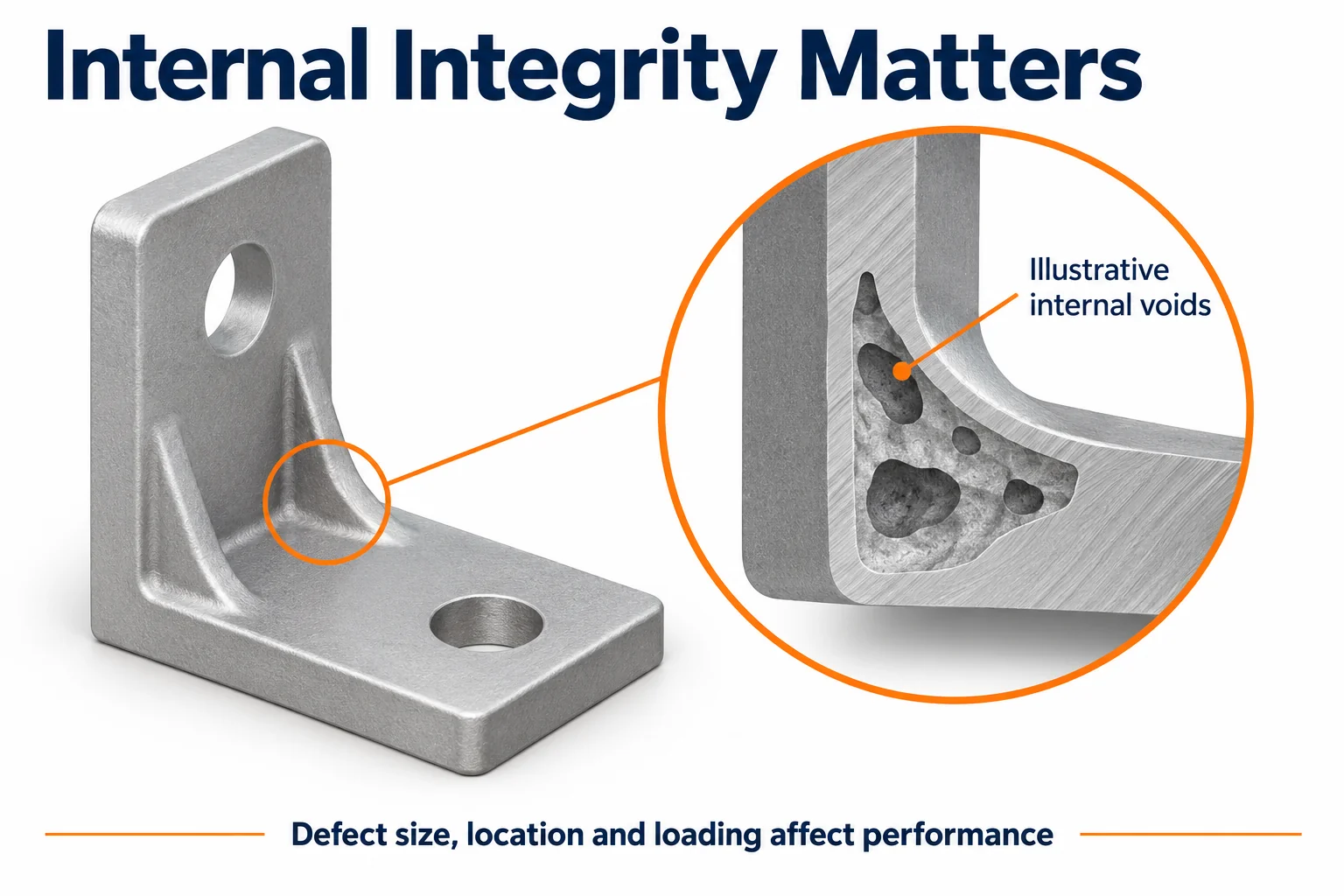
Porosity And Local Defects
Gas entrapment and solidification shrinkage can leave internal voids. A smooth exterior does not prove internal soundness.
Voids reduce the effective load-bearing section and can concentrate local stress. Their location matters: a defect near a highly stressed fillet deserves different attention from one in an unloaded region.
Higher injection pressure alone does not eliminate these risks. Filling behavior, ventilazione, equilibrio termico, and feeding during solidification all matter.
NADCA describes high-integrity processes, including high-vacuum and squeeze casting, for demanding applications. Ask which process controls address your part’s risks, and how their effectiveness will be verified.
Machining And Finished Condition
Machining can expose subsurface defects and change the remaining wall section. Evaluate the finished geometry, including bores, discussioni, and sealing faces.
Specify critical machining allowances early. A casting that passes inspection before machining may need another check afterward.
A separately cast test bar also differs from a specimen taken from your component. Record specimen origin and location when comparing results.
Heat Treatment Limits
Heat treatment is alloy- and process-dependent; it is not a universal upgrade for die cast aluminum.
Conventional gas-containing castings can blister during high-temperature treatment. Research on blister formation links this behavior to casting defects and thermal exposure.
Heat-treatable structural alloys and suitable casting processes offer other options. Confirm the alloy, temper, internal quality, distortion allowance, and resulting properties together before specifying treatment.
How Geometry Changes Load Capacity
Geometry determines where loads travel and how much stress or deflection develops in the casting.
Consider a simple hypothetical calculation. UN 1,000 N axial force across 100 mm² produces a nominal stress of 10 MPa. The same force across 50 mm² produces 20 MPa.
This arithmetic assumes uniform axial loading. It excludes bending, buchi, stress concentrations, difetti, e affaticamento. It illustrates why a material strength figure cannot answer how many kilograms your bracket will carry.
Support The Load Path
Place ribs or gussets where they help transfer force between attachment points. Avoid adding mass to areas that contribute little stiffness.
Use generous transitions where geometry permits. Review boss roots, angoli affilati, and nearby holes as possible stress concentrations.
NADCA design-data guidance discusses ribs and analysis for strength and rigidity. Finite element analysis can identify highly loaded regions, but its assumptions still require verification.
Keep Castability In The Design
Excessively thick junctions can complicate solidification. Abrupt wall changes can create manufacturing and structural problems in the same location.
Esaminare le transizioni dei muri, bozza, gating, and ejection with the die caster before freezing the design. Avoid prescribing a universal minimum wall thickness without considering alloy and flow distance.
Check The Joint
A failed assembly may originate at a thread, bearing seat, or fastener interface rather than in the main wall.
Define assembly torque and repeated assembly requirements. Consider thread engagement, local bearing stress, inserts where appropriate, and the surrounding boss geometry.
Validate the joint in its actual assembled condition. Tightening loads can be significant even before the external service load appears.
Temperature Fatigue And Corrosion In Service
Service conditions can change the relevant material properties and the way a casting fails.
For vibration or repeated loads, define the load range, cycle count, and mounting conditions. A single static overload test does not establish fatigue life.
For elevated temperatures, request data at the actual operating temperature. Include exposure duration and whether the loading is sustained. Thermal conductivity describes heat transfer, not allowable mechanical stress.
For corrosive environments, specify fluids, umidità, esposizione al sale, and contact with other metals. Local corrosion can reduce a load-bearing section. Coatings and joint isolation need validation for the actual assembly.
Avoid a blanket claim that all die cast aluminum remains suitable at 300°C. The grade, duration, carico, and permissible deformation must be assessed together.
Die Cast Metal Versus Steel And Forged Aluminum
Compare complete designs under the same requirements, because material-family labels cannot establish the better component.
Many steels provide higher stiffness and strength than common die casting alloys, but grade and condition matter. A larger lightweight casting may still meet the same functional requirement with lower mass.
Forging shapes solid metal rather than injecting a liquid. NADCA compares forging and die casting, highlighting forging’s mechanical advantages and die casting’s geometric flexibility.
Evaluate forged or wrought alternatives when impact tolerance, fatigue demands, or defect sensitivity dominate. Compare certified properties and finished-part tests rather than assuming every forged component exceeds every casting.
For low volumes or changing designs, machining may avoid dedicated casting tooling. Per una produzione stabile, a casting may combine features that otherwise require several parts.
Includere la lavorazione, ispezione, scrap, finitura, and tooling amortization in your comparison. The cheapest metal per kilogram does not necessarily produce the lowest-cost accepted assembly.
How To Verify Die Cast Part Strength
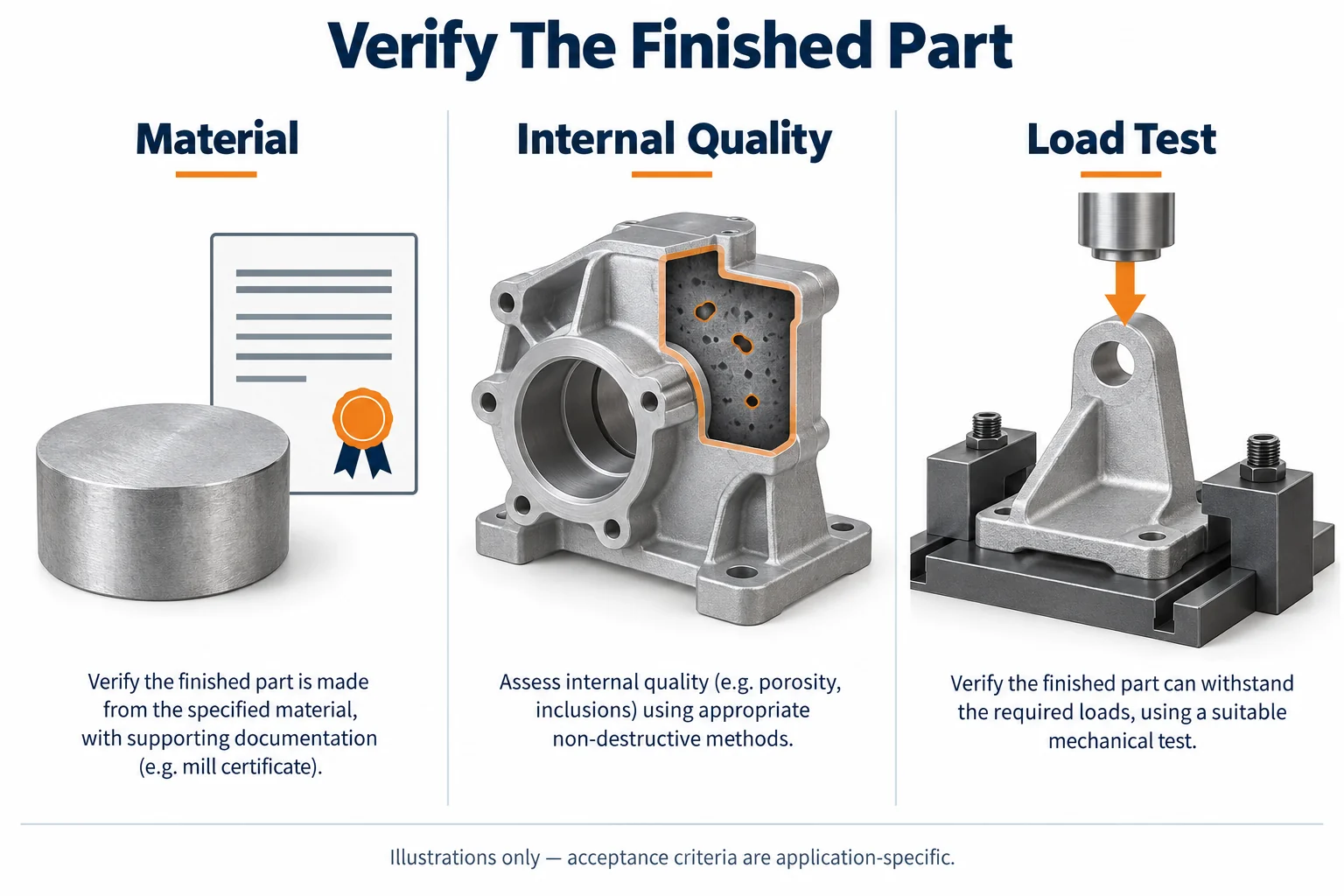
Verify strength through an agreed combination of material records, controllo dimensionale, internal-quality checks, and representative mechanical testing.
| Prova | Cosa aiuta a stabilire | Limite importante |
|---|---|---|
| Alloy chemistry and traceability | Material identity and production history | Does not establish finished-part strength |
| Controllo dimensionale | Critical sections, interfaces, and machining results | Does not reveal all internal defects |
| Radiography or CT where specified | Internal discontinuities within method capability | Acceptance needs agreed locations and criteria |
| Tensile specimens | Properties under the specified test conditions | Specimen origin affects relevance |
| Assembly load and fatigue tests | Performance under defined operating conditions | Results apply to the tested configuration |
| Leak testing where required | Pressure integrity under specified conditions | Passing does not prove structural capacity |
Agree the test method, sample quantity, acceptance limits, and reporting format before tooling approval. Identify critical zones on the drawing.
A useful validation sequence starts with your failure modes. Select measurements that address them, test representative samples, then document the approved manufacturing condition.
Include final machining, rivestimenti, and assembly where they affect performance. Define when material, attrezzo, or process changes require revalidation.
What To Send TOPS For A Strength Review
Send your functional requirements with the CAD model so the quotation addresses performance as well as geometry.
Offerte TOP Die Services di casting across aluminum, zinco, and magnesium projects. Review the available die casting materials as a starting point.
Confirm the exact alloy, casting route, machining scope, and inspection arrangements for your part. Specialized mechanical testing should be identified in the quotation rather than assumed.
Include these details:
- The 3D model and drawing, with critical dimensions and minimum finished sections.
- Load direction, magnitude, mounting conditions, and expected operating cycles.
- Intervallo di temperatura, exposure time, and corrosive environment.
- Proposed alloy and specification, or permission to suggest alternatives.
- Required mechanical tests, acceptance criteria, e tracciabilità.
- Annual volume, order quantities, e la durata prevista del programma.
Request A Die Casting Review with these files to discuss material selection, producibilità, and quotation scope.
Domande frequenti
These answers help you interpret common strength claims before selecting a die casting alloy.
Is Die Cast Metal Strong Enough For A Bracket
Può essere, provided the alloy, geometria, casting quality, and joint withstand the specified loads. Validate static strength, deflessione, and fatigue where relevant. The word bracket does not define the loading requirement.
Does Die Cast Metal Break Easily
There is no universal answer. Duttilità, difetti, stress concentrations, temperatura, and loading rate affect fracture behavior. Inspect the failure location and operating conditions before attributing a break solely to die casting.
Is Zinc Stronger Than Aluminum
Some zinc alloys exceed some aluminum alloys in particular properties. In the cited example, gli oneri 3 has higher yield strength than aluminum 380, but lower tensile strength. Compare grades and conditions.
Is A380 Stronger Than ADC12
Do not decide from alloy names alone. Compare the relevant specifications and properties under equivalent conditions. ADC12 and A380 are distinct designations; an alternative requires engineering review and agreed acceptance criteria.
Can Die Cast Aluminum Be Used For Structural Parts
SÌ, with suitable alloy selection, controllo del processo, geometria, and validation. Structural applications may require high-integrity casting methods and application-specific mechanical testing.
Can A Coating Make A Weak Casting Strong Enough
A protective coating can help limit environmental damage, but it does not replace adequate structural design. Do not treat plating or painting as a repair for insufficient load capacity or unacceptable internal defects.
Conclusione
Choose die cast metal strength around your part’s failure modes. Compare the exact alloy and condition, design a practical load path, and verify representative finished parts. Agree acceptance criteria before tooling so the quotation, piano di ispezione, and production process support the same performance requirements.


1 pensato a “Resistenza del metallo pressofuso e come scegliere una lega”