



Il codice G è il nome comunemente usato per il formato di programmazione CNC basato su testo che indica a una macchina come posizionare e spostare i suoi assi ed eseguire operazioni di lavorazione. Un programma CNC completo utilizza anche codici M e parole di indirizzo come X, Y, Z, F, S, e t. Questa guida spiega come funziona, its types, and where it is used.
Cos'è il codice G?
Il codice G è il nome comune del formato basato su testo che controlla il movimento e le operazioni della macchina CNC.
A rigor di termini, un programma pezzo contiene diversi tipi di parole. Le parole G di solito definiscono le modalità preparatorie e di movimento. Le parole M gestiscono varie funzioni della macchina. S imposta la velocità del mandrino, F imposta l'avanzamento, e T affronta gli strumenti. Le lettere delle coordinate impostano le posizioni.
Le moderne convenzioni del codice G affondano le loro radici nello storico formato RS-274 e nell'ISO 6983 famiglia di norme. Le implementazioni effettive variano in base al controller e al costruttore della macchina utensile.
Come funziona il codice G?
Il CNC interpreta i blocchi di programma in sequenza, spesso utilizzando la previsione e la pianificazione della traiettoria prima di comandare gli assi della macchina.
Un blocco è una riga di istruzioni di programma. Ogni blocco contiene parole composte da una lettera di indirizzo e un valore numerico. Le lettere definiscono il significato del numero.
- Le parole G impostano l'operazione, come G01 per un taglio dritto.
- X, Y, e le coordinate Z impostate.
- F imposta la velocità di avanzamento e S imposta la velocità del mandrino.
- T seleziona un utensile e M imposta le funzioni della macchina.
Alcuni comandi sono modali. Un comando modale rimane attivo finché non lo modifichi o lo annulli. G01, G21, G90, e G54 sono esempi modali comuni.
Ecco un esempio di blocco:
G21 G90 G54 G01 X50.0 Y25.0 F250
I significati dei codici e le combinazioni consentite dipendono dal controller. Gli esempi in questo articolo utilizzano convenzioni comuni in stile Fanuc.
Che aspetto ha un programma G-Code?
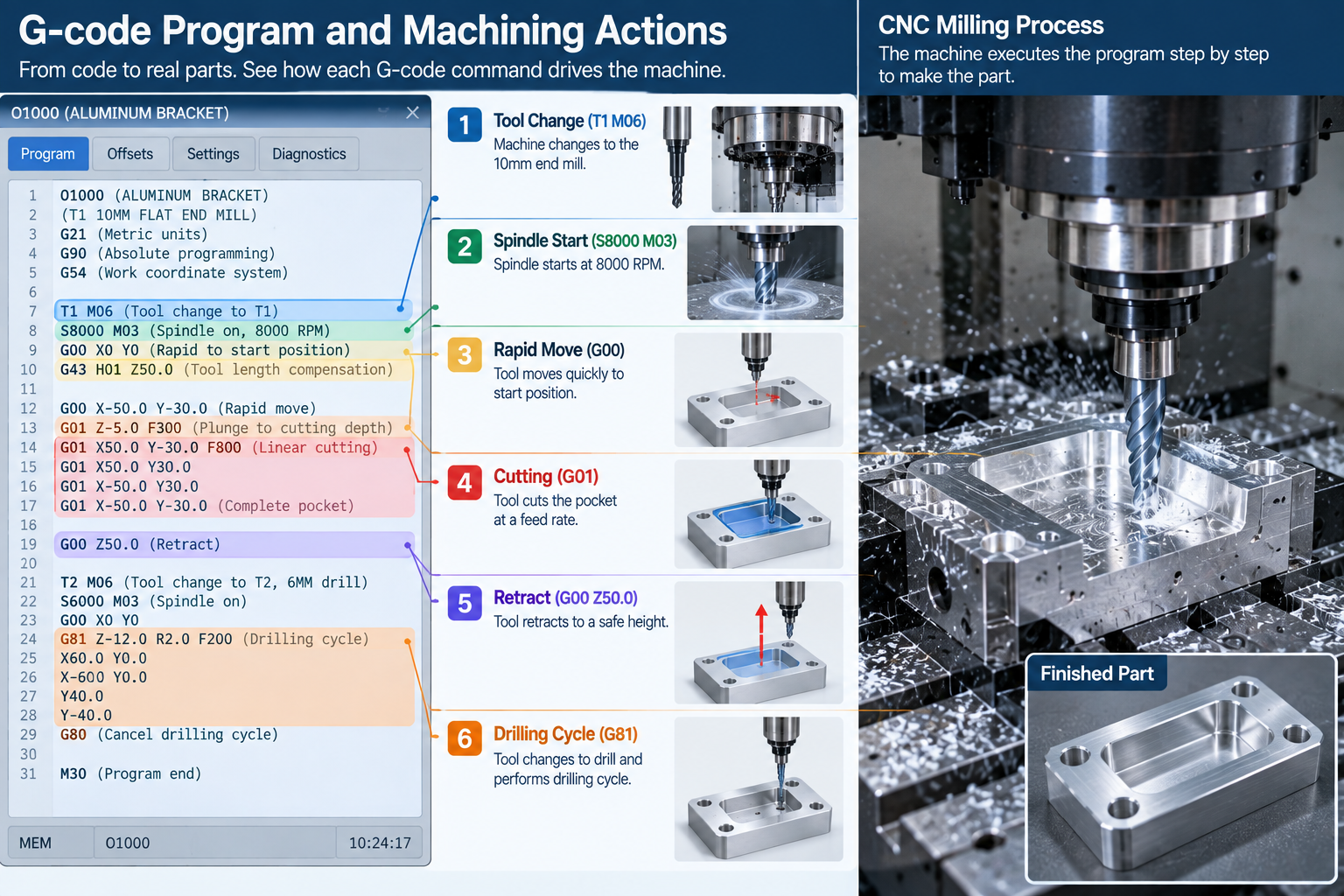
Un programma in codice G è una sequenza di blocchi che va dall'inizio sicuro alla fine del programma.
G21 G17 G90 G40 G49 G80
G54
T1 M06
S8000M03
G00 X0 Y0 Z5
G01 Z-2 F150
G01 X50 F300
G00 Z5
M05
M30
I programmi di produzione utilizzano comunemente un blocco di avvio sicuro per annullare gli stati modali indesiderati prima dell'inizio della lavorazione.
Cosa sono le parole e gli indirizzi del codice G?
Una parola è una lettera di indirizzo seguita da un valore. La lettera dà al valore il suo significato.
| Indirizzo | Significato comune |
| G | Funzione preparatoria o motoria |
| M | Funzioni varie della macchina |
| X, Y, Z | Coordinate degli assi |
| IO, J, K | Compensazioni del centro dell'arco su molti controlli |
| R | Parametro raggio o ciclo, a seconda del contesto |
| F | Velocità di alimentazione |
| S | Velocità del mandrino |
| T | Selezione dello strumento |
| N | Numero di sequenza o di blocco |
| H | Registro dell'offset della lunghezza dell'utensile su molti controlli |
| D | Registro di compensazione della taglierina su molti controlli |
Le mosse circolari usano comunemente I, J, e gli offset del centro K o un valore del raggio R, a seconda del controller e del metodo di programmazione.
Cosa sono i comandi modali e non modali?
I comandi modali rimangono attivi finché non vengono modificati o annullati. I comandi non modali si applicano solo al blocco che li contiene.
Normalmente è attivo un solo comando alla volta dello stesso gruppo modale. G00 e G01 si sostituiscono a vicenda. G90 e G91 si sostituiscono a vicenda. G17, G18, e G19 si sostituiscono a vicenda.
Comprendere i gruppi modali spiega perché un breve programma può controllare una lunga sequenza di mosse.
Common Types Of G-Code
Un programma pezzo CNC contiene funzioni G, M-functions, coordinate words, comandi di avanzamento e mandrino, tool data, e offset.
Le funzioni G impostano le modalità di movimento e operative. Le funzioni M attivano azioni ausiliarie della macchina come il mandrino, refrigerante, and program flow.
| Gruppo | Esempi | Scopo |
| Movimento | G00, G01, G02, G03 | Movimenti di posizionamento e taglio |
| Units and mode | G20, G21, G90, G91 | Inch or millimeter, absolute or incremental |
| Piani e offset | G17-G19, G54-G59 | Selezione del piano e spostamenti pezzo |
| Compensazione | G40, G41, G42, G43, G49 | Compensazione della lunghezza della fresa e dell'utensile |
| Cicli fissi | G81, G83, G84 | Perforazione, perforazione a becco, toccando |
| Macro e sondaggi | G65 e cicli specifici del controller | Routine riutilizzabili, misurazione, automazione |
La sintassi delle macro e i cicli di sonda variano in modo significativo tra controller e sistemi di sonda.
Codici G e codici M comuni
I seguenti codici sono comuni sui controlli di tipo Fanuc e compatibili. Verifica sempre il manuale del controller.
| Codice | Funzione |
| G00 | Posizionamento rapido |
| G01 | Interpolazione lineare |
| G02 | Interpolazione circolare, in senso orario |
| G03 | Interpolazione circolare, antiorario |
| G04 | Dimorare |
| G17 / G18 / G19 | Selezione del piano |
| G20 / G21 | Pollice / unità millimetriche su molti controlli |
| G28 | Ritorno alla posizione di riferimento, comportamento specifico del controller |
| G40 / G41 / G42 | Compensazione taglierina disattivata / Sinistra / Giusto |
| G43 | Compensazione positiva della lunghezza utensile, utilizzato con un registro offset H |
| G49 | Annulla la compensazione della lunghezza utensile |
| G54-G59 | Offset e sistemi di coordinate di lavoro |
| G81 / G83 / G84 | Perforazione / perforazione a becco / cicli di maschiatura |
| G90 / G91 | Assoluto / posizionamento incrementale |
| G94 / G95 | Alimentazione al minuto / avanzamento per giro |
| Codice | Funzione |
| M00 | Arresto del programma |
| M01 | Sosta facoltativa |
| M03 / M04 | Mandrino in senso orario / antiorario |
| M05 | Arresto del mandrino |
| M06 | Cambio utensile |
| M08 / M09 | Refrigerante acceso / spento |
| M30 | Fine del programma e ripristino |
Il comportamento del codice M dipende soprattutto dal costruttore della macchina. Refrigerante, cambio pallet, porte, morsetti, e i trasportatori di trucioli possono utilizzare funzioni M specifiche della macchina. Scopri di più nella nostra guida a Codice M.
Su molti centri di lavoro, una parola T preseleziona o richiama un numero di utensile, mentre M06 comanda il cambio utensile vero e proprio.
Posizionamento assoluto o incrementale
G90 e G91 cambiano il modo in cui il controllo legge le coordinate.
- Posizionamento assoluto G90: le coordinate vengono misurate dall'origine delle coordinate di lavoro attive.
- Posizionamento incrementale G91: ciascuna coordinata viene misurata dalla posizione corrente.
La maggior parte dei programmi utilizza il posizionamento assoluto per maggiore chiarezza, quindi passare a incrementale per ripetere i pattern.
Machine Coordinates, Offset pezzo e offset utensile
Le coordinate della macchina sono legate al sistema di riferimento della macchina. Le coordinate di lavoro individuano la parte all'interno di quello spazio macchina. Gli offset utensile tengono conto quindi della lunghezza e del raggio dell'utensile.
- G54-G59 imposta il sistema di coordinate di lavoro per la parte.
- G43 applica una compensazione positiva della lunghezza dell'utensile utilizzando un registro H, come G43 H01 Z50.
- G41 e G42 applicano la compensazione utensile utilizzando un registro D su molti controlli.
- G49 annulla la compensazione della lunghezza dell'utensile.
Questa gerarchia mantiene il programma portabile quando la parte si sposta sulla tavola.
Dialetti e standard del codice G
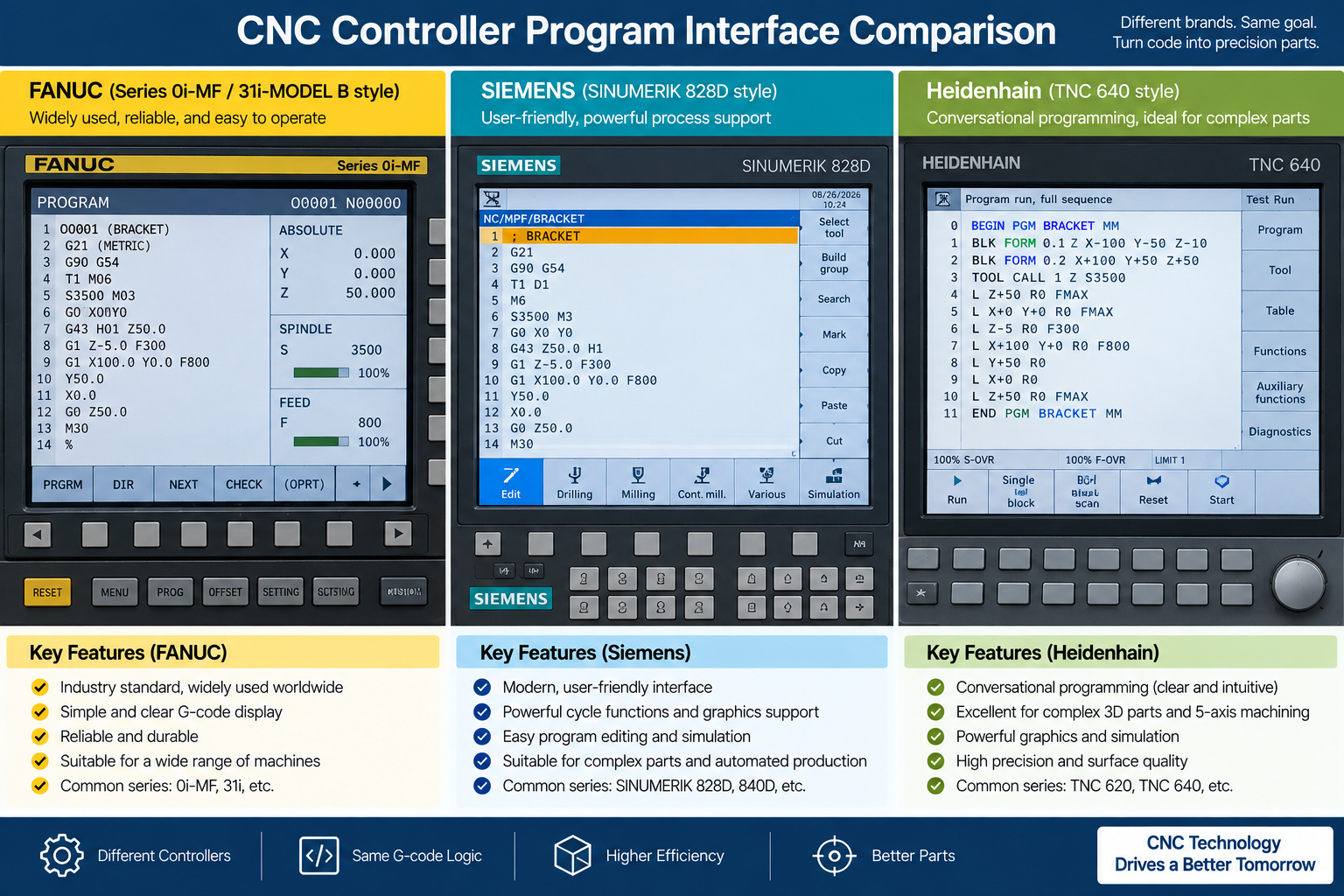
Esiste un nucleo comune, ma ogni controller CNC ha il proprio dialetto.
ISO 6983 e RS-274 definiscono la base comune. I dialetti basati su Fanuc sono ampiamente utilizzati, mentre Siemens, Heidenhain, Piccolo, e altri controlli utilizzano la propria sintassi, cicli, estensioni, e funzioni specifiche del controller.
Alcune funzioni, come la tastatura o la lavorazione ad alta velocità, sono specifici del controller. Questo è il motivo per cui un programma scritto per una macchina potrebbe non funzionare su un'altra. Controllare sempre il manuale del controller prima di utilizzare un codice sconosciuto.
How Is G-Code Created?
Programmi di produzione complessi vengono comunemente generati con software CAM, ma non tutto il codice G proviene dal CAM.
- I percorsi utensile CAM vengono generati dal modello CAD.
- Le parti semplici possono essere programmate manualmente sul controllo.
- I controlli conversazionali consentono all'operatore di creare cicli con suggerimenti.
- Macro e programmi parametrici automatizzano il lavoro ripetuto.
- Il codice scritto a mano è ancora importante per la configurazione, modifiche, e risoluzione dei problemi.
Consulta la nostra guida su Linguaggi di programmazione CNC che utilizzano i codici G e M.
Che cos'è un post-processore CAM?
Un post-processore converte i percorsi utensile CAM nel dialetto del codice G previsto da uno specifico controllore della macchina.
Gestisce le differenze tra i controller, compresi i formati di ciclo, compensazioni, e funzioni specifiche della macchina. Un post-processore corretto è essenziale quando un pezzo viene lavorato su macchine diverse. Consulta la nostra guida su File CAD per la lavorazione CNC.
Where Is G-Code Used?
Il codice G guida la maggior parte delle macchine utensili CNC e molti altri sistemi di movimento.
- Fresatura CNC per tasche, contorni, e volti.
- Tornitura CNC per alberi, discussioni, e diametri.
- Sistemi di elettroerosione CNC, utilizzando programmi di controllo numerico per il movimento dell'elettrodo o del filo con sintassi specifica del controller.
- Laser, plasma, e taglio a getto d'acqua.
- Molte stampanti 3D FDM/FFF, che utilizzano il codice G o dialetti correlati per il movimento, estrusione, riscaldatori, e tifosi.
Per i servizi di lavorazione, vedi il nostro Fresatura CNC E Tornitura CNC pagine.
G-Code Vs CAD And CAM
In un tipico flusso di lavoro moderno, Il CAD definisce la geometria, CAM crea percorsi utensile, e un post-processore genera il codice CNC specifico della macchina.
| Palcoscenico | Ruolo principale | Produzione |
| CAD | Definisce la geometria della parte | 2Modello D o 3D |
| CAMMA | Crea strategie di lavorazione e percorsi utensile | Dati del percorso utensile |
| Post-processore | Traduce i percorsi utensile per una macchina e un controllo | Programma CNC |
| Controllore CNC | Interpreta il programma e controlla il movimento | Movimento della macchina |
Le parti semplici possono anche essere programmate manualmente o conversazionalmente senza un flusso di lavoro CAM separato. Consulta la nostra guida su cos'è il CAD.
Limitations And Risks
Il codice G è potente ma spietato. Un errore può mandare in crash una macchina o rottamare una parte.
- I dialetti differiscono tra i controller.
- Offset o dati utensile errati causano errori di posizione.
- Un singolo errore di battitura può inviare uno strumento nell'attrezzatura.
- Il codice G non ha una consapevolezza integrata della configurazione fisica.
- Il codice G tradizionale descrive principalmente il movimento e gli stati, non intento progettuale. Il controllo non sa se una serie di mosse rappresenta una tasca, capo, o superficie di tenuta.
I percorsi utensile complessi vengono normalmente generati e verificati tramite CAM, simulazione, e prove specifiche per la macchina.
Verifica del codice G e migliori pratiche
Queste abitudini riducono i rischi e proteggono la macchina.
- Simulare il programma prima di eseguirlo.
- Utilizzare la simulazione approvata dal costruttore della macchina, grafica, prova a secco, blocco della macchina, monoblocco, e sovrascrivere le procedure ove applicabile.
- Verificare il bloccaggio del lavoro, utensili, compensazioni, aerei di sgombero, e limiti di viaggio prima della corsa.
- Utilizzare un blocco di avvio sicuro per annullare gli stati modali indesiderati.
- Eseguire una prova preliminare della prima parte in condizioni controllate.
- Blocchi di commento in modo che il programma sia leggibile.
- Mantieni i backup e il controllo della versione dei programmi comprovati.
Domande frequenti
Il codice G è lo stesso per ogni macchina?
NO. C'è un nucleo comune, ma ogni controller ha il proprio dialetto.
Qual è la differenza tra codice G e codice M?
Le funzioni G impostano le modalità di movimento e operative. Le funzioni M controllano le azioni della macchina come il mandrino, refrigerante, and program flow.
Devo imparare il codice G per eseguire una macchina CNC?
CAM genera la maggior parte del codice, ma leggere il codice G aiuta con la configurazione, compensazioni, e risoluzione dei problemi.
Quali codici G dovrebbero imparare prima i principianti?
I codici iniziali comuni includono G00 e G01 per il movimento lineare, G02 e G03 per archi, G17-G19 per gli aerei, G54-G59 per gli offset pezzo, G90 e G91 per il posizionamento, e cicli fissi come G81. I codici esatti dipendono dal controllo.
Il codice G può essere utilizzato per la stampa 3D?
SÌ. Molte stampanti FDM/FFF utilizzano il codice G o dialetti correlati.
Cos'è un post-processore?
Converte i percorsi utensile CAM nel dialetto del codice G previsto dal controller di una macchina specifica.
Il codice G può mandare in crash una macchina CNC?
SÌ. Coordinate errate, compensazioni, tool data, stati modali, o movimenti rapidi possono causare collisioni. I programmi dovrebbero essere simulati e provati prima della produzione.
Puoi scrivere il codice G manualmente?
SÌ. Parti semplici e modifiche possono essere programmate manualmente. I percorsi utensile 3D complessi vengono solitamente generati con CAM.
Ottieni indicazioni sulla lavorazione CNC
Invia il tuo modello 3D, 2disegno D, materiale, quantità, e requisiti di tolleranza. I nostri ingegneri esamineranno il progetto e consiglieranno il giusto processo di lavorazione prima del preventivo.


3 pensieri su "Cos'è il codice G? Definizione, Funzione, Tipi e usi”