



Stainless steel resists corrosion because of its chromium content, which forms a protective oxide layer. It comes in families and grades with different strength, machinability, and corrosion behavior. This guide covers the key properties, popular grades, and where each one fits.
What Is Stainless Steel?
Stainless steel is an iron alloy that contains at least about 10.5% chromium.
The chromium forms a thin, self-healing oxide layer that blocks corrosion. This is why stainless steel resists rust. It is not rustproof in every environment, but the right grade resists most industrial and everyday conditions.
What Gives Stainless Steel Its Properties?
Properties come from the alloying elements added to iron.
| Element | Main Role |
| Chromium | Forms the passive film; about 10.5% minimum defines stainless steel |
| Nickel | Stabilizes austenite and adds toughness and formability |
| Molybdenum | Improves resistance to pitting and crevice corrosion in chlorides |
| Carbon | Adds strength, but too much can cause sensitization when welded |
| Manganese and nitrogen | Strengthen and help stabilize austenite |
| Sulfur | Improves machinability in grades such as 303, but can lower corrosion resistance |
These elements explain why 303, 304, 316, 410, and 2205 behave differently.
Key Physical And Mechanical Properties
Chromium provides the passive film. Molybdenum can improve resistance to pitting and crevice corrosion, while nickel stabilizes austenite and contributes to toughness, formability, and corrosion performance in selected environments.
The table below gives typical room-temperature values. They depend on product form and condition, so verify them against the standard and the mill certificate.
| Property (typical) | 304 | 316 | 303 | 17-4 PH (H900) |
| Density (g/cm3) | 7.9 | 8.0 | 7.9 | 7.8 |
| Elastic modulus (GPa) | 193 | 193 | 193 | 196 |
| Yield strength (MPa) | 205 | 205 | 205 | 1170 |
| Tensile strength (MPa) | 515 | 515 | 620 | 1310 |
| Hardness | About 92 HRB | About 95 HRB | About 92 HRB | About 44 HRC |
| Magnetic when annealed | No | No | No | Yes |
Austenitic grades also conduct heat less effectively than aluminum or carbon steel, and they expand more with temperature. This matters in machining and in assemblies that see temperature changes.
Five Stainless Steel Families
| Family | Typical Grades | Key Traits | Typical Uses |
| Austenitic | 304, 316, 303, 321 | Non-magnetic when annealed, formable, weldable | Food, medical, chemical, marine |
| Ferritic | 430, 409 | Generally magnetic, lower cost, moderate corrosion resistance | Trim, automotive exhaust |
| Martensitic | 410, 420, 440 | Generally magnetic, hardenable by heat treatment | Cutlery, shafts, valves |
| Duplex | 2205 | High strength, chloride resistant | Marine, chemical, oil and gas |
| Precipitation hardening | 17-4 PH | Very high strength with good corrosion resistance | Aerospace, medical instruments |
Popular Stainless Steel Grades Compared
| Grade | Family | Corrosion Resistance | Machinability | Strength | Typical Use |
| 304 | Austenitic | Good | Moderate | Good | General industrial, food |
| 316 | Austenitic | Better chloride resistance than 304 | Moderate | Good | Marine, chemical |
| 303 | Austenitic | Good | Excellent | Good | Precision machined parts |
| 430 | Ferritic | Moderate | Good | Moderate | Trim, appliances |
| 410 | Martensitic | Moderate | Fair | High after hardening | Valves, shafts |
| 17-4 PH | Precipitation hardening | Good | Fair | Very high after aging | Aerospace, medical |
| 2205 | Duplex | Better chloride resistance than 316 in many conditions | Fair | High | Marine, oil and gas |
Ratings are relative. They depend on heat treatment, surface condition, and environment.
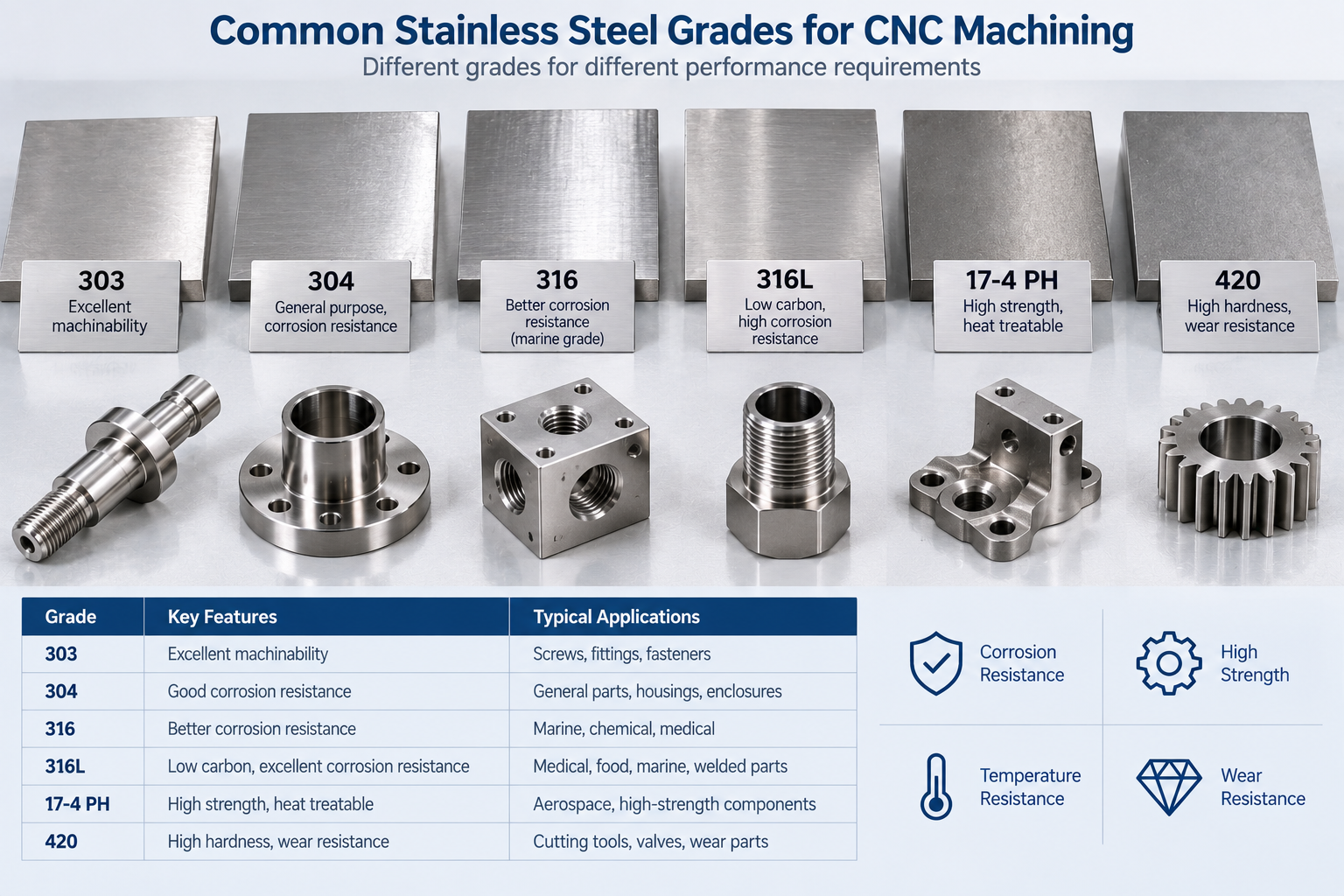
304 Vs 316 Vs 303 Vs 17-4 PH
- 304 is the general-purpose grade for industrial and food contact.
- 316 adds molybdenum, giving better resistance to chlorides than 304.
- 303 is optimized for machining and cuts more easily, but with reduced corrosion resistance and poorer weldability in many applications.
- 17-4 PH gives very high strength after aging, but only when the condition is specified. 17-4 PH H900 and H1150 do not have the same strength, hardness, or machining behavior.
For welded assemblies, the lower-carbon 304L and 316L grades are common choices. They reduce susceptibility to sensitization and related corrosion problems. See 316 vs 316L for the detail.
How Can Stainless Steel Corrode?
Stainless steel can still corrode under the wrong conditions.
- Pitting: localized attack, often from chlorides.
- Crevice corrosion: attack under gaskets, fasteners, or deposits.
- Galvanic corrosion: contact with a dissimilar metal in a conductive environment.
- Intergranular corrosion: can follow sensitization from welding if carbon content is high.
- Stress-corrosion cracking: cracking under tensile stress in hot chloride environments.
The grade, surface finish, and environment decide the risk. See different types of stainless steel for more.
Stainless Steel Applications
| Industry | Typical Grades | Why |
| Food and beverage | 304, 316 | Cleanable, corrosion-resistant surfaces |
| Medical devices | 316L, 17-4 PH | Corrosion resistance and strength |
| Marine | 316, 2205 | Chloride resistance |
| Chemical processing | 316, 2205 | Chemical and corrosion resistance |
| Aerospace | 17-4 PH, 321 | Strength and temperature resistance |
| Architecture | 304, 316 | Appearance and weather resistance |
| Automotive | 409, 430 | Exhaust and trim parts |
Medical suitability depends on the device, applicable material specification, surface condition, traceability, and regulatory requirements. A grade alone does not qualify a part for medical use.
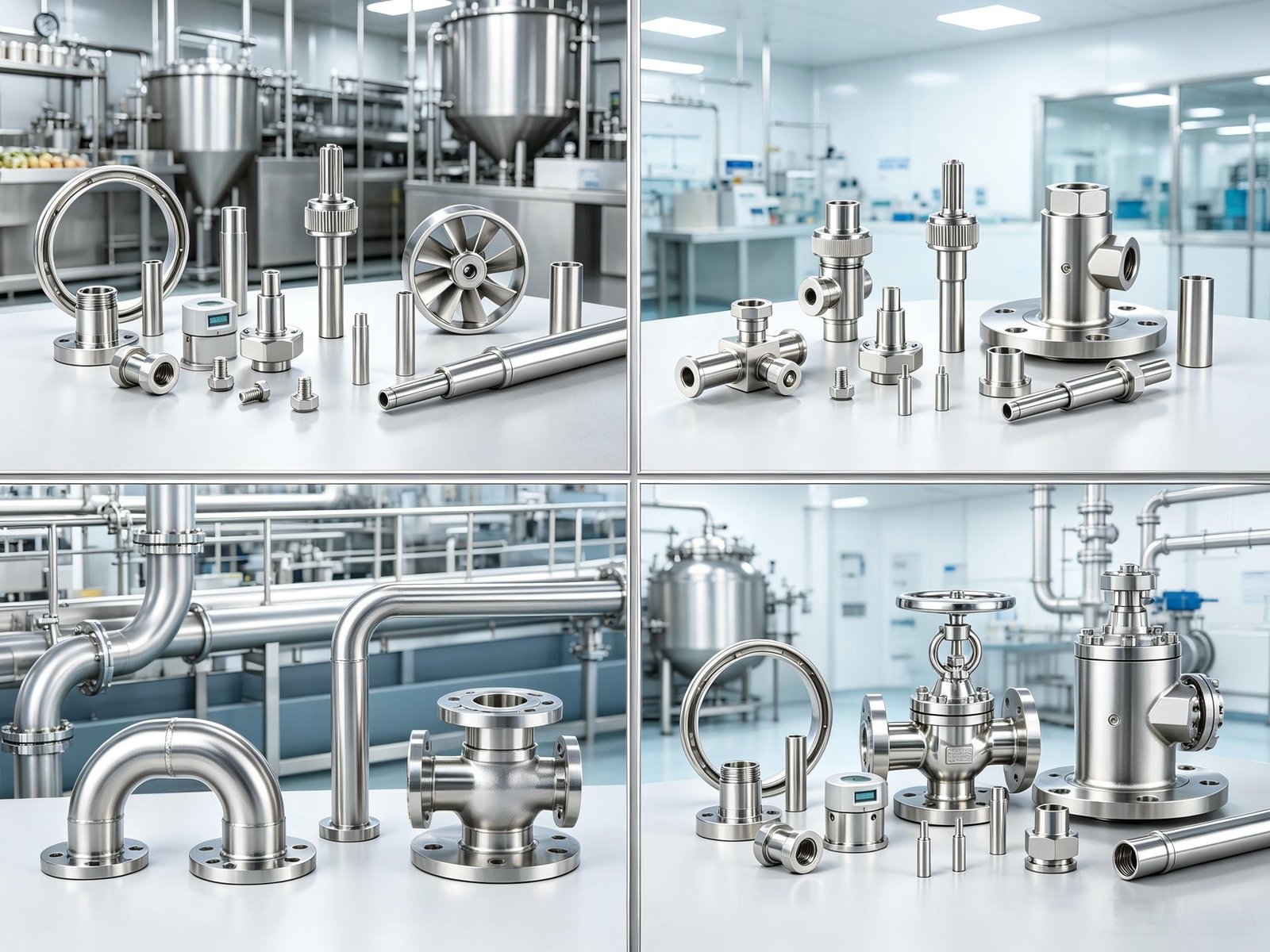
How To Choose A Stainless Steel Grade
Choose by environment, mechanical requirement, fabrication method, and cost.
- Identify the environment. Chlorides, food contact, and chemicals each point to a family.
- Set the strength and hardness you need. Hardening after fabrication points to martensitic or PH grades.
- Decide how the part is made. Machining-heavy parts favor 303. Welded assemblies favor 304L or 316L.
- Compare cost and availability. Higher-alloy grades cost more.
- Verify the grade, temper, and condition against the standard and material certificate.
Stainless Steel Machining Considerations
Machining stainless requires controlling heat, work hardening, and chips.
- Stainless conducts heat away from the cut less effectively than aluminum.
- Austenitic grades produce long, stringy chips that need good chip control.
- 303 is the easiest stainless grade to machine.
- 304 and 316 work-harden, so use sharp carbide tooling and consistent feeds.
- Avoid dwelling or repeated light rubbing cuts, which can work-harden the surface.
- Use coolant to control heat at the cutting edge.
For practical details, see how to cut stainless steel and our stainless steel machining service.
Surface Treatment And Passivation
After machining, clean the part thoroughly and specify passivation where required to remove free-iron contamination and support a clean passive surface.
Heat tint, scale, or chromium-depleted surface layers from machining, welding, or heating may require pickling or other appropriate treatment. Passivation alone does not necessarily remove those conditions.
When Stainless Steel Is Not The Best Choice
Stainless steel can still corrode and is not always the best material.
- Wrong grade plus chlorides can still pit or crack.
- Carbon steel costs less when corrosion is not a risk.
- Threads and fasteners can gall. Use anti-seize or compatible grades.
- Austenitic grades are not reliably magnetic. Magnetic response depends on composition and processing.
- Electrical and thermal conductivity are lower than copper or aluminum.
If you need high strength without stainless properties, compare alloy steel vs stainless steel.
Frequently Asked Questions
What are the most common stainless steel grades?
304 and 316 are the most common. 303 is common for machined parts.
What is the difference between 304 and 316 stainless steel?
316 adds molybdenum, which improves resistance to pitting and crevice corrosion in chloride environments.
What is the difference between 303 and 304 stainless steel?
303 is optimized for machining and generally cuts more easily than 304, but it has reduced corrosion resistance and poorer weldability in many applications. Use 304 when corrosion resistance and fabrication matter more than machining speed.
Is stainless steel magnetic?
It depends on the family. Austenitic grades are largely non-magnetic when annealed. Ferritic, martensitic, and duplex grades are generally magnetic.
Which stainless steel is best for food contact?
304 and 316 are common because they are cleanable and corrosion-resistant.
Which stainless steel is best for marine use?
316 is commonly used for many marine and coastal applications. Duplex grades such as 2205 may be selected when greater strength and chloride resistance are required. Actual selection depends on temperature, chloride concentration, crevices, and exposure.
What is the difference between 304 and 304L, or 316 and 316L?
The L grades have lower carbon. They reduce sensitization risk and are common for welded assemblies.
Can stainless steel be CNC machined?
Yes. 303 machines most easily, while 304 and 316 need sharper tooling and controlled cutting.
Get Help Selecting A Stainless Steel Grade
Tell us the grade, condition, environment, mechanical requirement, and quantity. Our engineers will confirm the specification, review machining and finish, and quote the part with material certification.


12 thoughts on “Stainless Steel: Properties, Grades, And Applications”