


Laser cut edge quality should be specified through measurable geometry, condición de la superficie, attached dross, and final finishing requirements. A clean-looking top face does not establish an acceptable cut edge. Define what your sheet metal part needs before comparing quotes or approving production.
Define Quality On The Cut Face
Your drawing should distinguish the cut face from the sheet’s original top and bottom surfaces.
Laser cutting creates a new edge through the sheet thickness. Its texture and geometry can differ from the original sheet finish. Identify edges that affect handling, asamblea, soldadura, revestimiento, caza de focas, or appearance.
A dimensionally correct outline can still have an unacceptable edge condition. En cambio, visible striations do not automatically make a part unsuitable. Your design authority should set acceptance requirements from the application.
Specify the material grade, espesor, revisión de dibujo, and delivered condition. These details help suppliers propose a suitable process and finishing sequence. Avoid using another material’s sample edge as an unexplained universal benchmark.
Separate Texture Angle And Attached Dross
Your edge specification should treat cut face texture, geometría, and attached material as separate characteristics.
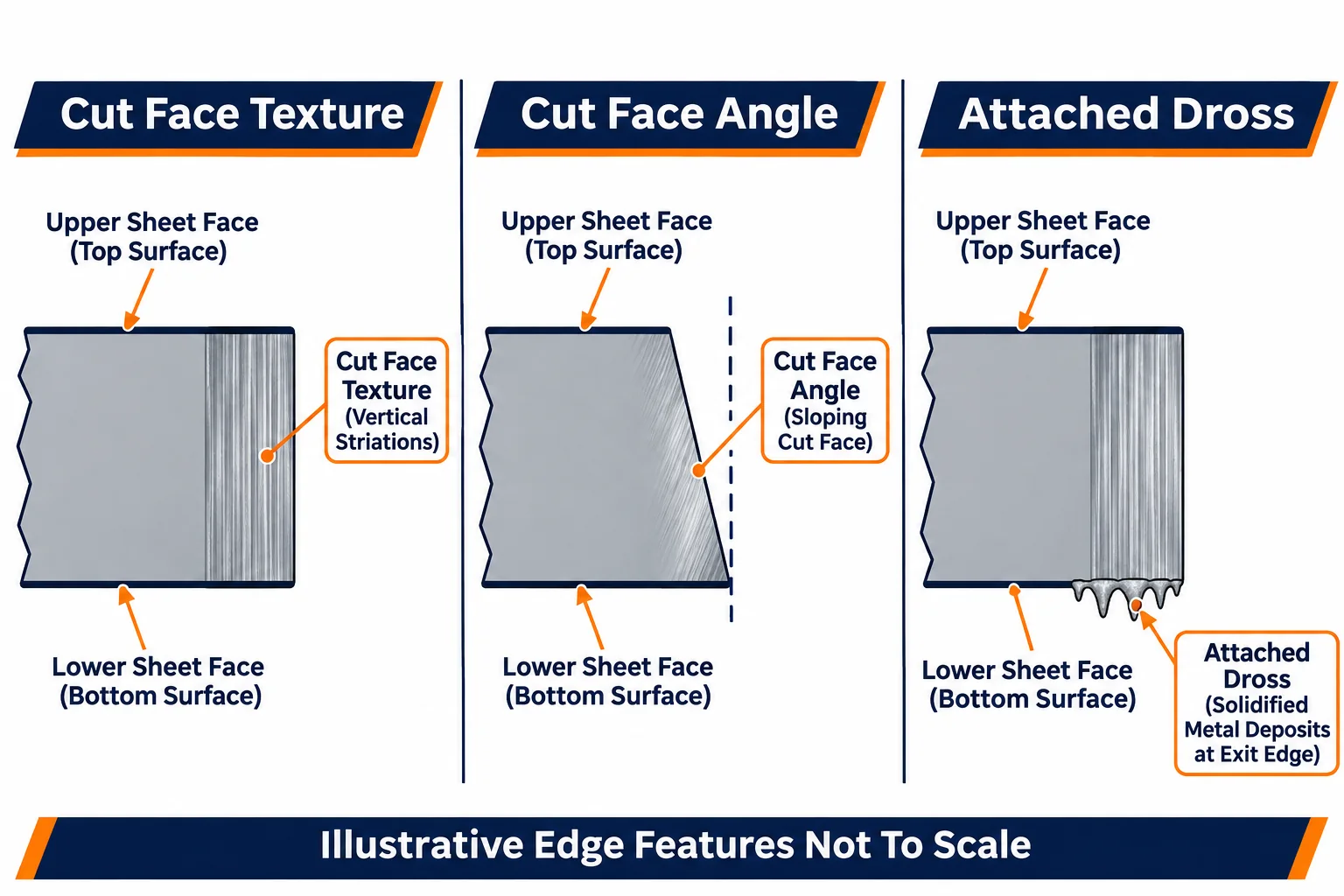
Cut face striations describe texture along the newly formed surface. Cut face angle describes how that surface departs from the intended orientation through the thickness. Attached dross is resolidified material that can remain near the cut exit.
Do not let a general “deburr” note stand in for every requirement. Removing attached material does not necessarily correct cut face angle or improve the entire surface texture.
Asimismo, an overall surface roughness note may not identify the cut face or the required measurement direction. Mark the relevant surface and agree the parameter, ubicación, and method when numerical texture control is needed.
Review corners, agujeros, tragamonedas, and contour changes separately where function requires it. One straight sample edge may not represent every feature on a complex part.
Use ISO 9013 With An Agreed Scope
Your purchase requirement should state the applicable standard edition and the characteristics you intend to control.
YO ASI 9013 addresses geometrical specifications and quality tolerances for thermal cuts, including laser cutting. ISO also publishes Amendment 1 de 2024 para el 2017 edición.
Identify the agreed edition and applicable amendment in your purchasing documents. Confirm its scope for the actual material, espesor, and cutting process. Ask qualified personnel to establish the required classifications and inspection procedure.
Avoid a bare note saying “ISO quality” without the relevant requirements. A standard reference should support an acceptance decision rather than leave both parties guessing.
Keep product requirements outside that agreed scope explicit. Handling safety, cosmetic acceptance, coating preparation, and final part dimensions may require additional drawing notes or procedures.
Match The Cutting Route To Subsequent Operations
Your proposed cutting route should support the required downstream condition.
TRUMPF explains fusion cutting, where gas removes molten material and shields the cut edge. Nitrogen-assisted fusion cutting can provide oxide-free cut edges under suitable process conditions.
That advantage does not establish every other edge requirement. You still need to review attached material, geometría, textura, and any specified finishing. Do not interpret “oxide-free” as proof that the whole component is ready for every coating or assembly process.
Ask which cut edge condition the supplier proposes for your welding or coating sequence. Agree preparation based on that sequence’s requirements. Avoid prescribing a gas solely from a photograph of a different component.
Bystronic's cut quality guidance illustrates how cutting technology affects edge quality and post-processing effort. Its equipment claims are not a capability guarantee for your supplier or part.
Define The Final Edge Finishing Condition
Your acceptance requirement should describe the edge after every specified finishing operation.
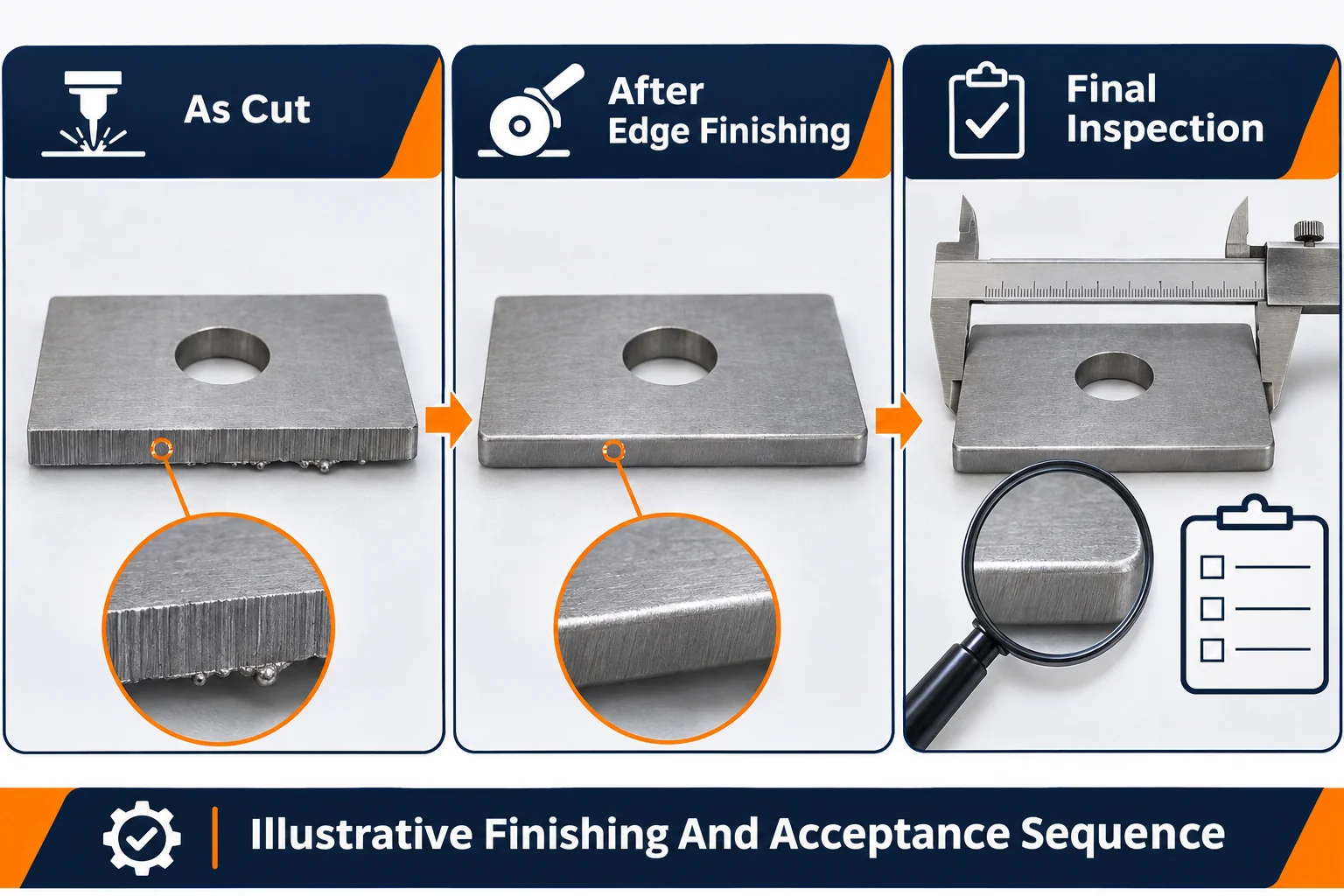
State whether parts are delivered as-cut, limpio, desaprobado, redondeado, or prepared for another operation. Identify edges where material removal is restricted. Include the required condition of holes, tragamonedas, and small features.
Excessive edge finishing can change dimensions or remove a functional sharp corner. Protect fits and appearance-sensitive areas when agreeing the process. Do not approve aggressive finishing simply because the original dross has disappeared.
Where a controlled radius or edge break matters, specify it through the drawing and inspection plan. Where only safe handling matters, define an agreed acceptance method or representative sample. Avoid an undefined promise of completely burr-free parts.
Check the final outline and critical features after finishing. An inspection performed only before material removal may not describe the delivered part.
Agree A Representative Inspection Plan
Your inspection plan should cover the edges, ubicaciones, and final condition that matter to the application.
Select representative straight edges and relevant internal features. Include difficult corners or small openings where appropriate. Define how the inspection team handles local irregularities and disputed observations.
Agree the instruments and measurement method for numerical requirements. Use visual samples only for characteristics that the approved comparison can establish. A photograph alone cannot establish a numerical cut face tolerance.
Keep process qualification and routine sampling distinct. A useful initial sample does not define production coverage by itself. Record the sampling frequency, lot definition, and response when results are outside the agreed requirements.
Retain part identifiers, revisión de dibujo, etapa de inspección, resultados, and any authorized deviations. For disagreements, compare the same edge locations and methods before deciding which process needs correction.
Compare Quotes For The Same Delivered Edge
Your quote comparison should include cutting, edge finishing, inspección, and any downstream preparation.
TOPS Precision proporciona servicios de fabricacion de chapa. Submit the edge requirements with your drawing. Confirm the proposed cutting and finishing arrangements for the actual material and thickness.
| Requisito | Define Before Ordering | Evidence To Agree |
|---|---|---|
| Cut Face | Controlled edges and surface extent | Feature identification |
| Geometría | Applicable tolerance or classification | Measurement method and results |
| Textura | Parameter and measurement location | Recorded texture evaluation |
| Attached Material | Permitted condition and removal | Agreed acceptance comparison |
| Final Finishing | Edge break and protected features | Final dimensional checks |
| Downstream Use | Welding or coating preparation | Approved preparation sequence |
Additional finishing and inspection can change cost and lead time. Apply demanding requirements to the features that need them. A broad premium finish requirement on every edge may add work without improving the assembly.
For finished components, review handling protection as well. The related parts packaging guide explains how to protect accepted surfaces during shipment.
Preguntas frecuentes
Your decision should address the complete delivered edge rather than a single visual feature.
Does Deburring Correct Every Laser Cut Edge Issue
No. Deburring removes unwanted attached material, but does not automatically establish cut face geometry or texture.
Does Nitrogen Cutting Eliminate All Further Finishing
No. An oxide-free edge may still require finishing or inspection for your particular product requirements.
Is A Smooth Top Surface Evidence Of A Good Cut Edge
No. Inspect the newly cut face and the specified final edge condition separately from the original sheet surface.
Request An Edge Quality Review
Contáctenos con tu dibujo, material, espesor, cantidad, critical edges, and downstream operations. Include applicable classifications, requisitos de acabado, y criterios de aceptación. Agree the delivered edge condition before releasing your sheet metal order.