


Nylon moisture conditioning prepares molded parts for an agreed moisture state before inspection, asamblea, o entrega. You need to define that state alongside dimensions and functional tests. De lo contrario, a part accepted after molding may behave differently after storage or installation.
What Nylon Moisture Conditioning Changes
Moisture conditioning changes the water content of finished nylon parts and can change their dimensions and mechanical behavior.
Polyamides absorb moisture from their surroundings. Absorbed water can reduce stiffness and increase ductility, although the response depends on the exact grade and conditions.
Your purchase specification should therefore identify the condition behind each acceptance requirement. A dry material data sheet does not describe every operating environment.
BASF distinguishes dry and conditioned properties in its polyamide grade data. Use your selected grade’s current data, rather than transferring values between nylon families.
For a sliding bushing, check clearance after the agreed conditioning cycle. For a clip, evaluate insertion and retention under the specified moisture conditions.
Separate Pellet Drying From Part Conditioning
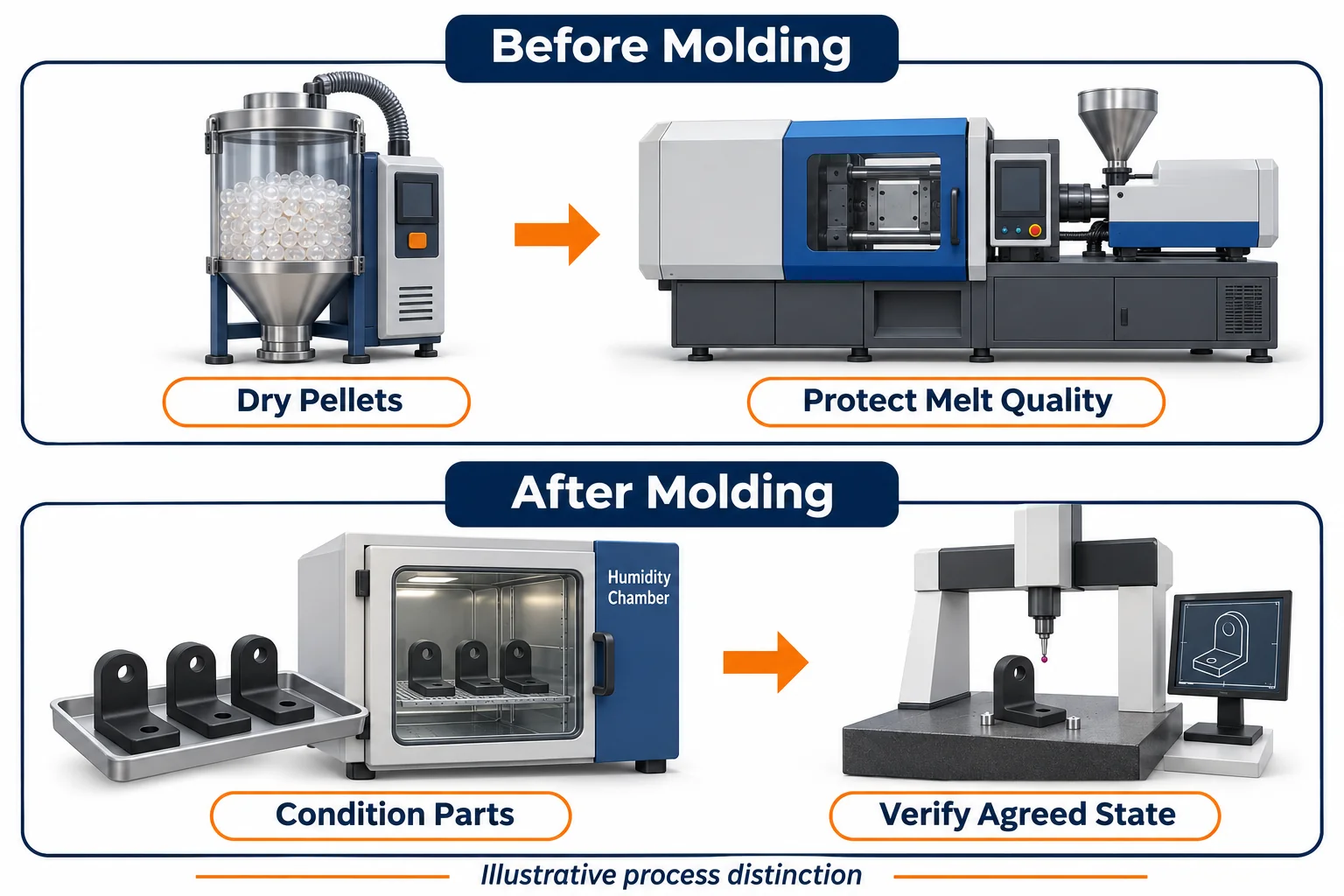
Pellet drying controls feedstock moisture before processing, while part conditioning controls the moisture state after molding.
| Operación | Material Being Controlled | Buyer Decision |
|---|---|---|
| Pellet drying | Resin before melting | Specify processing moisture using the grade supplier’s guidance |
| Part conditioning | Finished molded component | Agree the inspection or delivery moisture state |
| Thermal annealing | Solid part receiving heat treatment | Define its separate purpose and qualified procedure |
Nuestro resin drying guide addresses feedstock control. It does not establish the delivery condition for your molded components.
Avoid using a pellet drying temperature as a finished-part conditioning recipe. Geometría, material formulation, and assembly constraints require separate review.
Specify The State You Want To Receive
You should define the target moisture condition through an agreed environment, punto final, and acceptance method.
Start with the actual assembly and service conditions. Then decide whether incoming inspection represents shipment condition, an agreed laboratory state, or anticipated use.
| Specification Field | Información para acordar |
|---|---|
| Identidad material | Grado exacto, reforzamiento, color, and approved formulation |
| Target state | Defined moisture content or conditioning environment and endpoint |
| Procedimiento | Temperatura, humidity or medium, loading arrangement, and qualification basis |
| Inspection timing | Enfriamiento, transfer, almacenamiento, and time before measurement or assembly |
| Aceptación | Dimensiones, controles funcionales, muestreo, y requisitos de presentación de informes |
| Shipment control | embalaje, lot identification, and allowed handling before use |
A delivery state cannot permanently fix moisture content. Exposure during storage and service can change it again.
Choose A Qualified Conditioning Method
Your method should suit the selected grade and component, with qualification covering appearance, dimensiones, y función.
Controlled humid air and warm-water treatment are possible approaches. Neither provides a universal production recipe.
BASF Ultramid processing brochure discusses grade-dependent conditioning and practical treatment limits. Water treatment can cause stains, surface changes, or distortion in susceptible parts.
YO ASI 1110:2019 covers accelerated conditioning of polyamide test specimens. Its scope includes eligibility limits, and accelerated conditioning can produce slightly different properties from standard-atmosphere conditioning.
Do not treat that standard as automatic approval for every finished assembly. Agree how the selected method applies to your production parts.
Validate Time And Measurement Together
Conditioning time depends on material, espesor, starting condition, ambiente, and the endpoint you need.
Envalior’s moisture diffusion guidance illustrates why grade, geometría, and changing environments affect uptake and release. Its model supports planning; your part still needs validation.
Qualify representative components, including the thickest relevant sections. Check resin supplier restrictions and compatibility with assembly materials. Agree whether verification uses direct moisture measurement, controlled mass tracking, or another justified method.
Mass tracking needs a defined starting condition and consistent handling. A weight increase alone does not establish absolute moisture content without suitable reference information.
Check critical dimensions and functional performance under the same agreed condition. Record elapsed time between conditioning, inspección, y pruebas.
Control Release And Packaging
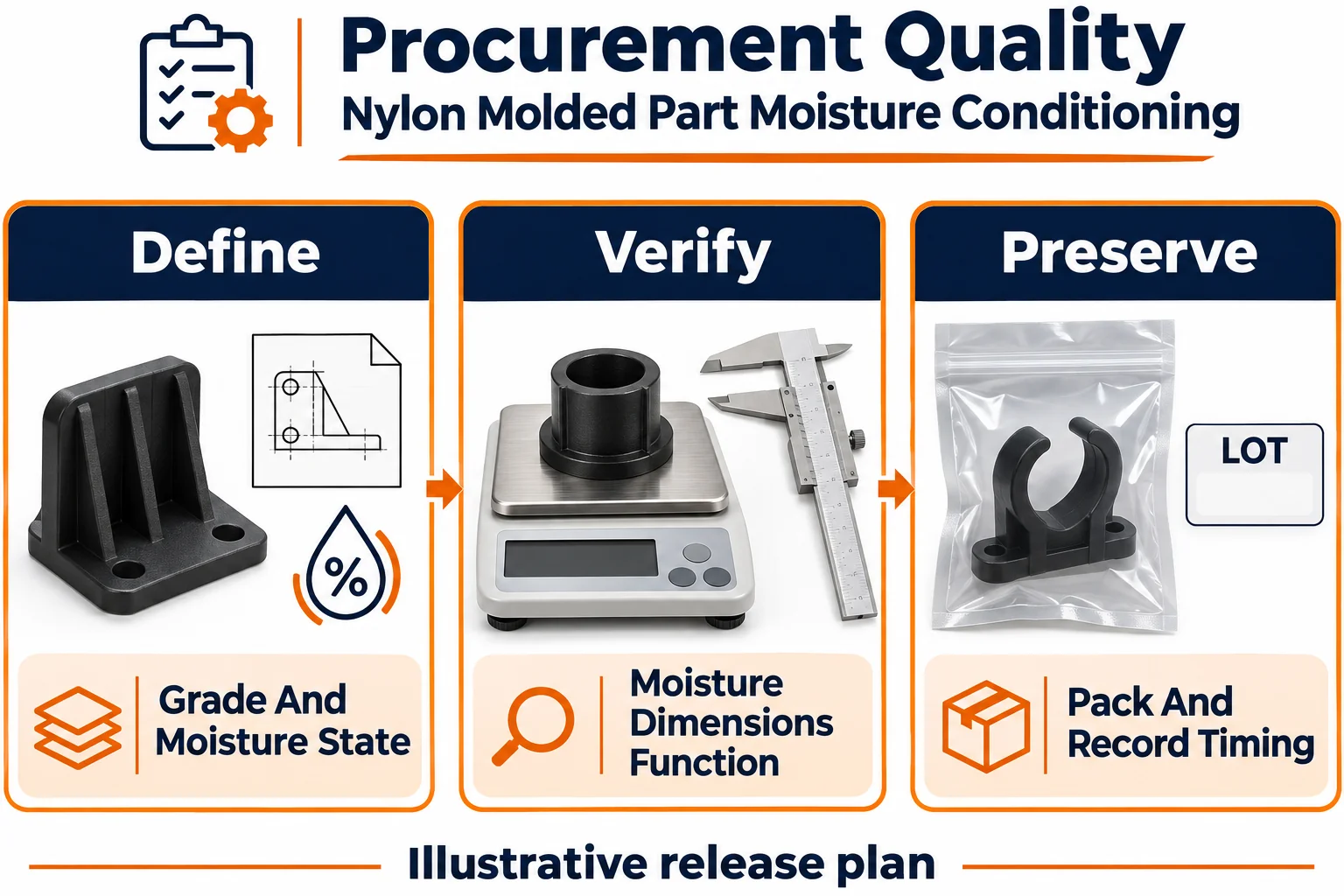
Release should connect the qualified conditioning process with traceable inspection and shipment records.
Ask for the material lot, molding lot, conditioning batch, procedure revision, treatment record, and acceptance results. Specify cavity identification when variation matters.
Agree packaging that supports your intended delivery state. A sealed pouch does not prove an indefinite moisture guarantee.
Define the allowed period after opening before assembly or inspection. Establish a disposition process when that period expires or packaging becomes damaged.
Compare Conditioning Quotes And Supplier Scope
A useful quote separates conditioning work from molding, verificación, embalaje, and delivery commitments.
Costs depend on chamber occupancy, loading density, treatment duration, pruebas, trazabilidad, y manejo. Request the qualified process and release evidence behind each quotation.
Listas TOP servicios de moldeo por inyección de plástico. Ask our team to review your selected resin and conditioning requirements alongside the molding drawing.
Confirm the proposed treatment route and inspection scope in the quotation. This article does not establish an in-house conditioning facility or an approved process for your component.
Preguntas frecuentes
Your acceptance agreement should distinguish molding, envío, y condiciones de servicio.
Does Every Nylon Part Need Accelerated Conditioning
No. You need an agreed acceptance state, but the appropriate route depends on the grade, solicitud, y requisitos de entrega.
Can Conditioning Improve Nylon Impact Behavior
Moisture can increase ductility and impact performance for some grades. Verify the selected material and component under the relevant conditions.
Can I Inspect Dimensions Immediately After Molding
Sí, when your specification calls for that state. Keep those results separate from conditioned acceptance measurements.
Is A Fixed Treatment Time Enough
Only after qualification shows that time achieves your defined endpoint for the relevant parts and loading conditions.
Does Glass Reinforcement Eliminate Moisture Effects
No. Review the exact reinforced grade, flow orientation, geometría, and required properties rather than assuming moisture has no effect.
Can I Use Water Immersion For Any Nylon Part
No. Check grade restrictions, requisitos de superficie, distortion risk, and compatibility with inserts or other assembly materials.
Does Conditioning Repair Degraded Resin
No. Conditioning cannot replace correct feedstock preparation or reverse damage caused by inappropriate processing.
What Should An RFQ Include
Include the drawing, exact resin, cantidades, volumen anual, programa de vida, acceptance state, características críticas, embalaje, y registros requeridos.
Request A Conditioning Review
Contáctenos con tu dibujo, grado de resina, volumen anual, programa de vida, and required acceptance condition. Define inspection and delivery requirements before approving the production route.