



Ultimo aggiornamento:
Per procurarsi componenti metallici dalla Cina, definire la parte finita, verificare il fornitore, compare equivalent quotations, and validate production samples. Then control material, finitura, ispezione, and shipment release. This guide shows you what to request before committing to custom CNC, lancio, or fabricated metal parts.
Immagine in primo piano: conceptual components for comparing manufacturing routes, non la produzione effettiva di TOPS.
How To Source Metal Components From China In Seven Steps
You need seven linked decisions, from a controlled RFQ to documented shipment approval.
| Fare un passo | Your Decision | Prove da richiedere |
|---|---|---|
| 1 Define the part | What must the finished component do | Revisione del disegno, materiale, fine, caratteristiche critiche |
| 2 Select the process | Which route fits geometry and demand | Process proposal, DFM comments, tooling assumptions |
| 3 Qualify the supplier | Who will manufacture and control the work | Legal identity, production review, subcontractor scope |
| 4 Compare quotations | What each price actually includes | Itemized quote, exclusions, delivery basis |
| 5 Approve samples | Whether the proposed route meets requirements | Identified samples, inspection results, material records |
| 6 Control production | How repeat batches will remain consistent | Inspection plan, tracciabilità, change approval |
| 7 Release shipment | Whether goods and records are ready | Ispezione finale, packing evidence, shipping documents |
Complete each decision before releasing the next commitment. A low quotation cannot compensate for an unresolved material or inspection requirement.
Prepare An RFQ That Defines The Finished Metal Part
A useful RFQ gives every supplier the same technical requirements and commercial assumptions.
Send a revision-controlled 2D drawing and a matching 3D model when available. State which document governs conflicting information. Identify units, datums, general tolerances, and features that affect assembly or safety.
Specify the material grade and condition, rather than writing only “aluminum” or “stainless steel.” Explain whether equivalent grades require your approval. Usa il CNC machining materials guide to frame material discussions.
Your Metal Components RFQ Checklist
- Part numbers, drawing revisions, quantities per part, and the complete bill of materials.
- Material specification, condizione, and required traceability or material certificates.
- Dimensioni critiche, geometric tolerances, discussioni, rugosità superficiale, and functional acceptance criteria.
- Trattamento termico, durezza, coating specification, spessore, masking, and cosmetic requirements.
- Prototype quantity, initial production quantity, domanda annuale, e la durata prevista del programma.
- Inspection reports, functional tests, retained samples, and any customer approval requirements.
- Packing method, etichettatura, delivery address, required arrival date, and requested quotation currency.
- Tooling ownership, maintenance expectations, confidentiality, and permitted subcontracting.
Separate mandatory requirements from preferences. Ask suppliers to identify deviations explicitly, rather than silently changing your specification.
Describe The Final Condition
State whether dimensions apply before or after coating. A plated thread can pass before finishing and fail during assembly. Define plug-gauge checks after plating where the drawing requires them.
For a hardened wear surface, specify the relevant hardness method and acceptance location. Add case-depth requirements when performance depends on them. Appearance alone cannot confirm treatment quality.
Match The Manufacturing Process To Your Part
Choose the process using geometry, materiale, richiesta, and finished-part requirements together.
| Component Example | Process To Evaluate | Purchasing Questions |
|---|---|---|
| Shaft or threaded bushing | Tornitura CNC, with secondary operations as needed | Which surfaces establish concentricity and inspection datums |
| Pocketed aluminum housing | Fresatura CNC | Can cutters reach deep features without redesign |
| Ribbed aluminum enclosure | Die casting plus secondary machining | Does demand justify tooling, and which faces need machining |
| Bent steel bracket | Laser cutting and bending | How will bend position, Burrs, and coating be controlled |
| Welded metal assembly | Fabbricazione, saldatura, and possible finish machining | How will distortion and assembly interfaces be checked |
These are starting points, rather than universal process prescriptions. A supplier should explain why its proposed route fits your drawing.
For changing designs, Servizi di lavorazione CNC can avoid dedicated casting tooling. For stable castable geometry, valutare Die Services di casting against expected program demand.
For enclosures and brackets, compare the manufacturing steps in fabbricazione di lamiere. Include welding, inserti, finitura, and assembly checks in the quotation scope.
For loaded castings, revisione die cast metal strength before specifying material and acceptance tests.
Do not use a universal quantity threshold for choosing casting over machining. Tooling cost, part mass, prodotto, Tempo di lavorazione, and design changes alter the decision.
Verify The Chinese Metal Parts Supplier Before Ordering
Supplier qualification must connect the contracting company to the people, attrezzatura, and processes producing your parts.
Find candidates through referrals, trade shows, industry directories, sourcing platforms, and direct manufacturer searches. These channels build a shortlist; they do not establish manufacturing capability.
Request the supplier’s registered Chinese company name, business license, registered address, and production address. Cross-check registration through an official business registry or qualified local verification service. Investigate inconsistencies before paying.
IL NOI. Commercial Service in China identifies company background checks as a due-diligence service. A background check complements, rather than replaces, a technical production review.
Check Capability With Your Own Drawing
Ask a supplier to explain the process sequence for a representative part. Discuss workholding, difficult tolerances, sfacciato, finitura, e ispezione finale. Request evidence relevant to your features, rather than unrelated machine photographs.
A factory visit, live walkthrough, or independent audit can help verify operations. Match the review depth to project risk. Permission-based references and redacted inspection records can add context without exposing another customer’s confidential information.
Identify Subcontracted Operations
Ask which operations happen internally and which use external suppliers. Trattamento termico, placcatura, anodizzazione, fusione, and testing may involve separate facilities.
Require a named owner for subcontractor qualification, tracciabilità dei lotti, and nonconformance handling. A trading company can coordinate work effectively if its responsibilities and manufacturing sources are transparent.
Verify Certificates And Payment Details
Check certificate issuer, scope, site address, and validity. Confirm that the scope relates to the work you need. ISO’s certification guidance explains that independent bodies provide certification; ISO itself does not certify companies.
A management-system certificate does not approve your drawing or shipment. You still need part-specific inspection and acceptance evidence.
Match the beneficiary to the contracting entity or obtain a documented explanation. Independently verify bank-detail changes through a previously established contact channel.
Compare Quotes Using Total Delivered Cost
Compare quotations only after aligning the drawing, processo, ispezione, imballaggio, and delivery scope.
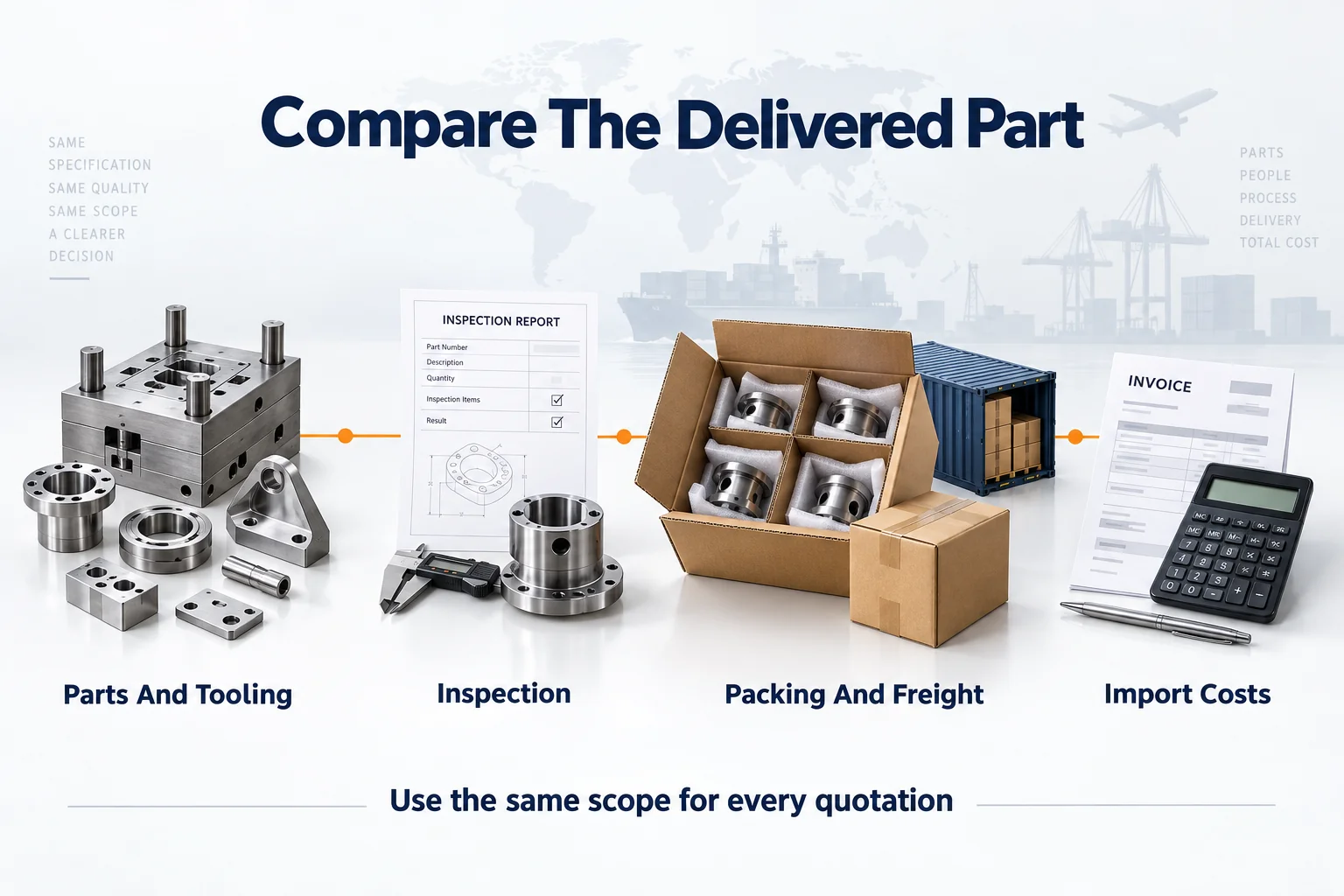
A cheaper unit price may exclude finishing, rapporti di ispezione, tooling maintenance, or export packing. Ask each supplier to return the same comparison sheet.
| Quote Item | What You Should Confirm |
|---|---|
| Part price | Materiale, fine, revision, quantity break, and currency |
| Setup and tooling | One-time charges, ownership, manutenzione, expected life assumptions |
| Inspection and testing | Report contents, laboratory work, sample quantity, and fees |
| Confezione | Protezione dalla corrosione, individual separation, etichettatura, and pallet requirements |
| Delivery basis | Named place, Incoterms version, freight scope, and insurance responsibility |
| Schedule | Engineering approval, approvvigionamento materiale, samples, produzione, and dispatch milestones |
| Exclusions | Taxes, duties, destination charges, storage, and other omitted costs |
Estimate landed cost from parts, tooling allocation, ispezione, imballaggio, freight, insurance, and applicable import charges. Model recoverable taxes separately. Track rejection, rielaborazione, and expedited freight as additional scenario costs, rather than assuming a universal percentage.
For multiple parts, request quantities per line item. A total quantity without a part-number breakdown produces misleading price comparisons.
Agree Commercial Terms Before Production Starts
Written commercial terms should define approval milestones, ownership, responsibilities, and remedies before money or tooling is committed.
Record the approved drawing revision, deviations, quantità, prezzo, and payment milestones. Define what evidence releases each payment. No payment split suits every project or supplier relationship.
For dedicated tools, specify identification, ownership, permitted use, storage, manutenzione, and transfer arrangements. Define how engineering changes and tool modifications are quoted and approved.
Agree how defects will be reported and reviewed. Set responsibilities for sorting, rielaborazione, replacement, freight, and containment. Use qualified legal advice for enforceable contracts and confidential designs where the project warrants it.
Use A Complete Delivery Term
Write the Incoterms rule, named place or port, and version. IL ICC Incoterms guidance explains their allocation of delivery obligations, costi, and risk.
Do not treat “shipping included” as a complete delivery agreement. Incoterms do not replace your requirements for payment, ownership, product acceptance, or defect remedies.
For containerized shipments handed to a carrier before vessel loading, discuss FCA with your forwarder. ICC’s FOB guidance explains why the transport handover matters.
Approve Samples With Measurable Acceptance Criteria
Sample approval should verify the proposed material, manufacturing route, finitura, e requisiti funzionali.
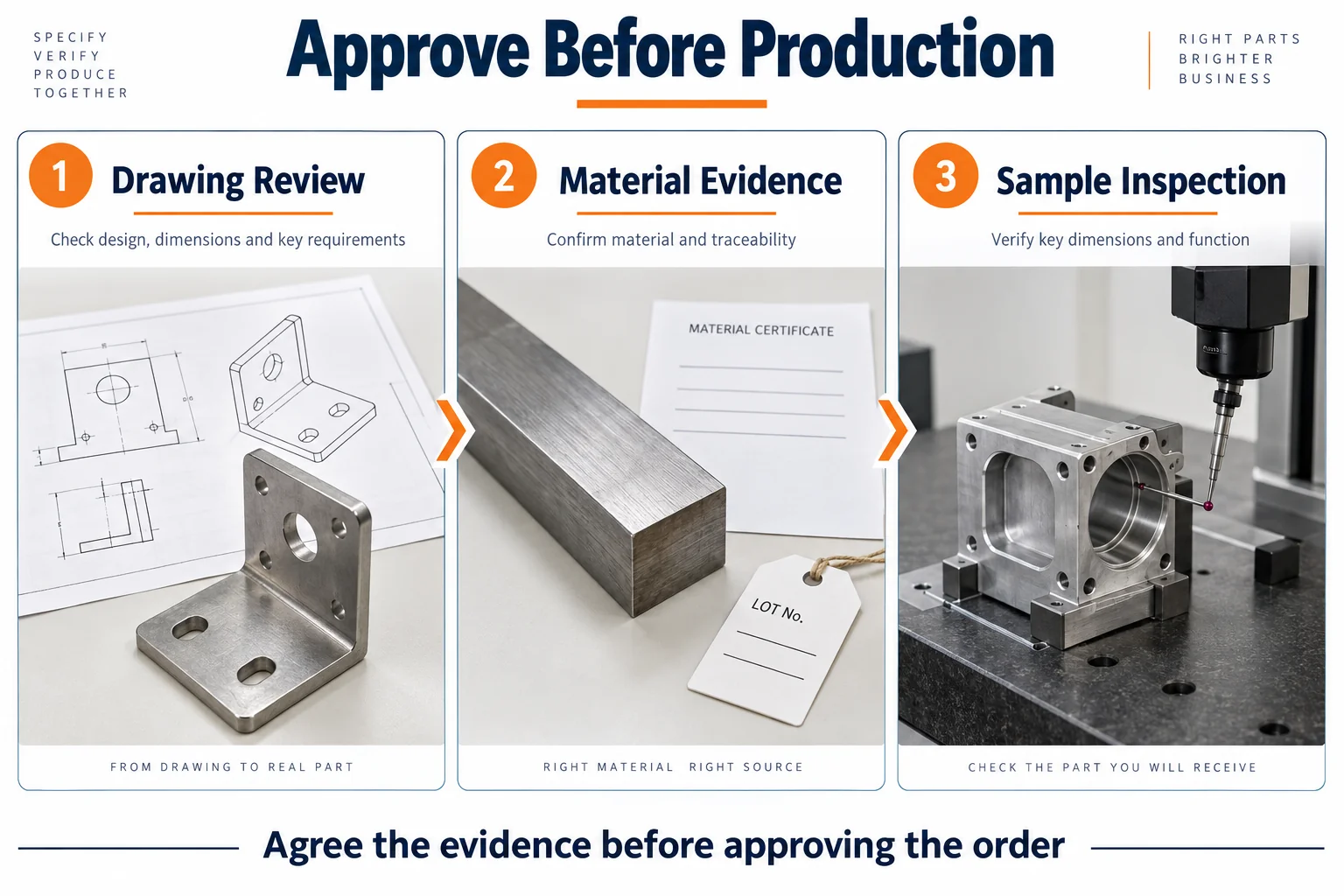
Request identified samples accompanied by the agreed inspection report. Connect each result to a drawing feature and sample identifier. Resolve failures or deviations in writing before production release.
Separate Material Evidence From Finished-Part Evidence
A raw-material certificate supports material identity and reported properties for its stated batch. It does not prove every finished dimension or coating characteristic.
Request treatment or coating records separately when required. Use independent laboratory verification where risk justifies it. Define test methods and acceptance limits before samples are made.
Use Samples That Represent Production
A machined prototype may confirm fit while leaving a later casting process unvalidated. Different tooling, materiali, or finishes can change the result.
For production approval, establish which tools, macchine, materiali, and finishing route must be represented. A successful sample is evidence about those conditions, rather than proof of unlimited future consistency.
An Illustrative Shaft Approval Example
Suppose your steel shaft needs a bearing fit and a hardened wear surface. Review the finished bearing diameter and relevant geometric requirements after treatment. Verify hardness at the specified location using the agreed method.
A diameter report alone cannot establish wear-surface hardness. A hardness result alone cannot establish bearing fit. This hypothetical example shows why acceptance evidence must follow function.
Control Quality During Repeat Production
Repeat production needs traceability, process checks, and approved changes in addition to a final inspection.
Agree an inspection plan covering incoming material, in-process features, finitura, and release. Identify critical characteristics and the equipment or gauges used to check them.
Define how batch numbers connect parts to material, trattamento, and inspection records. Keep approved samples or reference standards where useful. For appearance, describe viewing conditions and defect limits rather than relying only on photographs.
Sampling must have an agreed lot definition, selection method, sample size, and acceptance rule. NIST’s acceptance-sampling explanation distinguishes lot acceptance from estimating every part’s quality.
Passing a sample inspection does not establish that every component is defect-free. Choose additional controls for critical features according to failure consequences and measurement practicality.
Require approval before changing material grade, manufacturing site, attrezzo, subcontractor, or relevant process conditions. Review whether the change needs new samples or testing.
Check Packing And Import Requirements Before Shipment
Shipment approval should cover the goods, protective packing, required records, and destination import requirements.
Metal parts can arrive dimensionally correct but unusable because of corrosion or surface damage. Agree separation, cushioning, pulizia, rust prevention, and moisture protection for the transport route.
Ensure protective oils or films are compatible with downstream assembly and cleaning. Request packing photographs and labels linked to part numbers, revisioni, quantità, and batches.
Review the commercial invoice, packing list, and transport documents together. Check descriptions, quantità, weights, declared values, and consignee details for consistency.
Ask your customs broker to confirm classification, origin requirements, and applicable charges before ordering. Do not rely on a generic duty rate for all metal parts. For U.S. imports, CBP’s importer guidance provides a starting point for classification questions.
Confirm production completion, inspection approval, dispatch, transit, and delivery as separate milestones. A finished batch is not automatically a delivered order.
Common Metal Sourcing Mistakes To Avoid
Most preventable sourcing problems begin with an assumption that nobody recorded or verified.
- Comparing prices while allowing different alloys, finiture, inspection scopes, or delivery terms.
- Accepting “equivalent material” without a documented technical review.
- Approving appearance without checking functional dimensions or treatment requirements.
- Treating a factory video or quality certificate as shipment acceptance.
- Leaving subcontracted finishing and traceability responsibilities undefined.
- Releasing a major batch before production-route samples are approved.
- Assuming final inspection will reveal every latent defect.
- Ordering overseas when urgent changes or unsupported local service make the supply route impractical.
Keep each decision attached to a specification, an owner, and evidence. This makes disagreements easier to resolve before shipment.
Frequently Asked Questions About Sourcing Metal Parts From China
Your sourcing decision should follow verified requirements rather than fixed assumptions about price, quantità, or location.
Should You Buy Directly From A Factory Or Use A Sourcing Agent
Buy directly when you can manage technical clarification, supplier qualification, e logistica. An agent may help coordinate multiple factories or local inspections. Confirm its fees, independence, access to production information, and quality responsibilities.
What Is The Minimum Order Quantity For Custom Metal Parts
MOQ depends on setup, raw-material purchasing, utensileria, finishing batch size, and supplier capacity. Ask for prototype and production price breaks. Avoid assuming one MOQ applies across machining, fusione, e fabbricazione.
Can You Source Metal Parts Without Visiting China
You can combine document checks, technical reviews, remote walkthroughs, identified samples, and independent inspections. The depth of verification should reflect the part’s risk. Remote review still needs access to meaningful evidence.
How Long Does Custom Metal Parts Production Take
Lead time depends on material availability, utensileria, geometria, finitura, ispezione, quantità, and approvals. Request separate dates for samples, produzione, and dispatch. Confirm the schedule again after specification changes.
How Do You Prevent Material Substitution
Specify the grade and condition, prohibit unapproved substitutions, and require traceable material records. Add independent testing where justified. A certificate without a reliable connection to the delivered batch provides limited assurance.
What Should You Do When A Shipment Fails Inspection
Identify and contain the affected batch, document the defect, and preserve samples. Ask for a documented cause and corrective action. Agree disposition and commercial responsibilities before reworking, returning, or replacing parts.
Request A Metal Components Quote From TOPS
You can ask TOPS to review custom machined, die-cast, and fabricated metal components against your drawing and production needs.
Send your 2D drawing, 3Modello D., materiale, fine, and quantities per part. Include annual demand, caratteristiche critiche, requisiti di ispezione, delivery destination, and target dates. For tooling-based parts, add expected program life.
Request A Metal Components Quote with these files so the technical and commercial scope can be reviewed together.


