



Los controles de calidad automatizados en el moldeo por inyección de plástico combinan señales de proceso, inspección de piezas, y clasificación controlada. You can detect defined defects faster and document results consistently. Sin embargo, automation only protects the characteristics you have specified and validated. Start with the failure risks, then select the equipment.
What Automated Injection Molding Inspection Actually Covers
Automated inspection evaluates selected characteristics against programmed acceptance criteria and routes the result into a defined production response.
Three activities often appear together, but they provide different evidence:
| Activity | Evidence Produced | Límite importante |
| Monitoreo de procesos | Presión, temperatura, momento, or other cycle signals | A stable signal does not directly verify every finished-part characteristic. |
| Part inspection | Images, dimensiones, presence checks, or functional test results | Each method has a defined field of view and detection capability. |
| Sorting and traceability | Part disposition and linked production records | A correct inspection result can still be assigned to the wrong part. |
Por ejemplo, cavity-pressure monitoring may flag an unusual filling cycle. A camera can inspect a visible mounting feature afterward.
Neither automatically confirms resin identity, long-term fatigue performance, or a hidden internal void.
Your inspection plan should state what each check proves. Avoid accepting a general promise of “fully automated quality control.”
Which Defects Can Automated Quality Checks Detect?
You can automate checks for visible defects, accessible dimensions, missing features, and selected functional failures using suitable equipment.
Choose the method around the defect’s location and its effect on the product.
| Characteristic Or Defect | Possible Method | What You Must Validate |
| Short shot or missing feature | Machine vision | The incomplete region remains visible in every presentation. |
| Flash along an edge | Vision or profile measurement | Edge coverage and the smallest unacceptable fin. |
| Surface mark or discoloration | Controlled-light imaging | Approved appearance limits across colors and textures. |
| Hole position or outline size | Calibrated optical measurement | Fecha, fijación, uncertainty, and temperature conditions. |
| Warpage or height variation | Suitable 3D or displacement measurement | Supported versus free-state geometry and accessible surfaces. |
| Missing insert | Visión, presence sensing, or an application-specific test | The system distinguishes presence from correct seating. |
| Fuga | Dedicated leak test | Test pressure, estabilización, sealing arrangement, and acceptance limit. |
| Hidden internal defect | Validated internal inspection or functional testing | Whether the chosen method can detect the relevant failure mechanism. |
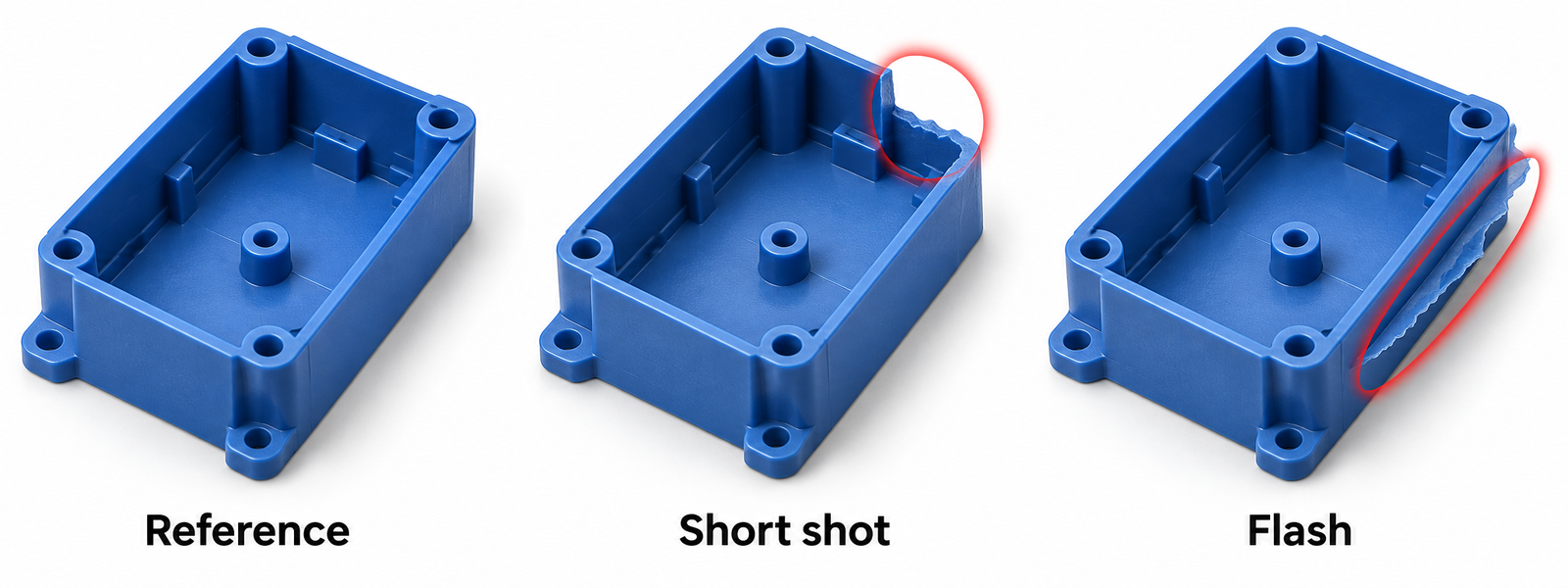
Cifra 2. Short shots and flash require different inspection regions and acceptance rules. Defects are exaggerated for illustration.
KEYENCE describes optical and three-dimensional methods for examining molded-part surfaces and flash. Complex geometry can require multiple viewing angles. Molding-defect inspection guidance
Treat this table as a selection starting point. It does not establish detection limits for your component.
A weld line may be visible without revealing its strength. A leak test can identify leakage without locating every internal defect.
The Main Technologies Used In Automated Quality Control
You usually need complementary technologies because process behavior, apariencia, dimensiones, and function answer different quality questions.
Machine Vision For Appearance And Feature Checks
A vision system captures an image, analyzes defined regions, and communicates a result to the production controller.
Cognex describes this sequence as part of a factory automation workflow. Image acquisition and lighting must be coordinated with the inspection. Cognex machine-vision workflow
Start with reliable part presentation. A loose or tilted component can change what the camera sees.
Then establish lighting that reveals the defect. Reflections, shadows, transparencia, and texture can conceal features or create false indications.
Use multiple views when necessary. One overhead camera cannot inspect an underside merely because it captures the whole top surface.
Optical And Contact Measurement For Dimensions
Automated dimensional checks compare measured geometry with drawing requirements. The method must support the required accuracy under production conditions.
KEYENCE provides an example of contactless vision measurement for molded parts and tooling. This illustrates a measurement approach, not a universal tolerance guarantee. Dimensional inspection for injection molding
Define the datum system and fixture support before programming measurements. Clamping can distort a flexible plastic component.
Also define when measurement occurs. A warm part leaving the mold may differ from its conditioned inspection state.
If you inspect warm parts inline, validate the relationship to the final acceptance condition.
Cavity-Pressure Monitoring For Process Changes
Cavity-pressure sensors capture conditions inside the mold during the molding cycle. Their signals can support process monitoring and quality prediction.
Kistler describes cavity pressure as a significant indicator of molded-part quality. Its monitoring systems evaluate pressure profiles and related production data. Kistler cavity-pressure guidance
Sin embargo, a process indicator requires a validated relationship to the characteristic you want to control.
Ask how monitoring limits were established. Confirm which cavities and locations are monitored, especially in multi-cavity tools.
Do not assume one sensor represents every cavity equally. Maintain direct checks for requirements that the signal does not reliably predict.
Functional Testing For Application Performance
Automated functional tests evaluate a defined behavior, such as leakage, electrical continuity, or assembly engagement.
For leak testing, specify the test conditions before selecting equipment. ATEQ emphasizes defining the application and test requirements first. ATEQ leak-test specification guidance
For your part, agree on fixtures, acondicionamiento, test pressure, duration, and acceptance limits.
A fixture leak can resemble a product leak. Include checks that distinguish equipment problems from genuine component failures.
How To Build A Reliable Automated Inspection Workflow
Build the workflow around traceable requirements, verified detection, and a controlled response to missing or failed results.
Paso 1 Define Critical Characteristics
List the features that affect assembly, caza de focas, seguridad, apariencia, or service life.
For each feature, document the requirement, inspection method, frequency, and reaction plan. Use drawing revisions and approved defect examples.
Terms such as “no visible flash” need clarification. State the location, condiciones de visualización, or dimensional limit that controls acceptance.
Paso 2 Link Each Part To Its Inspection Result
Define how the system identifies parts through transfer, inspección, and collection.
You may use individual identification, cavity tracking, carrier positions, or another validated method. The appropriate detail depends on product risk.
Review what happens when a part drops, a carrier is empty, or the conveyor stops.
A timestamp alone may not preserve identity when several parts leave the mold together.
Paso 3 Validate The Measurement And Classification
Check dimensional systems for repeatability, relevant variation between conditions, and measurement uncertainty.
NIST identifies these topics as essential elements of measurement-process characterization. Calibration alone does not address every source of measurement variation. NIST measurement-process guidance
For appearance classification, test known acceptable and unacceptable samples. Include borderline defects, different cavities, and permitted material or color variation.
Use independently evaluated samples to assess performance. Repeatedly testing the same training images can overstate real detection capability.
Paso 4 Prove The Sorting Mechanism
Challenge the complete chain from detection to physical segregation. Confirm that the intended part reaches the correct destination.
Test missing results, delayed responses, actuator faults, full reject containers, and restart sequences.
Specify whether uncertain parts are held or production stops. A missing result must not silently become an acceptance decision.
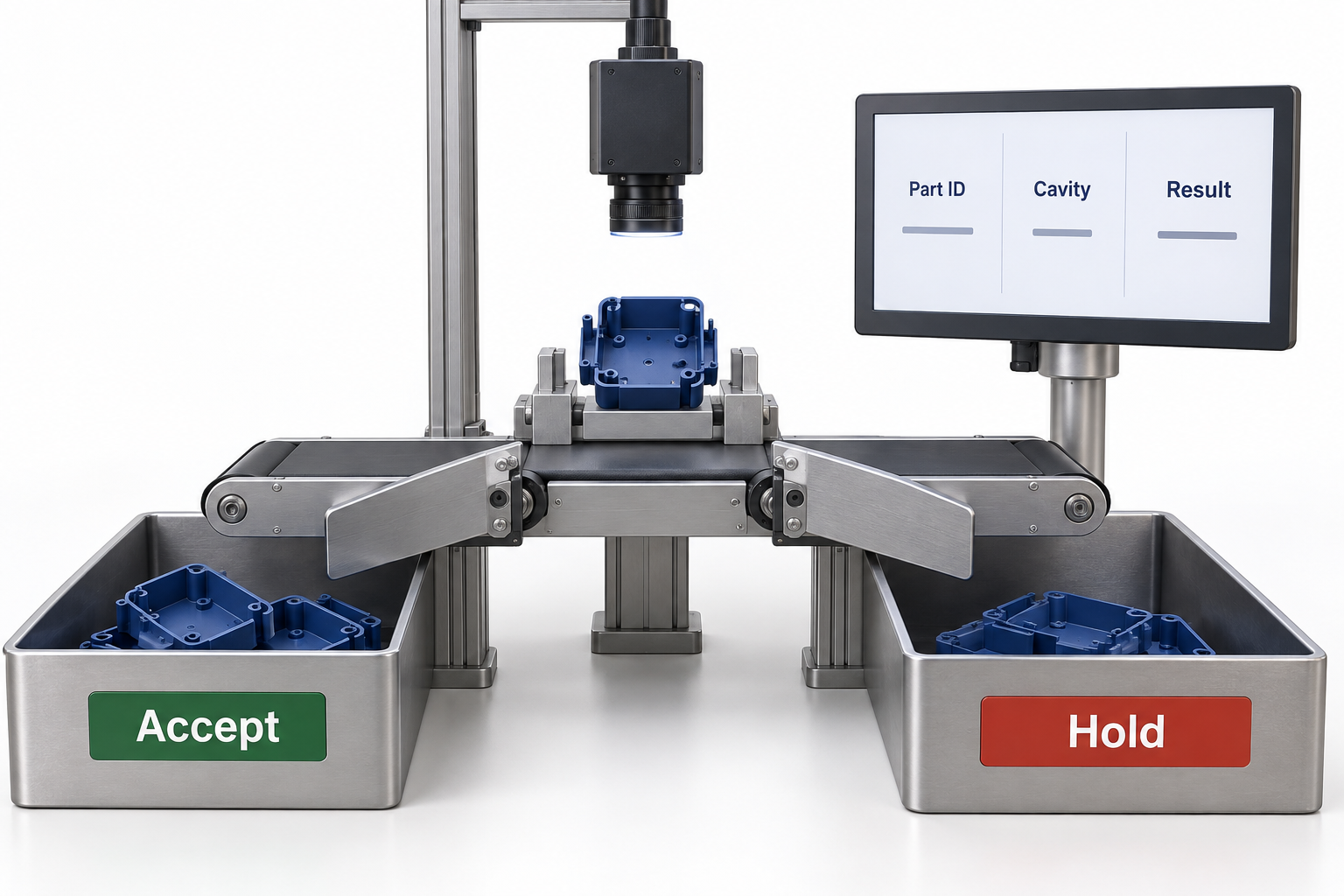
Cifra 3. Results must remain linked to the correct part through segregation. Ilustración conceptual, not an equipment layout.
Paso 5 Release And Maintain The Approved Setup
Control inspection recipes, fixture versions, thresholds, and software changes. Restrict changes to authorized personnel.
Repeat relevant validation after changes to lighting, estampación, resina, geometría, or inspection software.
Record startup checks and periodic challenge tests. Establish a response when a check fails, including the potentially affected production interval.
Por qué 100 Percent Inspection Does Not Mean Zero Defects
Inspecting every part provides coverage of every part, not guaranteed detection of every defect.
A system may miss damage outside its view or below its validated detection capability. It may also reject acceptable variation.
Measure both outcomes:
- False acceptance:an unacceptable part passes inspection.
- False rejection:an acceptable part fails inspection.
Report results by defect class where practical. One overall accuracy figure can hide poor detection of a rare, important failure.
Por ejemplo, imagine 1,000 test parts containing ten known defects. Accepting every part produces 99% overall accuracy while missing every defect.
This is an illustrative calculation, not a supplier performance claim. It explains why detection evidence matters more than a headline percentage.
Challenge-test results also depend on the samples and conditions represented. Zero misses in a limited trial does not prove zero future escapes.
Where AI Helps And Where It Needs Extra Validation
AI can support difficult appearance classification, but it still requires representative data, controlled thresholds, and independent testing.
Cognex’s anomaly-detection documentation describes learning acceptable appearances and evaluating abnormal images. It also distinguishes classification performance metrics. Cognex anomaly-detection documentation
You should compare AI with simpler rule-based methods for the actual task. A clear missing-hole check may not require AI.
Include real production variation when validating either approach. Different gloss, pigment, iluminación, or mold condition can change the images.
Keep uncertain classifications reviewable. Specify whether they trigger a hold, secondary inspection, or another approved response.
Do not allow unreviewed model changes to redefine acceptance during production.
How SPC And Inspection Work Together
Statistical process control helps you recognize process changes, while inspection evaluates the defined acceptance requirements.
Control limits describe process behavior. Specification limits come from product requirements. They should not be treated as interchangeable.
A stable process can still produce unacceptable parts. En cambio, an unusual process signal may require investigation before product disposition.
NIST defines capability as comparing an in-control process with specification limits. Capability calculations also depend on their statistical assumptions. NIST process-capability guidance
For multi-cavity tools, preserve cavity-level information when relevant. Pooling data can hide a cavity-specific shift.
Agree on the required study and acceptance criteria. Do not request a capability number without specifying the characteristic and measurement conditions.
When Automated Inspection Is Worth The Investment
Automation is most useful when repeatable inspection tasks, stable designs, and production demand justify the validated system’s total cost.
Compare these factors before approving equipment:
| Cost Or Benefit | What To Include |
| Inversión inicial | Sensores, cámaras, accesorios, integración, programación, y validación |
| Operating cost | Mantenimiento, calibration, limpieza, changeovers, y almacenamiento de datos |
| Production effect | tiempo de manipulación, inspection bottlenecks, falta del tiempo, and recovery |
| Quality effect | Demonstrated escape reduction, false rejects, and reinspection |
| Program fit | Volumen anual, design stability, variantes, y vida esperada del programa |
Measure the whole inspection cycle. Fast image analysis does not remove loading, estabilización, sorting, or functional-test time.
Manual or offline inspection may remain appropriate for low volumes, changing designs, and tests unsuitable for inline automation.
Choose the mix around product risk and production economics. Automating every characteristic is not always the best investment.
What To Ask Your Injection Molding Supplier
Ask for evidence that the proposed inspection system can verify your drawing and prevent known failures from reaching shipment.
Before approving production, pedido:
- A characteristic-by-characteristic control plan.
- Defined coverage, including blind spots and sampled checks.
- Measurement-system or classification validation results.
- Evidence that inspection results stay linked to the correct parts.
- Demonstration of rejection, sostener, and fault-handling behavior.
- Material, cavidad, lote, and recipe traceability where required.
- Change-control and periodic verification procedures.
TOPS describes design review, estampación, muestreo, and inspection within its servicios de moldeo por inyección de plástico.
Confirm project-specific automated inspection equipment and validation requirements during quotation. A general quality-control statement does not establish a dedicated automated inspection cell.
For broader preparation, ver nuestro guía del comprador de moldeo por inyección.
Preguntas frecuentes
The right inspection plan combines automation with the additional evidence your part requires.
Can Machine Vision Detect Internal Voids?
Ordinary surface imaging cannot reliably verify hidden internal voids. Use an appropriate validated internal-inspection or functional method when required.
Can Cavity Pressure Replace Dimensional Inspection?
Only a validated, application-specific relationship can support that decision. Retain direct measurement where pressure data does not establish conformity.
Does Automated Inspection Require AI?
No. Many dimensional, presence, and geometry checks use conventional measurement or rule-based vision. Select the simplest validated method that works.
Is Every Part Inspected Automatically?
That depends on the control plan. Ask which characteristics receive every-part checks and which remain sampled, offline, or destructive tests.
Can A Camera Guarantee A Tight Tolerance?
No. Confirm the complete measurement system’s capability under production conditions, including fixturing, calibration, uncertainty, and part conditioning.
Define Your Inspection Requirements Before Production
A clear inspection specification helps you obtain a meaningful manufacturing quotation and acceptance plan.
Solicitar una revisión del proyecto con tu dibujo, 3D Modelo, material, volumen anual, y vida esperada del programa. Incluir tolerancias críticas, appearance standards, pruebas funcionales, and reporting requirements.
Conclusión
Automated quality checks work best when each result supports a defined decision. Specify the failure risks, validate detection and measurement, and test physical segregation. Keep process monitoring, product inspection, and traceability connected without treating any single method as proof of every requirement.


