



El mecanizado en miniatura produce piezas de precisión muy pequeñas con precisión dimensional fina.. Utiliza procesos de corte reducidos en componentes que pueden ser más pequeños que una moneda.. Esta guía cubre métodos, materiales, tolerancias, aplicaciones, y reglas de diseño para componentes en miniatura.
¿Qué es el mecanizado en miniatura??
El mecanizado en miniatura es la eliminación precisa de material para producir piezas pequeñas con dimensiones controladas y características finas..
No se trata simplemente de hacer funcionar una máquina normal más rápido. Tamaño de herramienta, rigidez de la máquina, vibración, eliminación de chips, y la inspección se comportan de manera diferente a pequeña escala. A profundidades de corte muy pequeñas, El radio del filo se vuelve significativo en relación con el espesor de la viruta.. En lugar de cortar el material limpiamente, la herramienta puede rozar o arar, aumento de calor, rebabas, y fuerzas de corte.
Las piezas generalmente se miden en milímetros., y algunas características de precisión se miden en micrómetros.
¿Qué tan pequeñas son las piezas mecanizadas en miniatura??
No existe un límite dimensional universalmente aceptado entre el mecanizado de piezas pequeñas, mecanizado en miniatura, y micromecanizado. En la práctica, El mecanizado en miniatura se refiere a pequeños componentes o características donde las herramientas convencionales, sujeción de piezas, control de chips, y la inspección se vuelve más difícil debido a la escala.
| Término | Significado práctico | Ejemplo |
| Mecanizado de piezas pequeñas | Pequeños componentes fabricados con mecanizado de precisión convencional. | Conectores, guarniciones, carcasa del sensor |
| Mecanizado en miniatura | Piezas pequeñas o características finas que necesitan herramientas y manipulación especializadas. | Patas, engranajes en miniatura, componentes médicos |
| Micromecanizado | Funciones muy pequeñas que necesitan herramientas o procesos a microescala | Microagujeros, canales, micro pines |
Confirme el límite práctico con su maquinista para su característica específica.
Mecanizado en miniatura versus micromecanizado
El mecanizado en miniatura describe la fabricación de piezas muy pequeñas.. El micromecanizado suele centrarse en características extremadamente pequeñas., herramientas, o dimensiones del proceso. Los términos se superponen, y no existe un límite único para toda la industria.
| Factor | Mecanizado en miniatura | Micromecanizado |
| Enfoque principal | Componentes pequeños | Funciones extremadamente pequeñas |
| Herramientas típicas | Pequeñas herramientas de corte convencionales. | Microfresas, ejercicios, electroerosión, láser |
| Principal desafío | Manejo, rigidez, rebabas | Fragilidad de la herramienta, efectos de escala, inspección |
| Aplicaciones típicas | Patas, guarniciones, tornillos, componentes médicos | Microfluidos, microagujeros, Funciones relacionadas con MEMS |
¿Qué métodos se utilizan para el mecanizado en miniatura??
Cada método se adapta a una forma y necesidad de producción diferentes..
| Método | Mejor para | Fortalezas | Límites |
| fresado CNC | Pequeñas piezas prismáticas, tragamonedas, bolsillos | Geometría flexible, características finas | Las herramientas pequeñas son frágiles |
| torneado CNC | Piezas cilíndricas pequeñas | Rápido, redondo, concéntrico | Sólo formas rotacionales |
| Torneado tipo suizo | Piezas pequeñas largas y delgadas | Fuerte control de longitud a diámetro | Más adecuado para geometría alimentada por barras |
| Microerosión / electroerosión por hilo | Materiales duros, Detalle bueno | Sin fuerza de corte, pequeñas características | Más lento, solo materiales conductores |
| Molienda | Dureza, finalizar, tolerancia estricta | Tamaño y acabado de precisión | Geometría limitada |
La perforación CNC y la microperforación producen pequeños orificios para conductos de fluidos, conectores, componentes médicos, y conjuntos de precisión. A medida que el diámetro del agujero disminuye, agotamiento de la herramienta, relación de aspecto, evacuación de chips, y la rotura de la broca se vuelve más importante.
Las herramientas de diámetro pequeño a menudo requieren altas velocidades del husillo para mantener una velocidad superficial adecuada.. La velocidad por sí sola no resuelve el problema. Desviación del husillo, balance, portaherramientas, alimentación por diente, y la estabilidad de la máquina siguen siendo críticas.
Para piezas pequeñas cilíndricas y de tipo tornillo, consulte nuestra guía sobre Mecanizado de tornillos suizos CNC. Para trabajos generales de piezas pequeñas, usamos fresado CNC y torneado CNC.
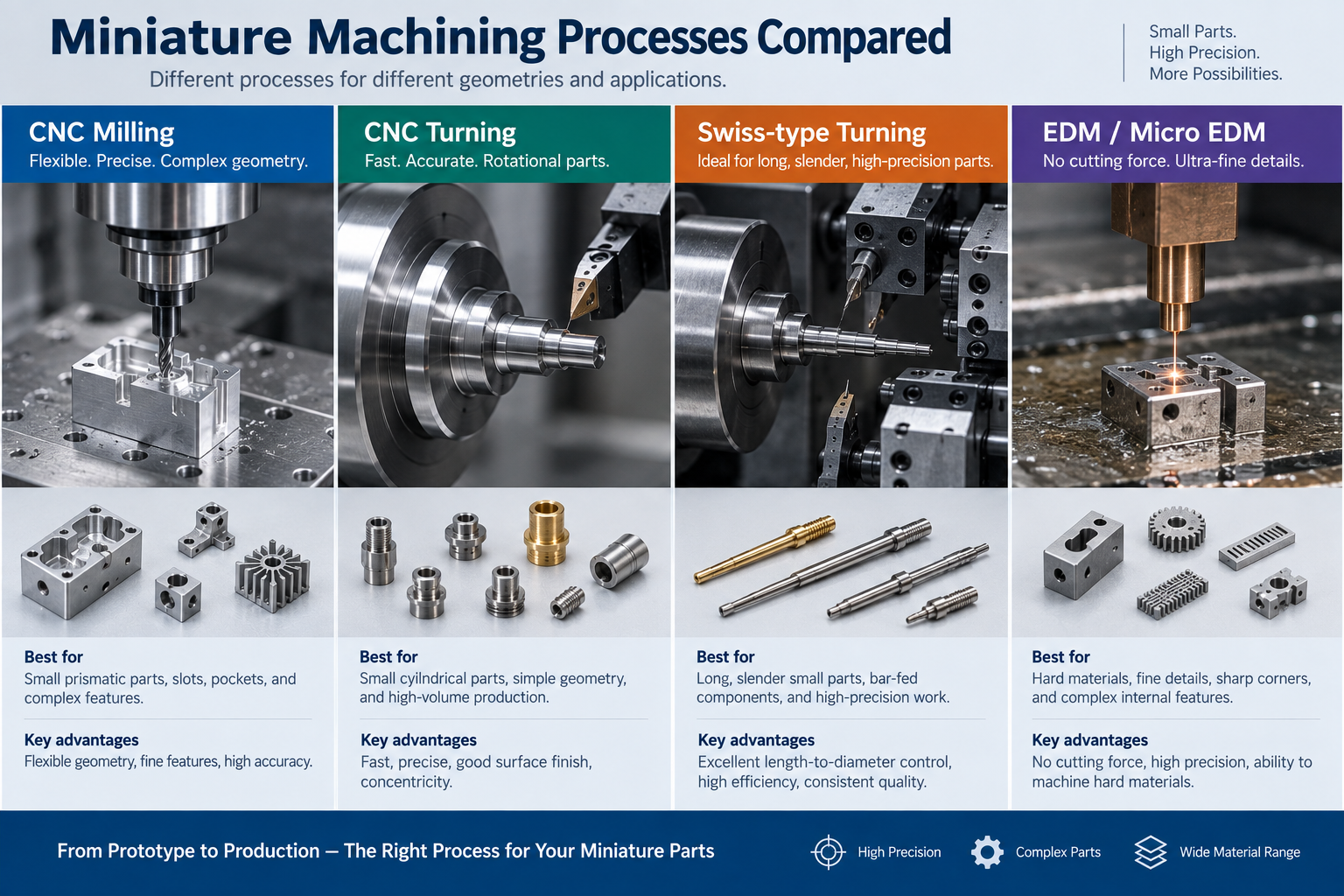
Fresado CNC versus torneado suizo para piezas en miniatura
Utilice torneado suizo cuando la pieza sea principalmente cilíndrica., de largo en relación con su diámetro, producido a partir de barras, Necesario en cantidades medias o altas., o concéntricos y con hilos pesados.
Utilice fresado CNC cuando la pieza necesite cavidades, pisos, agujeros fuera del eje, geometría prismática, superficies complejas, o mecanizado multicara.
Definir la geometría primero. Esa decisión suele apuntar a un proceso..
¿Qué materiales se utilizan para las piezas en miniatura??
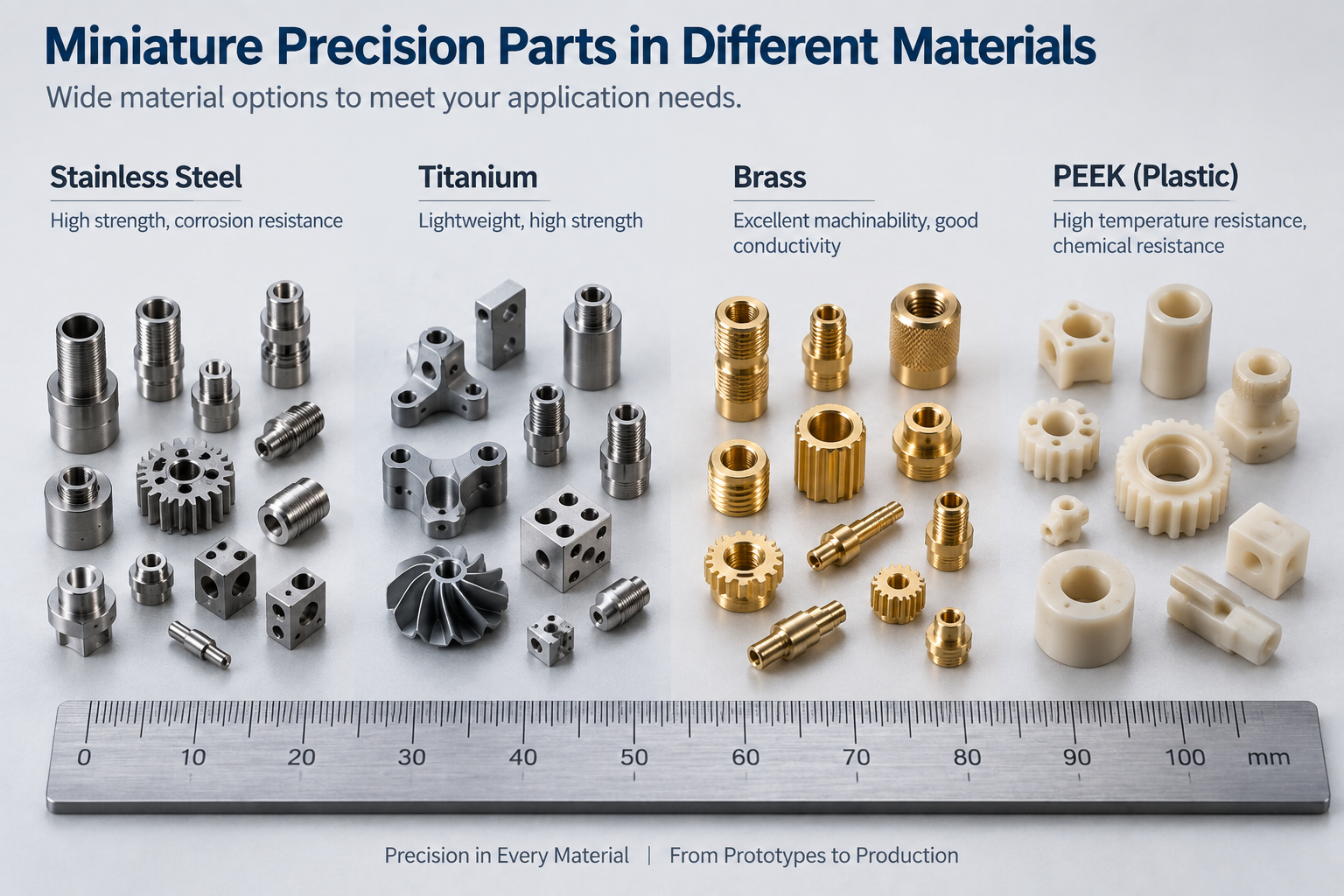
Trabajos de mecanizado en miniatura sobre metales y plásticos., pero el comportamiento material importa más a pequeña escala.
- Acero inoxidable: 303 para maquinabilidad; 316Tierra 17-4 PH para corrosión y resistencia..
- Aleaciones de titanio: utilizado para alta resistencia, Componentes ligeros médicos y aeroespaciales.. Las aplicaciones de implantes requieren material de grado médico específico, documentación, y controles validados.
- Latón y cobre: conductivo y de mecanizado libre, bueno para conectores.
- Aluminio: ligero y rápido de mecanizar.
- Plásticos de ingeniería: OJEADA, Delrín (acetal), y PTFE para aislamiento, fricción, y resistencia química.
- Aleaciones especiales: puede ser mecanizado donde la fuerza, temperatura, corrosión, o los requisitos de la solicitud justifican la dificultad añadida. Confirma la aleación con nuestro equipo..
Elija el material por función y maquinabilidad, no solo por el costo. Las piezas pequeñas son sensibles a defectos de material y rebabas.. Ver Materiales de mecanizado CNC para comparaciones.
¿Qué tolerancias puede alcanzar el mecanizado en miniatura??
Las piezas en miniatura a menudo requieren tolerancias medidas en centésimas o milésimas de milímetro., dependiendo de la característica y la aplicación.
Sobre geometrías adecuadas, El mecanizado CNC de precisión puede contener alrededor de ±0,01 mm.. Las dimensiones críticas seleccionadas pueden alcanzar aproximadamente ±0,005 mm cuando la capacidad de la máquina, material, configuración, y la inspección permite. Las tolerancias dependen del diseño., así que especifíquelos solo en superficies funcionales.
¿Cómo se inspeccionan las piezas en miniatura??
Cambios en la estrategia de inspección a pequeña escala.
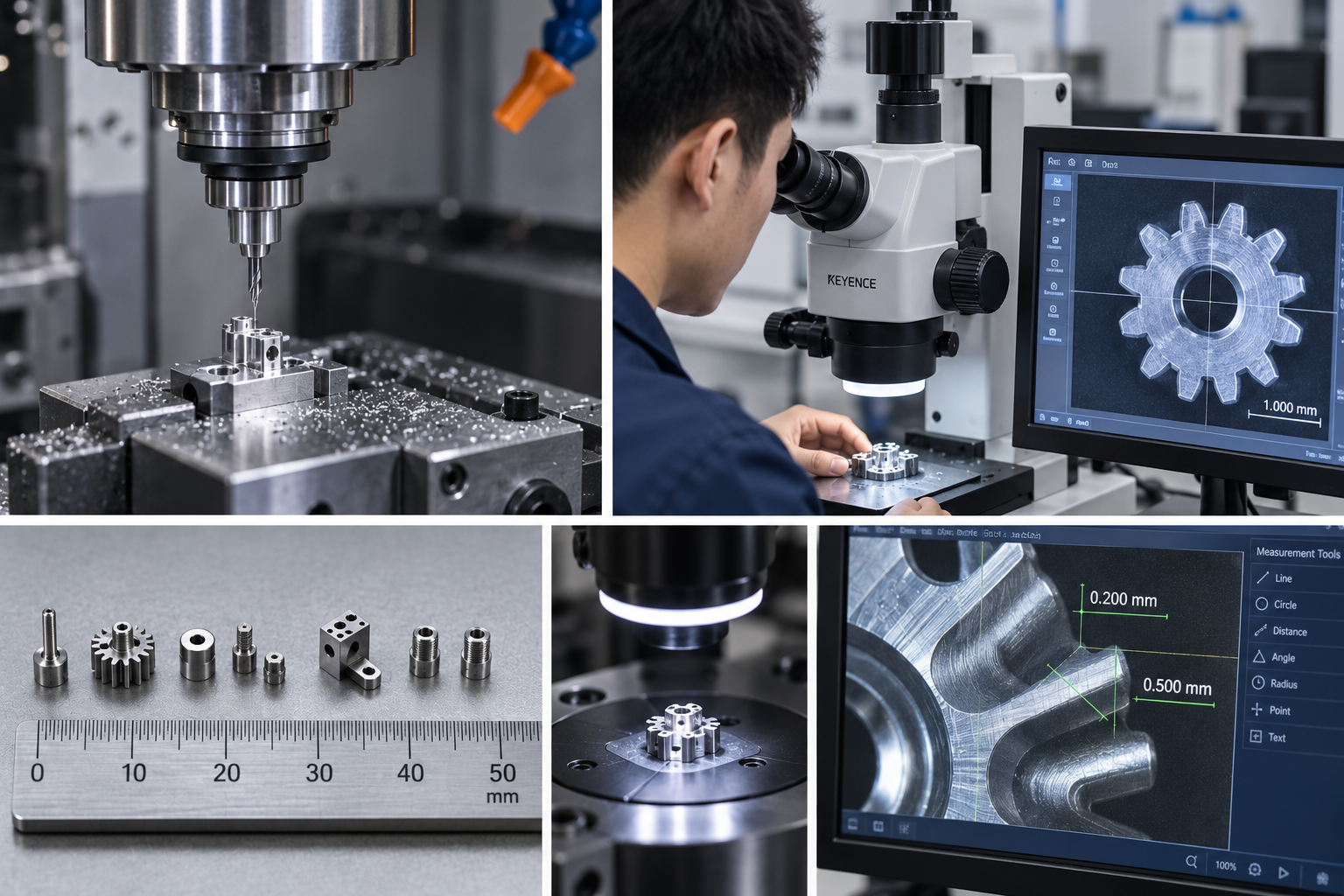
- Traje de medición óptica y de visión pequeño., rasgos delicados.
- La CMM de lápiz fino puede medir dimensiones críticas accesibles. La visión o la medición óptica pueden ser preferibles para características muy pequeñas o delicadas..
- Comparadores ópticos y microscopios para fabricantes de herramientas comprueban las rebabas y el estado de los bordes.
- Los probadores de rugosidad de superficies verifican el acabado cuando sea necesario.
A medida que las tolerancias se estrechan, La incertidumbre de la medición debe permanecer pequeña en relación con la tolerancia que se verifica.. De lo contrario, el resultado puede no mostrar de forma fiable la conformidad.
¿Cómo se sujetan las piezas en miniatura durante el mecanizado??
La sujeción debe asegurar la pieza sin deformarla ni dañarla..
- Las pinzas de precisión se adaptan a piezas redondas.
- Las mandíbulas suaves y los accesorios personalizados protegen las características delicadas..
- Trabajo de barra de soporte de casquillos guía en máquinas suizas..
- Los accesorios adhesivos o de sacrificio sujetan piezas muy delgadas.
- Las piezas pueden mecanizarse a partir de existencias más grandes y separarse al final..
El diseño del accesorio también debe proporcionar acceso a las herramientas y un punto de referencia estable para la inspección..
¿Cuáles son los principales desafíos del mecanizado en miniatura??
Las piezas pequeñas amplifican problemas que son fáciles de ignorar a gran escala.
- La deflexión y rotura de la herramienta aumentan a medida que disminuye el tamaño de la herramienta.
- El descentramiento de la herramienta importa más: unos pocos micrómetros de desviación pueden llegar a ser significativos cuando el diámetro de la fresa y la carga de viruta son muy pequeños, causando un corte desigual, mal acabado, o rotura.
- Las rebabas importan más: una rebaba que sería insignificante en gran parte puede interferir con un agujero, cara de sellado, contacto eléctrico, o interfaz de montaje.
- La evacuación de virutas es difícil en profundidad., pequeñas características.
- La vibración de la máquina y el crecimiento térmico afectan la precisión.
- Las piezas son fáciles de perder., doblar, o daño. Embalaje en bandeja, limpieza controlada, y la separación parcial puede convertirse en parte del proceso.
- El acceso de inspección está limitado en geometrías pequeñas.
- Las tolerancias deben ser realistas para el tamaño de la característica..
Planifique estos problemas con antelación.
Acabado superficial y control de rebabas
El acabado de la superficie depende del tamaño del cortador., material, descentramiento del husillo, alimentar, vibración, y condición de la herramienta.
Las características pequeñas pueden ser difíciles de pulir o desbarbar después del mecanizado.. Especifique Ra y criterios cosméticos sólo cuando la función los exija.. Defina bordes críticos y límites de rebabas en lugar de aplicar un requisito estricto de desbarbado a cada borde.
Directrices de diseño de mecanizado en miniatura
Siga estas reglas para que su pieza en miniatura siga siendo fabricable.
- Evite paredes extremadamente delgadas donde se necesita rigidez.. La pared mínima depende del material y del tamaño de la característica..
- Mantenga la profundidad del orificio razonable en relación con el diámetro del orificio.
- Evite agujeros extremadamente profundos y de pequeño diámetro donde la evacuación de virutas se vuelve poco fiable..
- Utilice el mayor radio de esquina interno práctico.
- Evite radios internos pequeños a menos que la función los requiera.
- Limite las tolerancias estrictas a las superficies funcionales..
- Especifique el control de rebabas solo en los bordes críticos.
- Evite bolsillos profundos que atrapen fichas.
- Agregar un dato al que la inspección pueda llegar.
- Especifique el grado del material y el acabado en el dibujo..
Diseños que simplifican el acceso a las herramientas, evacuación de chips, desacuerdo, y la inspección son generalmente más fáciles y económicos de fabricar.. Por la estrategia de tolerancia, consulte nuestra guía sobre Tolerancias de mecanizado CNC.
¿Dónde se utiliza el mecanizado en miniatura??
El mecanizado en miniatura respalda industrias donde el tamaño, precisión, y la confiabilidad importa.
- Componentes médicos y de laboratorio.: partes de instrumentos, componentes del dispositivo, carcasas, y piezas prototipo.
- Electrónica y conectores: terminales, patas, carcasas, y microconectores.
- Equipos de prueba y semiconductores.: alfileres de precisión, componentes de alineación, accesorios, y pequeñas piezas mecánicas.
- Aeroespacial y defensa: pequeños accesorios, sensores, y piezas del actuador.
- Automotor: sensores, componentes del inyector, y pequeños mecanismos.
- Robótica y automatización: microengranajes, ejes, y herramientas.
Cada aplicación añade sus propios requisitos de material y limpieza.. Indique el uso previsto en su consulta..
¿Qué afecta el costo del mecanizado en miniatura??
Una pieza en miniatura puede utilizar muy poco material., pero un tamaño pequeño no significa automáticamente un bajo costo.
- tiempo de la máquina: Las piezas pequeñas aún pueden ejecutar ciclos largos con herramientas finas..
- Estampación: Las microherramientas son caras y se desgastan más rápido..
- Manejo: Las piezas pequeñas necesitan una fijación cuidadosa., limpieza, y embalaje.
- Inspección: las tolerancias finas necesitan más tiempo de medición.
- Riesgo de rendimiento: herramientas frágiles, piezas delicadas, y las características exigentes pueden aumentar el riesgo de desperdicio o retrabajo.
- Cantidad: El costo de instalación se distribuye a lo largo del lote..
- Material: Las calificaciones médicas y de especialidad cuestan más..
No existe un precio confiable por pieza sin un dibujo. Envíe el modelo y la cantidad para una cotización precisa..
¿Cuándo el mecanizado en miniatura no es el mejor proceso??
El mecanizado no siempre es la mejor forma de fabricar una pieza pequeña.
| Requisito | Proceso probable |
| Metal de precisión de bajo volumen | Mecanizado CNC o suizo |
| Pieza torneada pequeña de gran volumen | Torneado suizo o automático |
| Geometría estampada de muy alto volumen. | Estampado |
| Plástico en miniatura de gran volumen | Moldeo por microinyección |
| Característica de material duro extremadamente fino | electroerosión |
| Prototipo de microgeometría compleja | CNC, electroerosión, o aditivo dependiendo de la característica |
Para micropiezas de plástico de gran volumen, ver nuestro servicio de moldeo por microinyección. Comparar Mecanizado CNC versus moldeo por inyección al decidir.
Preguntas frecuentes
¿Qué es el mecanizado en miniatura??
Es una eliminación de material de precisión que produce piezas muy pequeñas., normalmente a escala milimétrica, con control dimensional fino.
¿Qué tan pequeño puede llegar a ser el mecanizado CNC??
El mínimo práctico depende del proceso., diámetro del cortador, relación de aspecto, material, capacidad de la máquina, e inspección. Las funciones muy pequeñas pueden necesitar micromecanizado o electroerosión dedicado en lugar del CNC convencional..
¿Cuál es la diferencia entre mecanizado en miniatura y micromecanizado??
El mecanizado en miniatura se centra en componentes pequeños. El micromecanizado se centra en funciones y herramientas extremadamente pequeñas.. Los términos se superponen.
¿Qué materiales se utilizan para el mecanizado en miniatura??
Acero inoxidable, titanio, latón, cobre, aluminio, y plásticos de ingeniería como PEEK, Delrín, y PTFE.
¿Qué tolerancias puede tener el mecanizado en miniatura??
Sobre características adecuadas, ±0,01 mm puede ser práctico. Se puede lograr aproximadamente ±0,005 mm para dimensiones seleccionadas. La capacidad real depende del tamaño., geometría, material, estampación, configuración, e inspección.
¿El torneado suizo es lo mismo que el mecanizado en miniatura??
No. El torneado suizo es un método. le queda largo, esbelto, piezas alimentadas por barras de pequeño diámetro.
¿Por qué son caras las piezas en miniatura??
Herramientas finas, Manejo cuidadoso, inspección detallada, y el riesgo de rendimiento añade tiempo. El costo depende de la geometría., material, y cantidad.
Obtenga una cotización para su componente en miniatura
Envía tu modelo 3D, 2dibujo, material, cantidad, y lista de dimensiones críticas. Nuestros ingenieros revisarán la capacidad de fabricación., marcar características de riesgo, y cotizar mecanizado más inspección juntos.
Contáctenos para una cotización


