Entre las diversas tecnologías de movimiento lineal disponibles en la actualidad, Los tornillos de avance siguen siendo una de las soluciones más utilizadas y rentables.. Su diseño simple, alta precisión de posicionamiento, capacidad de autobloqueo, y su facilidad de mantenimiento los convierten en la opción preferida en muchas industrias.
En esta guía completa, Exploraremos todo lo que necesita saber sobre los tornillos de avance., incluyendo sus principios de trabajo, tipos de hilos, materiales, ventajas, limitaciones, aplicaciones, y criterios de selección.
¿Qué es un tornillo de avance??
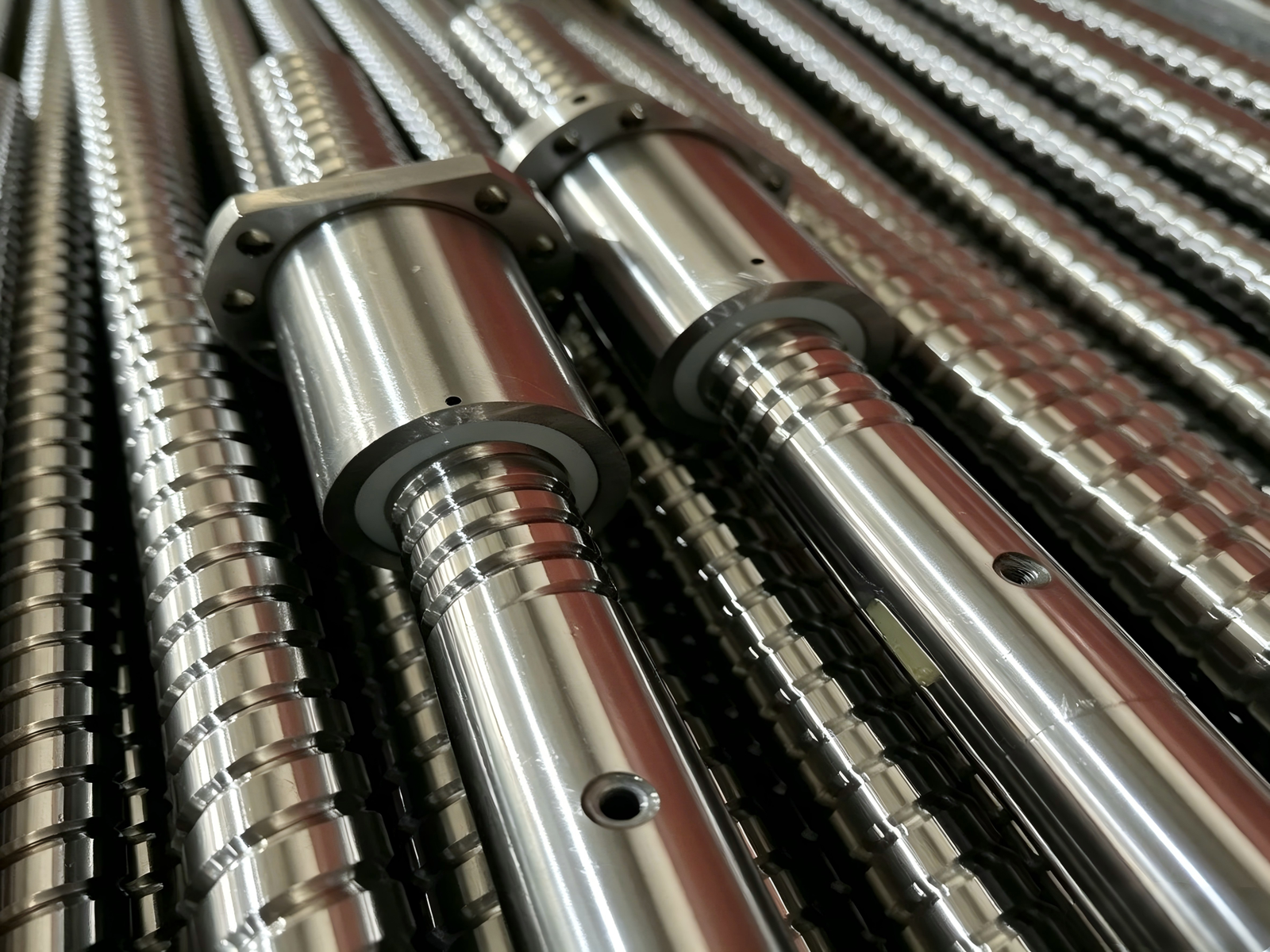
Un tornillo de avance es un componente de transmisión de potencia mecánica que convierte el movimiento de rotación en movimiento lineal.. Consiste en un eje roscado y una tuerca correspondiente que se desplaza a lo largo del eje cuando cualquiera de los componentes gira.
A diferencia de los husillos de bolas, Los tornillos de avance dependen de la fricción por deslizamiento entre el tornillo y la tuerca en lugar de rodamientos de bolas..
Este diseño proporciona varias ventajas.:
- Menor costo de fabricación
- Estructura más simple
- Funcionamiento silencioso
- Capacidad de autobloqueo
- Fácil mantenimiento
Debido a estas características, Los tornillos de avance se utilizan comúnmente en aplicaciones donde se requiere velocidad moderada y alta precisión..
Componentes principales de un conjunto de husillo
Un sistema completo de husillo normalmente incluye los siguientes componentes:
Eje de tornillo
El eje del tornillo contiene roscas externas que guían el movimiento de la tuerca.. Generalmente se fabrica a partir de:
- Acero inoxidable
- Acero carbono
- Acero aleado
- Aluminio
- Titanio
Tuerca de plomo
La tuerca contiene roscas internas que coinciden con el perfil del tornillo..
Los materiales de tuercas comunes incluyen:
- Bronce
- Latón
- Plásticos de ingeniería
- Compuestos de PTFE
- Polímeros autolubricantes
Aspectos
Los rodamientos sostienen el eje del tornillo y reducen los movimientos no deseados..
Acoplamientos
Los acoplamientos conectan el tornillo de avance a motores o sistemas de accionamiento..
Soportes finales
Estos componentes garantizan estabilidad y alineación durante la operación..
¿Cómo funciona un tornillo de avance??
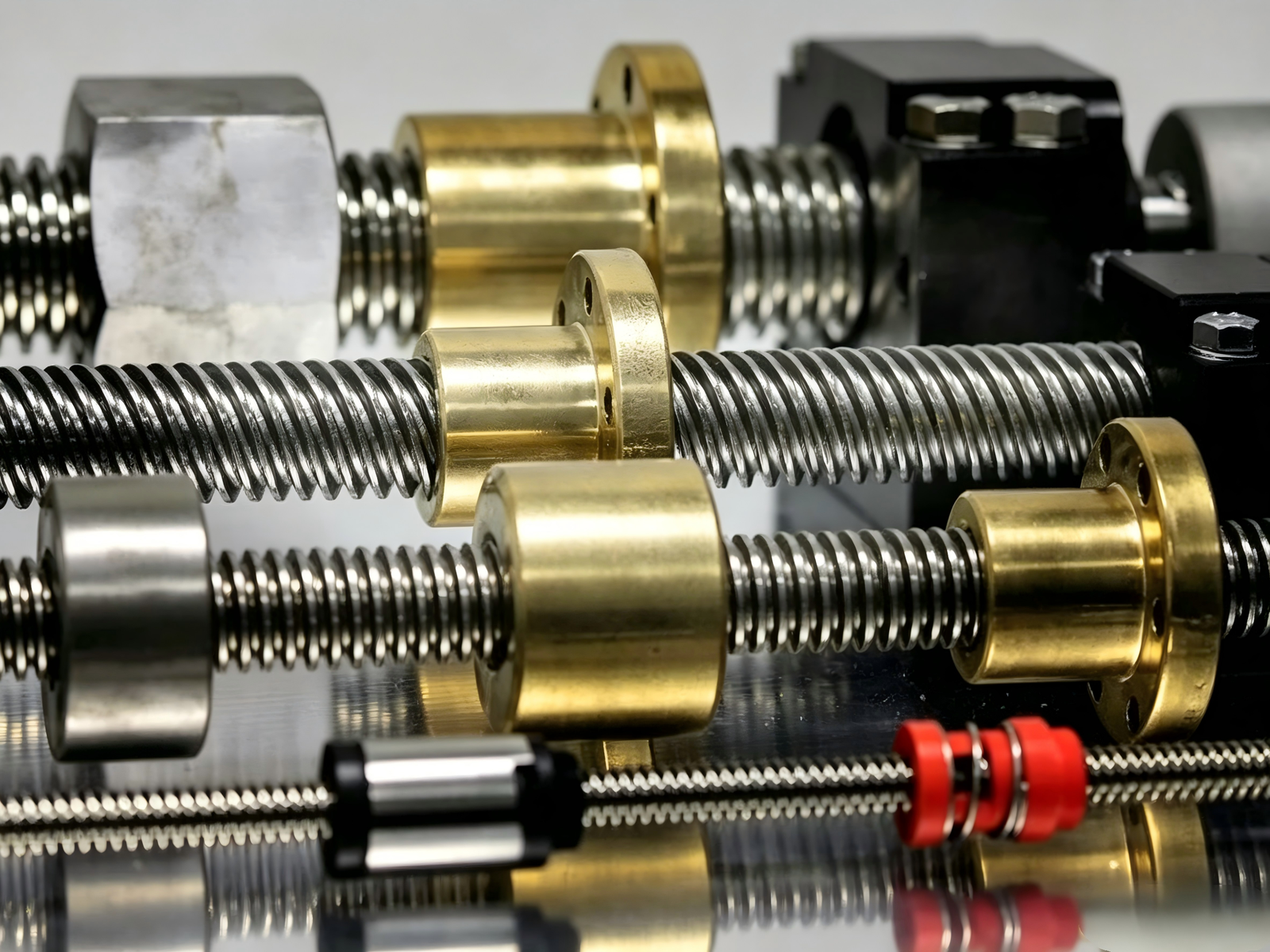
El principio de funcionamiento de un husillo es relativamente simple..
Cuando se aplica fuerza de rotación al tornillo o tuerca, la interacción roscada convierte el movimiento giratorio en movimiento lineal.
Este movimiento se produce porque la tuerca sigue la trayectoria helicoidal creada por las roscas del tornillo..
Tornillo giratorio, Tuerca viajera
Esta es la configuración más común..
El tornillo gira mientras la tuerca se mueve linealmente a lo largo del eje..
Las aplicaciones incluyen:
- Equipo CNC
- Maquinaria de embalaje
- Sistemas de automatización
Tuerca giratoria, Tornillo fijo
En esta configuración, El tornillo permanece estacionario mientras la tuerca gira y se mueve..
Las aplicaciones incluyen:
- Sistemas de posicionamiento de alta velocidad.
- Maquinaria con limitaciones de espacio
Entendiendo el liderazgo, Paso, y geometría del hilo
Antes de seleccionar un husillo, es importante comprender varios parámetros clave.
Paso
El paso es la distancia entre hilos adyacentes..
Por ejemplo:
Si la distancia entre hilos es 5 milímetros, el tono es igual 5 milímetros.
Dirigir
El avance se refiere a la distancia lineal recorrida durante una revolución completa..
Para tornillos de entrada simple:
Plomo = Lanzamiento
Para tornillos de varias entradas:
Plomo = Lanzamiento × Número de salidas
Ángulo de hélice
El ángulo de la hélice afecta:
- Eficiencia
- Capacidad de carga
- Velocidad
Los ángulos de hélice más grandes generalmente proporcionan mayor velocidad pero menor capacidad de autobloqueo..
Tipos de roscas de tornillo de avance
La geometría del hilo afecta significativamente el rendimiento.
Los tipos de roscas de tornillo de avance más comunes incluyen:
1. Hilo cuadrado
Las roscas cuadradas se consideran el diseño de rosca más eficiente porque minimizan la fricción..
Ventajas
- Máxima eficiencia
- Desgaste reducido
- Menores pérdidas por fricción
- Excelente transmisión de potencia
Desventajas
- Difícil de fabricar
- Mayor costo de producción
- Menor fuerza de la raíz
Aplicaciones Típicas
- Sistemas de elevación para cargas pesadas
- Maquinaria de precisión
- prensas industriales
2. Hilo Acme
Las roscas Acme presentan un perfil trapezoidal con un ángulo de rosca de 29°..
Se encuentran entre los tipos de hilos más utilizados en todo el mundo..
Ventajas
- Perfil de hilo fuerte
- Fácil fabricación
- Buena capacidad de carga
- Menor costo de producción
Desventajas
- Eficiencia ligeramente menor que los hilos cuadrados.
- Mayor fricción
Aplicaciones Típicas
- maquinas cnc
- Automatización industrial
- Máquinas herramienta
3. Hilo trapezoidal
Las roscas trapezoidales son el equivalente métrico de las roscas Acme y cumplen con los estándares internacionales..
Ventajas
- Estructura fuerte
- Alta durabilidad
- Dimensiones estandarizadas
- Producción rentable
Aplicaciones
- Maquinaria europea
- Equipo de automatización
- Actuadores industriales
4. Hilo de contrafuerte
Las roscas de contrafuerte están diseñadas para soportar cargas extremadamente altas en una dirección..
Ventajas
- Capacidad de carga muy alta
- Raíz de hilo fuerte
- Excelente transmisión de fuerza axial
Desventajas
- No apto para carga bidireccional.
Aplicaciones
- gatos
- Prensas
- Sistemas de elevación pesada
Materiales del tornillo de avance
La selección de materiales afecta directamente el rendimiento., durabilidad, y vida operativa.
Materiales comunes para tornillos
Acero inoxidable
Beneficios:
- Resistencia a la corrosión
- Larga vida útil
- Adecuado para industrias alimentarias y médicas.
Acero carbono
Beneficios:
- Rentable
- Alta resistencia
- Fácil mecanizado
Aleación de acero
Beneficios:
- Dureza superior
- Alta resistencia al desgaste
- Rendimiento de servicio pesado
Titanio
Beneficios:
- Ligero
- Excelente resistencia a la corrosión
- Aplicaciones aeroespaciales
Materiales comunes para tuercas
Bronce
La elección tradicional para tuercas de husillo.
Beneficios:
- Excelente resistencia al desgaste
- Alta capacidad de carga
- Larga vida útil
Ingeniería de plásticos
Beneficios:
- Autorrubricante
- Bajo nivel de ruido
- Resistente a la corrosión
Materiales compuestos
Beneficios:
- Baja fricción
- Funcionamiento sin mantenimiento
- Vida útil extendida
Ventajas de los tornillos de avance
Los husillos de avance siguen siendo populares debido a varias ventajas importantes.
Alta precisión de posicionamiento
Los tornillos de avance proporcionan un movimiento lineal preciso y repetible.
Capacidad de autobloqueo
Muchos diseños de tornillos de avance evitan el retroceso.
Esta característica mejora la seguridad en aplicaciones de elevación vertical..
Costo más bajo
Comparado con husillos de bolas, Los tornillos de avance son significativamente más asequibles..
Diseño compacto
Los sistemas de husillo requieren menos componentes.
Operación silenciosa
La ausencia de bolas de recirculación resulta en menores niveles de ruido..
Mantenimiento fácil
Los husillos son fáciles de inspeccionar, lubricar, y reemplazar.
Limitaciones de los tornillos de avance
Aunque versátil, Los tornillos de avance también tienen ciertas limitaciones..
Menor eficiencia
La eficiencia típica oscila entre:
- 20% a 80%
Los husillos de bolas a menudo exceden 90%.
Fricción y desgaste
El contacto deslizante continuo crea desgaste con el tiempo.
Generación de calor
Una mayor fricción puede generar calor durante el funcionamiento..
Velocidad limitada
Los husillos de avance generalmente funcionan a velocidades más bajas que los husillos de bolas..
Husillo de avance versus husillo de bolas
La elección entre un husillo de avance y un husillo de bolas depende de la aplicación.
| Característica | Tornillo de avance | Husillo de bolas |
| Costo | Bajo | Alto |
| Eficiencia | 20–80% | 90–98% |
| Mantenimiento | Simple | Moderado |
| Velocidad | Moderado | Alto |
| Autobloqueo | Sí | No |
| Ruido | Bajo | Moderado |
| Precisión | Alto | muy alto |
Elija tornillos guía cuando:
- El costo es importante
- Los requisitos de velocidad son moderados.
- Se necesita autobloqueo
- Se prefiere la simplicidad del mantenimiento.
Elija husillos de bolas cuando:
- Se requiere la máxima eficiencia
- La operación de alta velocidad es crítica
- Se necesita una precisión extremadamente alta
Aplicaciones industriales comunes
Los husillos de avance se utilizan en numerosas industrias..
Máquinas CNC
Proporcionar un posicionamiento preciso para los ejes de la máquina..
3Impresoras D
Permita el movimiento controlado de los cabezales de impresión y las plataformas de construcción..
Equipo medico
Utilizado en:
- Sistemas de imagen
- Dispositivos de diagnóstico
- Equipo quirúrgico
Sistemas de automatización
Apoyo:
- Máquinas de recoger y colocar
- Posicionamiento robótico
- Equipos de manipulación de materiales
Maquinaria de embalaje
Ofrezca un movimiento repetible y confiable.
Equipo aeroespacial
Utilizado en mecanismos de control de precisión..
Fabricación de semiconductores
Proporciona capacidades de posicionamiento ultraprecisas.
Cómo seleccionar el tornillo de avance adecuado
Seleccionar el husillo adecuado requiere evaluar varios factores.
1. Capacidad de carga
Considere ambos:
Carga estática
Cargar mientras está parado.
Carga dinámica
Carga durante la operación.
2. Requisitos de velocidad
Las aplicaciones de mayor velocidad requieren cables más grandes y diseños de rosca optimizados..
3. Precisión de posicionamiento
Determine los niveles de tolerancia requeridos antes de seleccionar la geometría de la rosca..
4. Requisitos de reacción
La reacción afecta directamente la precisión del posicionamiento.
Las tuercas antirretroceso pueden minimizar este problema.
5. Entorno operativo
Evaluar:
- Temperatura
- Humedad
- quimicos
- Exposición al polvo
6. Compatibilidad de materiales
Elija materiales que equilibren:
- Fortaleza
- Resistencia al desgaste
- Resistencia a la corrosión
- Costo
7. Factor fotovoltaico
Presión-Velocidad (fotovoltaica) Los cálculos ayudan a determinar las condiciones de funcionamiento seguras y la vida útil esperada..
8. Análisis de velocidad crítica
Exceder la velocidad crítica puede causar vibraciones y fallas en los tornillos..
Verifique siempre los límites de velocidad durante el diseño del sistema.
Mejores prácticas de mantenimiento de husillos
El mantenimiento adecuado prolonga la vida útil y mejora el rendimiento..
Inspección regular
comprobar si:
- Tener puesto
- Corrosión
- Daño del hilo
- Desalineación
Lubricación adecuada
La lubricación reduce la fricción y la generación de calor..
Mantenga los componentes limpios
Prevenir la contaminación por:
- Polvo
- virutas de metal
- Escombros
Supervisar la reacción
Un juego excesivo a menudo indica desgaste y la necesidad de reemplazo..
Tendencias emergentes en la tecnología de husillos
La industria de los husillos sigue evolucionando.
Tuercas autolubricantes
Reducir los requisitos de mantenimiento.
Polímeros de ingeniería avanzada
Mejorar la resistencia al desgaste y la eficiencia..
Tornillos de avance de tierra de precisión
Ofrezca mayor precisión para aplicaciones exigentes.
Sistemas de movimiento inteligentes
Integre sensores y capacidades de monitoreo en tiempo real.
Industria 4.0 Compatibilidad
Los sistemas de husillos modernos respaldan cada vez más el mantenimiento predictivo y las iniciativas de fabricación digital..
Preguntas frecuentes
1.¿Cuál es la diferencia entre tono y plomo??
El paso es la distancia entre hilos adyacentes., mientras que el plomo es la distancia recorrida durante una revolución.
2.¿Los tornillos de avance son autoblocantes??
Muchos tornillos de avance son autoblocantes debido a la fricción entre el tornillo y la tuerca..
3.¿Qué tipo de hilo es más eficiente??
Las roscas cuadradas generalmente ofrecen la mayor eficiencia..
4.¿Pueden los tornillos de avance reemplazar los tornillos de bolas??
En muchas aplicaciones, Sí. Sin embargo, Los sistemas de alta velocidad y alta eficiencia pueden requerir tornillos de bolas..
5.¿Cuánto duran los tornillos de avance??
La vida útil depende de:
- Carga
- Velocidad
- Lubricación
- Selección de material
- Entorno operativo
Conclusión
Al seleccionar un tornillo de avance, Los ingenieros y profesionales de adquisiciones deben evaluar cuidadosamente la capacidad de carga., velocidad, exactitud, tipo de hilo, selección de material, y condiciones ambientales. Un tornillo de avance elegido correctamente puede mejorar significativamente la confiabilidad del equipo, eficiencia, y vida operativa.
Si está desarrollando una nueva máquina, actualizar un sistema de automatización, o adquirir componentes mecánicos de precisión, asociarse con Tapas de precisión puede ayudar a garantizar la solución de husillo óptima para su aplicación y presupuesto.